What you do today can help open doors tomorrow. That may sound like a big idea, but it starts with small things: finishing your work, practicing a skill, being honest, asking questions, and using your time wisely. Even at your age, your choices are helping you become the kind of person who is ready for new chances later on.
Future opportunities are the good chances you may have as you grow up. These can include going to college one day, learning a job skill, joining a team or club, helping in your community, creating art, building technology, or starting a small business. You do not need to decide your whole future right now. You only need to start making choices that help you grow.
Future opportunity means a chance you may have later to learn, help, create, work, or reach a goal.
Choice means a decision you make.
Responsibility means doing what you should do, even when it is not easy.
When you make responsible choices, people learn they can trust you. Trust matters. A trusted student is more likely to be given new tasks, bigger challenges, leadership roles, and helpful support
Your future is not built in one giant moment. It is built little by little. If you practice reading, listening, and solving problems, those skills grow. If you keep trying after mistakes, your confidence grows too. Good choices are like planting seeds. At first, the changes seem small. Later, they become big strengths.
Think about two students learning online at home. One student often says, "I'll do it later," forgets assignments, and quits when something feels hard. The other student uses a checklist, asks for help, and keeps practicing. After many weeks, the second student is more prepared for harder work and new chances. The difference comes from daily choices.
This does not mean you must be perfect. Everyone forgets things, gets distracted, or has a hard day. What matters most is noticing the problem and choosing a better step next time.
Your brain gets stronger at skills you practice often. The more you practice helpful habits, the easier those habits become.
That is good news, because it means you can grow. If organization is hard for you now, you can improve it. If speaking up feels scary, you can practice it. If planning ahead seems tricky, you can learn one step at a time.
Future opportunities can look different for different people, as [Figure 1] shows. One person may dream of college. Another may want to learn a trade or skill, such as coding, cooking, art, animal care, building, or music. Someone else may want to help the community by leading projects or volunteering. The important thing is that strong choices now help keep many paths open.
You may hear adults talk about post-secondary plans. That means learning after high school, such as college, job training, certificate programs, apprenticeships, or other ways to build skills for adult life. You do not need to know your exact plan yet. You are preparing by learning how to work hard, stay curious, and act responsibly.
Opportunities also include things you can do before you are grown up. You might join a library program, take music lessons, help with a community garden, learn to use a new digital tool, or practice speaking kindly in online groups. These experiences teach you skills that can help later.
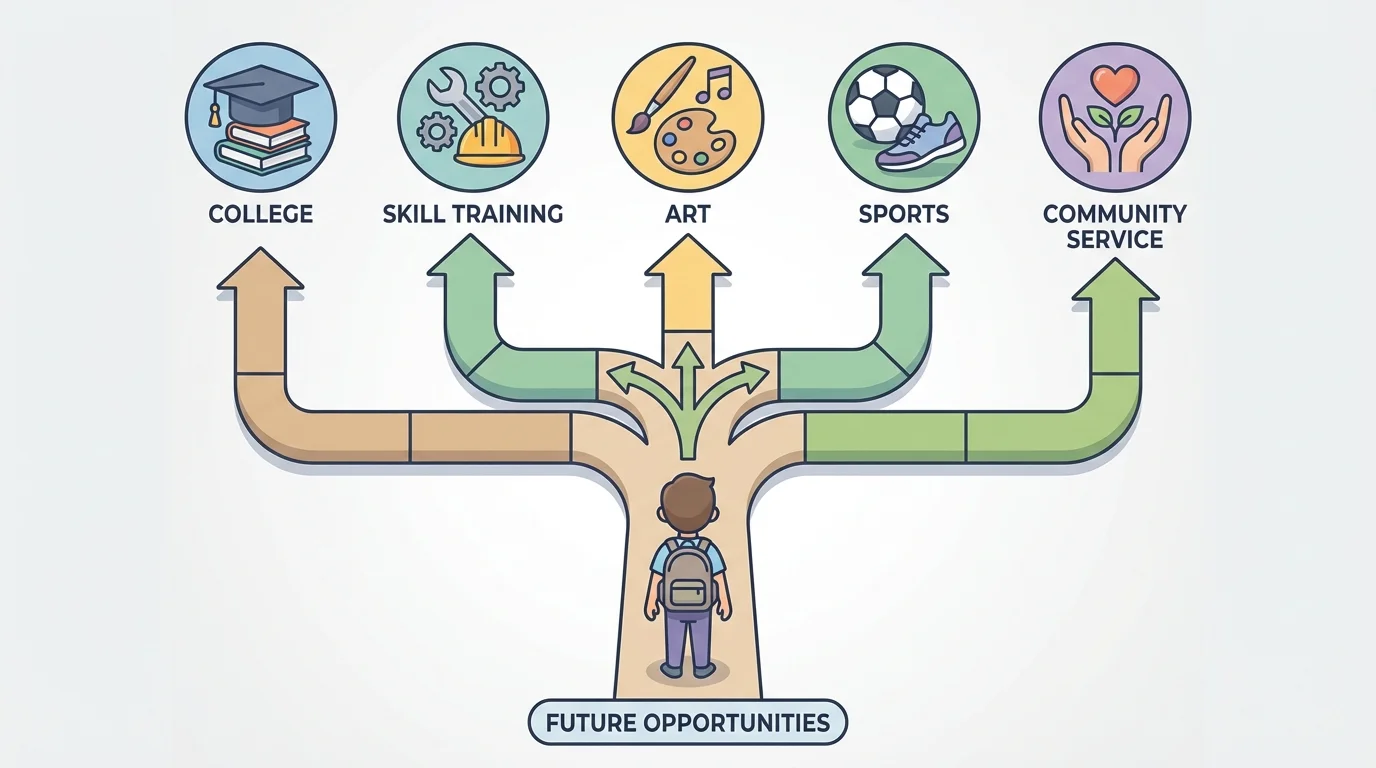
If you close yourself off from learning, practice, or help, some chances become harder to reach. But if you keep learning and trying, more doors stay open. That is why preparing for the future is really about building yourself now.
Some choices are especially helpful because they build habits you will use for many years. One of the biggest is finishing what you start. When you complete a task, even a small one, you show responsibility. That habit helps in school, at home, and later in jobs and training.
Another helpful choice is asking for help when you need it. Some students think asking for help means they are not smart. Really, it shows maturity. People who grow well know when to ask a parent, teacher, tutor, librarian, coach, or trusted adult for support.
A third helpful choice is practicing even when you are not perfect yet. Learning often feels messy at first. Your playing may sound shaky. A drawing does not look right. A new app is confusing. A speech feels scary. Practice is what turns "not yet" into "getting better."
Strong choices build strong habits. One good choice helps with the next one. For example, if you keep your materials organized, you can start tasks on time. If you start on time, you feel less stress. If you feel less stress, you can focus better and do better work.
Being honest is another future-building choice. If you make a mistake, tell the truth. Honest people are trusted. Trust leads to more chances. If you hide mistakes or blame others, trust becomes weaker, and people may hesitate to give you important responsibilities.
Kindness matters too, especially online. Words can help or hurt. If you are respectful in messages, on video calls, and in group chats, people remember that. Strong communication helps you make friends, work with others, and build a good reputation.
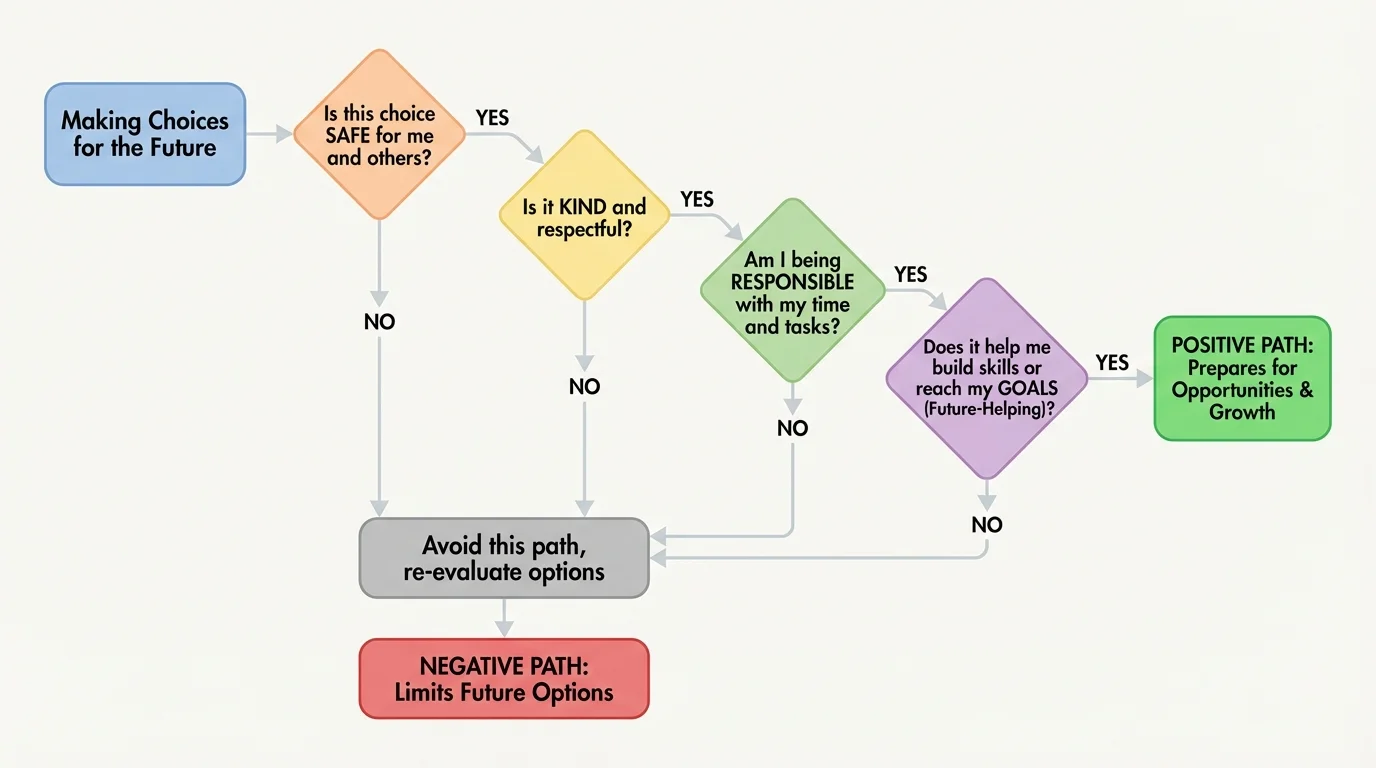
When you have a choice to make, use a simple tool, as [Figure 2] illustrates. Ask yourself four questions: Is it safe? Is it kind? Is it responsible? Will it help my future? If the answer is "no" to one or more of these questions, stop and think again.
This tool can help with many everyday situations. Should you spend your time watching random videos or finish your task first? Should you send a rude message when angry or wait and calm down? Should you give up when something is hard or ask for help and keep trying? These choices may seem small, but they shape your habits.
Here is a simple way to decide:
Step 1: Pause before acting.
Step 2: Name the choice.
Step 3: Ask the four questions.
Step 4: Pick the choice that helps you grow.
Step 5: Check what happened and learn from it.
Suppose you have free time before dinner. You can play a game now and rush later, or you can finish one assignment first and then relax. The second choice is often smarter because it lowers stress and helps you stay prepared.
Real-life decision example
Maya has a reading task, a piano practice, and time to chat online with a friend.
Step 1: She pauses and lists her choices.
She can chat first, do one job first, or try to do everything at once.
Step 2: She asks the four questions.
Chatting first is not unsafe, but it may not be the most responsible choice if it makes her late on her work.
Step 3: She chooses a better order.
She finishes the reading task, practices piano for a short set time, and then chats with her friend.
Maya still has fun, and she also keeps a promise to herself. That is a future-ready choice.
Sometimes there is not one perfect answer. You may have two good choices. In that case, pick the one that best matches your goals and responsibilities.
Preparing for future opportunities is not only about grades or awards. It is also about skills that help in real life. One important skill is organization. Organization means keeping your things, time, and tasks in order. When you know where your materials are and what you need to do, you are more ready for learning and projects.
Another important skill is communication. Communication means speaking, writing, listening, and responding clearly. If you can explain your ideas, ask good questions, and listen carefully, you will be ready for teamwork and leadership later.
Goal setting is helpful too. A goal is something you want to reach. Big goals can feel far away, so break them into small steps. If your goal is to become a stronger reader, a small step might be reading for 20 minutes each day. Since this is grade 3, 20 minutes can also be seen as two sets of 10 minutes because \(10 + 10 = 20\).
Problem-solving is another future skill. Problems happen in every part of life. Maybe your internet connection stops during a lesson. Maybe your project materials are missing. Maybe two activities happen at the same time. Instead of panicking, problem-solving helps you look for a smart next step.
Curiosity also matters. Curious students ask, "How does this work?" "What can I try?" "Who can teach me?" Curiosity leads to learning, and learning leads to more opportunities.
As we saw earlier in [Figure 1], there are many possible future paths. Skills like organization, communication, curiosity, and problem-solving help on almost all of them.
| Helpful choice | What it builds | Why it matters later |
|---|---|---|
| Finishing tasks | Responsibility | People trust you with bigger jobs |
| Practicing often | Skill growth | You improve and feel more confident |
| Asking for help | Wisdom | You learn faster and solve problems |
| Being kind online | Good reputation | Others enjoy working with you |
| Planning ahead | Organization | You are ready for deadlines and goals |
Table 1. Examples of helpful choices, what they build, and why they support future opportunities.
You do not have to prepare for the future alone. Strong people often have a support team. This can include family members, teachers, tutors, neighbors, librarians, coaches, club leaders, faith leaders, or other trusted adults. These people can notice your strengths, cheer you on, and help you improve.
A mentor is a trusted person who gives guidance and encouragement. A mentor might help you learn a skill, set a goal, or think through a problem. Not every mentor has to be connected to a job. A person who helps you become more responsible and confident is already making a difference.
"Small steps every day can lead to big places later."
Community connections matter because future opportunities often grow through relationships. For example, a librarian might tell you about a reading club. A coach might encourage leadership. A neighbor might teach you gardening, fixing things, or caring for animals. These experiences build skills and confidence.
If you want help, be brave and ask. You can say, "Can you help me practice this?" or "Do you know a good way for me to learn more about this?" Asking respectfully is a powerful step.
Sometimes the hardest part of making good choices is dealing with obstacles. An obstacle is something that gets in the way. Common obstacles include distraction, fear, frustration, tiredness, and thinking, "I am just not good at this."
When you face a problem, try not to let one bad moment become a bad pattern. If you forget an assignment, do not decide you are "bad at school." Make a better plan. If you speak sharply to someone online, apologize and choose kinder words next time. If a task feels too hard, break it into smaller pieces.
This is called perseverance. Perseverance means continuing to try even when something is difficult. It does not mean doing everything alone. It means not quitting on your growth.
Obstacle example
Jordan wants to learn beginner coding, but the instructions feel confusing.
Step 1: Jordan notices the obstacle.
The problem is not "I can never do this." The problem is "This part is confusing right now."
Step 2: Jordan chooses a better action.
Jordan watches the lesson again, writes down one question, and asks a trusted adult or teacher for help.
Step 3: Jordan keeps going.
After getting help, Jordan completes one small part of the task and feels more confident.
That is how perseverance works: notice, adjust, and continue.
The decision tool from [Figure 2] still helps when obstacles show up. You can ask, "What choice right now is safe, kind, responsible, and helpful for my future?"
You do not need a giant life plan. You just need a simple plan for your next steps. A future-ready plan has four parts, as [Figure 3] shows: one goal, small actions, a helper, and a check-in time.
Start with one small goal. Maybe you want to become a better reader, practice speaking clearly, learn to cook simple foods safely, improve your digital skills, or manage your time better. Pick something important and realistic.
Next, choose small actions. If your goal is reading, your action might be reading for 15 minutes each weekday. If your goal is organization, your action might be cleaning your study space each evening. If your goal is communication, your action might be practicing polite messages online.
Then choose a helper. This is someone who can encourage you, answer questions, or remind you to keep going. Finally, choose a check-in time, such as the end of the week, to see what went well and what needs to change.
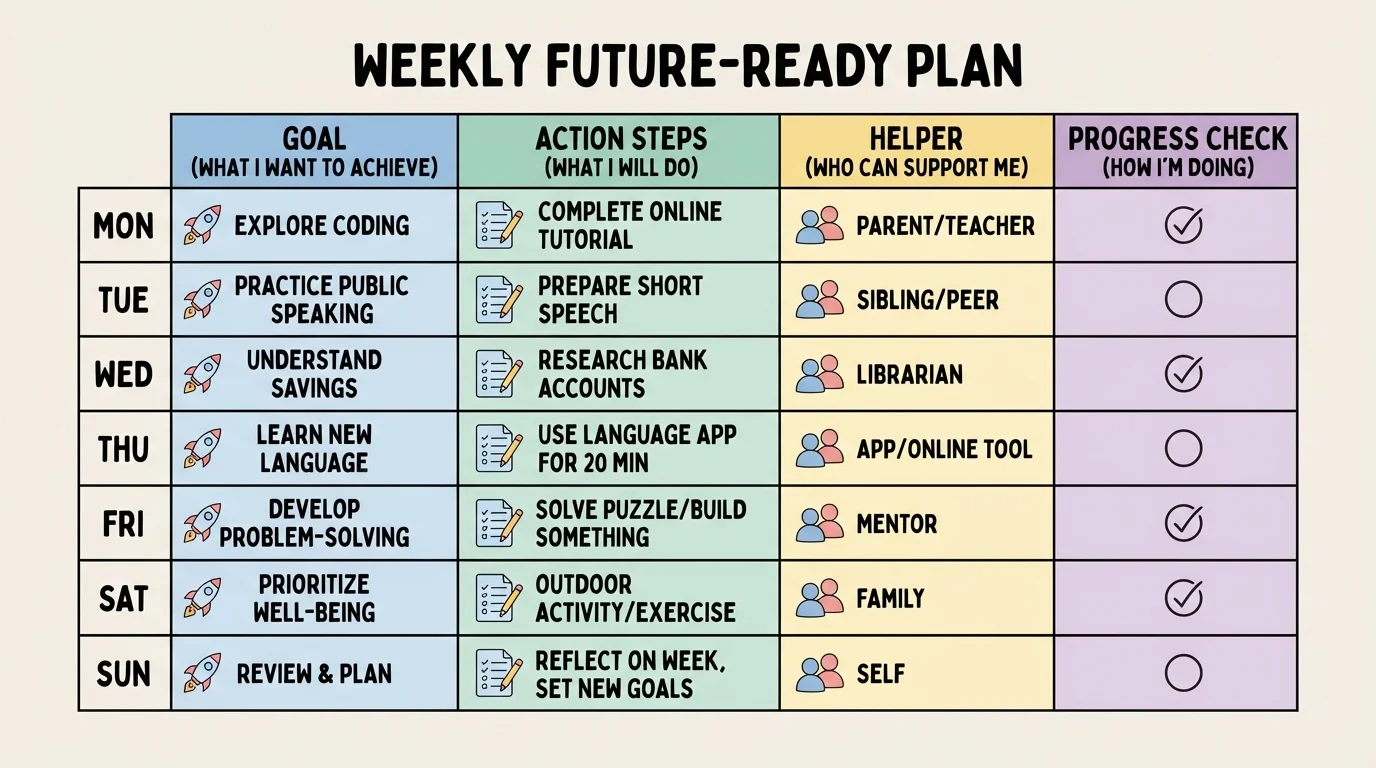
Here is an example: "My goal is to be more organized. My actions are to use a checklist every day and put materials away after lessons. My helper is my parent. My check-in time is Friday evening." This plan is simple, but it builds an important life skill.
You can also track your progress with a simple count. If you use your checklist on 4 days out of 5, that is good progress. In math, that can be written as \(\dfrac{4}{5}\). You do not need perfect success to be growing.
Growth usually happens a little at a time. One better choice today may not seem huge, but many better choices together can change what you are ready to do later.
When you look again at the plan in [Figure 3], you can see that preparing for the future is really about noticing what matters, taking small actions, and asking for support. That is something you can begin right now.
