Have you ever tried to do something with other people, but nobody knew who should do what? One person talks over everyone, another forgets the plan, and the job takes much longer than it should. Teams work best when people have clear jobs. A team does not need a bossy person. It needs people who know how to help in different ways.
When a group shares work, each person can take on a role. A role is a job or part that helps the team. Good roles make it easier to stay calm, kind, and focused. This matters when you work on a family project, join a club, play on a sports team, help in your neighborhood, or work with classmates online.
Team means a group of people working toward the same goal. Respect means treating others with kindness, fairness, and care. Productive means getting useful work done. Organized means having a clear plan, clear jobs, and the materials or information you need.
Knowing team roles is a practical life skill. It helps you get things done without a lot of stress. It also helps you become someone other people trust. When you understand how roles work, you can join a group and be helpful right away.
Roles help teams because they reduce confusion. If everyone tries to do the same job, some tasks get repeated while other tasks get forgotten. If no one keeps track of time, the team may run out of it. If no one notices feelings, people may become upset or left out.
Clear roles also make teamwork fairer. One person should not have to do everything. A team is stronger when work is shared. When each person knows their job, the whole group can move forward together.
Think about making a short video with your siblings or friends for a community event. Someone needs to plan the idea. Someone needs to gather supplies. Someone needs to check the time. Someone needs to make sure everyone gets a turn to speak. These are all different jobs, and each one matters.
Why roles matter
Roles help a team in three big ways. First, they bring order, because people know what to do. Second, they build respect, because everyone has a chance to help. Third, they improve results, because the team can finish the job more smoothly.
Without roles, a team can still try to work, but it often becomes messy. People interrupt each other, forget steps, or feel frustrated. With roles, the same team often feels calmer and more successful.
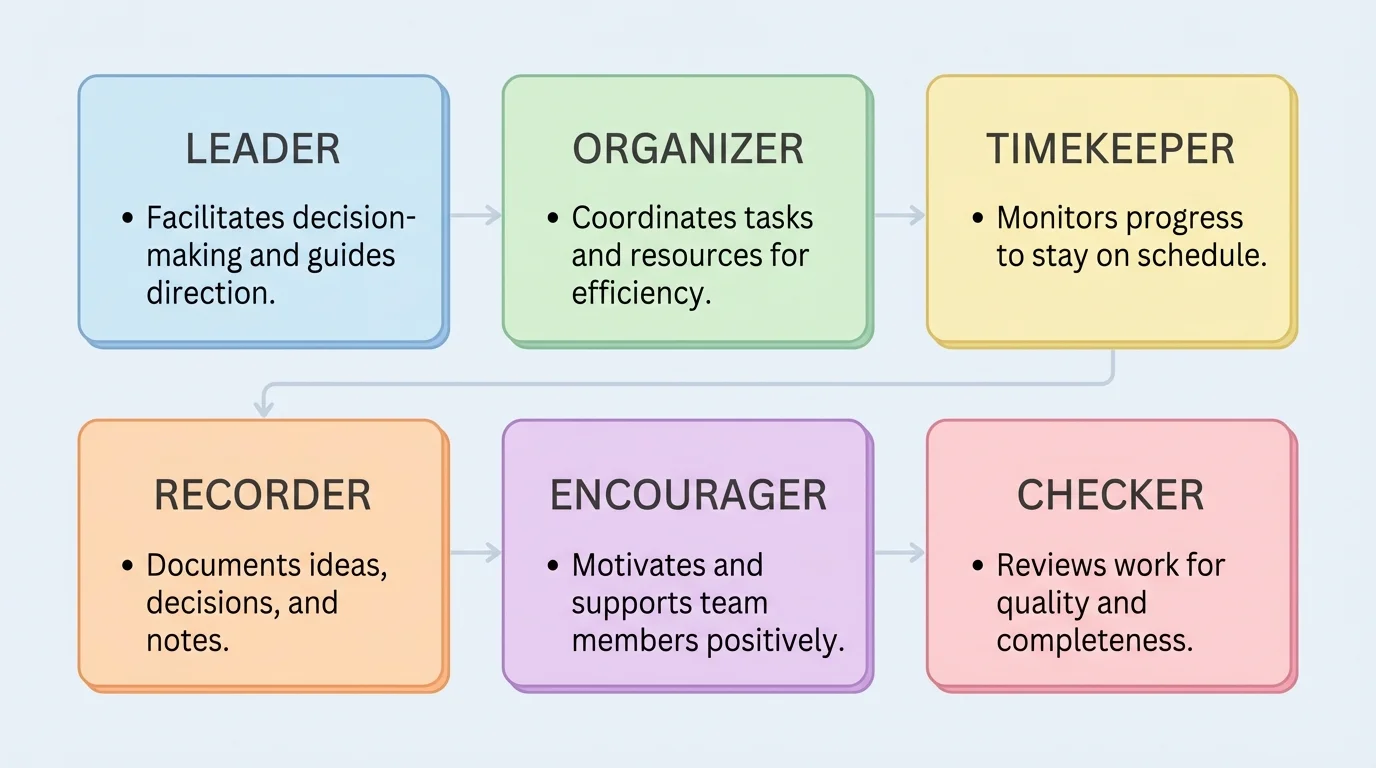
Many teams use jobs that work together, as shown in [Figure 1]. The exact names can change, but the main idea stays the same: different people help in different ways.
Leader is the person who helps the team begin, keeps everyone focused on the goal, and makes sure all voices are heard. A good leader does not boss people around. A good leader guides the group and listens.
Organizer is the person who helps the team make a plan. This person may help decide what happens first, second, and third. The organizer also helps keep track of materials, links, notes, or supplies.
Timekeeper watches the clock and gives reminders. This helps the group finish on time. The timekeeper might say, "We have five minutes left to decide," or "Let's move to the next step."
Recorder writes things down. This could mean taking notes during a video call, typing ideas into a shared document, or making a list of what each person will do next.
Encourager helps the team stay positive and included. This person notices when someone has not spoken yet and says kind things like, "Your idea matters too," or "Nice job sticking with it."
Checker looks over the work. This person asks, "Did we finish every part?" "Did we follow directions?" and "Does everyone understand the plan?"
Sometimes one person does more than one role, especially in a small group. For example, the leader might also be the encourager, or the organizer might also be the recorder. In a larger group, roles can be shared among more people.
Each role is valuable. Some roles are easy to notice, like leader. Some are quiet but very important, like recorder or checker. A team needs both visible helpers and behind-the-scenes helpers.
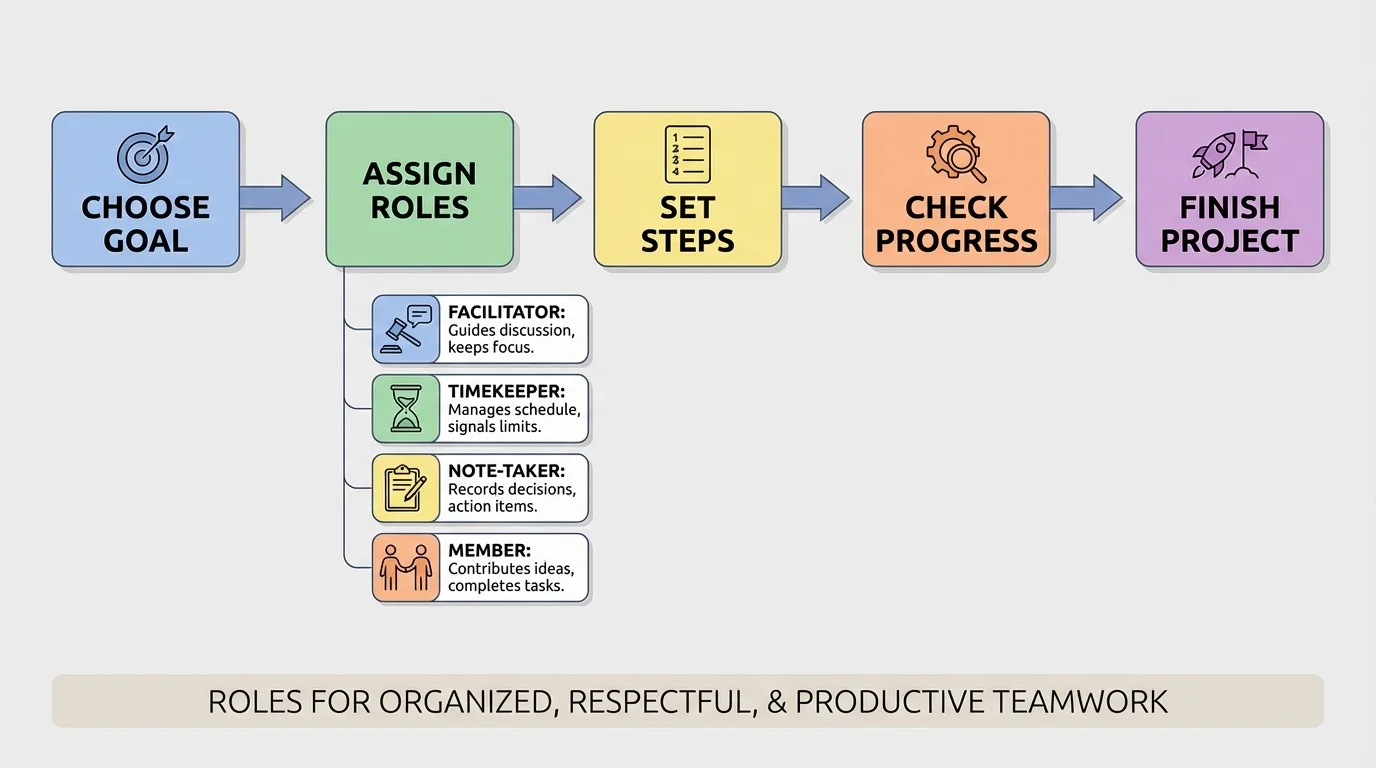
Organization means the team has a clear path, and [Figure 2] shows that path in simple steps. Teams stay organized when they know the goal, break it into parts, and give each part to someone.
Here is a simple way to organize teamwork. First, decide the goal. Next, list the jobs that must be done. Then, choose who will do each job. After that, check progress and adjust if needed. Last, finish and review the work.
A clear plan stops the team from wasting time. If your group is making care packages for neighbors, the organizer can make a supply list, the recorder can write who is bringing what, and the timekeeper can remind everyone when the packages need to be ready.
Roles also help when people work from different places. In online teamwork, someone may share the meeting link, someone may keep notes in a shared document, and someone may remind the group about due dates. This makes remote teamwork much smoother.
If nobody is organizing, small problems grow fast. People might bring the same item twice, skip an important step, or forget a deadline. As we saw in [Figure 2], a team that follows a simple plan has a better chance of success.
Example: Organizing a family game night
Step 1: Set the goal
The team decides the goal is to host a fun game night for the family on Friday evening.
Step 2: Choose roles
One person becomes the leader, one the organizer, one the timekeeper, and one the encourager.
Step 3: Share jobs
The organizer makes a list of games and snacks. The timekeeper reminds everyone when it is time to set up. The encourager checks that each family member gets to pick a game.
Step 4: Check the plan
The checker asks whether the games, snacks, and space are ready.
Because everyone has a role, the event starts on time and feels less stressful.
Organization is not about making everything perfect. It is about making the next step clear. A role helps you know what your next helpful step should be.
Respectful teamwork means people feel safe, heard, and valued, and [Figure 3] shows some simple ways that happens during online teamwork. Roles support respect because they remind people to listen, take turns, and treat each other kindly.
The leader helps by making sure one person does not take over. The encourager helps by inviting quieter people to share. The recorder helps by writing down ideas fairly, not only the loudest ideas. These jobs make room for everyone.
Respect also means speaking kindly, even when you disagree. You can say, "I have a different idea," or "Can we try this way?" instead of saying something rude. Team roles make these moments easier because people know how to respond and who can help calm things down.
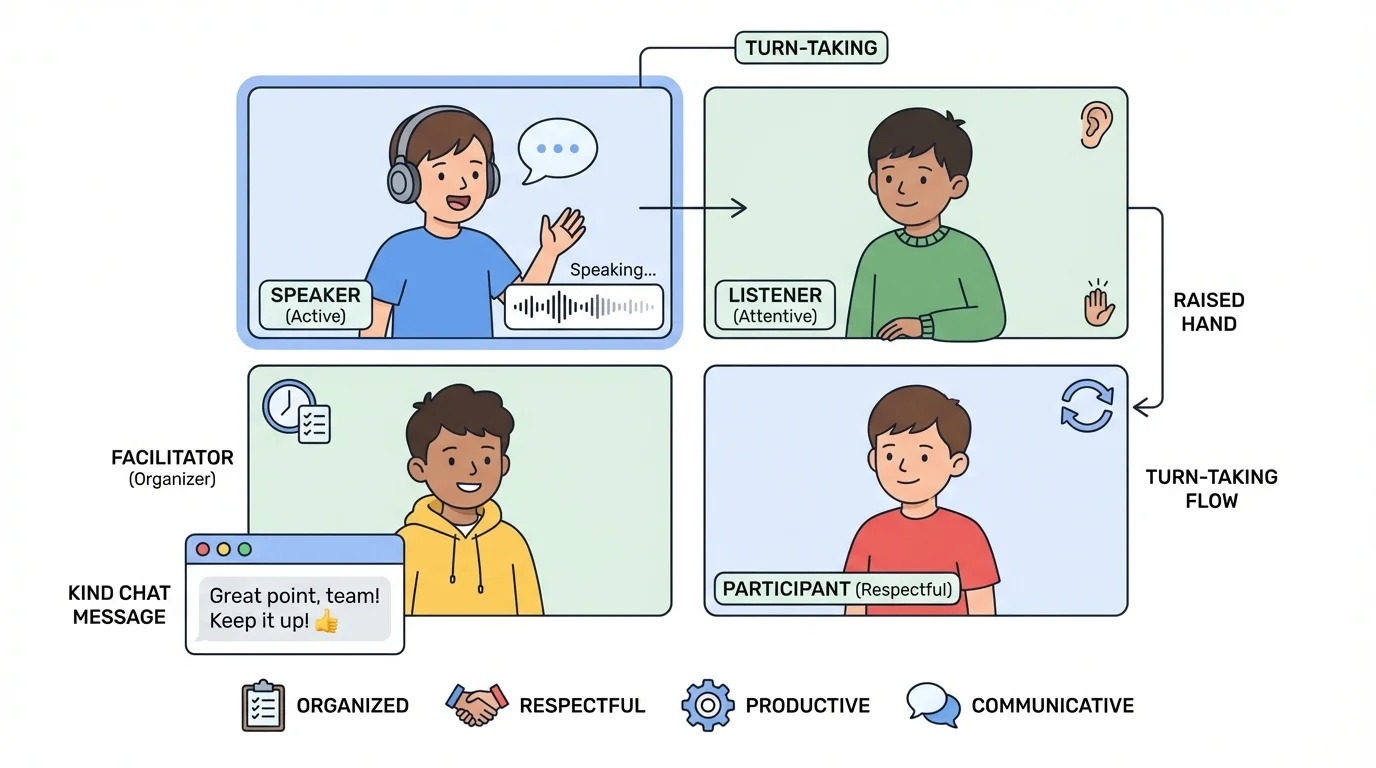
Listening is a big part of respect. When a teammate is speaking on a video call or sharing in a group chat, wait your turn. Read messages carefully. Ask questions if you are confused. Looking closely at the actions in [Figure 3], you can see that respectful teams do not interrupt or ignore people.
Respect also means fairness. If one person always gets the fun job and another always gets the boring job, the team may begin to feel unhappy. Sharing roles fairly helps everyone feel included.
"A good team is not made of people who are the same. It is made of people who help each other."
When respect is missing, even talented teams struggle. People may stop trying, stop sharing ideas, or leave the group. When respect is strong, people are more willing to help and solve problems together.
Productive teams do not just stay busy. They finish useful work. Roles help productivity by preventing wasted time and helping the group focus on what matters most.
For example, if your team is planning a small neighborhood clean-up, the organizer can list needed supplies, the timekeeper can remind everyone when to meet, the recorder can keep track of who is bringing gloves and bags, and the checker can make sure the area was fully cleaned. Because jobs are shared, more gets done.
Productivity also grows when people know who to ask. If you are unsure about the next step, ask the organizer. If the team is running late, listen to the timekeeper. If someone feels left out, the encourager can help bring them back in. This saves time and reduces confusion.
Some of the best teams in sports, music, science, and business spend time deciding jobs before they begin. They know that a few minutes of planning can save much more time later.
Teams are productive when they can keep going even if a problem appears. Maybe the internet connection drops, someone forgets a supply, or the plan needs to change. Clear roles help the team adjust instead of freezing.
A productive team is not the team with the loudest person or the fastest start. It is the team that keeps working together until the goal is complete.
Teams should choose roles in a fair way. One good method is to ask, "What jobs do we need?" and then let people volunteer for roles they can do well. Another good method is to rotate, which means taking turns so different people get different jobs over time.
Rotate is an important idea in teamwork. If you are the recorder today, someone else can be the recorder next time. Rotating roles helps everyone learn new skills. It also prevents one person from always carrying the same responsibility.
It is helpful to match roles to strengths, but not in a way that traps someone. A student who is good at planning might be a strong organizer, but that student should still get chances to try leading or recording. Teams grow when members practice different jobs.
| Role | Main job | Helpful words to say |
|---|---|---|
| Leader | Guide the group | "Let's hear everyone's ideas." |
| Organizer | Make the plan | "First we do this, then that." |
| Timekeeper | Watch the time | "We have a few minutes left." |
| Recorder | Write down ideas | "I'm adding that to our notes." |
| Encourager | Support teammates | "You can do it. Your idea matters." |
| Checker | Review the work | "Did we finish every part?" |
Table 1. Common team roles, their main jobs, and examples of helpful words.
Before starting, it can help to say roles out loud or type them into a shared message. That way, everyone knows who is doing what. This small step can prevent many misunderstandings.
Example: Fair role sharing in an online group
Step 1: Name the jobs
The group needs a leader, recorder, timekeeper, and checker.
Step 2: Ask for choices
Each person shares one role they would like to try.
Step 3: Make it fair
If two people want the same role, the team can take turns this time and next time.
Step 4: Confirm the plan
The recorder writes the roles in the group chat so everyone can remember.
This keeps the team fair and clear.
Choosing roles fairly builds trust. Trust is what helps teams stay strong when work becomes harder.
Sometimes a team has roles, but the team still struggles. Maybe the leader talks too much. Maybe the timekeeper forgets to watch time. Maybe the recorder misses notes. This does not mean the team failed. It means the team needs to adjust.
Start by naming the problem kindly. Say what is happening, not what is wrong with a person. For example, say, "We are missing some notes," instead of, "You are bad at this." This keeps the problem small and fixable.
Next, decide what would help. The recorder may need support. The timekeeper may need a timer. The leader may need a reminder to pause and listen. Sometimes the best answer is to switch or share roles.
Fix the job, not the person
When teamwork is not going well, focus on changing the plan instead of blaming. You can adjust the role, add support, or rotate jobs. This protects respect while solving the problem.
Here is a simple plan you can use: notice the problem, name it kindly, adjust the role, and try again. Teams improve through practice, not perfection.
If feelings are hurt, pause and reset. Respect comes first. A team that protects kindness can recover from mistakes much more easily.
You do not need a formal project to use teamwork roles. You can use them while cleaning a room with family members, planning a birthday surprise, helping with a neighborhood event, making a poster for a club, practicing with a sports team, or working on a shared online activity.
For example, if your family is cooking dinner together, one person can organize ingredients, one can watch the time, one can read the recipe and record what is done, and one can check that the table is ready. If your soccer team is getting ready for a game, one teammate can encourage others, one can help organize equipment, and one can remind the team about timing.
Even in friendly online gaming, roles can matter. One person may guide the plan, another may watch for changes, and another may support teammates who need help. Good teamwork makes the experience more fun and less frustrating.
You already use leadership and teamwork skills in small ways every day when you help at home, listen to others, take turns, and finish shared tasks. Team roles build on those same habits and make them stronger.
When you understand team roles, you are not just helping a group finish one task. You are practicing leadership, responsibility, and initiative. These are skills that will help you now and later in life.
Try This: The next time you work with other people, pause before you begin. Ask, "What jobs do we need?" Then help the team choose roles clearly. That one small action can make the whole job better.
