Have you ever said, "I want to do that," but then it did not happen? Maybe you wanted to clean your room, finish a book, save money for a game, or learn a new trick on your bike or scooter. Wanting something is a good start, but goals usually do not happen by accident. They happen when you plan what to do and reflect on how it went.
These two skills are powerful because they help you act on purpose. Planning helps you know what to do next. Reflection helps you stop and think about what worked, what did not work, and what you should try next. When you use both, you become more responsible, more confident, and better at reaching goals.
A goal is something you want to do, make, learn, or improve. Some goals are small, like putting your shoes away every day. Some goals are bigger, like reading ten chapter books this year or learning to bake cookies with help from an adult.
If you only think about a goal, it can stay a wish. A wish sounds like, "I hope my room gets clean." A plan sounds like, "First I will pick up the toys, then I will put books on the shelf, and after that I will put dirty clothes in the basket." The second one gives you a path to follow.
Planning means thinking ahead about what you want to do and deciding the steps to get there.
Reflection means looking back at what happened and thinking about what you learned.
Planning is helpful because it makes a job feel smaller and clearer. Reflection is helpful because it turns every try into a chance to learn. Even if something does not go the way you hoped, reflection helps you improve instead of giving up.
A plan is like a map for your goal. It does not need to be fancy. For a third grader, a plan can be a short list, a picture checklist, or a note on a family calendar. What matters is that your plan helps you know what to do first, next, and last.
Good planning often includes a few simple parts: what your goal is, the small steps, what you need, when you will do it, and how you will know you are done. For example, if your goal is to practice piano three times this week, your plan might include choosing the days, setting a timer, and deciding which song to practice.
Planning also helps with time. If you have a goal but never choose a time to work on it, it is easy to forget. But when you say, "I will practice after lunch on Monday, Wednesday, and Friday," your goal becomes more real.
Big goals become easier when they become small jobs. Your brain can feel stuck when a goal is too large. Breaking it into steps helps you start. Starting is often the hardest part. Once you begin, the next step is easier to see.
Planning can also help you ask for help early. If your goal is to bake muffins, you may need an adult to help with the oven. If your goal is to join a community soccer team, you may need a grown-up to help sign you up. A smart plan notices these needs before the last minute.
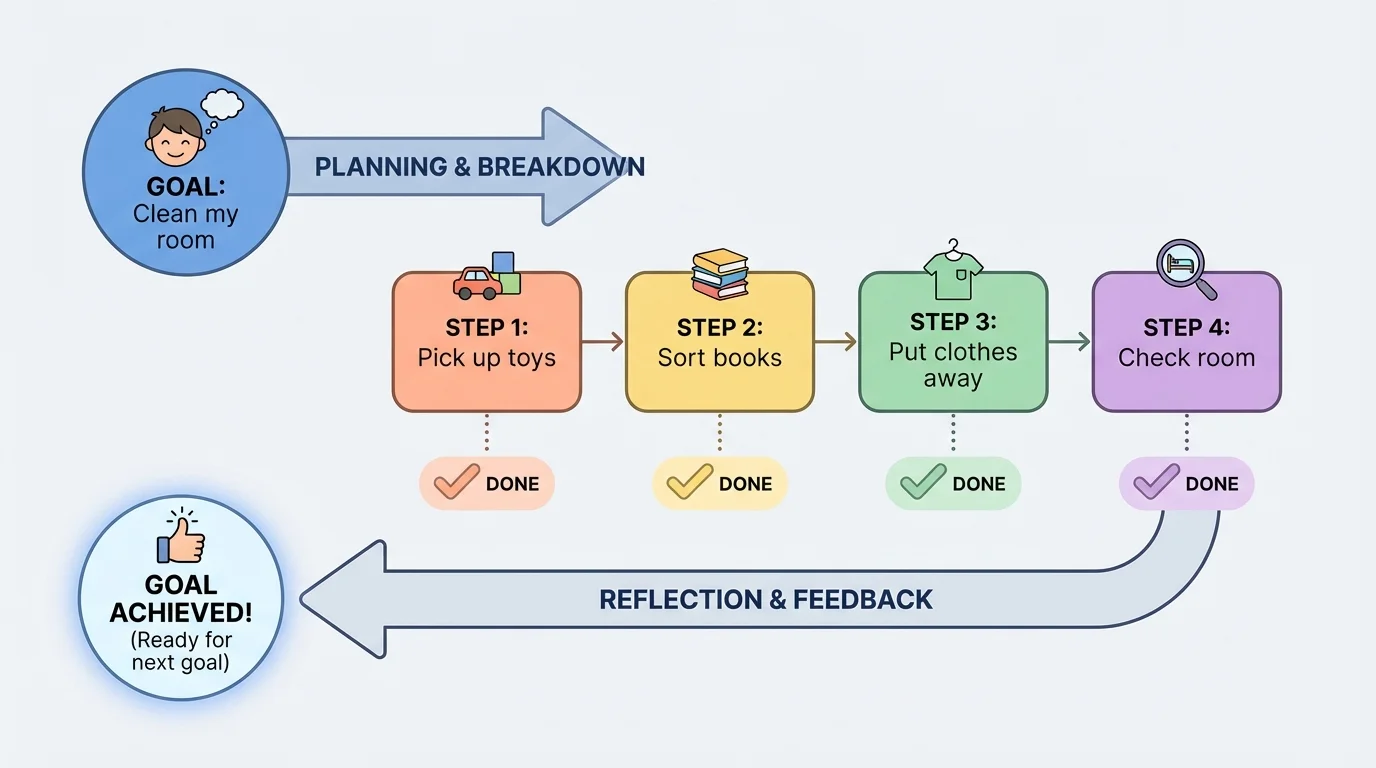
When a goal feels huge, breaking it apart helps, as [Figure 1] shows with one everyday task turned into clear steps. You do not have to plan every tiny detail, but you should know enough to get started without feeling lost.
Start by picking one clear goal. "Be better at reading" is hard to measure. "Read for 15 minutes before bed four nights this week" is much clearer. Clear goals are easier to follow because you know what success looks like.
Next, break the goal into smaller parts. Ask yourself, "What comes first?" Then ask, "What comes next?" If your goal is to clean your room, your steps might be: pick up toys, put books away, place dirty clothes in the basket, make the bed, and check the floor.
Then think about what you need. Do you need a timer, a notebook, your library book, a water bottle for soccer practice, or coins for your savings jar? Getting supplies ready ahead of time can stop delays.
After that, choose a time. Saying "later" often means "not today." Saying "after breakfast" or "at 4 o'clock" gives your plan a real place in your day. If your family uses a calendar, you can add your goal time there.
Last, decide how to check your progress. You might use a sticker chart, a checklist, or simply tell a parent or caregiver what you finished. Progress checks help you notice that your hard work is adding up.
A simple goal plan
Goal: Read for 15 minutes on four days this week.
Step 1: Choose the days.
Monday, Tuesday, Thursday, and Saturday.
Step 2: Pick the time.
Right before bed.
Step 3: Get ready.
Put the book on the nightstand so it is easy to find.
Step 4: Check progress.
Make a check mark after each reading time.
This plan is simple, but it gives a clear path.
You can use the same idea for many goals at home: practicing a sport skill, remembering chores, helping care for a pet, or finishing a creative project.
Reflection means stopping to think after you try. It is like asking yourself a few helpful questions: What went well? What was hard? What should I do the same next time? What should I change?
Reflection is not about being mean to yourself. It is not saying, "I messed up, so I am bad at this." Reflection is calm and honest. It sounds more like, "I forgot on Wednesday because I left my book in another room. Next time I will put it by my bed."
This matters because goals do not always go perfectly. Sometimes you get busy. Sometimes you feel tired. Sometimes your first plan is not the best plan. Reflection helps you learn from real life instead of quitting.
People who think about their progress often get better at new skills because they notice patterns. They can see what helps them succeed and what gets in their way.
Reflection can be very short. You do not need a long journal entry. You might just say one sentence out loud: "Practicing after lunch worked better than practicing before lunch." That one thought can improve your next try.
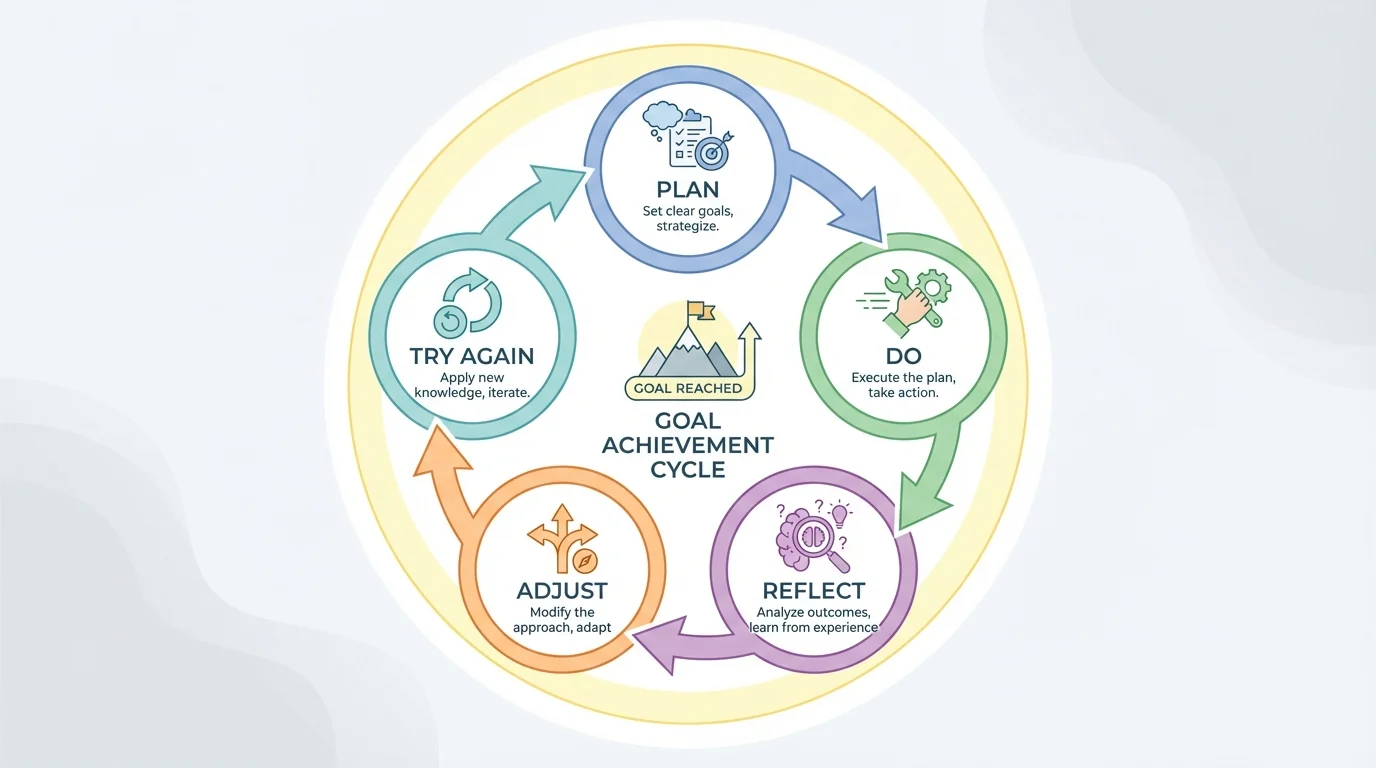
Planning and reflection are a team, and [Figure 2] illustrates how they keep repeating in a helpful cycle. First you make a plan. Then you do the plan. Then you reflect on what happened. Then you adjust the plan so your next try is even better.
This means reaching a goal is not usually one straight line. It is more like a loop. You try, learn, and try again. If something goes wrong, that does not mean the goal is impossible. It often means your plan needs a small change.
For example, maybe your goal is to feed the family pet every morning. You planned to do it right after waking up, but you kept forgetting. After reflection, you notice that mornings are rushed. So you adjust the plan: put a reminder note near the kitchen door and ask an adult to remind you for one week while you build the habit.
That is how responsibility grows. Responsible people are not perfect all the time. They notice what needs to be done, make a plan, and fix problems when needed.
Later, when you face bigger goals, the same cycle still works. As we saw in [Figure 2], you do not fail just because you need to adjust. Adjusting is part of success.
One useful place to practice these skills is reading. If your goal is to finish a book, planning helps you choose when to read and how much to read each day. Reflection helps you notice if your reading time is too short, too late in the day, or in a place with too many distractions.
Another example is cleaning and organizing your space. If your room, desk, or art area is messy, planning helps you work in parts instead of staring at the whole mess. Reflection helps you notice what keeps the area neat afterward. Maybe putting a bin near your toys works better than stacking everything on one shelf.
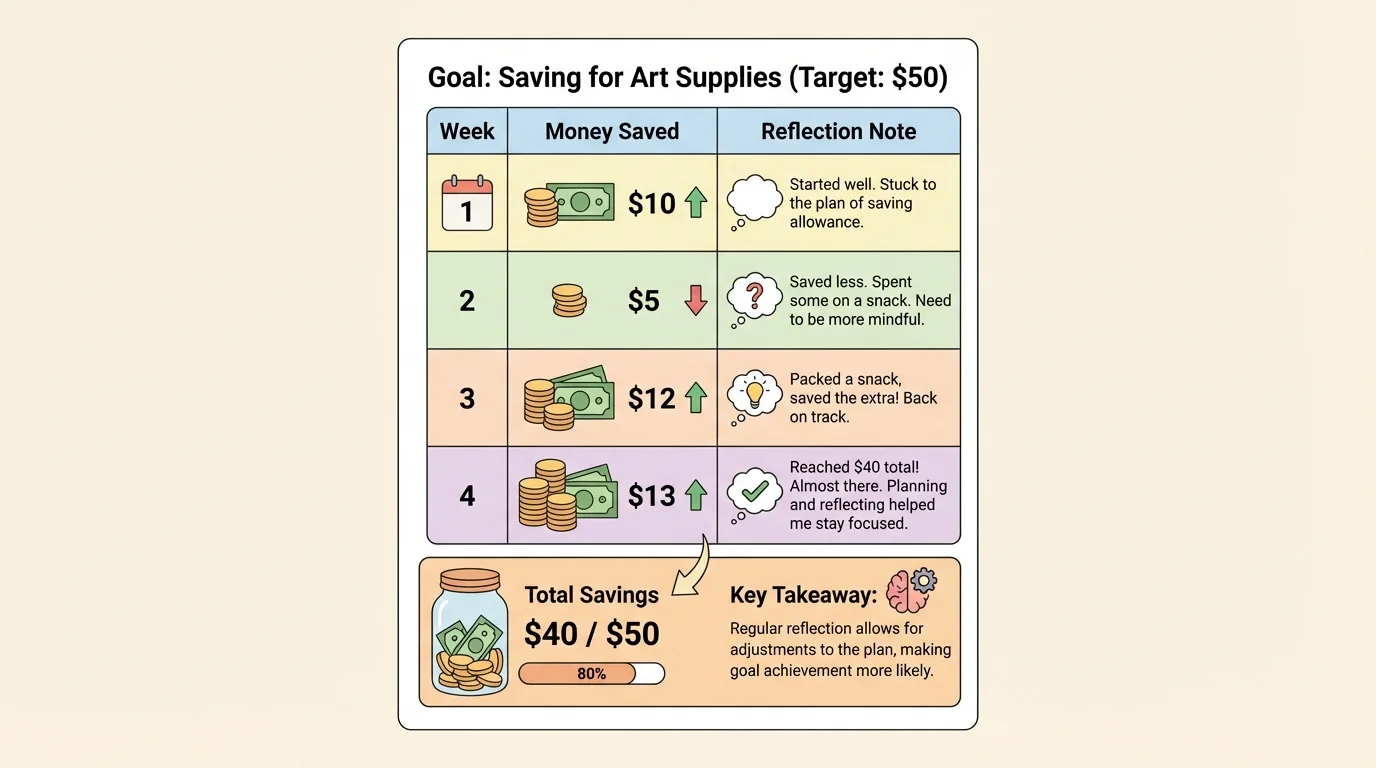
Saving money is another real-life goal, and [Figure 3] shows a simple progress tracker for this kind of plan. Maybe you want to buy art supplies or a small toy. Planning helps you decide how much you need, where you will keep your money, and when you will add to your savings. Reflection helps you check if your saving habit is working.
If you get $2 each week for helping with extra chores, you might save part of it. After a few weeks, you can reflect: "Am I remembering to put money in the jar?" "Am I spending too quickly?" "Should I make a label for my savings jar?"
You can also use planning and reflection when learning a new skill, such as dribbling a basketball, tying a friendship bracelet, or cooking a simple snack with help. You make a plan for practice, then reflect on what got easier and what still needs work.
Helping in your community
Goal: Help keep a neighborhood park clean during family visits.
Step 1: Make a plan.
Bring gloves, a small trash bag, and water.
Step 2: Do the task.
Pick up safe pieces of litter for 10 minutes with an adult nearby.
Step 3: Reflect.
Ask: What tools helped? Was 10 minutes a good amount of time? What should we do next visit?
This shows that planning and reflection are not only for personal goals. They also help you care for your community.
When you help at home or in your neighborhood, these skills make you more dependable. Other people learn they can count on you.
Sometimes a goal does not work out because it is too big. "Clean everything today" can feel overwhelming. A smart fix is to shrink the job. Try "clean the floor first" or "sort books for 10 minutes." Smaller jobs are easier to begin.
Another problem is forgetting. If you forget often, that does not mean you are lazy. It may mean your reminder system is weak. You could use a note, a checklist, an alarm, or place what you need where you can see it. The savings chart from [Figure 3] shows how a visible tracker can remind you to keep going.
Sometimes people quit because they think one bad day ruins the whole goal. That is not true. Missing once does not erase your progress. Reflection helps you restart. You can say, "I missed yesterday, so today I will do the next right step."
Another problem is choosing a goal that belongs to someone else, not to you. Goals work better when you care about them. If your goal matters to you, you are more likely to stick with it.
"Small steps every day can lead to big changes."
You do not need to do everything alone, either. Asking for help is a strong choice. A parent, caregiver, coach, sibling, or trusted adult can help you make a plan and talk through your reflection.
Planning and reflection help you now, but they also prepare you for the future. As you grow, your goals may become bigger: managing homework time, saving for something important, learning digital safety habits, helping more at home, joining clubs or teams, or caring for younger children safely with an adult nearby.
These skills also help you become a person others trust. If you say you will do something and then make a plan to do it, people notice. If you make a mistake and reflect on how to improve, people notice that too. That is part of building strong character.
Being future-ready does not mean you know everything today. It means you know how to take the next step, learn from experience, and keep improving. That is what planning and reflection teach you.
Try This: Pick one small goal for this week. Make it clear, choose a time, and decide how you will check your progress. After you try, pause and ask yourself what worked and what you want to change next time.
Try This: If a goal feels too hard, cut it into smaller pieces. Doing one small part is better than waiting for the "perfect" time to do everything.
Try This: At the end of the day, say one reflection sentence: "Today I did well at ___," or "Next time I will ___." This helps your brain get stronger at learning from experience.
