Some people think a leader is the person who gives orders. But in real life, the best leaders often do something different: they help, they keep promises, and they make other people feel stronger. A leader might be the child who notices that someone is confused on a video call and kindly explains the next step. A leader might be the person who remembers the plan, stays calm, and helps everyone work together. Leadership is not mostly about being first. It is about helping a group do well.
Leadership means guiding people toward a goal in a helpful way. You do not need a special title to be a leader. You can lead when you help your family finish a job, when you welcome someone into an online club, or when you speak up kindly during a team activity in your community.
Good leadership usually includes three important parts: service, responsibility, and encouragement. These parts work together. If a person tells others what to do but does not help, does not act responsibly, and does not treat people kindly, that is not strong leadership. A real leader makes life better for the group.
Service means helping others and meeting needs. Responsibility means doing what you should do and being someone others can trust. Encouragement means using words and actions that help people feel brave, valued, and ready to keep trying.
Think of leadership like holding a flashlight on a dark path. The flashlight is not pushing anyone. It is helping everyone see where to go. In the same way, a leader helps people move forward safely and confidently.
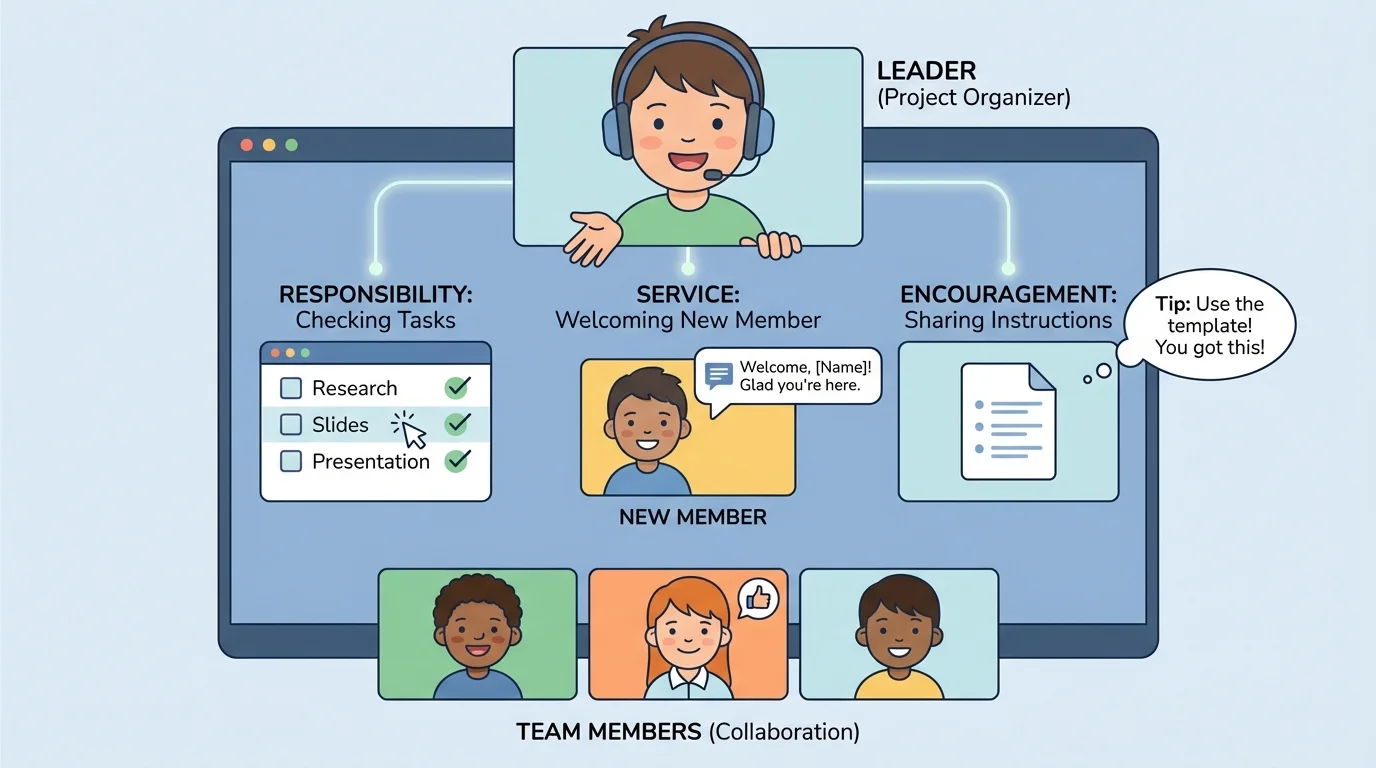
A leader serves the group by thinking, "What would help right now?" This idea is shown clearly in [Figure 1], where the leader is not acting like a boss but is helping the team stay organized and included. Service means noticing needs, taking useful action, and caring about other people, not just yourself.
For example, if your family is getting ready for a busy day, leadership through service might mean packing your own things without being reminded, helping a younger sibling find what they need, or setting out supplies for dinner. If you are part of an online club, service might mean sending a clear reminder about the meeting time, helping someone understand the rules, or making sure everyone gets a turn to speak.
Service does not mean doing everything for everyone. It means doing your part in a way that helps the group succeed. A leader who serves thinks, "How can I make this easier, fairer, or better for others?" Sometimes that means helping with a task. Sometimes it means listening carefully. Sometimes it means sharing tools, information, or time.
Leadership through service also includes initiative. Initiative means doing a helpful thing without waiting for someone to tell you. If you notice that your team is confused, you can make a simple checklist. If a neighbor needs help carrying light grocery bags, you can offer help if it is safe and an adult says it is okay. That is service in action.
Real-life example: service leadership at home
Step 1: Notice the need.
You see that everyone is busy and the living room needs to be cleaned before guests arrive.
Step 2: Choose a helpful action.
You pick up your own things, put books back, and ask, "Would it help if I folded the blankets?"
Step 3: Help others succeed too.
You calmly remind your brother where the game pieces belong instead of complaining.
This is leadership because you are serving the group and helping the job get done.
When leaders serve others, people often feel more willing to cooperate. They can see that the leader cares about the whole group, not just about control. Later, when we look at encouragement, you will see how the helpful attitude in [Figure 1] also makes people feel included and ready to join in.
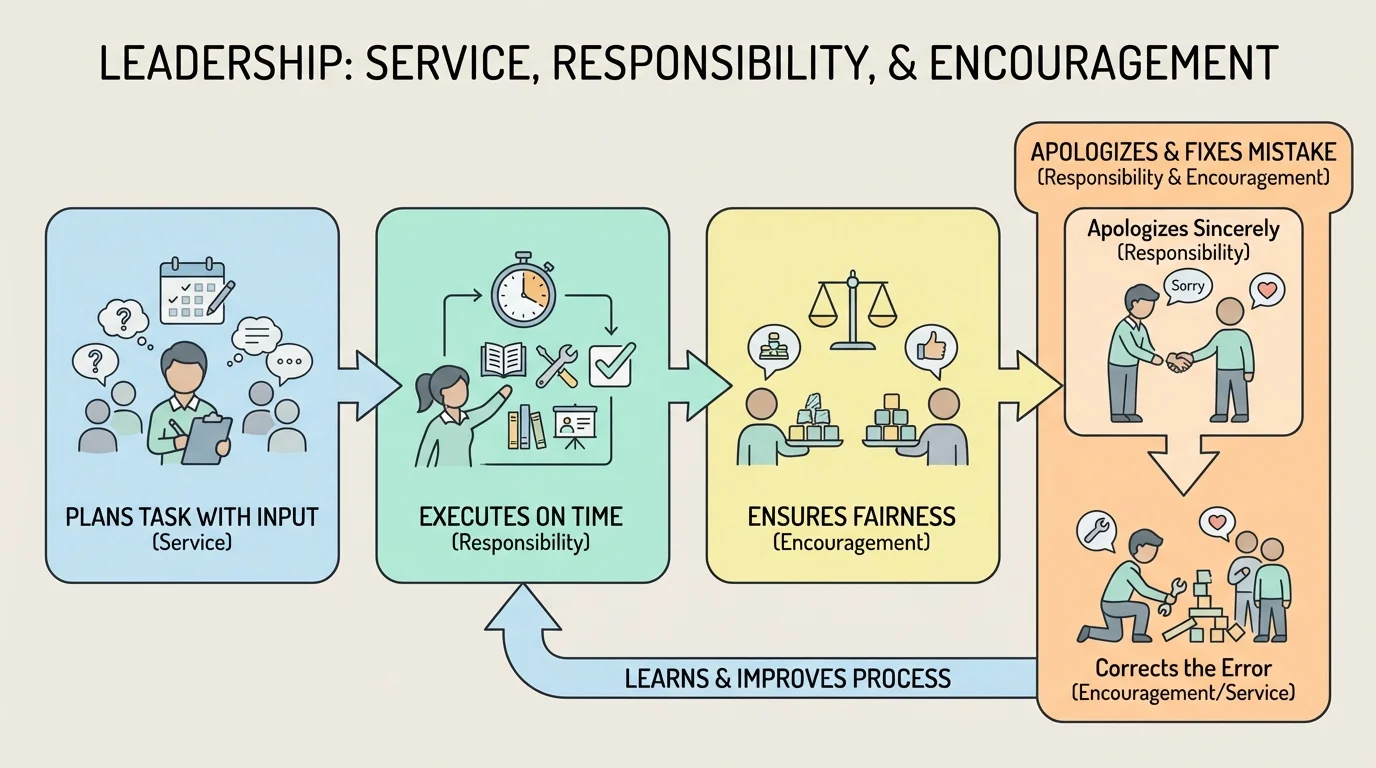
Service is important, but leadership also depends on responsibility. A responsible leader is someone people can count on, as [Figure 2] illustrates through planning, follow-through, fairness, and fixing mistakes. If you say you will do something, others need to know that you mean it.
Responsibility in leadership includes several parts. First, it means doing your job on time. Second, it means being honest. Third, it means being fair. Fourth, it means owning your mistakes and trying to fix them. These are not fancy skills. They are everyday actions that build trust.
Suppose you are helping lead a neighborhood game. You say you will bring the supplies, but you forget and do not tell anyone. The game might be delayed, and people may feel frustrated. Now suppose you remember the supplies, arrive on time, explain the rules clearly, and make sure everyone gets a turn. The whole activity goes more smoothly because your responsibility helps the group.
Responsible leaders also think about safety and respect. If you are in an online space, responsibility means protecting privacy, using kind language, and not sharing someone else's personal information. If someone is being left out in a group chat, a responsible leader notices and helps correct that. If there is a misunderstanding, a responsible leader does not spread rumors or make things worse.
Why responsibility builds trust
Trust grows when your words and actions match. When people see that you prepare, tell the truth, and fix problems instead of hiding them, they feel safer working with you. This is one reason responsibility is a powerful part of leadership.
Owning a mistake can be one of the strongest leadership actions. If you gave unclear directions during an online meeting, you can say, "I think I explained that badly. Let me try again." That is better than blaming someone else. Responsible leaders do not need to be perfect. They need to be honest and ready to improve.
The pattern in [Figure 2] is useful in many situations: plan, act, check fairness, and repair mistakes. You can use it with chores, group projects outside school, team sports, or family plans. Responsibility makes leadership steady.
Words can change a whole group. Encouragement is leadership because it helps people believe they can try, learn, and contribute.
Encouraging leaders do not pretend everything is easy. Instead, they help others keep going. They might say, "You are getting closer," "Thanks for trying," or "Let's work on this together." These words matter. When people feel safe from teasing and put-downs, they are more likely to ask questions, share ideas, and do their best.
Encouragement also includes listening. A leader who only talks is missing something important. When you listen, you learn what people need. Someone might need more time, clearer directions, or simply to be noticed. A good leader pays attention to feelings as well as tasks.
There is a big difference between encouragement and empty praise. Empty praise sounds like, "You're amazing at everything," even when it does not help. Real encouragement is specific. It sounds like, "I noticed you kept trying even when that was hard," or "Your idea helped us solve the problem." Specific encouragement teaches people what is working.
Real-life example: encouraging a teammate
Step 1: Notice what the person may be feeling.
Your teammate goes quiet during a video call after making a mistake.
Step 2: Speak kindly and specifically.
You say, "It's okay to make mistakes. Your first idea helped us get started."
Step 3: Invite them back in.
You ask, "Do you want to share your next thought?"
This kind of encouragement helps the person feel safe, respected, and ready to participate again.
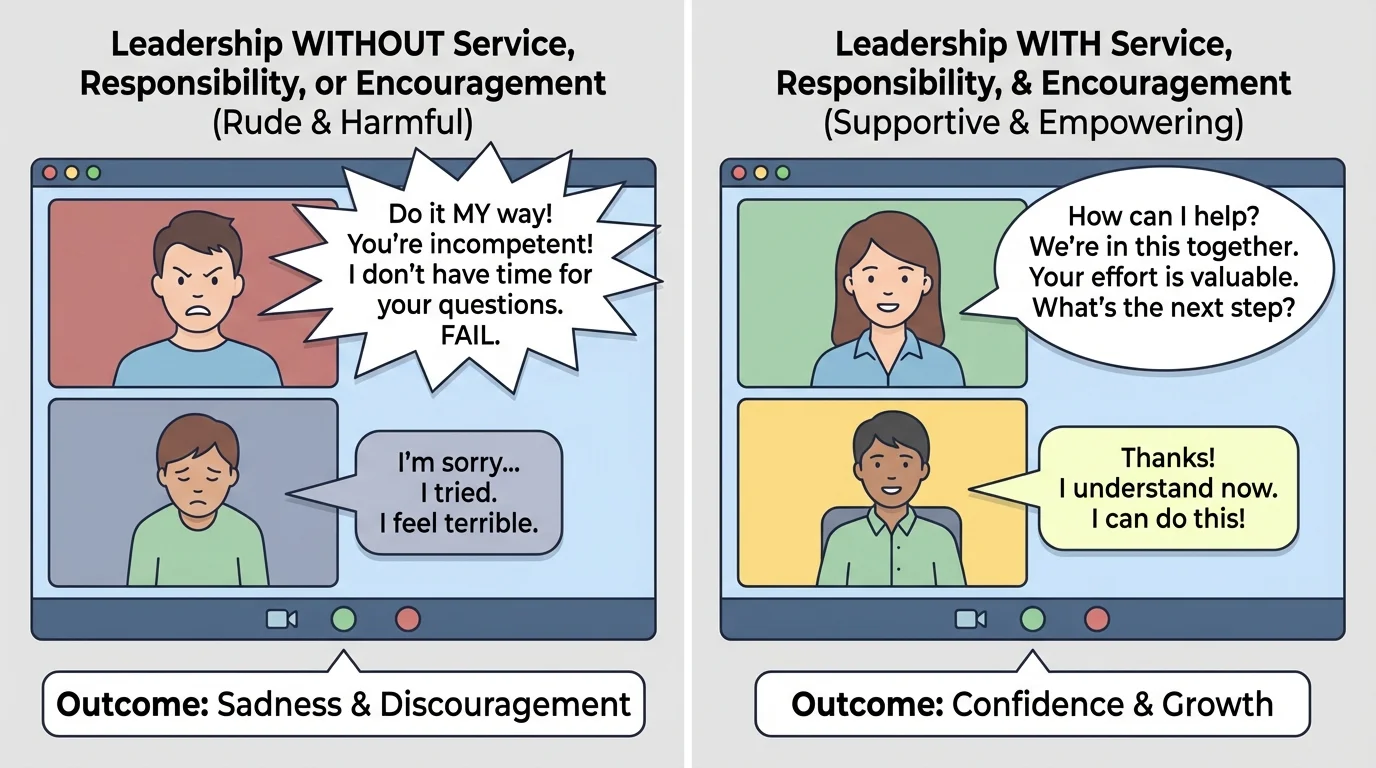
Leaders who encourage others help create a stronger team. Compare the two scenes in [Figure 3]. In the discouraging group, people shut down. In the encouraging group, people participate. Encouragement does not just feel nice. It helps the whole group work better.
Leadership can happen in many places, not just during a big event. At home, it can look like starting your chores without reminders, helping plan a family task, or staying calm when something goes wrong. In a community sports team, it can look like showing up prepared, cheering for others, and playing fairly. In an online group, it can look like sharing helpful information, taking turns, and making sure quiet people are included.
Here is a simple comparison of weak and strong leadership behaviors.
| Situation | Weak Leadership | Strong Leadership |
|---|---|---|
| Online group chat | Interrupts, ignores others, posts unkind comments | Welcomes others, stays on topic, uses respectful words |
| Family task | Waits for others to do the work | Starts own part, offers help, keeps promises |
| Community activity | Tries to control everything | Shares jobs, listens, solves problems calmly |
| When a mistake happens | Blames someone else | Admits the mistake and helps fix it |
Table 1. This table compares unhelpful leadership choices with strong leadership actions in everyday situations.
You may notice something important: strong leadership does not always look loud. Sometimes it is quiet and steady. It is the person who remembers the plan, notices who is left out, and keeps going even when no one claps. That kind of leadership matters a lot.
Many great leaders are remembered not because they were the loudest person in the group, but because they helped others succeed. The strongest leadership often makes a team better, not just the leader more visible.
If you have ever helped a younger child learn a game, shared clear directions in a group message, or encouraged a friend to keep trying, then you have already practiced leadership in a real way.
You do not have to guess what to do. Here is a simple way to lead with service, responsibility, and encouragement.
Step 1: Notice the goal. Ask yourself, "What are we trying to do?" Maybe your goal is to finish a home project, organize an online meetup, or help a team activity run smoothly.
Step 2: Notice people's needs. Ask, "What would help this group right now?" Someone may need instructions, a reminder, extra time, or kindness.
Step 3: Do your part first. A leader should not ask others to do things they refuse to do themselves. Start with your own job.
Step 4: Speak clearly and kindly. Use simple words. Avoid blaming, teasing, or showing off.
Step 5: Invite others in. Good leaders make room for more than one voice. You can say, "What do you think?" or "Do you want a turn?"
Step 6: Stay responsible. Remember the plan, be fair, and fix mistakes.
Step 7: Encourage effort. Notice progress, not just perfect results.
"A good leader helps others do their best."
This step-by-step approach works in small moments too. You do not need a big audience. Leadership grows through practice, one choice at a time.
Sometimes leadership feels hard because people disagree, ignore the plan, or get upset. This is normal. Being a leader does not mean everything goes perfectly. It means you respond in a helpful way.
If people disagree, stay calm. Listen first. Repeat the problem in simple words. Then help the group choose a fair next step. If someone is left out, include them. If you made a mistake, admit it quickly. If another person is frustrated, do not answer with rudeness. Strong leadership is often most visible during difficult moments.
There may also be times when you should ask an adult for help. If a situation is unsafe, involves bullying, or feels too big for you to handle alone, getting help is a responsible leadership choice. Asking for help is not weakness. It is wisdom.
Being responsible does not mean handling every problem by yourself. It means making good choices, including knowing when a trusted adult needs to step in.
One trap to avoid is thinking, "If I am leading, I have to be perfect." That is not true. Leadership is not perfection. It is helpful action, honest effort, and learning from mistakes.
You can start practicing leadership right away in simple, real ways.
Try This: Before your next family task, ask, "What is one thing I can do without being told?" Then do it.
Try This: In your next online conversation or group activity, notice who has not spoken much. Invite them in with a kind question.
Try This: If someone makes a mistake, say one encouraging sentence instead of one critical sentence.
Try This: If you forget a responsibility, tell the truth quickly and help repair the problem.
Try This: At the end of the day, ask yourself three short questions: "How did I help?" "Was I responsible?" "Did I encourage anyone?" These questions can help you grow into a stronger leader over time.
Leadership is not about being the most important person in the room. It is about helping other people, taking your role seriously, and using your words to build others up. When you serve, act responsibly, and encourage people, you lead in a way that others can trust and respect.
