Have you ever noticed that one task feels easy for you while the same task feels tricky for someone else? Maybe you are great at explaining ideas out loud, but you need extra time to stay organized. Maybe you learn quickly by watching a video, while another student learns best by trying it with their own hands. That is not random. It is part of knowing yourself, and that skill can make your life easier, calmer, and more successful.
When you understand what you do well, what is hard for you, and how you learn best, you can make smarter choices. You can plan homework in a way that works for your brain. You can ask for help before a problem gets bigger. You can explain yourself better in group chats, video calls, clubs, sports, or family conversations. Self-knowledge is a life skill, not just a school skill.
If you do not know your patterns, small problems can keep repeating. You might think, "I'm bad at this," when the real problem is that you need quieter space, shorter directions, or a checklist. But when you do know your patterns, you can make changes that help. That is where a personal profile comes in.
Personal profile means a clear description of who you are as a learner and person. It includes your strengths, your needs, and your learning preferences that help you succeed. Strengths are things you do well or qualities that help you. Needs are supports, conditions, or strategies that help you function well. Learning preferences are the ways you often like to take in, practice, and remember information.
A personal profile is not a label. It does not put you in a tiny box. It is more like a useful map. A map helps you know where you are and where you want to go. It also helps you choose the best path.
Your profile should be honest, specific, and useful. "I'm good at stuff" is too vague. "I explain my ideas clearly during video discussions" is much more helpful. "I struggle sometimes" is also too vague. "I need reminders to break big tasks into smaller steps" is clearer and more powerful.
A strong personal profile usually answers questions like these: What am I good at? What helps me stay calm, focused, and ready to learn? What makes work harder for me? How do I like to learn new things? What support can I ask for? What habits help me succeed?
It is also important to remember that everyone has both strengths and needs. Having needs does not mean something is wrong with you. Every person needs support in some areas. One student may need movement breaks. Another may need extra time. Another may need spoken directions instead of long written directions. Knowing that about yourself is a strength by itself.
Your strengths are not only about grades. They can include how you think, how you treat people, how you solve problems, and how you keep going when something is hard. Strengths come in different types, as [Figure 1] shows, and noticing more than one kind gives you a fuller picture of who you are.
You might have learning strengths, such as remembering details, asking thoughtful questions, noticing patterns, reading quickly, or explaining ideas. You might have work-habit strengths, such as being prepared, finishing tasks, staying patient, or checking your work. You might also have interpersonal strengths, such as listening, encouraging others, being kind online, or staying calm during disagreements.
Some strengths are easy to notice because other people praise them. Others are quiet. For example, maybe you are the person who keeps trying after making mistakes. Maybe you are good at noticing when instructions are confusing. Maybe you are creative and come up with unusual solutions. Those count too.
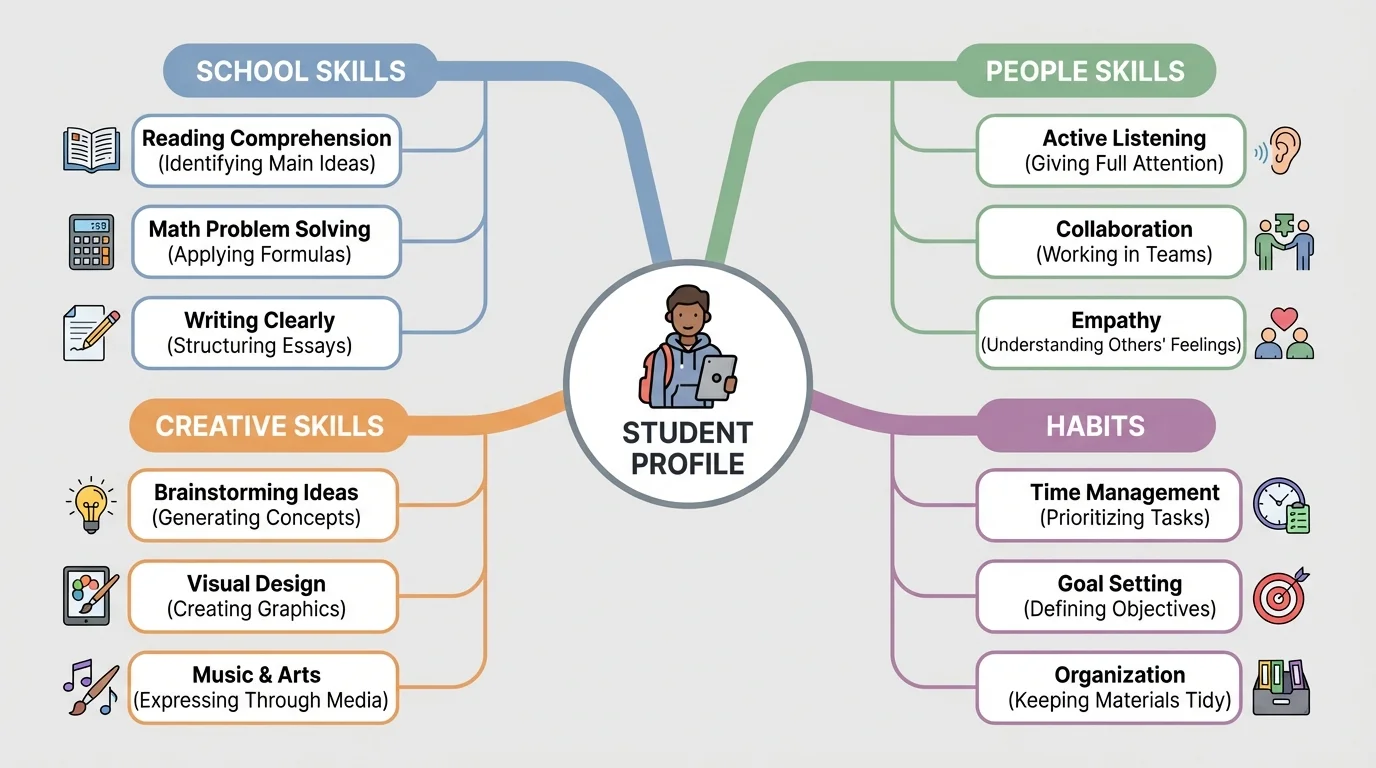
One way to find strengths is to look for patterns. Ask yourself: What feels easier for me than for many people? What do others thank me for? What do I enjoy practicing? When do I feel proud? What do I do even when nobody reminds me?
Another way is to think about real situations. Maybe during an online science project, you were the one who kept the team on task in messages. That shows leadership and organizational skills. Maybe when learning a game or recipe at home, you followed directions carefully and fixed mistakes without giving up. That shows persistence and problem-solving. Strengths often show up in ordinary moments.
Real-life strength example
Sofia thinks she does not have many strengths because math feels hard. But when she looks closely, she notices that she always remembers due dates, sends respectful messages, and practices piano without being told.
Step 1: She lists things people often notice about her.
Her parent says she is dependable. Her music teacher says she sticks with difficult songs.
Step 2: She turns those into strength words.
Dependable becomes responsible. Sticking with hard songs becomes persistent.
Step 3: She writes specific evidence.
"I usually turn in work on time, and I keep practicing even when a task is frustrating."
Now Sofia has a clearer and more accurate picture of herself.
Notice that strengths are strongest when you can support them with evidence. Instead of saying, "I am creative," you can say, "I like making slides, drawing diagrams, and thinking of new ways to explain ideas." Specific words help you use your strengths on purpose.
Your needs are the things that help you learn, focus, and feel balanced. Needs are not excuses. They are helpful information. If a plant needs sunlight and water, that does not make it weak. It just means those conditions help it grow. People are the same way.
Your needs might be about your environment. Maybe you focus better in a quiet room. Maybe background music distracts you. Maybe you need a clean workspace. Your needs might also be about time. Perhaps you work best in short blocks with small breaks. Maybe you need extra time to read directions carefully before starting.
Some needs are about emotions and energy. You may need encouragement before trying something new. You may need to ask questions when directions are unclear. You may need a short reset, like stretching, getting water, or taking deep breaths, when you feel overwhelmed.
Other needs are about task support. You may need checklists, reminders, color-coded notes, a calendar, examples to copy from, or directions broken into parts. Needing support does not mean you cannot do the task. It means you know the tools that help you do it well.
It also helps to separate a need from a preference. A preference is something you like. A need is something that strongly helps you function. For example, preferring blue notebooks is not a major learning need. But needing short instructions one step at a time may make a real difference in whether you can begin and finish a task.
Needs are clues, not flaws. When something keeps getting in your way, ask, "What support would make this easier?" Maybe the answer is a timer, a calmer work space, a snack before work time, or asking for directions in a different format. This shifts your thinking from self-blame to problem-solving.
Being honest about needs can prevent frustration. If you know that long assignments feel overwhelming, you can split them into smaller parts before stress builds up. If you know that you forget details after hearing them once, you can write them down right away. These are smart actions, not signs of weakness.
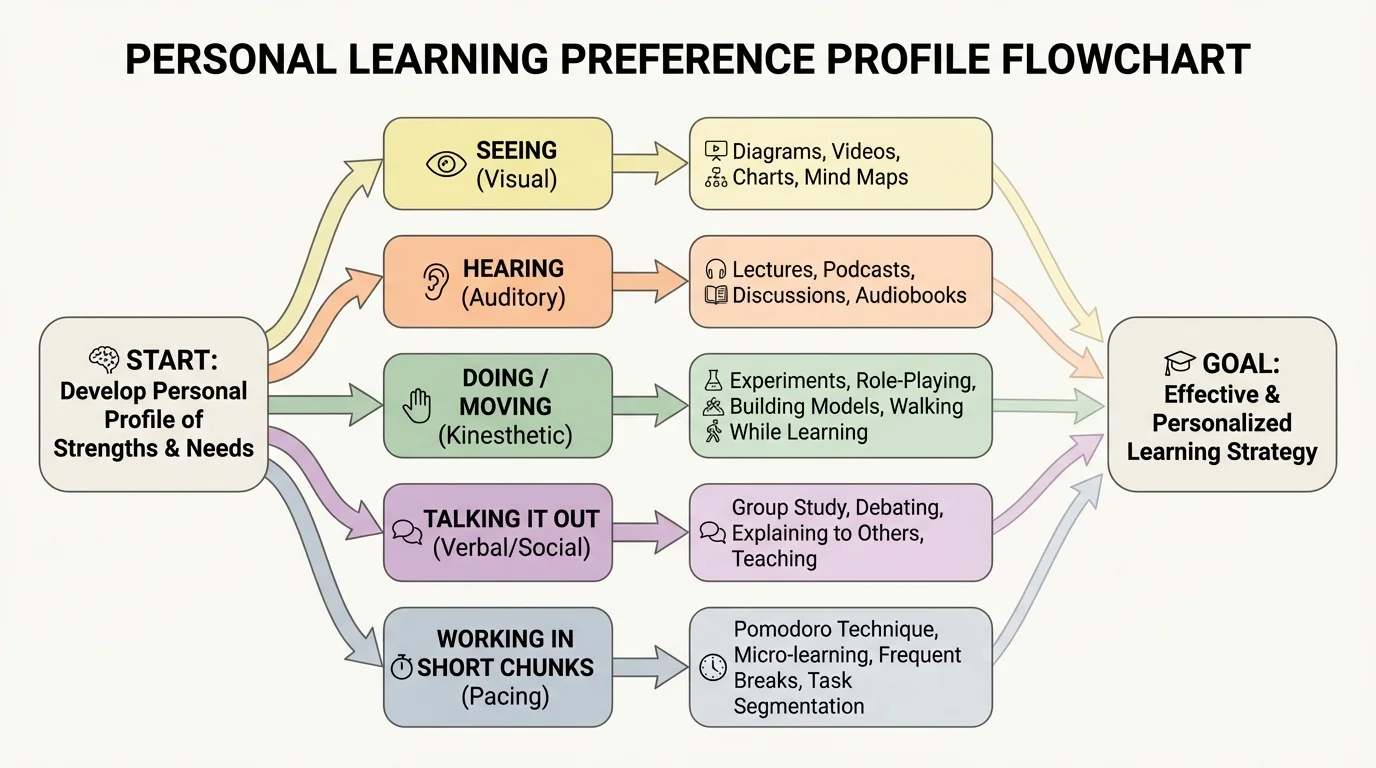
Your learning preferences are patterns in how you often like to understand and remember information. They are not strict rules. You can learn in many ways, but some ways may feel more natural or helpful for you, as [Figure 2] illustrates.
Some students like to see information. They learn well from diagrams, highlighted notes, maps, charts, or watching someone model a task. Some like to hear information. They remember better when they talk through ideas, listen to explanations, or repeat directions aloud.
Some students like to do things while learning. They want to build, test, sort, click, practice, or try the steps themselves. Others learn well by moving, such as pacing while reviewing flashcards, stretching during breaks, or acting out steps. Some prefer learning in short chunks instead of one long session.
You might also notice social preferences. Maybe you think best alone first, then share ideas later. Maybe you understand more when you talk through a problem with a family member or club teammate on a call. Learning preferences can include whether you like quiet independent work, discussion, hands-on practice, or a mix.
The key is to observe what actually helps, not just what feels easiest at first. For example, watching videos may feel fun, but if you forget everything afterward, videos alone may not be enough. You may need to pause, take notes, and practice. A useful preference is one that helps learning stick.
Here are some clues. If you often doodle diagrams to understand ideas, visual learning tools may help. If you remember songs or spoken directions, audio tools may help. If you get restless during long lessons but focus better after moving, short movement breaks may be important. As with [Figure 2], many students have a mix of preferences, not just one.
| Preference pattern | What it may look like | Helpful strategy |
|---|---|---|
| Seeing | You like diagrams, color, and examples you can look at. | Use charts, highlight key words, sketch ideas. |
| Hearing | You remember spoken explanations or like to talk things out. | Read notes aloud, discuss ideas, use audio when possible. |
| Doing | You learn by trying steps yourself. | Practice right away, use models, follow along actively. |
| Moving | You focus better when your body is not still too long. | Take short movement breaks, pace while reviewing. |
| Chunking | You do better with smaller pieces of work. | Break tasks into mini-goals with a timer. |
Table 1. Common learning preference patterns and strategies that match them.
No preference is better than another. The goal is not to prove you are a certain "type." The goal is to notice what helps you learn well so you can use it on purpose.
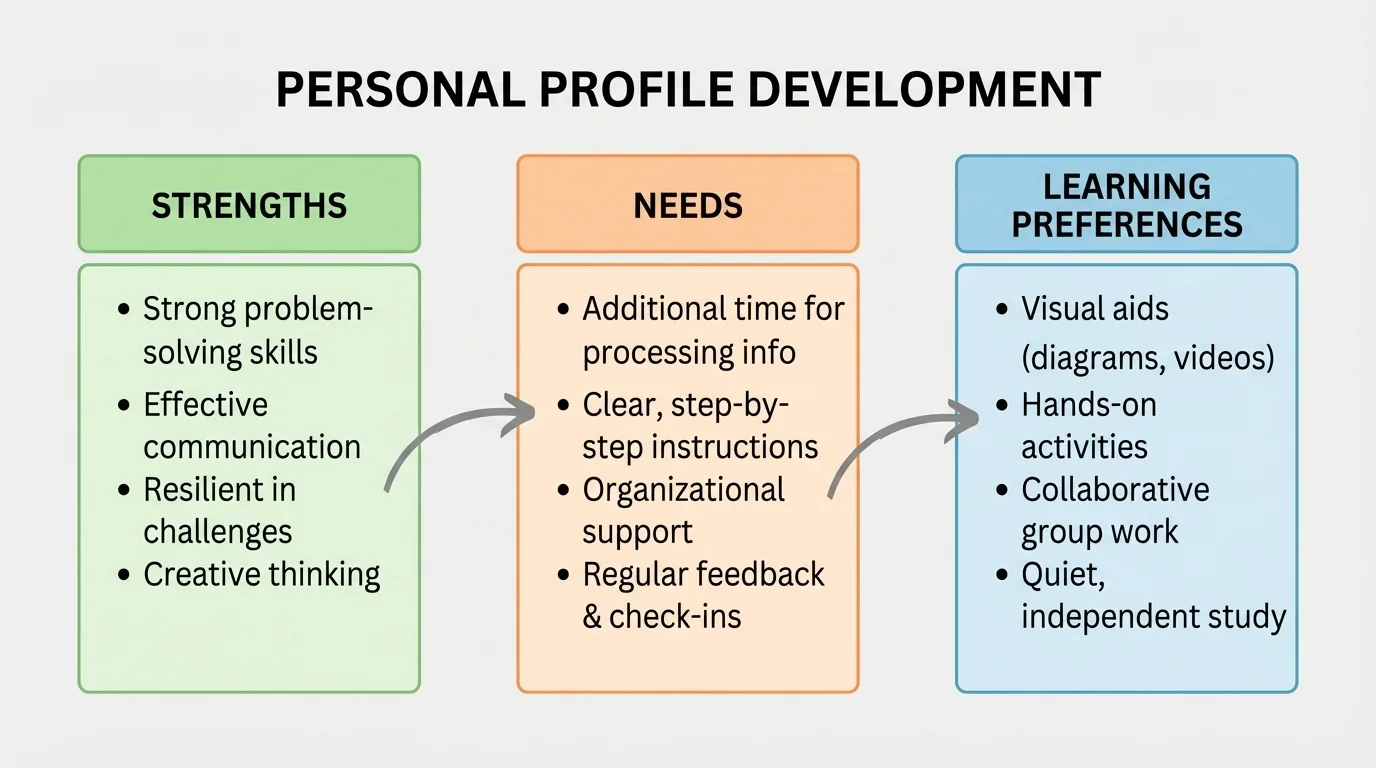
Once you know your patterns, you can organize them into a clear personal profile. A good profile has three main parts, and [Figure 3] shows how those parts fit together on one page: strengths, needs, and learning preferences.
Step 1: Write down at least a few strengths. Include skills, habits, and personal qualities. Try to use evidence. For example: "I am good at noticing details in instructions," "I stay calm when plans change," or "I enjoy helping others solve problems."
Step 2: Write down your needs. Think about what helps you focus, begin tasks, stay organized, and manage stress. For example: "I need a checklist for big assignments," "I work better in a quiet place," or "I need short breaks during long tasks."
Step 3: Write down your learning preferences. Be practical. For example: "I remember more when I draw or color-code notes," "I learn well when I can talk through ideas," or "I understand best when I practice right after watching an example."
Step 4: Add helpful actions. This is what makes the profile useful. If you know you need chunked work time, write: "I will set a timer for short work sessions." If you learn best by hearing information, write: "I will read directions aloud or ask to hear them explained."
Step 5: Keep your words kind and honest. A profile should describe you without putting you down. Instead of "I'm terrible at staying focused," write, "I focus better with fewer distractions and clear mini-goals."
Sample personal profile
Here is a short example of what a profile might sound like:
Strengths: I am curious, I ask good questions, and I keep trying when work is challenging. I am also respectful in messages and video calls.
Needs: I need big tasks broken into smaller parts. I work better in a quiet spot and do best when I can check directions more than once.
Learning preferences: I learn best when I see examples and then try the steps myself. Talking through ideas also helps me remember.
This kind of profile is short, clear, and useful.
Your profile does not need to be long. Even a few strong sentences can help a lot. What matters most is that it sounds true and gives you something you can use.
A personal profile becomes powerful when you use it. In online learning, it can help you plan your day. If your profile says you focus best in the morning, do harder work then. If it says you need movement, build short stretch breaks into your schedule. If it says you learn by seeing examples, look for diagrams or create your own notes.
It can also help you communicate. You might tell a parent, "I need help breaking this project into steps." You might tell a club leader, "I do best when I know the plan ahead of time." You might tell a teammate in an online group, "I'm strong at organizing tasks, so I can help make the checklist."
Notice how this connects back to the three-part structure in [Figure 3]. Your strengths help you contribute, your needs help you protect your energy and attention, and your preferences help you choose smart strategies.
Using your profile can also improve confidence. Confidence does not mean believing you can do everything easily. It means knowing how to approach challenges. A student who knows, "I need to see one example first," can start with a plan instead of panic.
People who are good at self-awareness often make better choices because they notice patterns early. They can catch problems sooner and use strategies before stress grows.
There are real consequences here. When you use your profile well, you may waste less time, feel less frustrated, ask for better help, and do stronger work. When you ignore your patterns, you may keep using methods that do not fit you, which can make tasks feel harder than they need to be.
Your profile is not permanent. As you get older, your strengths can grow, your needs can change, and your preferences can shift. A strategy that worked last year may not fit this year. That is normal.
For example, maybe you used to need someone to remind you about every task, but now you can manage a digital calendar on your own. Maybe you used to dislike discussion, but now you enjoy talking through ideas. Maybe a new hobby, like coding, art, sports, or music, shows strengths you had not noticed before.
A good habit is to check your profile every so often and ask: What still sounds true? What has changed? What new strategy is helping me now? Self-awareness grows with practice.
"Knowing yourself is the beginning of growing yourself."
The more clearly you understand yourself, the easier it becomes to make choices that fit who you are and who you are becoming.
