One video, one post, or one message can sound very convincing, even when it is wrong. That matters because information about your body, your feelings, your friendships, your boundaries, and your safety can affect real choices you make every day. Good information can help you stay safe and healthy. Bad information can confuse you, scare you, or push you toward unsafe choices.
As you grow, you will hear advice from family members, websites, videos, games, group chats, social media, and other people in your community. Some of that advice will be helpful. Some will be opinions. Some will be completely false. A big life skill is learning how to pause and ask, "Can I trust this?"
This is especially important in topics like healthy relationships, consent, personal boundaries, body safety, emotional health, and basic health care. These are not topics where you should just guess. You deserve clear, safe, truthful information from people and places that are knowledgeable about the topic.
Reliable information helps you make better decisions. If you know where to find trustworthy advice, you are more likely to speak up when something feels wrong, get help when you need it, and avoid unsafe situations. You are also less likely to fall for rumors, tricks, or pressure from others.
Think about two different situations. In the first, a kid reads a random post saying, "If someone asks you to keep a secret about touching, don't tell or you'll get them in trouble." That is dangerous advice. In the second, a kid learns from a trusted safety source that unsafe touching should always be reported to a trusted adult. That information protects them. The source makes a huge difference.
"If information affects your safety, your body, or your feelings, it is worth checking carefully."
Reliable sources are not just for emergencies. They also help with everyday growth, like learning how to handle strong feelings, how to treat others with respect, how to set boundaries, how to ask for consent, how to stay safe online, and how to take care of your health.
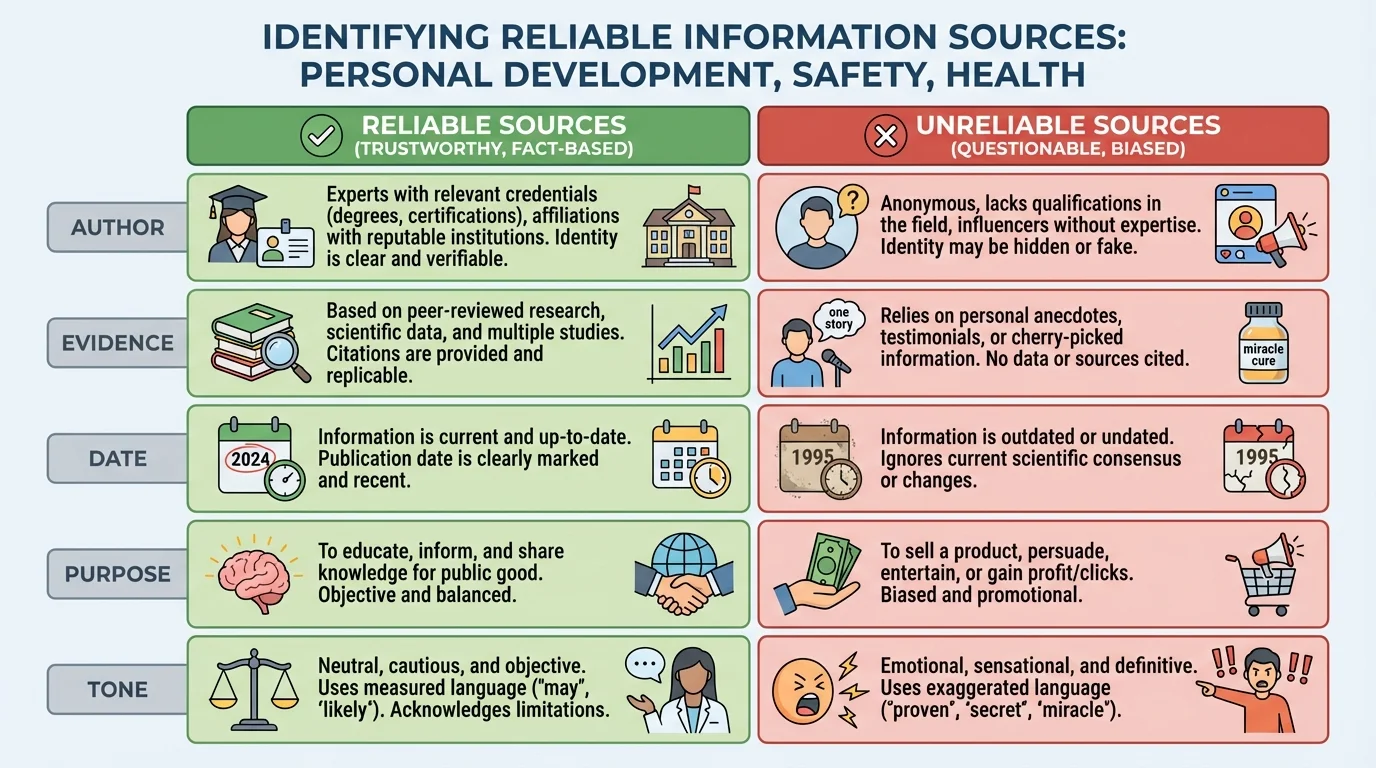
A source is where information comes from. A source might be a person, a book, a website, a video, or an organization. Some sources are much more trustworthy than others. You can look for clues that show whether a source is dependable, as [Figure 1] illustrates with a side-by-side comparison.
A reliable source gives information that is accurate, safe, and based on real knowledge. Reliable sources often include facts, evidence, or expert advice. They do not try to trick you with fear, fake drama, or wild promises. They usually tell you who created the information and why.
Reliable information is especially important when the topic is your body, health, or safety. If someone gives advice about medicine, injury, private body parts, online safety, or relationships, that advice should come from someone with real experience or training, not just a random opinion.
Reliable source means a person or place that gives information you can trust because it is accurate, current, and based on real knowledge or evidence.
Evidence means facts, examples, research, or proof that support a claim.
Expert means a person with special training, experience, or knowledge in a topic.
You do not need to become a detective every time you read something. But you do need to notice a few important signs. Ask: Who made this? How do they know? Is the information current? Is it trying to help, or is it trying to shock, sell, or pressure?
One of the best sources for kids your age is a trusted adult. This could be a parent, guardian, older family member, doctor, homeschool teacher, counselor, youth group leader, coach, or another safe adult who listens, takes concerns seriously, and wants to protect your well-being.
For health questions, medical professionals are important. Doctors, nurses, pharmacists, and counselors are trained to give safe advice. If you are worried about pain, illness, your body changing, sleep, food, exercise, or mental health, these professionals are better sources than random posts or comments online.
Official organizations can also be reliable. These may include children's hospitals, government health departments, well-known health organizations, and safety groups. Their websites are usually designed to educate people, not just to get clicks or likes.
Books and articles written by experts can be helpful too, especially when they are recent and made for kids or families. A well-made children's health book is usually much more dependable than a dramatic video made by someone you know nothing about.
Some websites look professional even when their information is poor. A fancy design does not prove the facts are true. You still need to check who made the site and whether trusted experts agree with it.
You can also use more than one trusted source. If a doctor, a children's hospital website, and a trusted adult all say the same thing, that is a strong sign the information is dependable.
Some warning signs are easy to notice once you know what to watch for. One red flag is when there is no author listed. If you cannot tell who made the information, it is harder to trust it.
Another red flag is when the source uses fear or pressure. For example, a video might say, "Share this right now or you are in danger," or "Never tell an adult about this." Safe, honest information does not usually try to rush you, scare you, or isolate you.
Be careful with sources that make extreme promises, such as "This one trick fixes every problem" or "This secret method works for everyone." Real health and safety advice is usually more careful than that. It explains that different people and situations may need different help.
A source may also be unreliable if it mixes facts with jokes, rumors, dares, or challenges. For example, an online challenge that tells kids to do risky things is not a safe source, even if many people are talking about it.
Watch out for messages that tell you to keep a secret about body safety, touching, threats, or harm. In healthy relationships, there is a difference between a fun surprise and a harmful secret. A surprise is something safe that will be shared later, like a birthday card. A harmful secret is something that makes you feel worried, trapped, or unsafe.
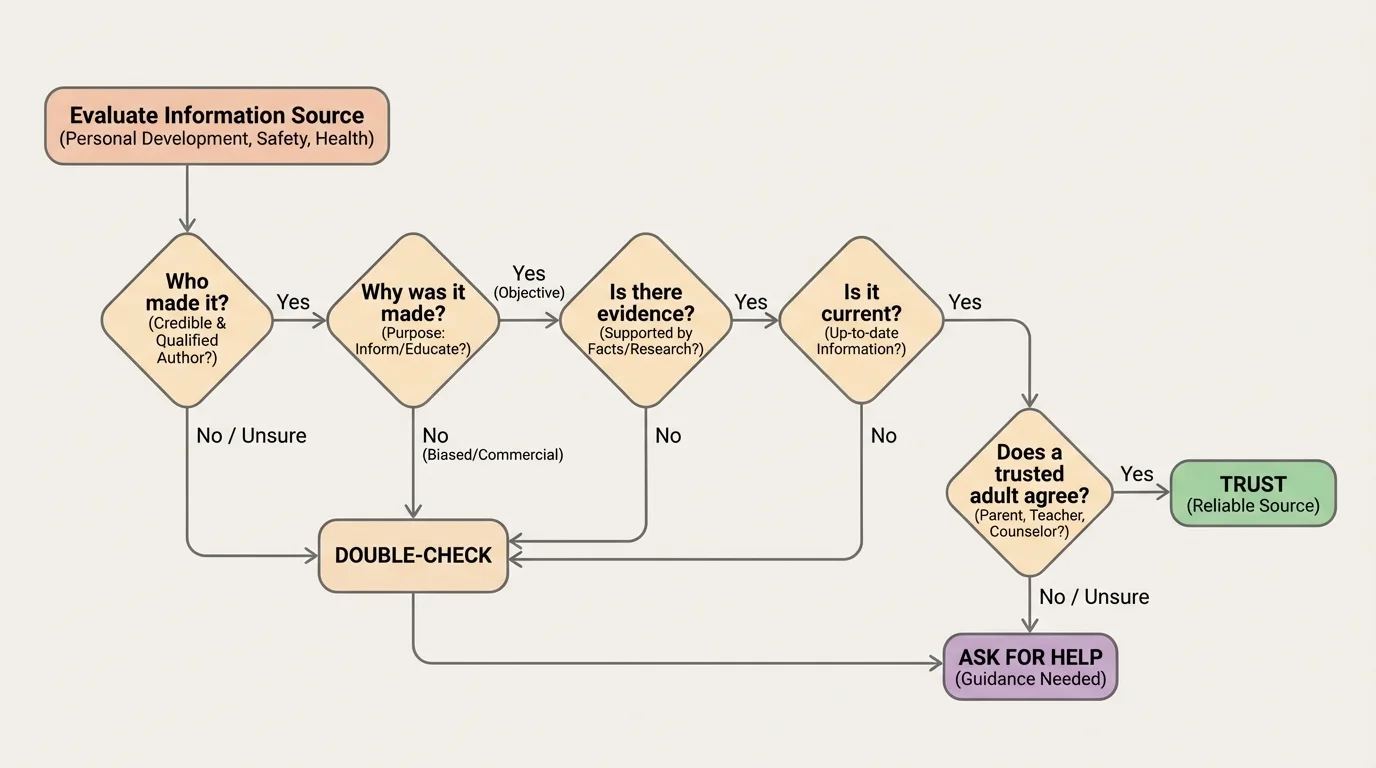
When you find information about personal growth, safety, or health, use a quick checking system. It works like a path with a few important questions, as [Figure 2] shows. You do not need to memorize technical terms. You just need a calm, smart routine.
Step 1: Ask who made it. Is it from a doctor, a hospital, a government health group, a trusted adult, or another trained expert?
Step 2: Ask why it was made. Is it trying to teach and protect, or is it trying to get attention, money, or clicks?
Step 3: Check whether it gives evidence. Does it explain where the information came from? Does it match what other trusted sources say?
Step 4: Check whether it is current. Some health or safety advice changes over time. Newer information from trusted sources is often better than old advice.
Step 5: If the topic is important or confusing, ask a trusted adult before you act on it or share it.
Example: Checking a video about online safety
Step 1: You see a video saying, "If a stranger online asks for a picture, just send one that does not show your face."
Step 2: You ask who made it. The account is unknown and gives no safety training or expert background.
Step 3: You ask whether the advice matches trusted safety rules. It does not. Sharing personal pictures with strangers is unsafe.
Step 4: You check with a trusted adult and a child safety website. Both say not to share photos and to report the message.
The video is not reliable, and checking the source helps keep you safe.
This same system works for many topics. You can use it for advice about friendship problems, body changes, internet rules, bullying, stress, sleep, or rumors about health.
Personal development means growing in how you understand yourself, handle feelings, make choices, treat others, and build healthy habits. Good sources can help you learn how to calm down when upset, apologize sincerely, set boundaries, and show respect.
Reliable personal development information often comes from trusted adults, counselors, youth programs, books by experts, and child-friendly health or family websites. These sources usually teach skills like naming emotions, solving conflicts, and asking for help.
Be careful with advice that tells you to be rude, controlling, or secretive in relationships. For example, if a post says, "If your friend says no, keep pushing until they agree," that is not healthy advice. Respecting another person's "no" matters. Consent and boundaries mean people get to decide what happens to their own body, space, and feelings.
Another example: if someone online says, "Real friends share every password," that is also unreliable. Healthy friendships do not require you to give up your privacy or safety.
Healthy advice supports respect. Information about relationships and boundaries is more trustworthy when it teaches kindness, honesty, safety, and respect for each person's choices. Advice that encourages pressure, guilt, threats, or control is a warning sign.
As you saw earlier in [Figure 1], tone also matters. Reliable sources usually sound calm and clear. Unreliable ones often sound bossy, dramatic, or manipulative.
Safety information includes body safety, online safety, home safety, and relationship safety. You need trustworthy advice so you know how to protect yourself and what to do if something feels wrong.
Reliable safety sources teach clear actions. They may tell you to leave an unsafe conversation, block and report harmful messages, tell a trusted adult, call for help, or move to a safe place. Good safety advice is practical.
For body safety, reliable sources explain that your body belongs to you. Safe adults do not ask kids to keep secrets about touching. If someone touches you in a way that feels wrong, asks to see private parts, shows you sexual content, or asks you to do something that makes you uncomfortable, you should tell a trusted adult right away.
For online safety, reliable information teaches you not to share personal details like your address, passwords, or private photos. It also teaches you to be careful with links, strangers, and messages that feel suspicious, pushy, or threatening.
When safety advice is real and trustworthy, it gives you choices that protect you. It does not blame you for another person's bad behavior. That is a very important clue.
Example: A boundary problem in a chat
Step 1: Someone in an online gaming chat keeps asking personal questions after you said you do not want to answer.
Step 2: You remember that reliable safety advice says boundaries should be respected.
Step 3: You stop replying, block the person if needed, take screenshots if it is safe to do so, and tell a trusted adult.
Using reliable information helps you act quickly and safely.
The checking system in [Figure 2] helps here too. If a stranger gives advice that says not to tell adults, that fails the safety check immediately.
Health information includes advice about your body, hygiene, illness, food, movement, sleep, feelings, and medical care. Because health affects your body, this is one area where guessing can be risky.
Good health information often comes from doctors, nurses, counselors, children's hospitals, official public health websites, and trusted caregivers. These sources explain things clearly and safely. They also remind you that every person is different and that serious concerns should be checked by a professional.
For example, if you have a rash, severe pain, trouble breathing, a fever that worries your caregiver, or a mental health concern like feeling hopeless, the best response is not to trust random advice online. The best response is to tell a trusted adult and get help from a health professional.
Reliable health information can also help with everyday habits. It can teach you why washing hands matters, why sleep helps your brain, why food and water matter, and why movement helps your body. Good health sources are usually realistic. They do not shame you, and they do not promise magical cures.
| Topic | More Reliable Source | Less Reliable Source |
|---|---|---|
| Feeling worried a lot | Trusted adult, counselor, doctor | Anonymous comment section |
| Question about body changes | Doctor, nurse, children's health site | Rumor from another kid |
| Online safety problem | Trusted adult, child safety organization | Stranger in a game chat |
| Friendship or boundary issue | Trusted adult, counselor, expert article | Influencer encouraging pressure |
Table 1. Examples of more reliable and less reliable sources for common personal development, safety, and health situations.
Sometimes the best answer is not a website at all. Sometimes the best answer is, "I need to talk to a real adult who can help me." That is a smart choice, not a weak one.
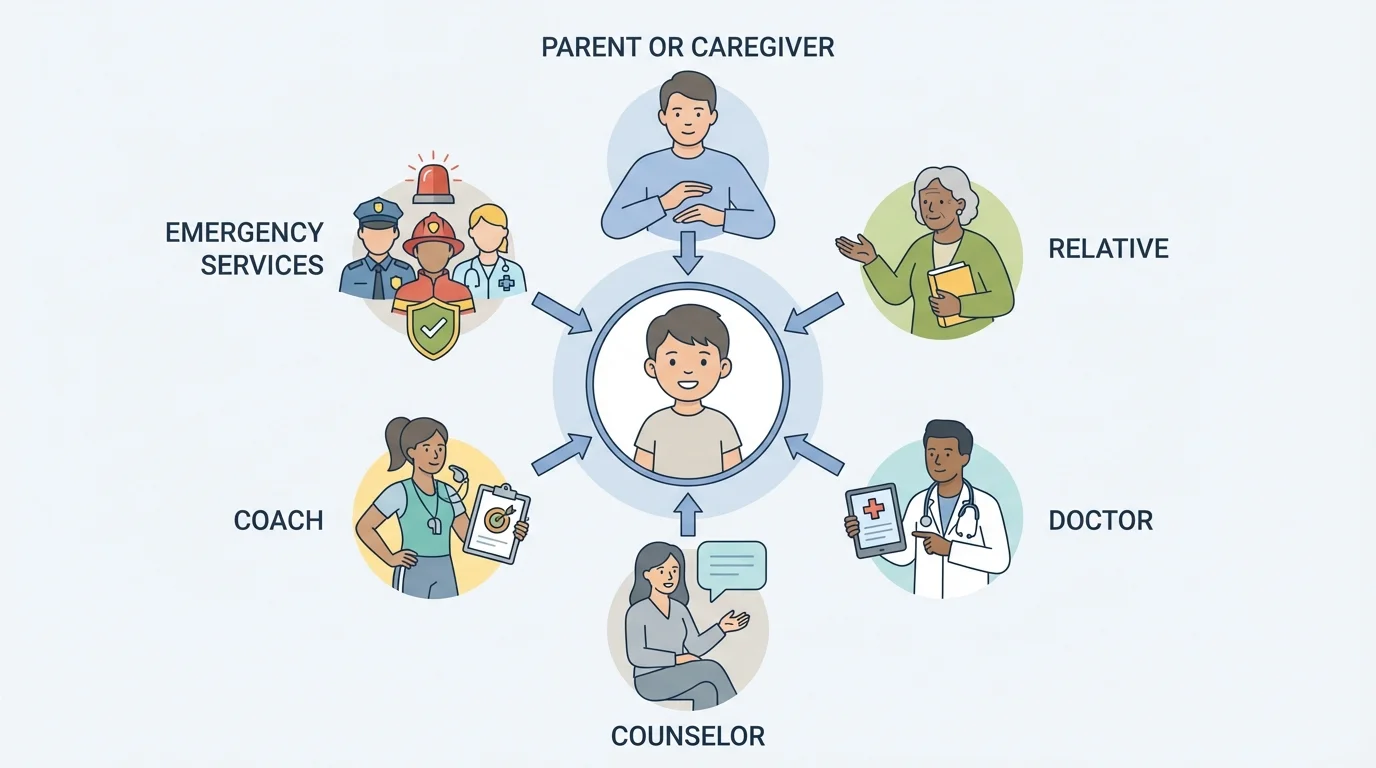
Some situations should not wait. If someone threatens you, asks for sexual pictures, touches you in an unsafe way, talks about hurting you, tells you to hurt yourself, or if you have a medical emergency, you need help right away. In these moments, your support circle matters, as [Figure 3] shows.
Your support circle can include a parent or caregiver, grandparent, aunt or uncle, neighbor you know well, doctor, counselor, coach, youth leader, or another safe adult. Pick adults who listen, stay calm, and take action to protect you.
If the first adult does not listen, tell another one. Keep telling until someone helps. Your safety matters more than someone else's comfort.
You never have to handle unsafe touching, threats, or scary health concerns by yourself. Asking for help is part of being safe and strong.
It helps to practice what you might say. You can say, "I saw something online that made me uncomfortable." Or, "Someone is not respecting my boundary." Or, "My body does not feel right and I need help." Short, clear words are enough.
Later, when you think about your support circle again, notice that you do not need a huge list. You just need a few safe people you can contact quickly.
You can build this skill a little at a time. Before believing something important, pause. Before sharing it, check it. Before following risky advice, ask a trusted adult.
Here are some smart habits you can use often:
These habits help in big moments and small ones. They can protect your health, help you handle friendship problems, and make it easier to set boundaries with confidence.
As the comparison in [Figure 1] and the decision path in [Figure 2] remind you, reliable information is usually clear, respectful, current, and backed by real knowledge. That is the kind of information worth trusting.
