One smart question can save you from making a confusing choice. If you only ask, "Is this school good?" or "Is that job fun?" you might get a quick answer, but not a very helpful one. Strong questions help you look deeper. They help you find out what daily life is really like, what responsibilities people have, and what support you might need. When you ask good questions, you are not being nosy. You are being prepared.
As you grow up, you will make more decisions about learning, work, and how you live. You do not have to decide everything now. But you can start learning how to explore choices. A good explorer does not just look around. A good explorer asks questions, listens carefully, and notices patterns.
If you ask weak questions, you may miss important details. For example, a student might hear that a program is "great" but not learn that it needs many hours of homework each week or special technology at home. A person might think a career sounds exciting but not realize it includes long shifts, teamwork, or lots of problem-solving. Questions help you avoid surprises.
Exploring options means learning about different choices before you make a decision. Open-ended questions are questions that cannot be answered with just "yes" or "no." They help you get fuller, more useful answers.
When you explore the future, you are really exploring three connected areas: learning, working, and living responsibly. School helps prepare you for later choices. Careers are ways people use skills to work and earn money. Adult roles include everyday responsibilities like managing time, taking care of health, helping a household, and being a good community member.
Post-secondary education or training includes any learning after high school. That can include college, trade school, job training, apprenticeships, certificate programs, and other ways to keep learning. Right now, you are not choosing one. You are learning how to ask about these options.
A career is more than one job on one day. It is a path of work someone grows in over time. A person might start in one role, learn new skills, and move into another role later.
An adult role is a responsibility or part a grown person has in life. Someone might be a worker, parent, neighbor, volunteer, renter, driver, or team leader. One adult can have many roles at the same time.
These three areas connect. If you understand school options, you can see how learning leads to work. If you understand careers, you can see what skills people need. If you understand adult roles, you can see that life is not only about earning money. It is also about responsibility, choices, and helping others.
Many adults work in jobs today that did not exist when they were children. That is one reason learning how to ask good questions matters so much: the future keeps changing.
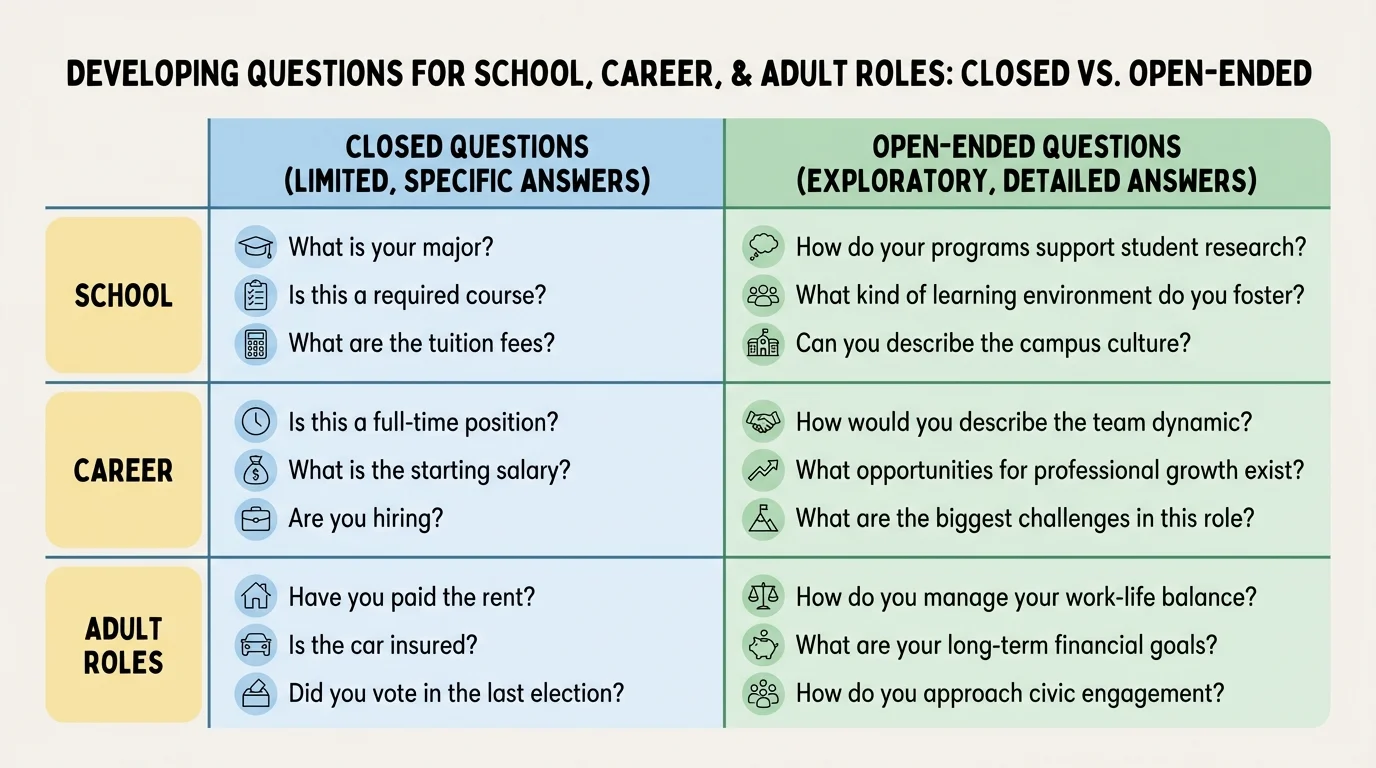
Some questions open a tiny door. Others open a whole room. Strong questions often begin with words like what, how, why, when, and which. Open-ended questions help you gather details, as [Figure 1] shows when comparing simple yes-or-no questions with stronger ones.
For example, instead of asking, "Is this school hard?" you could ask, "What kinds of assignments do students usually complete each week?" Instead of asking, "Do you like your job?" you could ask, "What do you do most days in your job, and what part is most challenging?" Instead of asking, "Is adult life busy?" you could ask, "How do adults balance work, chores, money, and family time?"
Another helpful tool is the follow-up question. A follow-up question is asked after someone answers. It helps you dig deeper. If someone says, "I like my job because it helps people," you can ask, "How do you help people during a normal day?" or "What skills do you need to do that well?"
You can also use question frames. These are sentence starters that make it easier to think. Here are some useful ones:
Using question frames does not make your questions fake. It makes them stronger. Just like builders use tools, curious people use question starters.
When you explore schools or training programs, it helps to group your questions by topic. That way, you do not forget important areas like learning style, support, and schedule, as [Figure 2] illustrates.
Start with questions about learning. You might ask: "What subjects or skills does this program focus on?" "How do students learn in this program?" "What kinds of projects or assignments do students complete?" "How much independent work is expected?" These questions help you understand what learning will actually feel like.
Next, ask about support. Good support matters. Questions could include: "How do teachers or mentors help students when they are stuck?" "What happens if a student needs extra help?" "Are there counselors, tutors, or advisors?" "How do students ask questions online?" Support can make a big difference when work gets challenging.
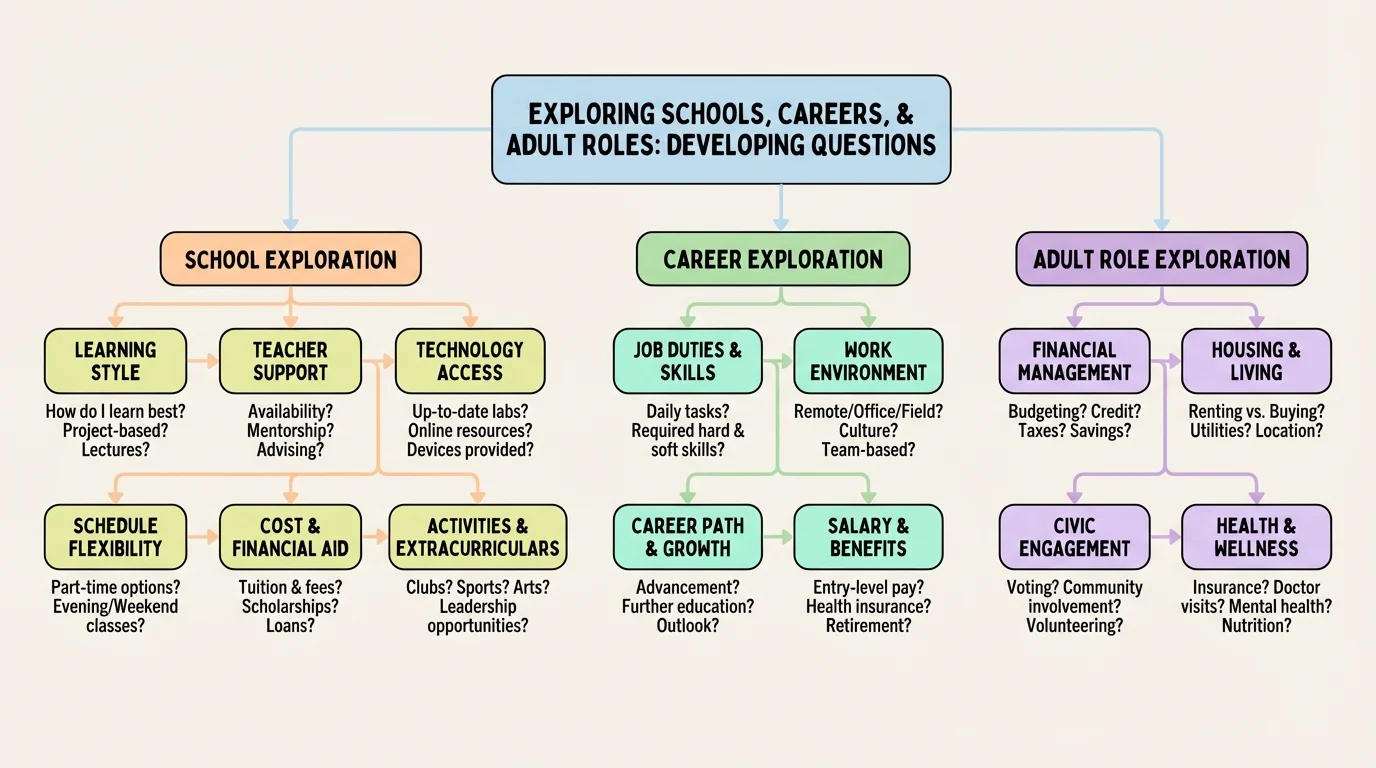
Then ask about schedule and time. Some programs take many hours each week. Some are flexible. Some have deadlines that must be met at certain times. You could ask: "How much time should students plan for each week?" "Is the schedule flexible or fixed?" "What happens if someone falls behind?" "How do students stay organized?"
It is also smart to ask about technology and materials. Since learning often happens online or with digital tools, ask: "What device or software is needed?" "Do students need strong internet access?" "Are special supplies required?" "Is technical help available?"
Another important topic is cost. Even if you are not paying for school now, learning to ask about money is a life skill. Questions might include: "How much does the program cost?" "Are there scholarships or financial aid?" "What extra costs might families need to know about?"
Do not forget community and activities. Even in online learning, connection matters. Ask: "How do students work together?" "Are there clubs, teams, competitions, or community projects?" "How do students build friendships or networks?"
Finally, ask yourself a few personal questions too: "Does this fit how I learn best?" "Would I feel supported here?" "Does this help me move toward my goals?" A school may be a great choice for one student and not the best match for another.
Example: Turning a general school question into stronger questions
Weak question: "Is this a good program?"
Step 1: Break "good" into parts.
Ask what "good" means to you. It might mean helpful teachers, flexible scheduling, interesting classes, or reasonable cost.
Step 2: Turn each part into a clear question.
You could ask: "How do teachers give feedback?" "How much work is due each week?" "What classes are offered?" "What costs should families expect?"
Step 3: Add a follow-up question.
If someone says, "Teachers are very supportive," you can ask, "What does that support look like during a busy week?"
Now you have questions that can lead to useful facts instead of a vague opinion.
Notice how the categories help you cover more than one part of school life. This keeps you from focusing on only one thing, like whether a program sounds fun, and forgetting something important, like time or support.
Career questions should help you understand real work, not just a job title. A title like engineer, chef, nurse, designer, mechanic, coder, or counselor does not tell you everything. You need to know what people do, what skills they use, and what challenges they face.
Start with daily tasks. Ask: "What do you do on a normal day?" "What tools or technology do you use?" "Do you work alone or with a team?" "Do you spend more time indoors, outdoors, online, or traveling?" These questions paint a picture of daily life.
Ask about skills and strengths. Try: "What skills help a person do this job well?" "What school subjects connect to this career?" "What personal qualities matter, like patience, creativity, focus, or communication?" This helps you see whether a career matches your growing strengths.
Ask about training. Some jobs need college degrees. Others need certificates, apprenticeships, practice, or licensing. You could ask: "What training is needed for this career?" "How long does that training usually take?" "Are there different pathways into this field?"
Ask about challenges. Every career has hard parts. Questions like "What is stressful about this work?" "What problems do you solve most often?" and "What mistakes do beginners make?" can teach you a lot. Honest answers are valuable.
Ask about rewards and growth. You might ask: "What do you enjoy most about your work?" "How can someone grow in this field?" "What other jobs can this career lead to later?" A career path often changes over time.
Money is part of career planning too. You do not need exact salary details right now, but you can ask smart money questions such as: "Does this job usually pay enough to live on?" "Does pay grow with experience?" "Are there benefits like health insurance or paid time off?" Learning that adults consider income, expenses, and benefits helps you understand real-world choices.
Good career questions connect dreams to daily life. It is fine to dream big, but useful questions help you test a dream against reality. If you think a career sounds exciting, ask what the workday is really like, what training is needed, and what problems people solve. That helps you move from "That sounds cool" to "I understand what this path involves."
You can ask career questions in many places: on video calls with family friends, during community events, while watching career interviews online, or when reading websites about jobs. You can even write down questions while watching a documentary or listening to a podcast. Curiosity works in many settings.
Adult roles are not just careers. Grown-ups also manage homes, relationships, health, schedules, and community responsibilities. Learning about adult roles helps you prepare for real life, not just a future job.
Ask about time management. Good questions include: "How do adults plan their day?" "How do they remember appointments and deadlines?" "What happens when work and home duties pile up?" These questions show that being responsible means planning ahead.
Ask about money management. You might ask: "What bills do adults usually pay each month?" "How do adults decide what to spend and what to save?" "What happens if someone spends without a plan?" These questions help you understand that money choices affect housing, food, transportation, fun, and future goals.
Ask about health and self-care. Adult life includes sleep, exercise, doctor visits, healthy food, and stress management. Questions could include: "How do adults take care of their health when they are busy?" "Why is rest important?" "How do adults handle stress in healthy ways?"
Ask about relationships and communication. Adults often need to solve conflicts, work with others, and speak respectfully even when they disagree. You can ask: "How do adults handle disagreements calmly?" "What makes someone a reliable friend, coworker, or family member?" "How do adults ask for help when they need it?"
Ask about community roles. Adults vote, volunteer, help neighbors, follow laws, and support local groups. Questions such as "How do adults help their community?" and "Why does it matter to be dependable?" show that adulthood is not only personal. It also involves responsibility to others.
Example: Questions for interviewing a trusted adult about adult life
Step 1: Pick one focus area.
You might choose money, health, work-life balance, or community service.
Step 2: Write three open-ended questions.
For money, you might ask: "What surprised you about paying bills?" "How do you decide what is a need and what is a want?" "What advice would you give a kid about money habits?"
Step 3: Listen for examples.
If the adult says, "Budgeting matters," ask, "Can you share a simple example of how budgeting helps?"
This kind of conversation can teach you more than one quick answer ever could.
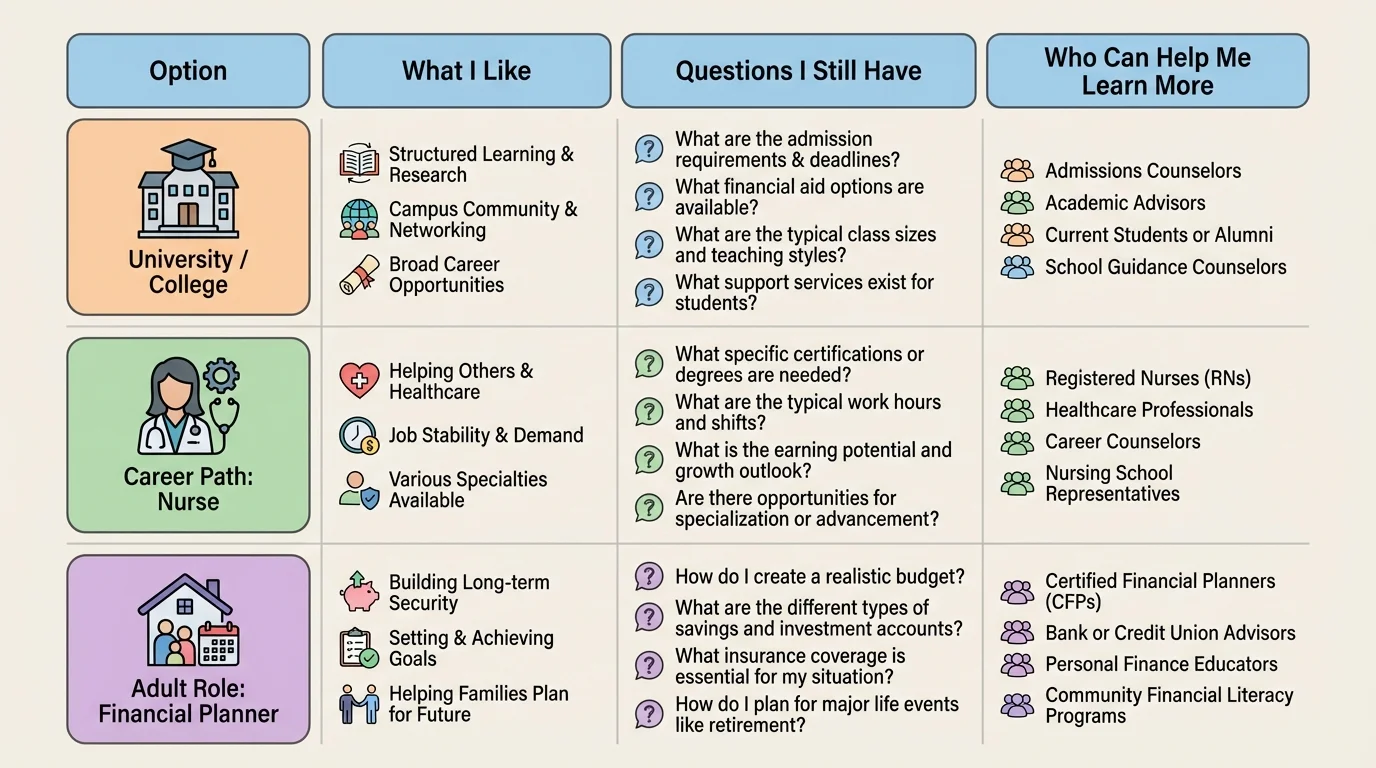
Good questions help you gather information, but you also need a way to keep track of what you learn. A simple comparison chart, like the one in [Figure 3], helps you stay organized when you explore more than one option.
You can make a list with columns such as: option, what I learned, what I like, what seems challenging, questions I still have, and who I can ask next. This works for schools, careers, and adult roles.
For example, if you compare two training programs, one may have flexible scheduling but less live support. Another may have stronger support but more fixed deadlines. If you compare careers, one may match your interests but require years of training. Another may lead to faster job entry but different daily tasks. Organized notes make those differences easier to see.
You do not need perfect notes. Short phrases are fine. What matters is that your notes help you remember. Writing things down also helps you notice patterns. If three different people in the same career mention teamwork, that is probably important. If several school programs mention self-management, that is worth noticing too.
| Topic | Helpful note to record | Possible follow-up |
|---|---|---|
| School | Amount of weekly work | How do students stay on track? |
| Career | Main daily tasks | What skills make those tasks easier? |
| Adult role | Big responsibilities | How do adults balance everything? |
Table 1. Examples of notes and follow-up questions for three exploration topics.
Later, when you look back at your notes, they can remind you that organized information makes decisions less overwhelming. You are turning lots of small answers into a clearer picture.
Asking questions is powerful, but you should do it respectfully and safely. If you contact someone online, start with a polite greeting, explain why you are asking, and keep your message short and clear. For example: "Hello, I am learning about different careers and wondered if you could answer two questions about your work."
Be patient. People may be busy. If someone answers, thank them. Good manners help build good connections.
Stay safe by protecting private information. Do not share your home address, passwords, phone number, or other personal details with people you do not know well. If you want to message or email someone, do so with the knowledge of a parent, guardian, or trusted adult. Trusted adults can also help you decide which questions are appropriate.
It is also okay if someone does not answer every question. Some people may not want to discuss pay, family matters, or private details. Respectful curiosity means understanding boundaries.
Remember: Safe communication includes using kind language, thinking before you send, checking with a trusted adult when needed, and never sharing private information carelessly.
You do not have to wait until you are much older to build this skill. You can start now by noticing the adults around you, the work people do in your community, and the kinds of learning paths that exist after high school. The more you practice asking strong questions, the more confident you become.
Try this in everyday life: when you hear about a school, career, or adult responsibility, pause and think of three questions. Make sure at least two are open-ended. Then think of one follow-up question. That tiny habit can make you a sharper thinker.
When done well, questioning leads to better decisions, stronger planning, and fewer surprises. When done poorly, people may choose based only on guesses, popularity, or one exciting detail. Asking good questions helps you look past the surface.
"Curiosity is a way of getting ready for the future."
Your future will include choices about learning, work, and responsibility. You do not need every answer today. But you can learn how to ask better questions today, and that is a powerful way to prepare.
