A lot of big problems start with tiny choices. Clicking "send," saying "yes," staying silent, joining a group chat, sharing a secret, or spending money fast can seem small in the moment. But one quick decision can affect your safety, your friendships, your time, your trust with family, and how you feel about yourself later.
Making good choices does not mean you always know the perfect answer right away. It means you slow down enough to think clearly. Strong decision-making is a life skill. You use it when a friend asks for your game password, when someone wants you to laugh at a mean joke online, when you have to choose between homework and entertainment, or when you are deciding whether to tell the truth after making a mistake.
Every day, you make many decisions without noticing: what to say, how to spend your time, what to post, how to react, and who to listen to. Some choices are small. Some are more important. But all of them help shape your habits. And habits shape your life.
If you often choose what is safe, honest, and respectful, people learn they can trust you. If you often choose what feels exciting for one minute but causes problems later, life gets harder. Decision-making is not about being perfect. It is about learning to notice what matters before you act.
Consequences are the results of a choice. Some happen right away, and some show up later.
Values are the beliefs and qualities that matter to you, such as honesty, kindness, fairness, responsibility, safety, and respect.
Social pressure is the feeling that other people want you to act a certain way, even if you are unsure it is the best choice.
When you understand these three ideas, decisions become clearer. Instead of asking only, "What do I feel like doing right now?" you can ask, "What could happen, what matters to me, and am I being pushed?"
You can make a stronger decision by checking three things, as [Figure 1] shows: the consequences, your values, and any social pressure around the situation. If you miss one of these, you may choose too quickly.
For example, a choice may seem fun until you think about consequences. Or it may seem harmless until you notice it goes against your values. Or you may think you want to do it, but then realize you only feel that way because other people are pushing you.
Good decision-makers do not just react. They pause, think, and choose on purpose.
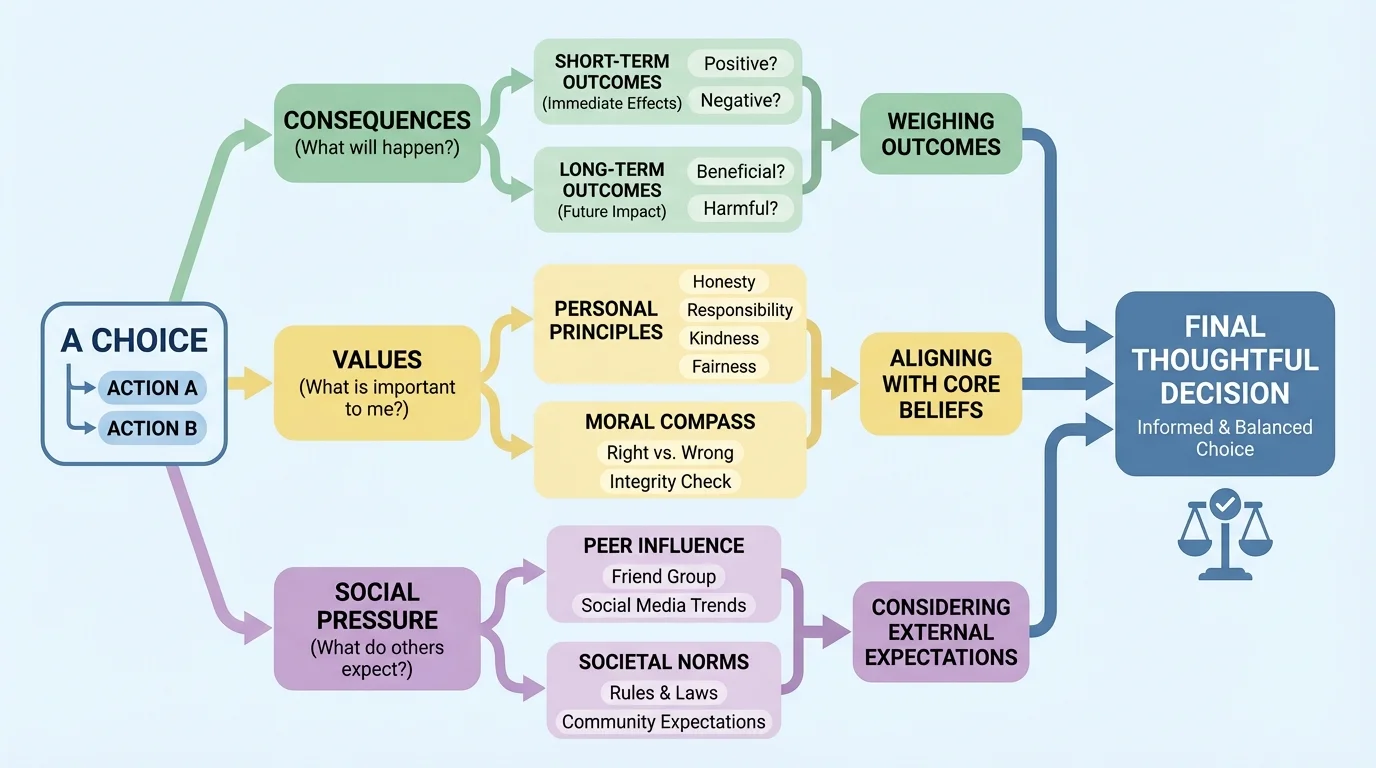
You can think of these three parts like three flashlights. One flashlight helps you see what might happen next. One helps you see what kind of person you want to be. One helps you see whether someone else is trying to steer your decision.
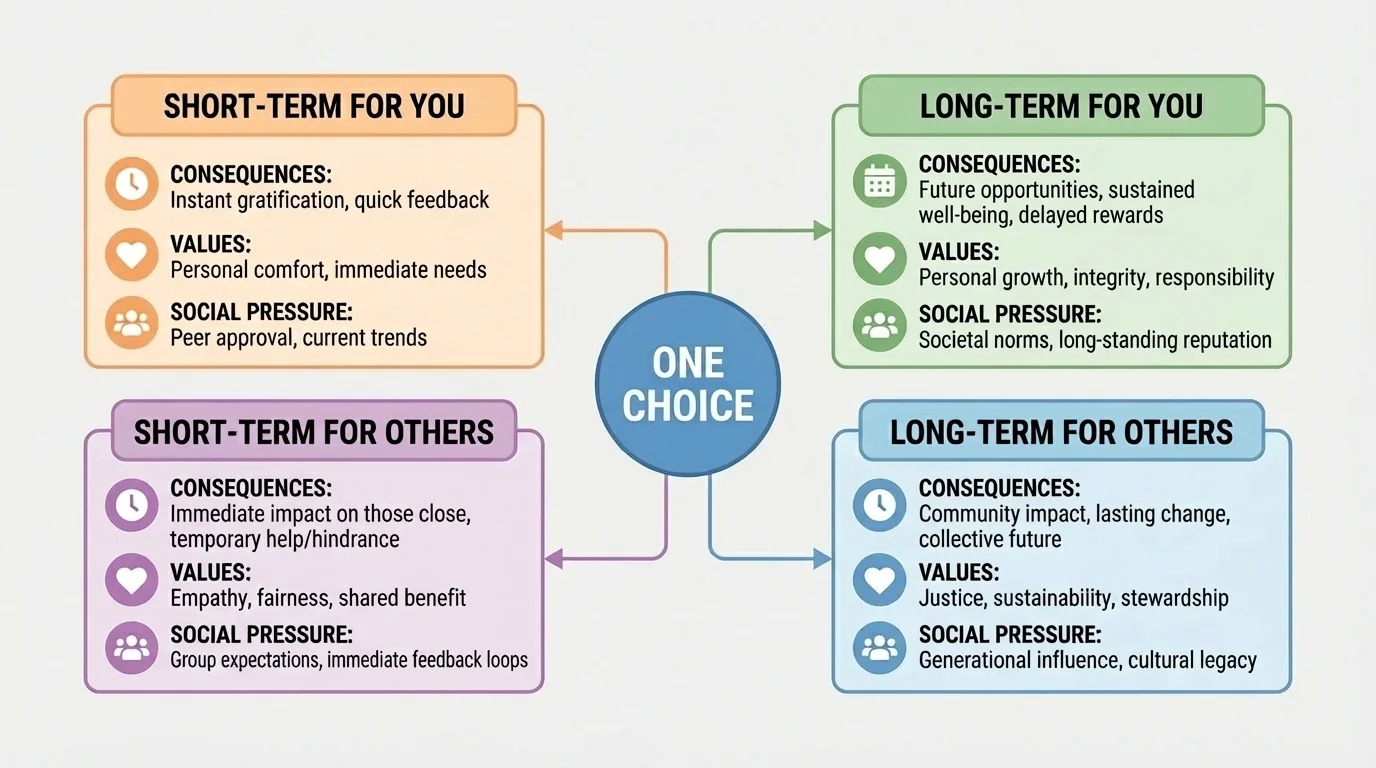
Consequences are more than what happens in the next five minutes. A smart choice looks at short-term and long-term effects, not just the fastest reward.
[Figure 2] When you think about consequences, ask four useful questions: What happens to me soon? What happens to me later? What happens to others soon? What happens to others later?
That matters because some bad choices feel good at first. For example, if you stay up very late watching videos, the short-term consequence may feel fun. But the long-term consequences may include being tired, getting behind on work, feeling stressed, and having a harder time focusing the next day.
Some consequences affect relationships. If you share a private message that was not yours to share, the short-term result might be attention from others. But the long-term result might be losing a friend's trust. Trust can take a long time to rebuild.
Consequences can also affect safety. If someone online asks you to keep a secret from a parent or trusted adult, that is a warning sign. The consequence of keeping that secret might be much bigger than it first seems.
Example: Joining a mean group chat
Step 1: Name the choice.
You are invited into a group chat where people are making fun of someone.
Step 2: Check short-term consequences.
You might feel included for a little while. Other people may react with laughs or attention.
Step 3: Check long-term consequences.
The person being targeted can get hurt. You may feel guilty. Screenshots can spread. Adults may get involved. Others may stop trusting you.
Step 4: Choose with care.
A stronger choice is to leave, not add hurtful comments, and if needed, tell a trusted adult.
One helpful habit is to ask, "How will I feel about this tomorrow?" If the answer is "embarrassed," "nervous," or "I hope no one finds out," that is important information.
Your values are like an inner guide. They help you decide even when nobody is watching. If consequences tell you what may happen, values tell you what matters most.
Common values for students your age include honesty, kindness, fairness, responsibility, courage, safety, loyalty, and respect. You may care deeply about more than one at the same time. Sometimes values work together. Sometimes they seem to clash, and that can make a decision feel harder.
For example, suppose your friend asks you to cover for them after they break a rule. You may value loyalty, but you may also value honesty and safety. A strong decision does not mean ignoring loyalty. It means asking which value should lead in that situation. If safety is involved, safety should come first.
Values help you choose your direction. Feelings can change quickly, but values are steadier. If you decide ahead of time that honesty, safety, and respect matter to you, it becomes easier to make good choices when pressure appears suddenly.
It can help to make a short personal list of values. You do not need a long speech. Just a few words can guide you: "I want to be honest. I want to be kind. I want to protect my safety. I want to respect myself and others."
When a choice feels confusing, ask: "Which option matches the kind of person I want to be?" That question often clears away a lot of noise.
Social pressure can be loud or quiet, as [Figure 3] illustrates. Sometimes someone directly says, "Come on, do it." Other times the pressure is subtle. Maybe everyone else in a chat seems to agree, and you feel weird being the only one who does not join in.
Pressure can happen in person in your community, during sports or activities, and very often online. It can show up in texts, video calls, comments, streaks, dares, trends, or posts that make you feel like you have to keep up.
One powerful kind of pressure is FOMO, which means fear of missing out. FOMO can make a risky or unkind choice seem more tempting because you do not want to feel left out.
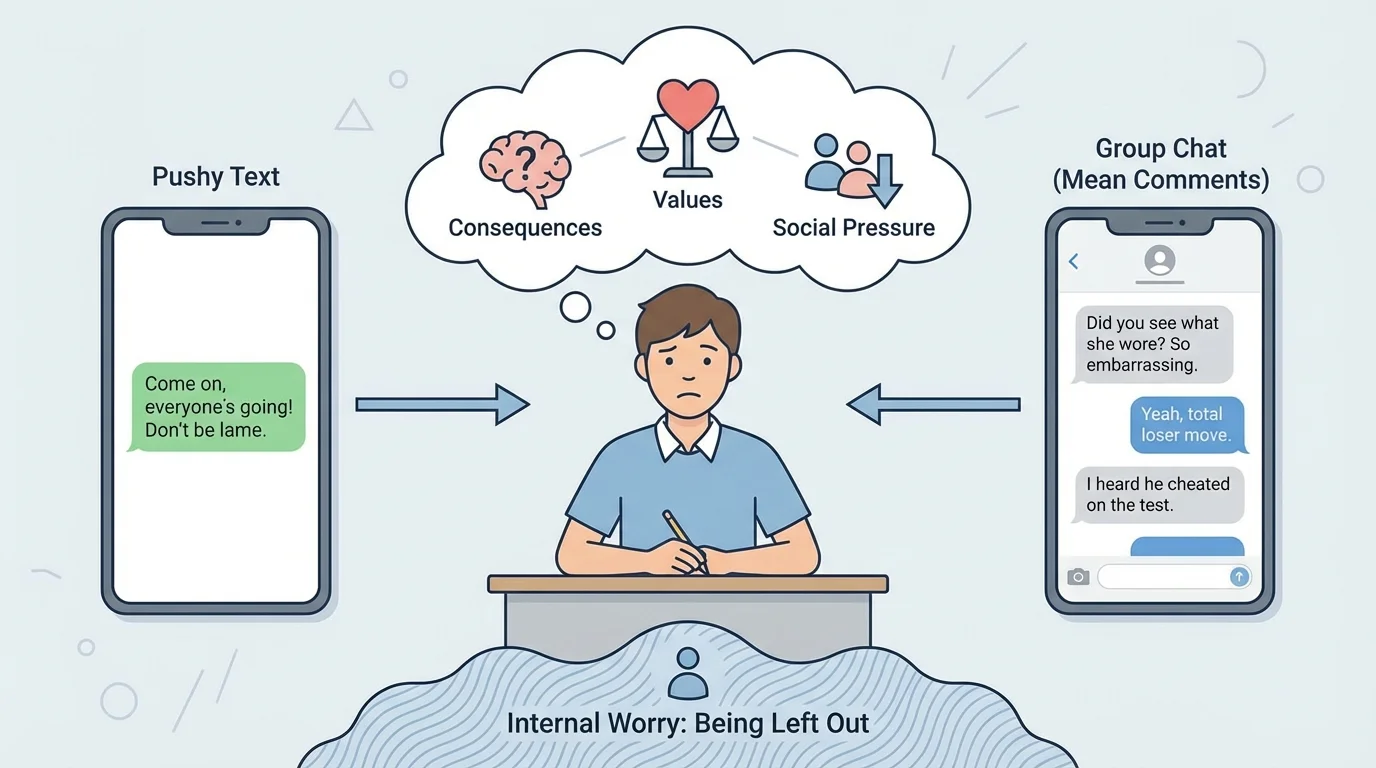
Here are some signs of social pressure: you feel rushed, you are afraid people will laugh at you, someone says "everyone is doing it," someone tells you to keep it secret, or you know you would not make this choice if you were alone.
Pressure is not always bad. People can pressure each other in positive ways too, like encouraging a teammate not to quit or reminding a friend to be respectful. But if pressure pushes you toward dishonesty, disrespect, danger, or regret, it is a signal to stop and think.
Your brain often reacts strongly to social approval, which is one reason being included can feel so important. That is normal, but it also means you need tools to notice when that feeling is steering your choices too much.
A useful question is: "If nobody else knew what I chose, would I still choose this?" If the answer is no, social pressure may be doing a lot of the work.
When choices feel messy, use a simple process. It works like a map, and [Figure 4] lays out the path step by step so you do not have to guess what to do next.
Step 1: Pause. If possible, do not answer right away. A pause can be a few seconds, a few minutes, or longer. Fast pressure often leads to poor choices.
Step 2: Name the choice clearly. Say what the real decision is. "Should I share my password?" "Should I post this joke?" "Should I spend all my money now?"
Step 3: Check consequences. Think short-term and long-term. Think about yourself and other people.
Step 4: Check values. Ask what matters most here: honesty, kindness, safety, fairness, respect, responsibility.
Step 5: Notice pressure. Ask whether you are being rushed, pushed, or worried about fitting in.
Step 6: Choose and act. Pick the option that best protects your safety, matches your values, and avoids harmful consequences.
Step 7: Review. Afterward, ask yourself what worked and what you would do next time. This is how your decision-making gets stronger.
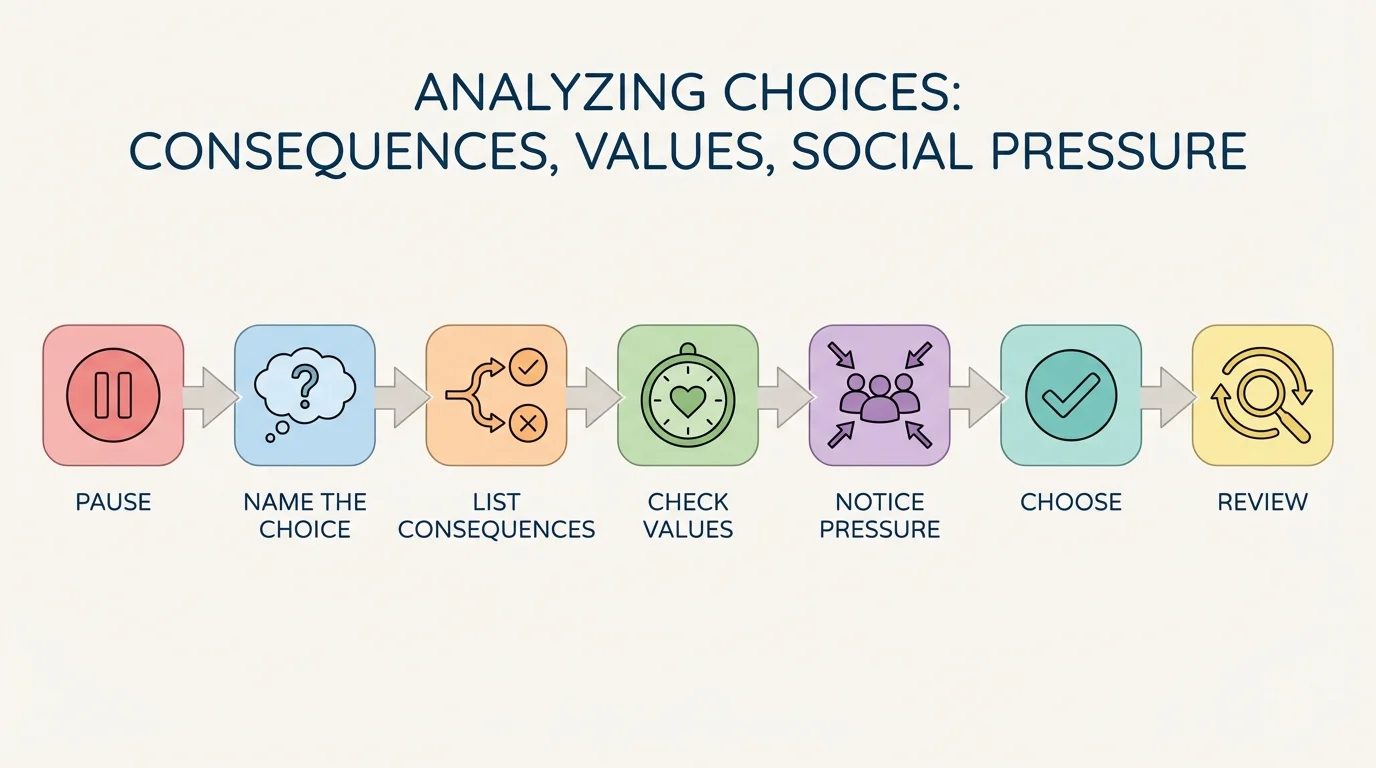
You can even turn this into a quick mental checklist: Pause. Consequences. Values. Pressure. Choose. The more you use it, the faster it becomes.
Example: Should you share your account password?
Step 1: Pause.
Do not send it immediately, even if the other person says it is "not a big deal."
Step 2: Check consequences.
Your account could be misused, messages could be sent from your name, private information could be exposed, and you could lose access.
Step 3: Check values.
Responsibility and safety matter here.
Step 4: Notice pressure.
If the person says, "If you trust me, you'll share it," that is pressure.
Step 5: Choose.
The stronger choice is not to share your password.
This same tool works for schoolwork at home, online behavior, spending choices, friend situations, and time management.
Suppose you saved $30 and want to spend it all on something you do not really need. There is nothing wrong with spending money sometimes, but thoughtful choices help. Consequences: if you spend all $30 now, you may have nothing left later for something more important. Values: responsibility and patience may matter. Pressure: maybe a trend or influencer makes it feel urgent. A stronger choice might be to wait one day before buying.
Suppose someone sends you a funny-looking photo of another kid and wants you to repost it. Consequences: the person could be embarrassed or hurt, and your own reputation could suffer. Values: kindness and respect matter. Pressure: the sender may want a quick reaction. A stronger choice is to delete it, not share it, and possibly tell a trusted adult if it is bullying.
Suppose your friends in an online game want you to keep playing, but you know you need sleep. The short-term consequence of logging off may be disappointment or missing part of the game. The long-term consequence of staying up late may be tiredness, irritability, and less focus. As we saw in [Figure 2], looking at both short-term and long-term results often changes what seems like the best choice.
Suppose you made a mistake and are tempted to lie so you do not get in trouble. Lying may seem easier in the moment, but it often creates more stress because then you have to protect the lie. Honesty can feel harder at first, but it usually leads to more trust over time.
It helps to prepare simple responses before you need them. If someone pressures you, you do not need a long speech. Short, calm answers work well.
You can say: "No thanks." "I'm not doing that." "That's not okay with me." "I need time to think." "I'm logging off now." "Don't send me that." "I'm asking an adult for help."
"Not deciding is still a decision."
— A useful reminder for everyday life
Another strategy is the delay strategy. If you are unsure, buy time. Say, "Maybe later," or "I need to check first." Pressure often loses power when you do not respond instantly.
You can also leave the situation. Exit the chat. Put the device down. Mute the conversation. Walk away from the activity. Getting distance gives your brain time to think.
If the pressure involves safety, threats, secrets, bullying, sexual messages, or anything that makes you feel scared, tell a trusted adult right away. Asking for help is not weakness. It is smart decision-making.
The three-part model from [Figure 1] still works here. If a choice has harmful consequences, clashes with your values, and only feels appealing because of pressure, that is a strong sign to say no.
Sometimes there is no choice that feels perfect. You may care about a friend but disagree with what they want. You may feel nervous that saying no will change the friendship. Hard choices often involve mixed feelings, and that is normal.
When this happens, focus on what you can control. You cannot control whether everyone likes your decision. You can control whether your choice is honest, safe, and respectful.
If you make a poor choice, do not give up on yourself. Instead, review it. What happened? What consequence did you miss? Which value did you ignore? Was pressure involved? This is where the review step in [Figure 4] matters. Learning from a mistake is part of becoming stronger at decision-making.
Example: Repairing a poor decision
Step 1: Admit what happened.
You reposted a hurtful comment because others were doing it.
Step 2: Stop the harm.
Delete the repost and do not add more comments.
Step 3: Take responsibility.
Apologize honestly if appropriate and tell a trusted adult if the situation is serious.
Step 4: Plan for next time.
Use a delay strategy, leave the chat sooner, or remind yourself that kindness matters more than fitting in.
Fixing a mistake may feel uncomfortable, but it is often the beginning of rebuilding trust.
Strong choices get easier with practice. You do not build this skill only during huge moments. You build it in ordinary moments: turning in your work on time, telling the truth, sticking to a budget, logging off when needed, and refusing to join in when something feels wrong.
Try this: before bed, think of one choice you made that day. Ask yourself three questions: What were the consequences? Which values were involved? Was there any pressure? This takes only a minute, but it trains your brain to notice patterns.
Try this: write three values on a note where you will see them often, such as honesty, safety, and kindness. When a decision comes up, check whether your choice matches those words.
Try this: practice one pressure response out loud. It may feel awkward at first, but practice helps your words come faster when you need them.
Over time, wise decisions help you feel more confident because you know you can trust yourself. That confidence does not come from always being comfortable. It comes from knowing you can pause, think clearly, and choose what is right even when pressure is real.
