You do not need to have your whole life planned at age 13, but you do need to start paying attention. The choices people make after high school can affect where they live, how they spend their time, what jobs they can apply for, and how much money they may need to invest in training. A good plan for your future is not about picking the most impressive-sounding option. It is about choosing a path that actually fits you.
That is why evaluating postsecondary options matters. Postsecondary means any education, training, or career preparation that happens after high school. Some people go to a four-year college. Some choose community college. Some enter a trade program, an apprenticeship, the military, or a job that includes training. The best option depends on your goals, your strengths, and the requirements of each path.
Postsecondary options are the education, training, and career pathways available after high school. These options can include college, trade school, apprenticeships, military service, certificate programs, or jobs that provide training.
One important truth can save you a lot of stress: there is no single "right" path for everyone. A student who loves repairing engines, learns best by doing, and wants to start working sooner may thrive in a trade program or apprenticeship. A student who wants to become a physical therapist will need a college path with advanced education later. Different goals lead to different choices.
Middle school is the right time to begin exploring because your current habits shape later opportunities. If you build strong study habits, communication skills, time management, and responsibility now, you create more choices later. If you ignore school, avoid deadlines, or never learn how to research your options, you may limit yourself without realizing it.
Think of your future like planning a road trip. You do not need every turn memorized today, but you should know the direction you want to travel. If you want a career in healthcare, technology, design, education, construction, business, or public service, each route has different stops along the way. Knowing that early helps you prepare instead of guessing at the last minute.
Many successful adults change jobs or even careers more than once. Learning how to evaluate options now helps you make smart decisions later, even if your interests change.
This process is also about independence. As you grow older, adults will expect you to make more of your own decisions. Evaluating options means you learn how to ask good questions, compare facts, and choose based on evidence instead of pressure.
When you compare pathways side by side, as [Figure 1] shows, you start to notice that they differ in cost, length, daily routine, and the kinds of careers they prepare you for. That makes it easier to stop thinking in terms of "good" and "bad" choices and start thinking in terms of "good fit" and "poor fit."
A four-year college or university often leads to a bachelor's degree. This path can be useful for careers such as engineering, teaching, nursing, computer science, accounting, or psychology. It usually takes more time and can cost more, but it may open doors to careers that require a degree.
A community college or two-year college can offer associate degrees, lower-cost general education courses, or career training. Some students start there and transfer later to a four-year college. Others complete a program that prepares them for work more quickly.
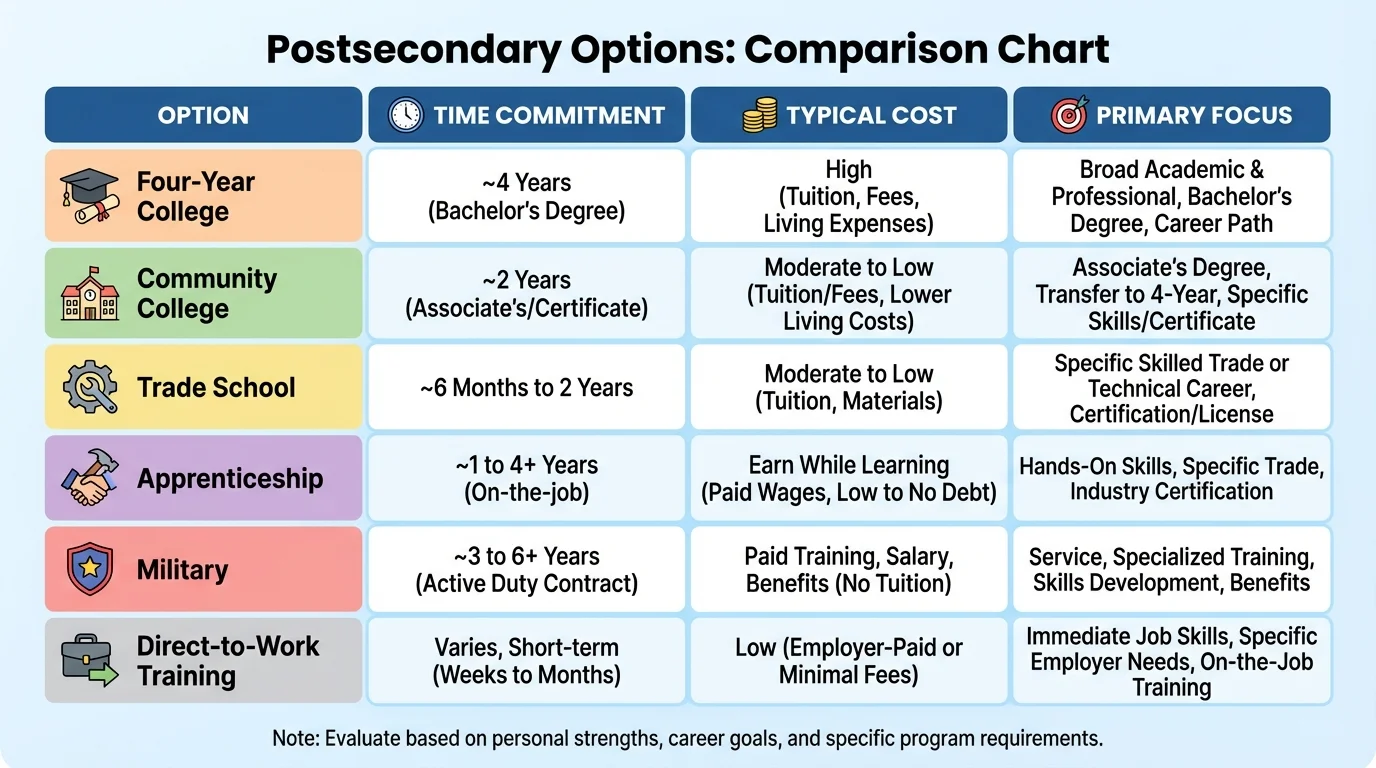
A trade school or certificate program focuses on practical job skills for fields like welding, cosmetology, automotive repair, plumbing, electrical work, culinary arts, or medical assisting. These programs are often more hands-on and may take less time than a traditional college degree.
An apprenticeship combines paid work with training. You learn by doing the job while building skills under supervision. This can be a strong option for students who like hands-on learning and want to earn money while training.
The military can provide training, structure, income, and education benefits, but it also comes with serious responsibilities, rules, and service commitments. This is not a choice to make lightly, but for some people it is a meaningful path.
Some jobs offer direct entry with employer training. For example, a person might start in customer service, office support, retail management training, or entry-level technology support while continuing to learn on the job. Later, they may choose more education or training to move up.
| Option | Main Focus | Typical Time | Good Fit For |
|---|---|---|---|
| Four-year college | Degree and broad academic study | 4 years | Careers that require a degree |
| Community college | Lower-cost degree or transfer start | 2 years | Students wanting flexibility or savings |
| Trade school | Job-specific training | 6 months to 2 years | Hands-on learners |
| Apprenticeship | Paid training while working | 1 to 5 years | Students who want to learn by doing |
| Military | Service, training, and benefits | Varies by commitment | Students ready for structure and service |
| Work with training | Immediate job entry | Starts right away | Students wanting to earn and build experience |
Table 1. A comparison of common postsecondary pathways by purpose, training length, and likely fit.
Notice that "faster" does not always mean "better," and "more expensive" does not always mean "more successful." A good decision weighs what the option requires and what it helps you become.
The smartest way to evaluate choices is to begin with self-knowledge. As [Figure 2] illustrates, your personal strengths and long-term goals connect directly to the kinds of postsecondary options that may fit you best. If you skip this step, you may choose a path based on pressure, trends, or someone else's dream.
Your strengths are the things you do well right now or can develop with practice. You might be organized, creative, patient, good with technology, good at explaining ideas, strong in problem-solving, or skilled with your hands. Strengths are not just school subjects. They also include habits and personal qualities.
Your interests are the topics and activities that naturally hold your attention. If you enjoy coding, cooking, drawing, helping younger children, fixing bikes, editing videos, or learning about health, those clues matter. Interests do not decide your future by themselves, but they help point you toward areas worth exploring.
Your values are what matters most to you in life and work. You may care about helping others, having financial stability, being creative, working outdoors, having a flexible schedule, being part of a team, or solving complex problems. Two students with similar talents may choose different paths because they value different things.
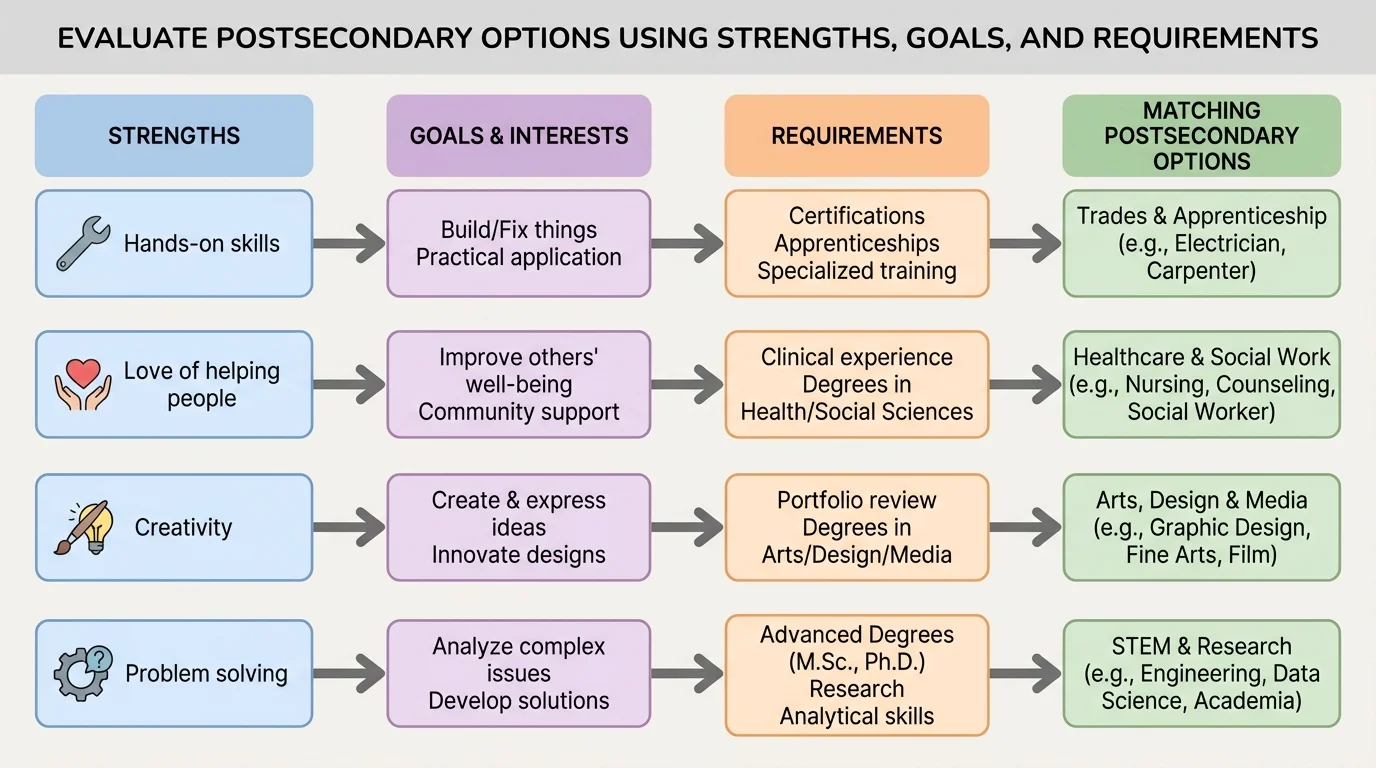
Your goals are the outcomes you want. Some goals are short-term, like improving grades, joining an online coding club, or learning to manage your time better. Some are long-term, like becoming a veterinarian, owning a business, designing games, or earning enough to live independently.
Here are useful questions to ask yourself:
Good fit does not mean easy. A strong postsecondary option may still be challenging, expensive, or time-consuming. "Good fit" means the challenge is connected to a goal you care about and matches the way you learn and work best.
For example, suppose you enjoy science videos, stay calm in emergencies, and care deeply about helping people. Healthcare careers might be worth exploring. But if you also know you dislike long years of school, you might compare paths like emergency medical technician, dental hygienist, medical assistant, nurse, or physical therapist assistant instead of choosing the longest route automatically.
Later, when you compare real programs, remembering the personal match from [Figure 2] helps you avoid choices that look impressive on paper but do not fit your daily life or motivation.
Once you know more about yourself, the next step is to study requirements. Requirements are the qualifications, conditions, or commitments needed for a path. This is where many people make weak decisions. They focus only on the dream and ignore what the path demands.
Common requirements include grades, classes completed, application deadlines, test scores, portfolios, physical fitness, interviews, background checks, training time, transportation, equipment, and cost. Some careers also require licenses or certifications after training.
You should ask practical questions such as:
Cost matters, but it should be viewed clearly. If Program A costs $4,000 and Program B costs $20,000, that difference is $16,000. You can write the comparison as \(20{,}000 - 4{,}000 = 16{,}000\). That does not automatically make Program A the better choice, but it means you should ask whether Program B offers enough extra value to justify the extra cost.
Time matters too. If one path takes \(2\) years and another takes \(6\) years, that is a difference of \(6 - 2 = 4\) years. Four more years may be worth it for some careers, but not for all. The point is to compare honestly, not emotionally.
Comparing two options
Jordan likes technology and wants to work in cybersecurity someday. Jordan is comparing a two-year community college program and a four-year university program.
Step 1: List the strengths and goals
Jordan is organized, persistent, and enjoys solving computer problems. Jordan's goal is to work in a tech field with room to grow.
Step 2: List the requirements
The community college costs $6,000 per year for \(2\) years. The university costs $18,000 per year for \(4\) years.
Step 3: Compare total cost and time
Community college total: \(2 \times 6{,}000 = 12{,}000\). University total: \(4 \times 18{,}000 = 72{,}000\). Difference: \(72{,}000 - 12{,}000 = 60{,}000\).
Step 4: Make a realistic judgment
If Jordan wants a lower-cost starting point, the community college may be a smart first step, especially if credits can transfer later.
The best choice depends on Jordan's long-term plan, finances, and readiness, not just the label of the school.
Requirements also include personal readiness. A path may be available to you, but are you ready to meet its demands? If a training program requires excellent attendance, strong reading skills, and self-discipline, then your current habits matter. You can build those habits now.
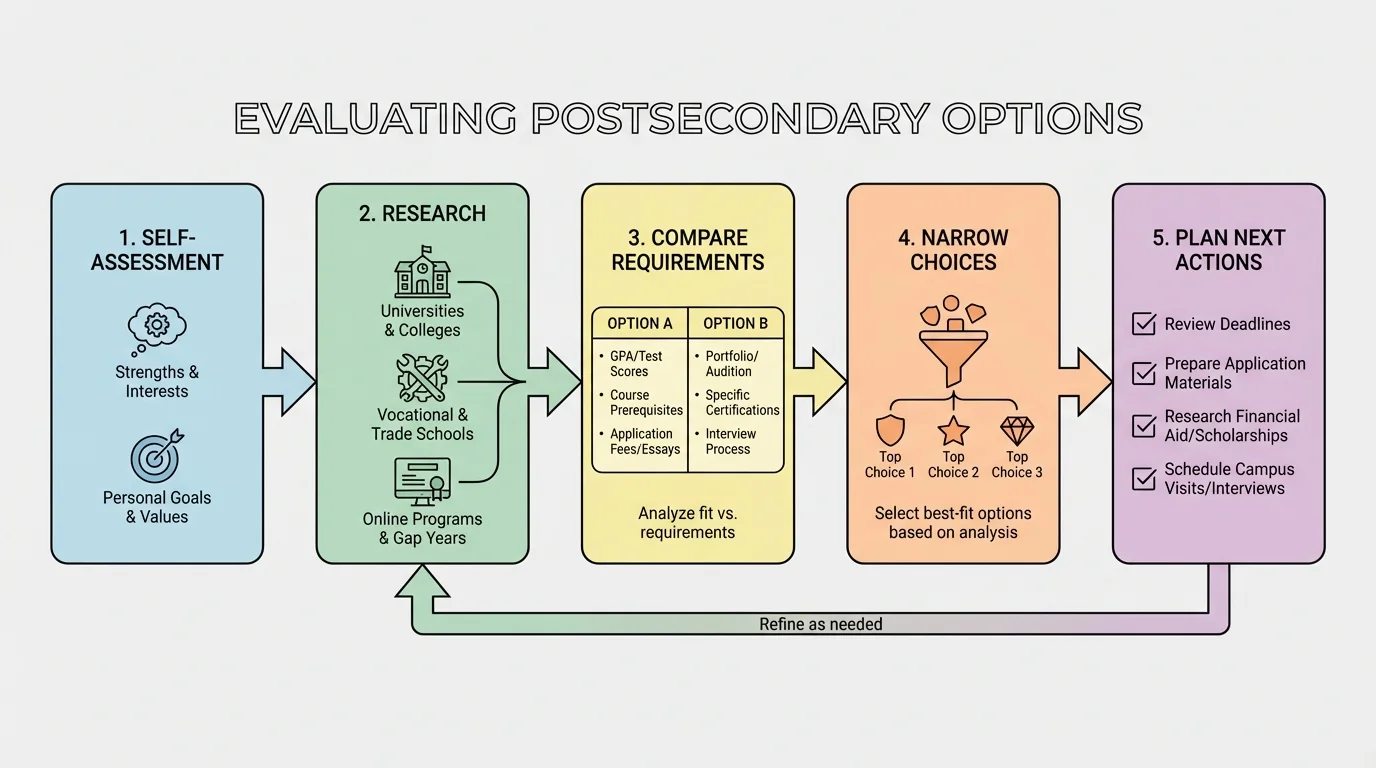
Choosing a future path feels less overwhelming when you follow a process, as [Figure 3] shows. You do not need perfect certainty. You need a repeatable way to make thoughtful decisions.
Step 1: Know yourself. Write down your strengths, interests, values, and goals. Ask a parent, guardian, mentor, coach, or trusted adult what strengths they notice in you.
Step 2: Create a short list. Pick \(3\) to \(5\) career areas or postsecondary paths to explore. This is enough to compare without becoming overwhelmed.
Step 3: Research each option. Look up program length, cost, admission requirements, daily work tasks, and career outcomes.
Step 4: Compare honestly. Ask which options match who you are, what you want, and what you are willing to do.
Step 5: Choose your next action. You do not have to choose your final career now. You only need to choose a next step, such as improving grades, exploring a field, or building a skill.
A simple rating system can help. For each option, score yourself from \(1\) to \(5\) in categories like interest, fit with strengths, cost comfort, and required training time. Then add the scores. If one option gets \(4 + 5 + 3 + 4 = 16\) and another gets \(3 + 2 + 5 + 2 = 12\), the first option may be a stronger fit. The score does not make the choice for you, but it helps you organize your thinking.
This kind of framework is useful because feelings change quickly. A process helps you make decisions based on patterns and evidence. That is especially important when social media, family opinions, or trends make one path seem more exciting than it really is.
Good decisions usually combine two things: what you want and what is realistic. Ignoring either one can lead to frustration.
Later, when you revisit the pathways chart from [Figure 1], you can use this process to sort broad options into a realistic shortlist instead of staring at every possible choice at once.
Here are a few realistic situations. Notice that each student chooses differently because each one has different strengths, goals, and requirements.
Case 1: Mia enjoys drawing, video editing, and storytelling. She is patient with digital tools and likes independent work. Mia might explore graphic design, animation, content creation, marketing, or web design. Her next steps could include building a small portfolio online and learning design software basics.
Case 2: Luis likes fixing things, working with tools, and seeing results quickly. Sitting still for long lectures is hard for him, but he is dependable and learns by doing. Luis may be a strong fit for a trade pathway or apprenticeship in electrical work, HVAC, automotive technology, or welding.
Case 3: Aisha enjoys science, communicates well, and wants a career helping people. She is willing to complete several years of training if needed. Aisha may explore nursing, dental hygiene, occupational therapy, public health, or pharmacy technician training depending on how much education she wants.
Case study: narrowing three options
Sam is choosing between culinary school, community college business classes, and entering a family business after high school.
Step 1: Identify strengths
Sam is creative, works well under pressure, and likes planning events and meals.
Step 2: Identify goals
Sam wants stable income, a chance to be creative, and the possibility of owning a business someday.
Step 3: Compare requirements
Culinary school offers direct cooking training. Business classes build management skills. Joining the family business offers immediate experience.
Step 4: Choose the next move
Sam may decide to start with business classes while continuing to gain cooking experience, keeping more than one future option open.
This is a strong decision because it matches both creativity and long-term business goals.
These examples show that choosing well is not about copying what friends plan to do. It is about building a path that matches your actual future, not someone else's.
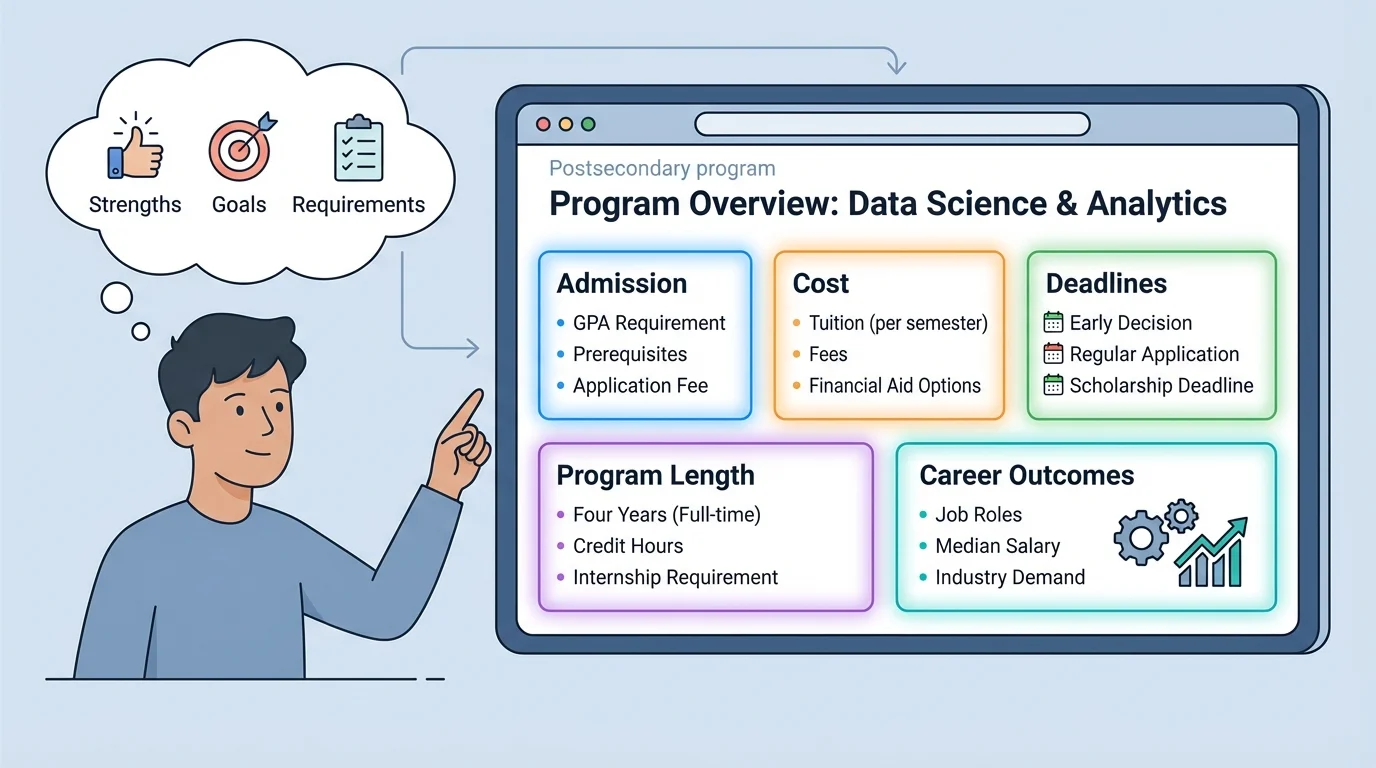
Because you learn online, you already have one useful advantage: you know how to find information digitally. But good research means more than scrolling. As [Figure 4] shows, the best way to compare options online is to look for the same key categories each time so you do not miss important details.
When you visit a school, training program, or career website, look for:
Use a notes document or spreadsheet to compare what you find. If you research \(4\) programs, keep the same categories for all \(4\) so your comparison is fair.
You can also ask questions by email, virtual information sessions, or phone calls. Good questions include:
Be careful with online advice from random influencers or comment sections. Personal stories can be helpful, but they are not always complete or accurate. Official program websites, licensed professionals, and trusted adults are more reliable sources.
When you compare websites using the checklist in [Figure 4], patterns become easier to spot. One option may seem exciting until you notice it has hidden fees, limited job outcomes, or entry requirements you do not currently meet.
One common mistake is choosing based only on status. Some students think a path is better only if it sounds prestigious. But a respected title does not guarantee happiness, success, or fit.
Another mistake is choosing based only on speed. Starting work sooner may be useful, but not if it leads to a dead-end path that does not support your goals. On the other hand, spending many years in training without a clear reason can also create problems.
A third mistake is ignoring cost. Even if adults help with expenses, understanding cost is part of being responsible. You should know whether a path is affordable and what support might exist.
A fourth mistake is following friends. Your friend's strengths, goals, and family situation may be very different from yours. Making the same choice just to stay together can lead to regret.
"Do not choose a path because it is popular. Choose it because it matches the future you want to build."
Another mistake is underestimating your own growth. Maybe you are not ready for a path yet, but that does not mean you can never reach it. If a career requires stronger grades, better communication, or more self-discipline, that gives you a target to work toward.
You can start preparing now without locking yourself into one future. Focus on actions that keep options open and build readiness.
Try This: Make a list of \(3\) strengths you already have and \(2\) strengths you want to build. Keep the list where you can review it once a month.
Try This: Research \(3\) career areas you are curious about and write down the training each one requires.
Try This: Practice one skill that matters in nearly every path: meeting deadlines, writing a clear email, speaking professionally on a video call, or organizing your week.
Try This: Talk with a parent, guardian, family friend, mentor, coach, or community member about how they chose their training or career path. Ask what they wish they had known earlier.
Try This: Keep a digital future folder with careers, programs, notes, and questions. Updating one folder over time is easier than starting over every year.
The goal right now is not to predict your exact adult life. The goal is to become someone who can evaluate choices wisely. That skill will help you in high school, after graduation, and far beyond.
