Have you ever said, "I can do it!" That is a big feeling for a young child. At school, growing up often looks like small choices: putting your materials in the right place, listening when your teacher talks, or trying a task before asking for help. These little choices show that you are learning to take care of yourself.
Growing independence means you can do more things on your own. You may still need help sometimes, and that is okay. Independence does not mean doing everything alone. It means making good choices that help you learn, stay safe, and be responsible.
At home, school happens in your own space. You might learn on a tablet, computer, or phone. You might talk to your teacher on a video call. You might do work with crayons, paper, or learning toys. Each time you choose to get ready, pay attention, or clean up, you are showing you are growing.
Independence means doing something by yourself when you are ready. Choice means picking what you will do. Responsibility means doing what you are supposed to do in a safe and helpful way.
When you make strong choices, school feels smoother. You know where your things are. You can start faster. You feel proud. When choices are not helpful, learning can feel harder. You may miss directions, lose supplies, or feel upset more quickly.
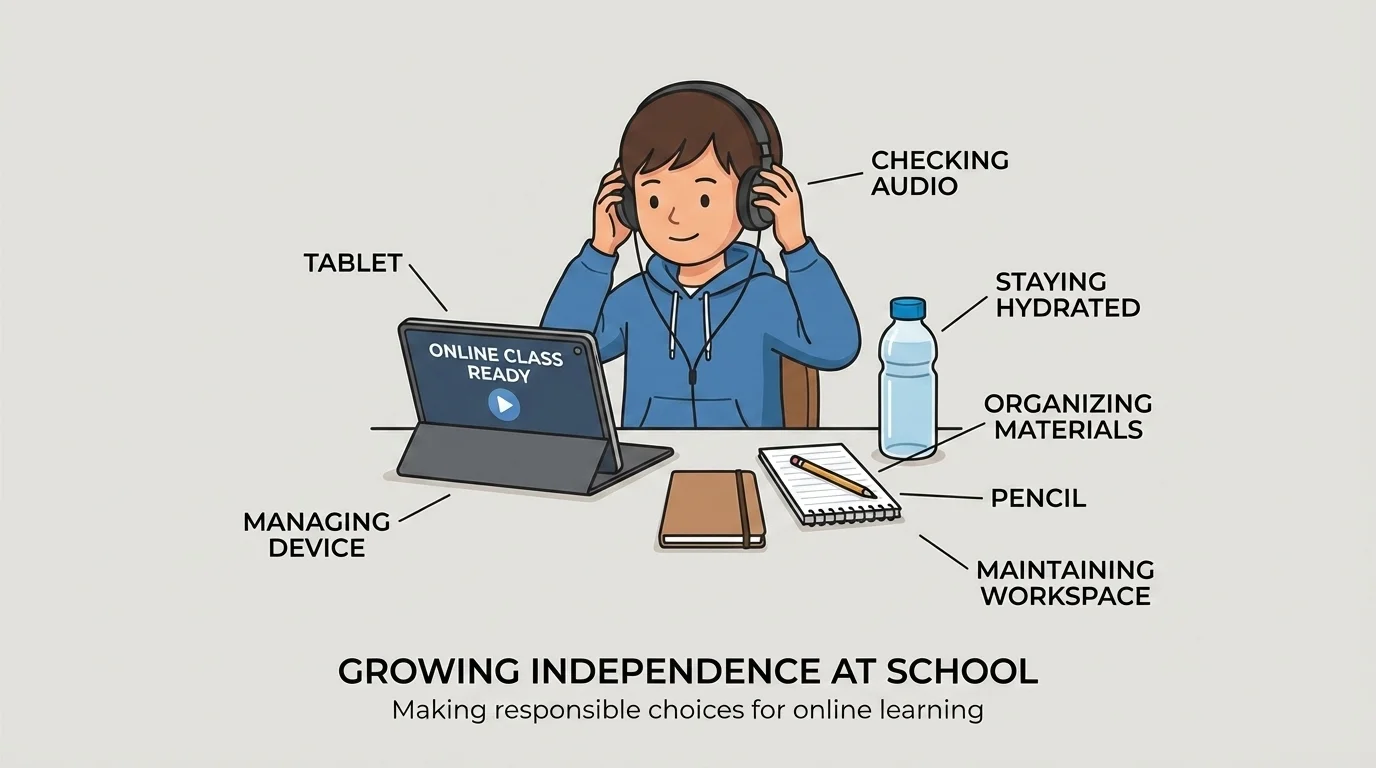
Independence at school can be simple, as [Figure 1] shows. It can look like sitting in your learning spot, keeping your materials nearby, and having your pencil ready before class starts. It can also look like getting into class with help nearby but not needing someone to do every step for you.
You also show growing independence when you remember a class rule, follow one direction at a time, and keep trying. If your teacher says, "Get your paper," and you do it, that is independence. If you finish and put your paper in the right place, that is independence too.
Sometimes independence means using your words. You might say, "I need help opening this," instead of crying right away. You might say, "I am ready," or "I need one more minute." Knowing what you need is part of growing.
Growing one step at a time
You do not become independent all at once. First, an adult may show you. Next, you do it together. Then, you do more of it by yourself. Each small step helps you become more confident.
That is why simple jobs matter. Picking up your crayons, closing your learning app when class is done, and putting your cup in a safe place are all signs that you are learning to care for your own school routine.
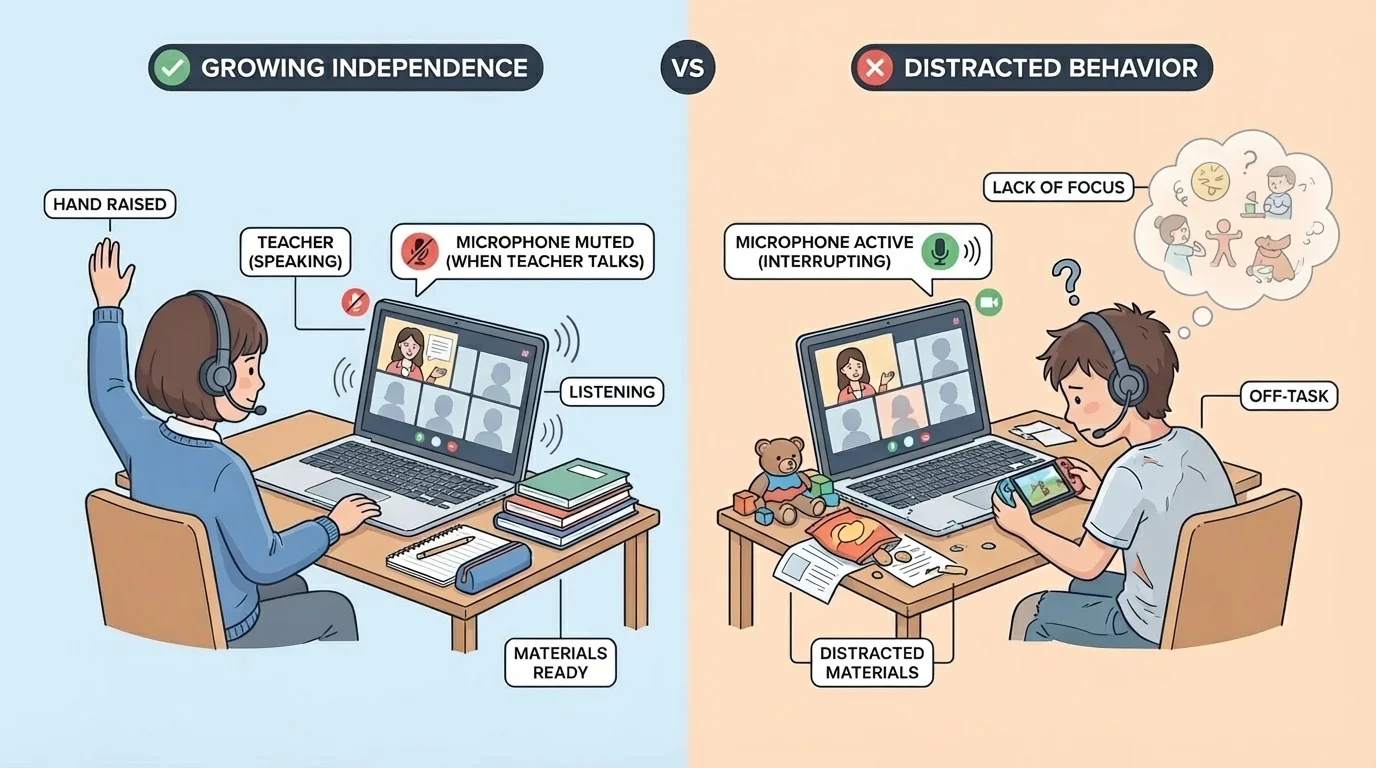
School-time choices matter every day, and [Figure 2] illustrates several of them. You can choose to look at the screen when your teacher is talking. You can choose to keep your hands busy with school tools instead of other toys. You can choose to listen first and then speak.
Here are some choices that show growing independence:
You can also show independence with your online manners. That means waiting for your turn, keeping your microphone muted when needed, and speaking kindly. These are not just school rules. They help everyone learn together.
If you forget sometimes, that is normal. Everyone is learning. What matters is noticing the choice and trying again. If you say, "Next time I will get my pencil first," you are already growing.
Later, when you think about the strong choices in [Figure 2], you can remember that independence is often quiet. It is not always a big moment. It is often a calm, helpful choice made at the right time.
Brains grow stronger when children practice doing small jobs on their own. Repeating the same helpful routine makes the job easier over time.
That is why doing the same steps each school day can help. Your body and brain start to remember what comes next.
A smart learner knows the difference between doing it alone and asking for help, as [Figure 3] shows. Growing independence does not mean staying stuck. It means you try what you can, then ask in a calm way if you still need support.
For example, you can try to open your notebook, find your red crayon, or click the class link. But if something is broken, confusing, or unsafe, it is time to ask a grown-up or teacher. Asking for help is also a good choice.
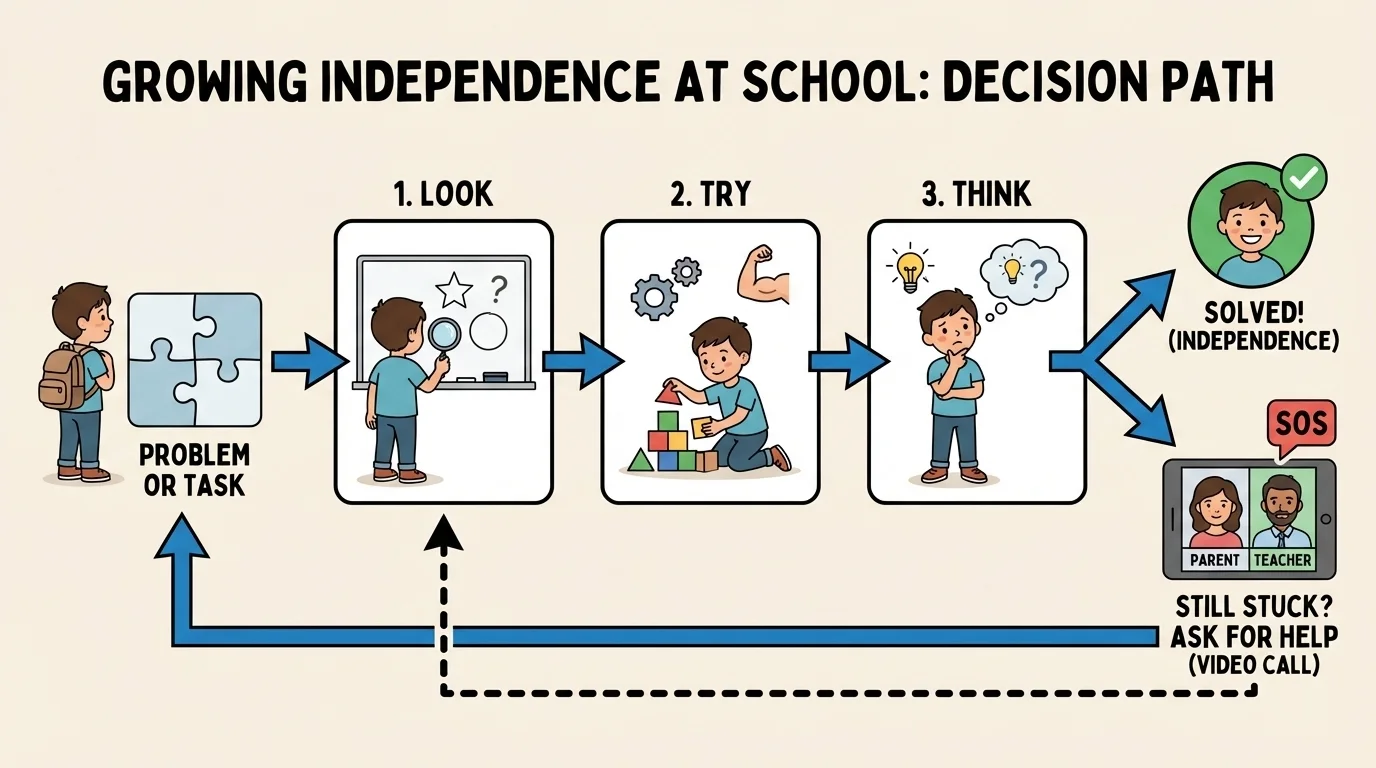
A helpful way to think is: look, try, ask. First, look at what you need to do. Next, try one step. Then, if you still cannot do it, ask for help with words.
You might say, "I tried to log in, but I need help," or "I cannot hear the teacher." Those are strong, clear words. They show responsibility because you are solving the problem in a safe way.
Example: Trying first
Step 1: Your teacher asks you to get scissors.
Step 2: You look in your school box by yourself.
Step 3: If you do not find them, you say, "I looked, and I need help."
This is an independent choice because you tried before asking.
Remember the routine in [Figure 1]. Being ready with your things often means you need less help later. A little planning at the start can make the whole school time easier.
A routine is something you do in the same order again and again. Routines help young children feel calm and ready. When you know what comes first, next, and last, it is easier to be independent.
Try this simple routine for your school day:
Before class: go to your learning spot, bring your device, get a pencil or crayons, and have water nearby.
During class: listen, watch, follow one direction, and use kind words.
After class: put away supplies, put materials back where they belong, and tell a grown-up what you finished.
These little jobs help build confidence. Confidence means believing, "I can try." The more you practice, the more your body remembers the steps.
"I can try one step by myself."
If one part feels hard, start with just one job. Maybe your one job is getting your pencil. Maybe it is hanging up your headphones. One small success can lead to another.
Here are some choices and what they show:
| Choice | What it shows |
|---|---|
| You sit down when class begins. | You are ready to learn. |
| You get your paper before the lesson. | You can prepare. |
| You try to do the first part alone. | You are becoming independent. |
| You ask politely when you are stuck. | You solve problems safely. |
| You put supplies away after class. | You take care of your space. |
Table 1. Examples of everyday choices that show growing independence during online school.
If a child waits for a grown-up to do every little thing, school can feel slow and frustrating. If that child starts making one helpful choice at a time, things improve. The child feels proud, the grown-up can support without doing everything, and learning becomes calmer.
Think again about the help decision in [Figure 3]. The strongest choice is not always doing everything alone. The strongest choice is doing what you can, then asking clearly when you truly need help.
You already know how to follow simple directions at home, like putting away toys or washing hands before eating. Those same skills help you become more independent at school.
Growing independence is really about practice. Each day gives you new chances to choose: get ready, listen, try, ask kindly, and clean up. Those choices show that you are learning to take care of yourself and your school day.
