Have you ever looked for a pencil and it seemed to hide right when class was starting? A good routine helps prevent that problem. When you learn at home, routines help you feel ready, calm, and confident. You know where your things are, you know what to do first, and you can start learning faster.
Your learning time goes better when your space is ready. You do not need a perfect room. You just need a small spot where your learning things stay together. That can be a little table, a desk, or a quiet corner with a basket.
When you use the same steps every day, your brain learns the pattern. Then you spend less time wondering, "What do I need?" and more time doing your work. That is called being independent little by little.
Routine means something you do the same way many times.
Materials are the things you use for learning, like paper, crayons, pencils, headphones, or a tablet.
Directions are the steps that tell you what to do.
A routine is not about being perfect. It is about making learning easier. If your materials are in the right place and you follow directions step by step, your day feels smoother.
As [Figure 1] shows, every learning item needs a home. When one spot is for pencils, one spot is for paper, and one spot is for headphones, you can find things quickly.
Try using a small box, tray, or basket. Put only the things you often need there. Keep it simple. Too many things can make the space feel busy and confusing.
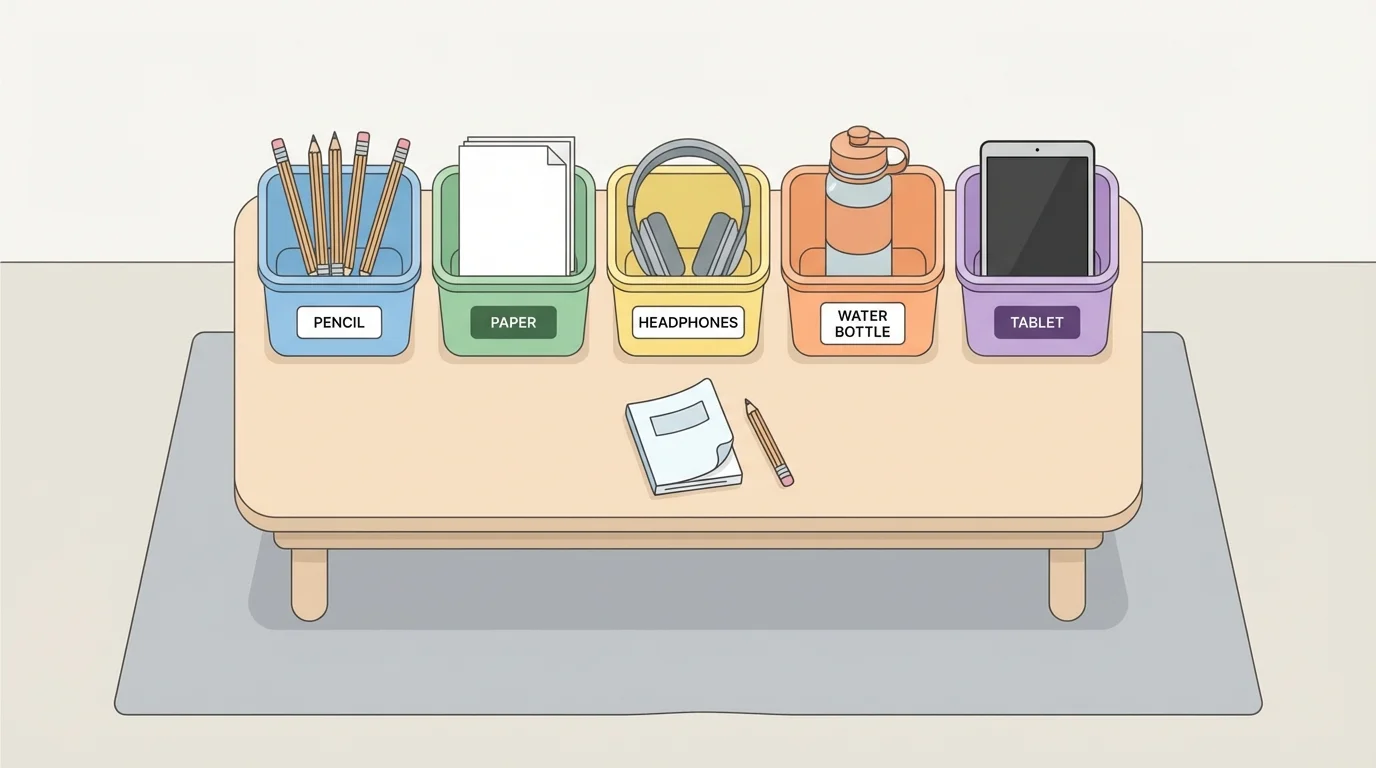
You can also use easy labels with pictures or words. A picture of crayons on a bin helps you know where crayons go. A paper tray helps you know where blank paper belongs. After class, put each item back in its home.
Good routines have three tiny parts: get ready, use, and put away. First get the item. Next use it. Last put it back. This keeps your space neat and saves time tomorrow.
Example: getting ready for an online lesson
Step 1: Sit in your learning spot.
Step 2: Get your pencil, paper, and device.
Step 3: Put your water bottle nearby.
Step 4: When class ends, return each item to its place.
If you toss things anywhere, they get lost. Then class may start while you are still searching. But if you put things back each time, you are ready much faster the next day.
Following directions works best when you do them in order. A simple routine is: stop, look, listen, do.
As [Figure 2] shows, Stop means pause your hands and body. Look means look at the screen or the adult helping you. Listen means hear the words. Do means begin the task.
If there are many steps, do one step at a time. For example: "Get paper. Write your name. Draw a circle." First get the paper. Next write your name. Then draw the circle. Taking one step at a time helps you avoid feeling confused.
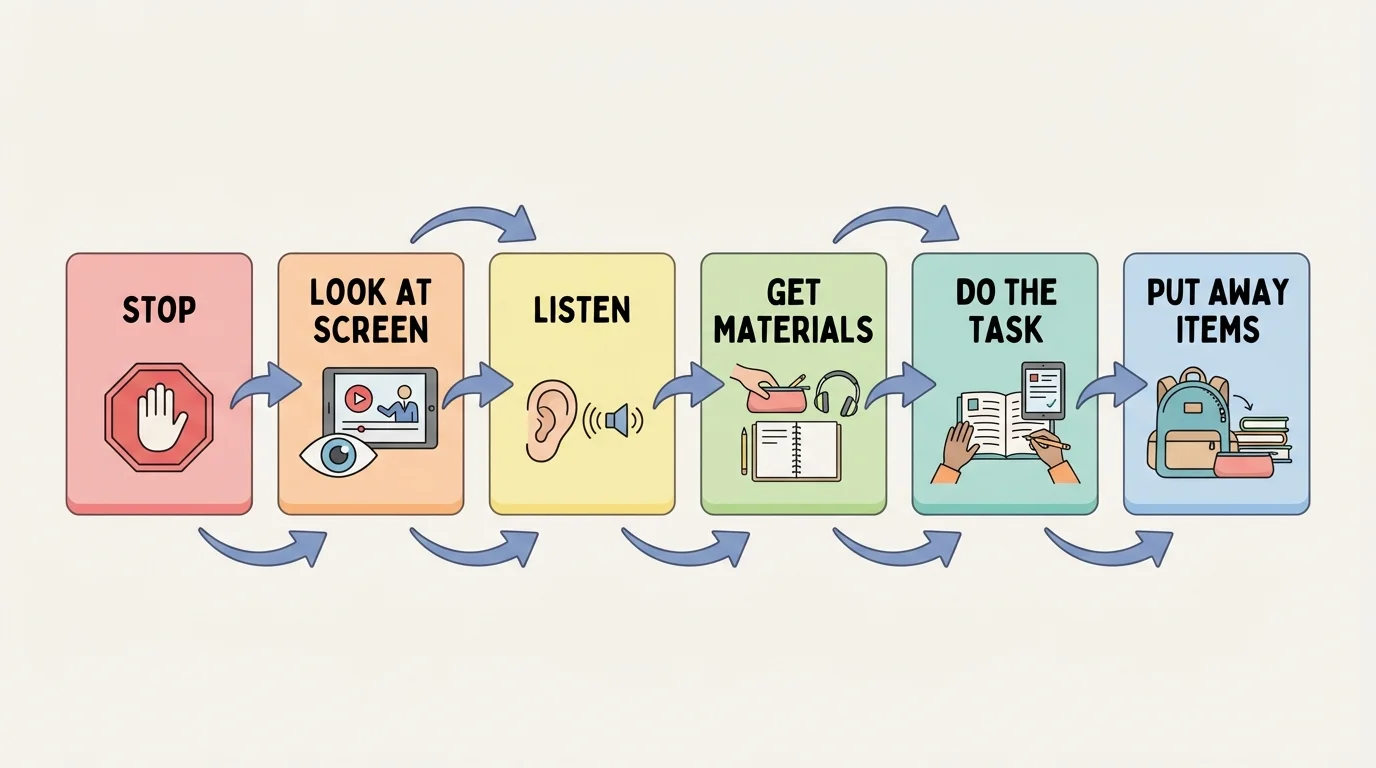
Sometimes it helps to say the steps softly to yourself. You might whisper, "Paper, name, circle." That is a checklist in your own words.
Why order matters
When directions are done in the right order, the job is easier. If you skip a step, you may need to go back and fix it. Following order helps your work get done and helps you feel successful.
You can also check for clues on the screen. Your teacher may show a picture, a pointer, or a page. Looking carefully helps you match your actions to the directions. Later, when you are doing a different task, the same pattern from [Figure 2] still works: stop, look, listen, do.
Everybody forgets sometimes. Forgetting does not mean you cannot do it. It means you need a restart.
First, take a calm breath. Next, look at your space. Ask, "What do I need?" Then look at the screen or ask an adult to repeat the step. You can say, "Please tell me the next step," or "Can you help me find my paper?"
A routine chart can help too. A routine chart is a simple list or picture list that shows what comes first, next, and last. You can keep one near your learning spot.
Many children do better with routines because the brain likes patterns. When you repeat the same steps, the steps become easier to remember.
If something goes wrong, do not quit. Restart with the first step you remember. Then keep going. Small restarts help big jobs get done.
A daily routine can happen the same way each learning day. When the day has a pattern, you know what comes next.
As [Figure 3] shows, before class, you can use this routine: go to your learning spot, get your materials, open your device, and sit with your body ready. During class, look at the screen, listen for directions, and do one step at a time. After class, save your work, put materials away, and tidy your space.
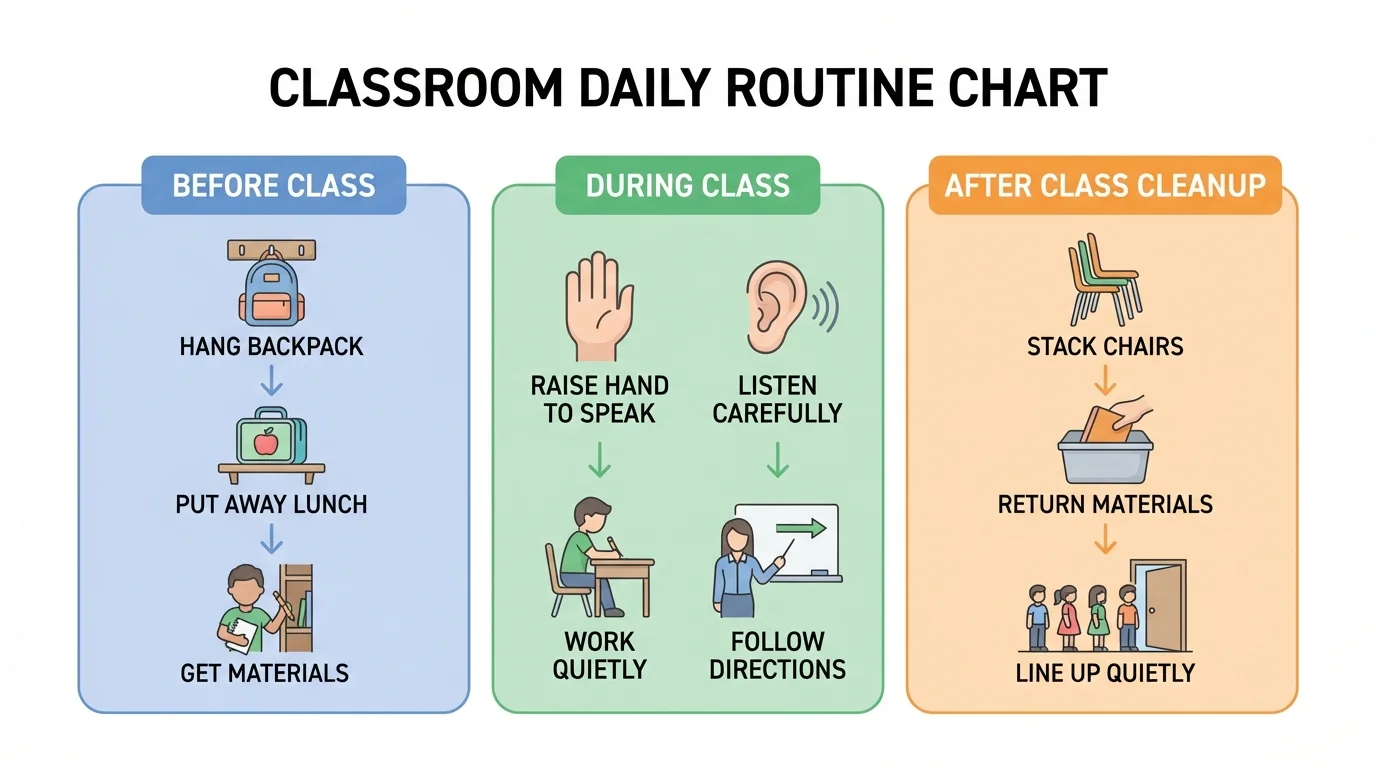
Here is a simple way to remember it: ready, work, put away. These three parts fit many learning tasks.
| Time | What you do |
|---|---|
| Before class | Get pencil, paper, device, and water. |
| During class | Stop, look, listen, and do the steps. |
| After class | Put items back, save work, and clean your spot. |
Table 1. A simple daily routine for online learning at home.
You can use the same idea for art, reading, or any lesson. As shown in [Figure 3], the routine stays simple even when the activity changes.
Example: cleanup routine after a drawing lesson
Step 1: Put the cap back on the marker or glue.
Step 2: Place crayons or pencils in their bin.
Step 3: Put finished work in the right folder or tray.
Step 4: Push in your chair or leave the space neat.
When cleanup happens the same way each time, your materials stay ready for later. That means less mess and less stress.
Routines help you become more responsible. They help you start faster, lose fewer things, and understand what to do next. They also help the adults supporting you because everyone knows the plan.
Without routines, a small problem can turn into a big delay. A missing pencil can stop your work. Not listening to the first direction can make the next direction hard to understand. With routines, small problems are easier to fix.
"A place for everything, and everything in its place."
That saying fits learning well. When your things have a place and your steps happen in order, you can focus on learning instead of searching, guessing, or rushing.
Try This: Pick one small routine for tomorrow. Maybe you will put your pencil and paper in the same basket tonight. Maybe you will practice saying, "Stop, look, listen, do." One small routine can make a big difference.
