What if you had just a few coins and had to choose: buy one small thing now, or keep your coins for something bigger later? That is a real money choice, and kids can practice making these choices every day with play money, tokens, stickers, or reward points at home.
Money is something people use to buy things. In learning games, you might use pretend coins, tokens, or stars instead of real money. These help you practice making choices. A choice means you pick one thing from two or more things.
Sometimes you use money for something you need. A need is something important, like food or soap. Sometimes you use money for something you want. A want is something fun or nice to have, like a sticker or a toy car.
Saving means keeping money now so you can use it later. Spending means using money to get something now. Both can be good choices, depending on what you need and what your plan is.
When you learn at home, you can still practice money skills in simple ways. You might earn one token for finishing a reading video, two tokens for cleaning up art supplies, or one token for helping put books away. Then you decide what to do with your tokens.
Saving means waiting and keeping your money for later, as shown in [Figure 1]. If you have $1 in pretend money today, you may decide not to use it yet because you want something that costs more tomorrow.
Spending means using your money now to get something. If you have 1 play coin, and a sticker costs 1 play coin, you can spend your coin and get the sticker. If you have 3 play coins and a box of crayons costs 3 play coins, you may choose to save until you have all 3 coins.
A simple way to think about it is this: if you use your money now, you cannot use that same money later. If you keep your money now, you may be able to buy something else later. For example, if you have 2 tokens and a bouncy ball costs 2 tokens, spending means you get the ball now. If a puzzle costs 4 tokens, saving means you keep your 2 tokens and wait to get 2 more.
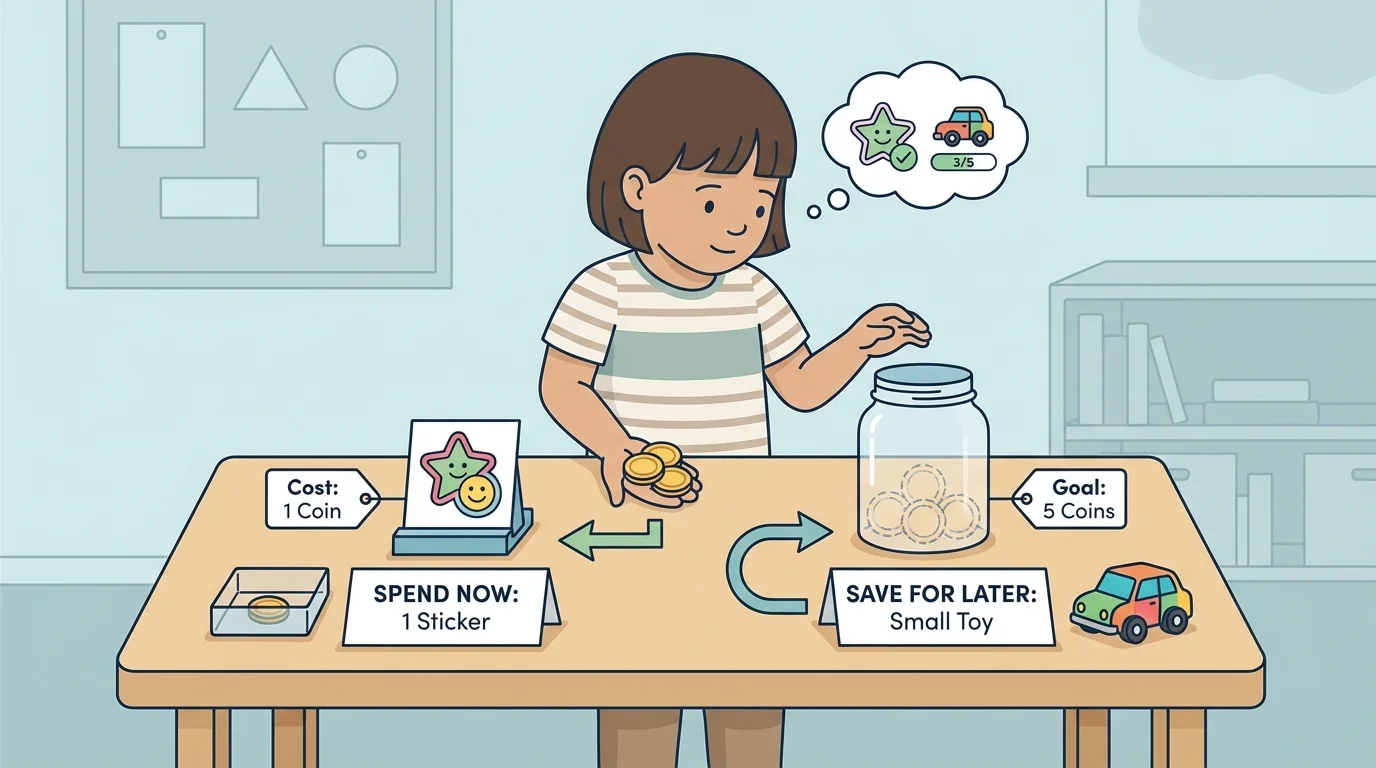
Saving can help you reach a goal. Spending can help you get something useful or fun right away. The smartest money choice is not always the same. It depends on what you have, what you need, and what matters most right now.
Young children can begin learning money habits long before they use real money by practicing with tokens, play coins, and simple reward systems at home.
If you spend every token right away, you may not have enough for a bigger prize later. If you only save and never spend, you may miss a good chance to get something helpful now. The picture in [Figure 1] shows that both choices can make sense at different times.
When money choices feel tricky, use a few easy questions. This simple thinking path, shown in [Figure 2], helps you slow down and choose well.
First, ask, "Do I need it or do I just want it?" If you need it, spending may make sense. If it is only a want, you can think more before choosing.
Next, ask, "Do I have enough?" If you need 3 tokens but only have 2, then you are not ready to buy it yet. In a pretend shop, if you have 2 coins and the marker costs 3 coins, then you need 1 more coin because \(3 - 2 = 1\).
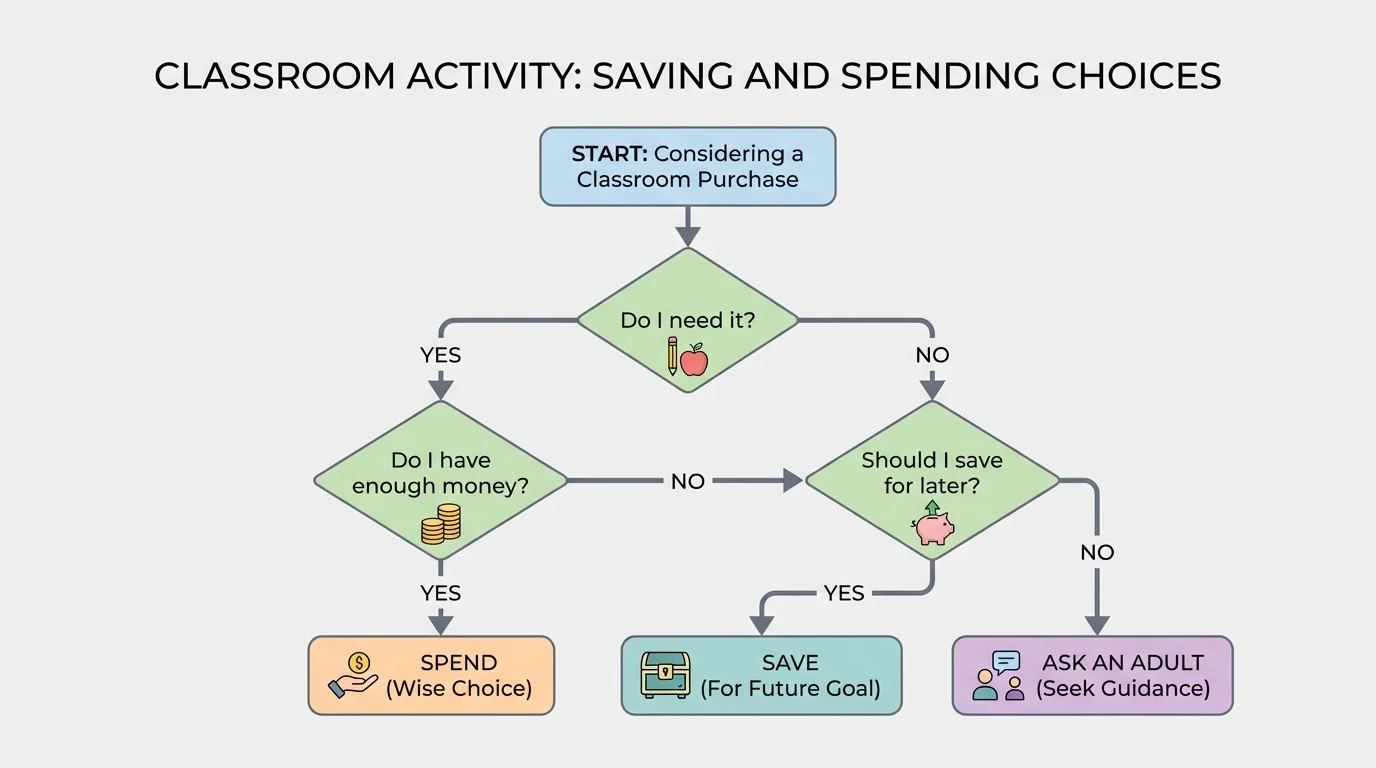
Then, ask, "Should I save for later?" Maybe you can buy one small thing today, but maybe you want something bigger in a few days. If a sticker costs 1 token and a coloring book costs 4 tokens, spending 1 token today means you still need 3 more later because \(4 - 1 = 3\).
Last, if you are not sure, ask a grown-up. A trusted adult can help you think about your choice. Asking first is especially important before using real money, clicking a buy button online, or choosing something that belongs to someone else.
Simple choice examples
Step 1: You have 2 stars. A snack coupon costs 2 stars.
You have enough because \(2 = 2\). You may spend now.
Step 2: You have 2 stars. A mini puzzle costs 5 stars.
You do not have enough because \(5 - 2 = 3\). You may save 3 more stars.
Step 3: You have 4 stars. A sticker costs 1 star.
If you buy the sticker, you will have 3 stars left because \(4 - 1 = 3\).
Good money choices often come from stopping, thinking, and then deciding. That is a strong life skill, not just a game.
You can practice money choices during home learning with a pretend budget. A budget is a simple plan for how to use your money or tokens. In a pretend store, like the one in [Figure 3], you may get 5 play coins for the week and choose how to use them.
Here is one example. You have 5 play coins. A sticker costs 1 coin, an eraser costs 2 coins, and crayons cost 3 coins. If you buy crayons, you have 2 coins left because \(5 - 3 = 2\). If you buy a sticker and an eraser, you spend 3 coins because \(1 + 2 = 3\), so you would still have 2 coins left. That means you can compare choices before you decide.
You can also practice with art supplies. Suppose you earn one token each time you put caps back on markers. After 4 times, you have 4 tokens because \(1 + 1 + 1 + 1 = 4\). Now you can choose to trade them for one bigger reward or save for something later.
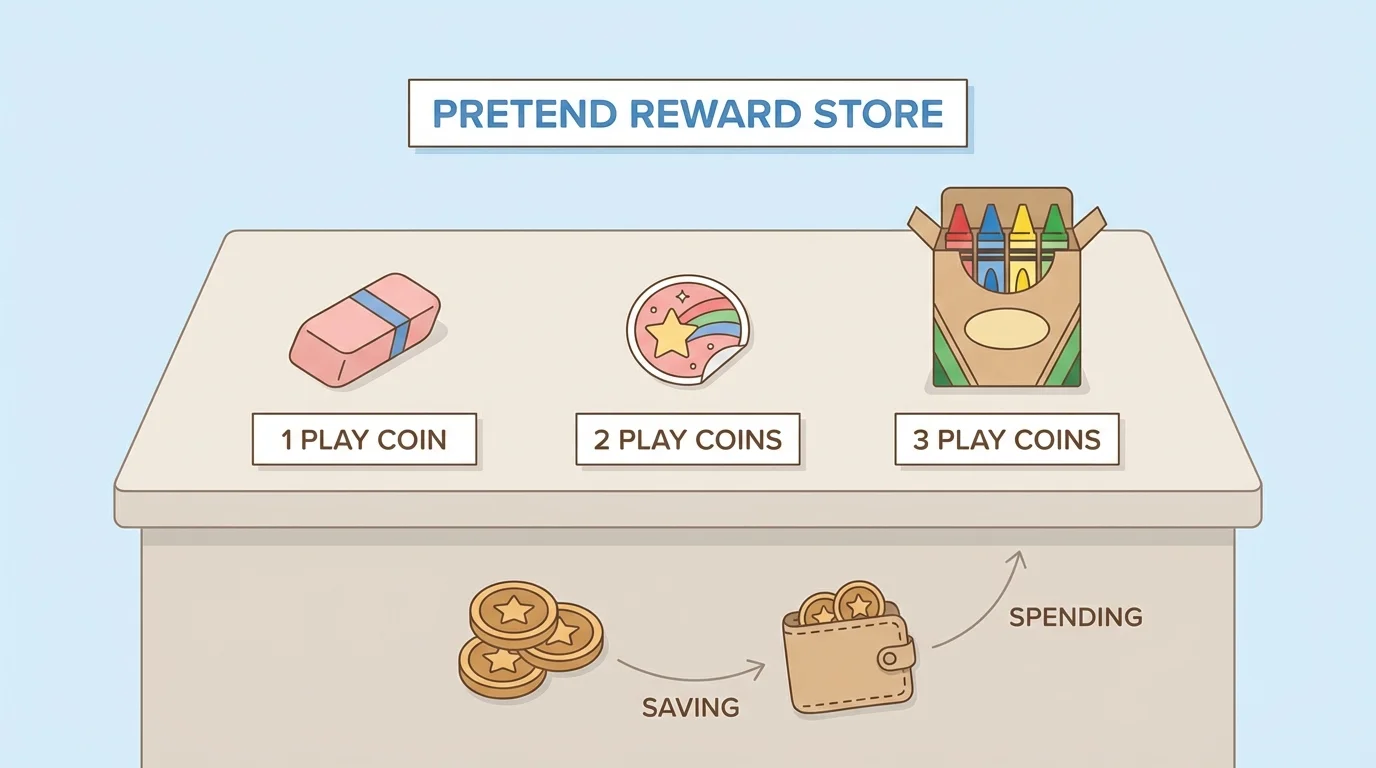
Snack decisions work the same way. If you have enough points for fruit now, that may be a good spending choice because it is useful and healthy. If you want a fancy treat later that needs more points, saving may be the better plan. The store picture in [Figure 3] shows how prices help you compare.
Reward charts, family chore tokens, and play shops are all safe ways to practice before using real money. These activities teach waiting, planning, and careful choosing.
Good money habits start small. Keep coins or tokens in one place so they do not get lost. Count carefully. Be honest about how many you have. If something is not yours, ask before using it.
Why waiting can help
Waiting is sometimes hard, but it helps you think clearly. When you wait, you can compare choices, remember your goal, and avoid using all your money too quickly. This makes it easier to save for something important or special.
Being careful with money also means taking care of your things. If you spend tokens on crayons, put the crayons away when you finish. If you buy a sticker book, keep it clean. Taking care of what you get shows respect for your money and your work.
When you make a wise choice, you feel proud and prepared. When you rush and spend without thinking, you may feel disappointed later. That is why simple questions, a small plan, and a little waiting can help so much.
"Use a little now, save a little for later."
You do not need lots of money to practice. Even a few pretend coins can teach a big lesson: every choice matters.
