Have you ever felt ready to play, draw, or eat a snack, but your things were not ready yet? Small routines help your day feel smooth and calm. A routine is a set of little steps you do in the same order. When you know what comes first, next, and last, it is easier to begin, finish, and clean up.
A routine helps your brain know what to do. That makes activities feel less confusing. When you use the same steps again and again, you need less help from a grown-up. You can feel proud because you know, "I can do this."
Routine means a group of steps you do the same way many times.
Clean up means putting things back where they belong so the space is ready again.
Routines are helpful during toy play, art time, snack time, getting ready for an online story, or helping at home. If you start well, the activity is easier. If you finish well, you know you are done. If you clean up well, your space stays safe and ready for next time.
A visual schedule can help you remember the beginning steps, and [Figure 1] shows a simple start routine in order. You can use the same little plan each time you begin something.
Step 1: Stop your body. Step 2: Look at what you need. Step 3: Get your things. Step 4: Sit or stand in the right place. Step 5: Begin.
For art time, your start routine might be: get paper, get crayons, sit at the table, and start drawing. For snack time, it might be: wash hands, sit down, get napkin, and begin eating. For online learning time, it might be: sit in your spot, get headphones, open the device with help, and listen.
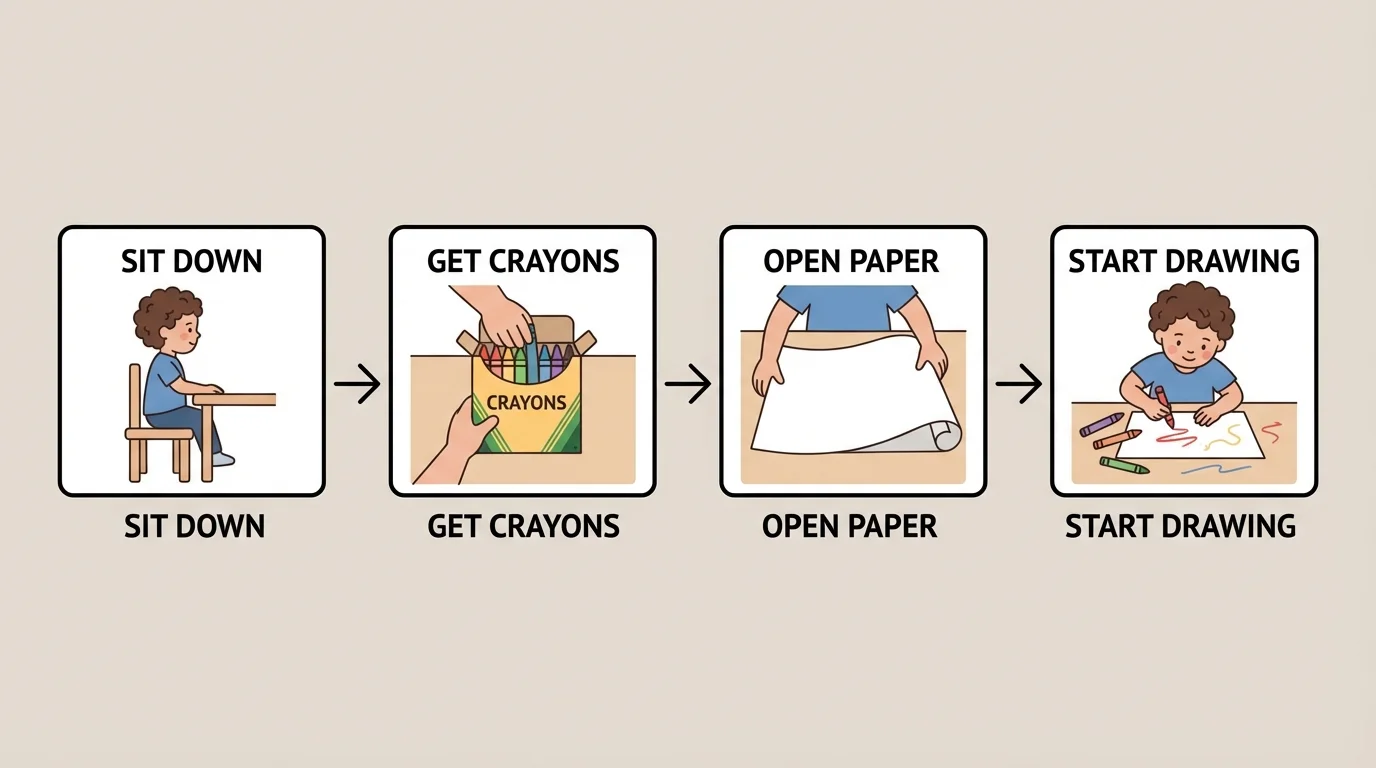
When you use the same order each time, your body learns the pattern. That means less waiting, less frustration, and more time for the activity. The order in [Figure 1] helps show that starting is not one big job. It is a few easy jobs done one after another.
Example: starting puzzle time
Step 1: Go to the puzzle spot.
Step 2: Get the puzzle box.
Step 3: Open the box and put pieces on the mat.
Step 4: Start with one piece.
Now the activity begins in a calm, easy way.
If you skip the start routine, pieces may be missing, your seat may not be ready, or you may feel upset. When you start with a routine, your activity begins more smoothly.
A finish routine helps you know when the activity is done. Sometimes children stop in the middle and walk away. A finish routine teaches you to pause and check.
Your finish routine can be very simple: stop, look, check, done. Stop your hands. Look at your work or play area. Check if the job is finished. Then say, "Done," or tell a grown-up.
Why finishing matters
Finishing is more than stopping. It helps you notice whether the activity is complete. That builds independence because you learn to check your own work and space before moving on.
For block play, finishing might mean the tower is built and you are done playing. For snack time, finishing might mean the food is eaten and the cup is empty. For coloring, finishing might mean you are done with the picture and you put the crayon down.
You can also use simple words: all done, finished, or my turn is over. These words help you tell others what is happening and help your day move to the next step.
A clean-up routine means doing the same easy steps every time, and [Figure 2] illustrates that things go back to their home spaces. Clean-up is part of the activity, not something extra.
A good clean-up routine can be: pick up, put back, wipe, check. Pick up the items. Put them back where they belong. Wipe the table or area if needed. Check that the space looks ready again.
For toys, put blocks in the block bin and animals in the animal basket. For crayons, place crayons in the box and paper in a pile. For snack, throw away trash, put dishes in the right place, and wipe the table with help if needed.
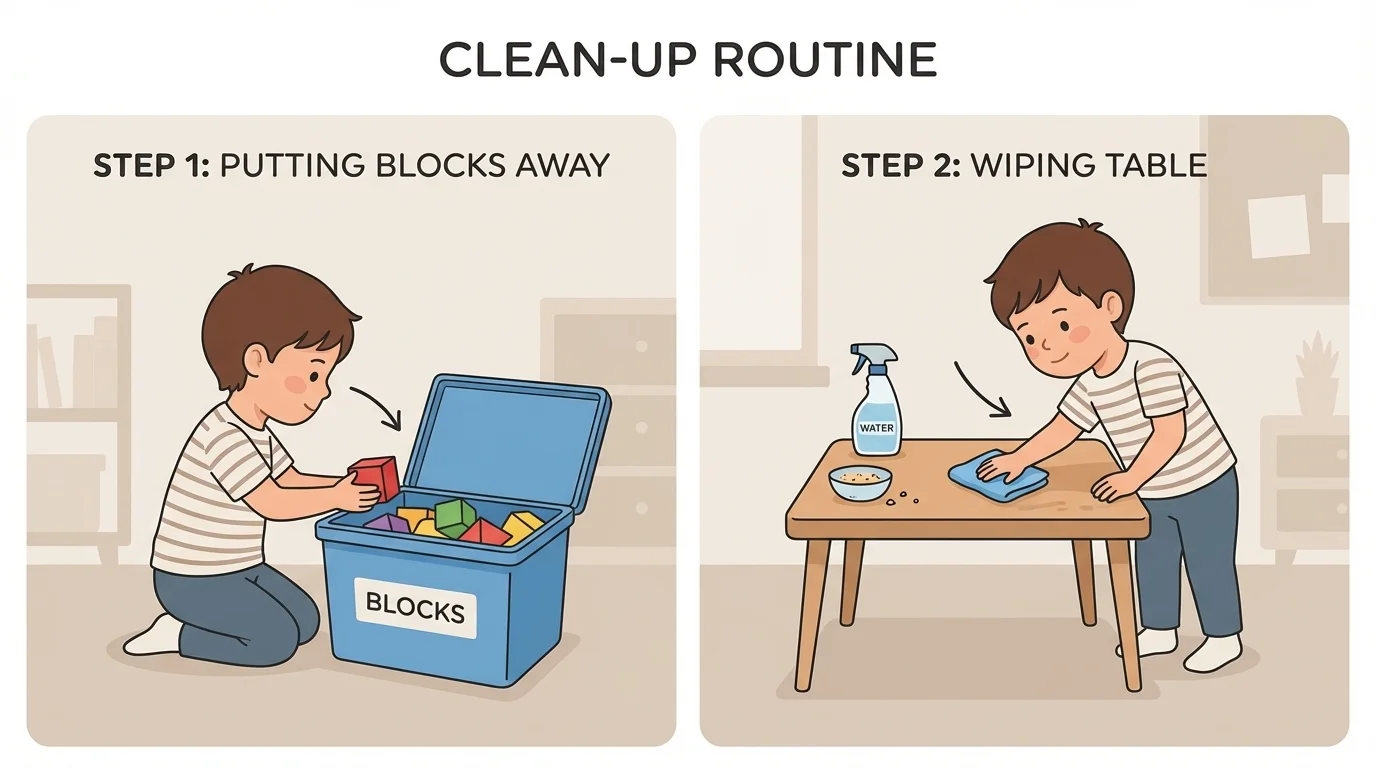
Labels, baskets, and shelves make clean-up easier. When each item has a home, you do not have to guess. Later, when you want to play again, your toys are easier to find. The organized space in [Figure 2] shows how clean-up helps the next activity start better too.
Many young children clean up more easily when they hear the same short song each time. A song can be a clue that tells your brain, "Now it is time to put things away."
If you do not clean up, pieces can get lost, spills can stay messy, and the next activity is harder to start. Clean-up keeps your space safe and calm.
Some tools make routines easier to remember. A picture chart can show the steps. A basket can hold all the things for one activity. A timer can let you know when it is almost time to finish. A grown-up can point to the next step instead of saying many words.
You can keep routines short. Young children do best with just a few steps. Too many steps can feel hard. Simple routines are easier to practice every day.
| Activity | Start | Finish | Clean Up |
|---|---|---|---|
| Toy play | Get toy, go to play spot | Stop and say "done" | Put toys in bin |
| Art | Get paper and crayons | Put crayon down | Stack paper, close crayon box |
| Snack | Wash hands, sit down | Eat, drink, say "all done" | Throw away trash, wipe table |
| Online story | Sit, get device, listen | Close the device when done | Put headphones away |
Table 1. Simple routines for starting, finishing, and cleaning up common home activities.
A timer is helpful when changing from one part of an activity to the next. A short beep or song can mean, "Finish now," or "Clean up now."
Try This: Before playtime, choose one start routine with a grown-up and practice the same steps every day.
Try This: When you finish a snack, say "all done," then do the clean-up steps right away.
Try This: Put pictures on baskets or shelves so you know where things belong.
Example: a simple routine for building with blocks
Start: Get the block bin, carry it to the mat, and sit down.
Finish: Stop building, look at the mat, and say "done."
Clean up: Put blocks back in the bin and return the bin to the shelf.
This routine is short, clear, and easy to remember.
These small steps help you feel ready, help you finish calmly, and help you leave the space neat. Over time, routines become easier and faster because your brain and body remember what to do.
"First, next, last."
— A simple way to remember a routine
When you use simple routines each day, you build confidence. You learn that starting is possible, finishing is important, and cleaning up is part of doing the job well.
