Look around your day for a moment. Before you get to school, many workers have already helped you. Someone may have driven a bus, sold food at a store, fixed a road, cooked breakfast at a restaurant, or cared for people at a clinic. Our world works because people do many different jobs.
A job is work a person does. People work to earn income, which is money they get for doing a job. Families use income to buy things they need and want, such as food, clothes, a home, books, and toys.
Job means the work a person does.
Income means money a person earns from work.
Community means the people who live and work in the same place.
Some people work in the daytime. Some work at night. Some work inside buildings, and some work outside. Some people wear uniforms, and some do not. All of these workers help make life better and safer.
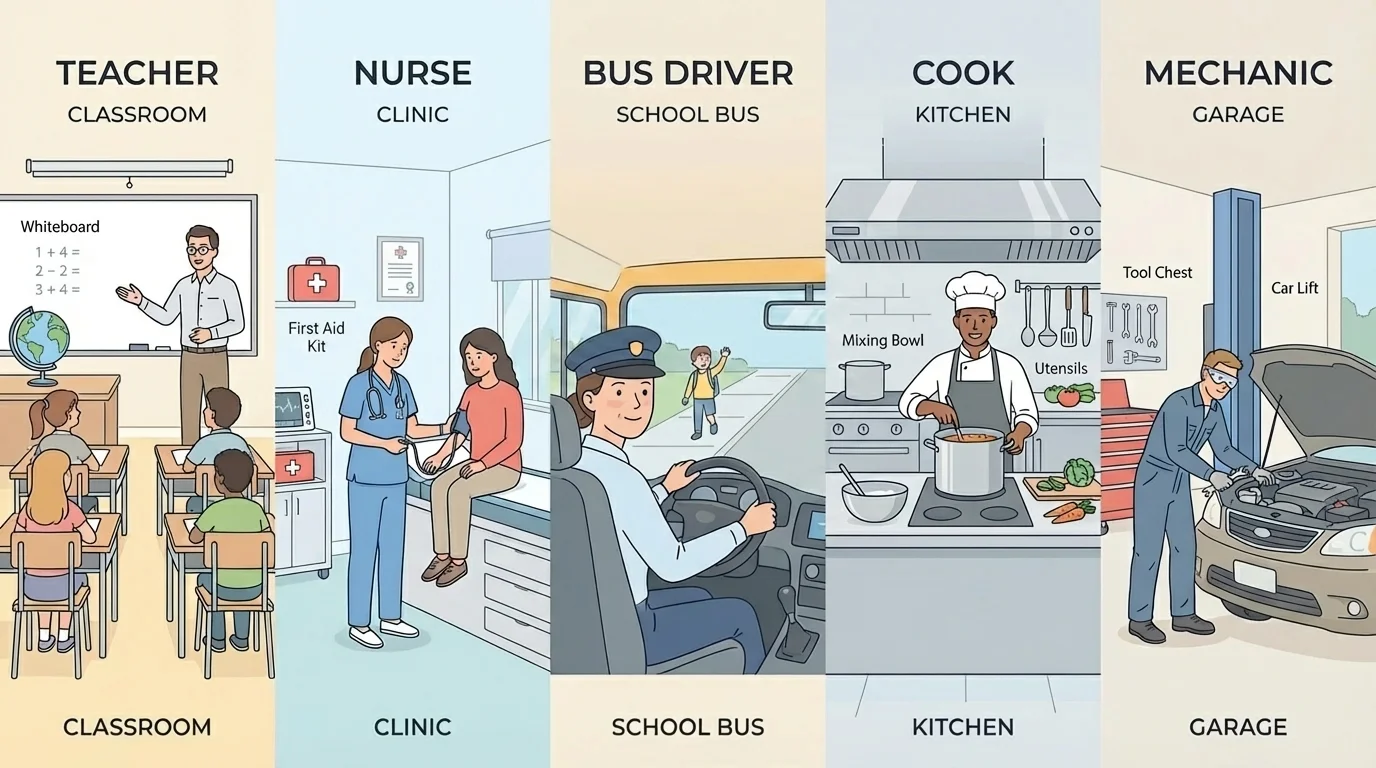
People in a family may have many different kinds of work. One grown-up might be a teacher who helps children learn to read. Another might be a nurse who helps sick people feel better. A family member could be a mechanic who fixes cars, a cook who makes meals, or a bus driver who takes people where they need to go. This variety of work, as shown in [Figure 1], helps children see that families can include many kinds of workers.
Some family members may work in a school, hospital, store, office, farm, factory, or home. Some may build houses. Some may clean buildings. Some may care for babies or older people. Some may cut hair. Others may grow food or fix machines.
Not every family looks the same, and not every family has the same jobs. One child may live with a grandparent who works at a store. Another may live with an aunt who is a police officer. Another may have a parent who works from home on a computer. What matters is that people can do different work to earn income.
Many people have jobs that children do not always see. For example, some workers repair water pipes, deliver packages very early, or answer emergency phone calls to help people quickly.
When we talk about family jobs, we are learning that work can look different from one home to another. A person's job may match what they are good at, what they like to do, and what the community needs.
In every community, people do jobs that help everyone. [Figure 2] shows a neighborhood with workers in different places, reminding us that many jobs happen all around us each day.
A firefighter helps put out fires and keeps people safe. A police officer helps protect people and solve problems. A doctor helps people when they are sick or hurt. A dentist cares for teeth. A mail carrier brings letters and packages. A librarian helps people find books and information.
Stores also need workers. A cashier takes payments. A store worker stocks shelves. A baker makes bread. A farmer grows crops or cares for animals. A truck driver moves food and other goods from one place to another.
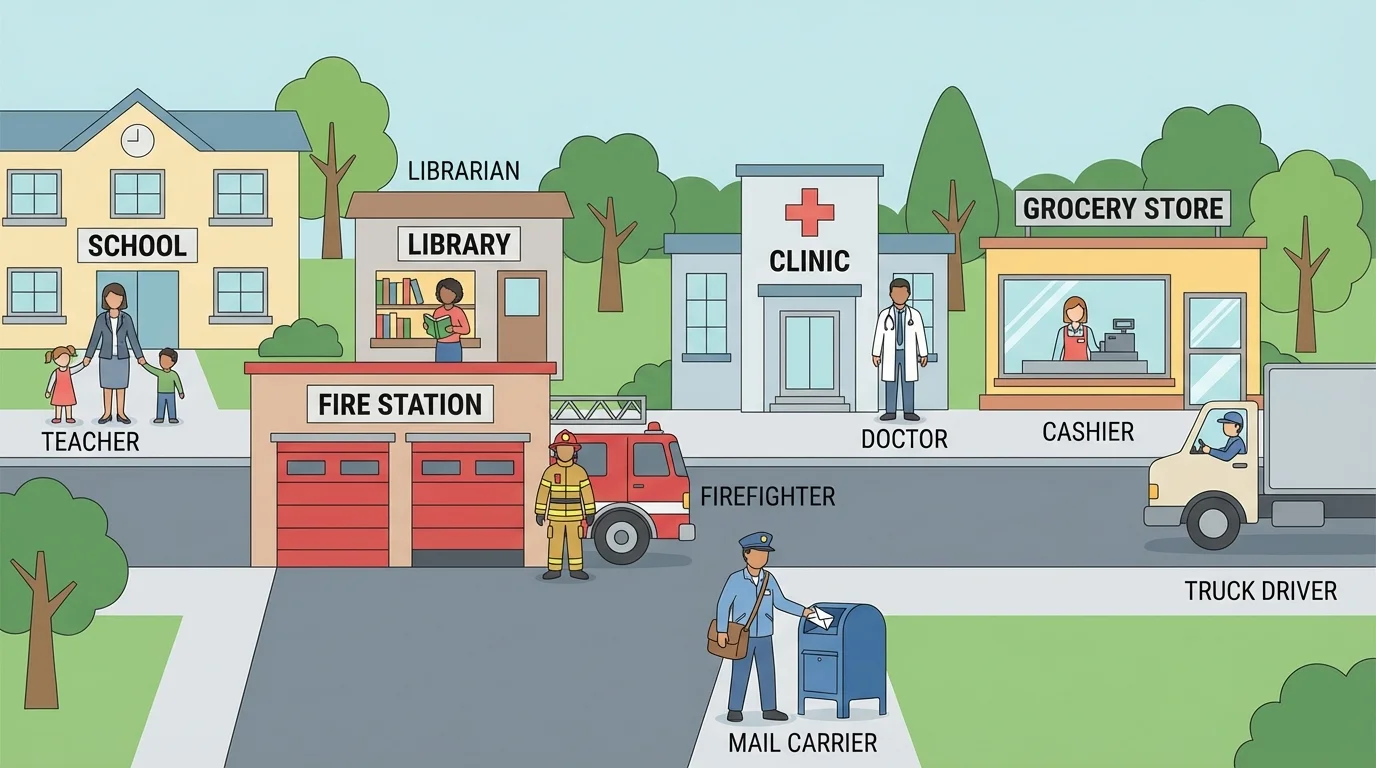
Schools need many workers too. A teacher helps students learn. A principal leads the school. A custodian keeps the building clean. A cafeteria worker prepares food. A bus driver brings children to and from school.
Workers often have special places where they do their jobs, but all of those places are part of the same community.
Jobs can be different depending on where people live. In a farming area, more people may work with crops, tractors, and animals. Near the ocean, some people may fish or work on boats. In a city, many people may work in tall buildings, stores, hospitals, and restaurants.
Some jobs use tools. Some use computers. Some use both. A builder may use a hammer. A dentist may use small tools for teeth. An office worker may use a computer. An artist may paint signs or pictures. A scientist may study plants, weather, or animals.
Different jobs, same big idea
People do not all work in the same way, but they all work to help meet needs. A farmer helps provide food, a teacher helps provide learning, and a doctor helps provide care. Communities are stronger when many kinds of work are done well.
Some jobs make goods, such as bread, tables, or clothes. Some jobs provide services, such as teaching, cutting hair, or delivering mail. Goods are things people can use or hold. Services are actions people do to help others.
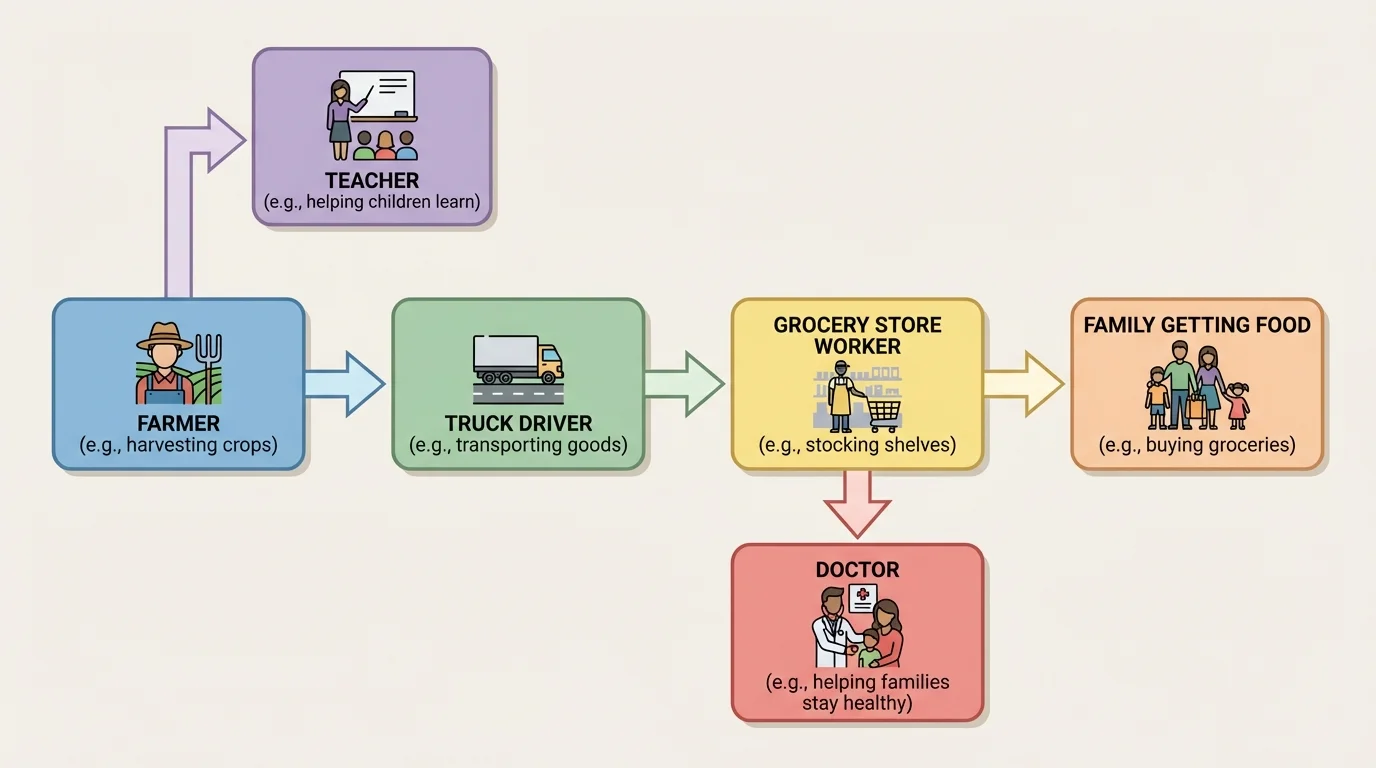
Jobs are connected. A farmer grows food, a truck driver carries it, and a store worker puts it on the shelf. Then families can buy it. This chain of helping teaches us that one job often depends on another job, as shown in [Figure 3].
A school depends on many workers too. Teachers teach children. Custodians clean classrooms. Cafeteria workers make lunches. Bus drivers bring students safely. When all of these people do their jobs, the school can work well.
Hospitals and clinics also need teams. Doctors and nurses care for patients. Reception workers greet families and help with papers. Cleaners keep rooms safe. Drivers may bring supplies. Many jobs work together in one place.
Later, when you think about food in a store or books in a library, remember that communities work best when many people do different jobs to help one another.
Real-life example: One morning in the community
Step 1: A baker gets up early and makes bread.
Step 2: A delivery driver brings the bread to the store.
Step 3: A store worker places the bread on the shelf.
Step 4: A family buys the bread to take home.
Many workers help before one loaf of bread reaches a table.
This is why every job matters. Even when workers do different tasks, they are all part of a larger team in the community.
Sometimes children notice only a few jobs, such as teacher, doctor, or firefighter, because these workers are easy to see. But many other jobs are important too. People repair roads, collect trash, plant gardens, answer phones, care for animals, wash windows, and fix electricity.
We should respect all workers. Work helps families earn income, and it helps communities meet needs. No single job can do everything. Communities need many workers with many skills.
As children grow, they may learn new skills and choose jobs they enjoy. Some may want to teach. Some may want to build. Some may want to heal people, write books, grow food, or invent things. Every kind of honest work can help others.
