What if you found coins in your pocket, under a couch cushion, and in a piggy bank all on the same day? Those tiny coins may look small, but together they can buy a snack, go into savings, or be shared with someone else. When we know how to count coins, we learn how much money we really have.
Money helps us buy things we need and want. We can also keep some money for later. That is called saving. Sometimes people choose to give some money to help others. That is called sharing. To make good choices, we need to know the value of our coins.
A coin is a piece of money made of metal. Different coins have different values. The value tells how many cents the coin is worth.
Value means how much something is worth. For coins, value means the number of cents each coin has.
When we count a collection of coins, we are finding the total amount of money. As [Figure 1] shows, we add the values of all the coins together.
The four common coins are the penny, nickel, dime, and quarter. Each coin has its own value, and learning these values is the first step to counting money.
A penny is worth \(1\) cent. A nickel is worth \(5\) cents. A dime is worth \(10\) cents. A quarter is worth \(25\) cents.
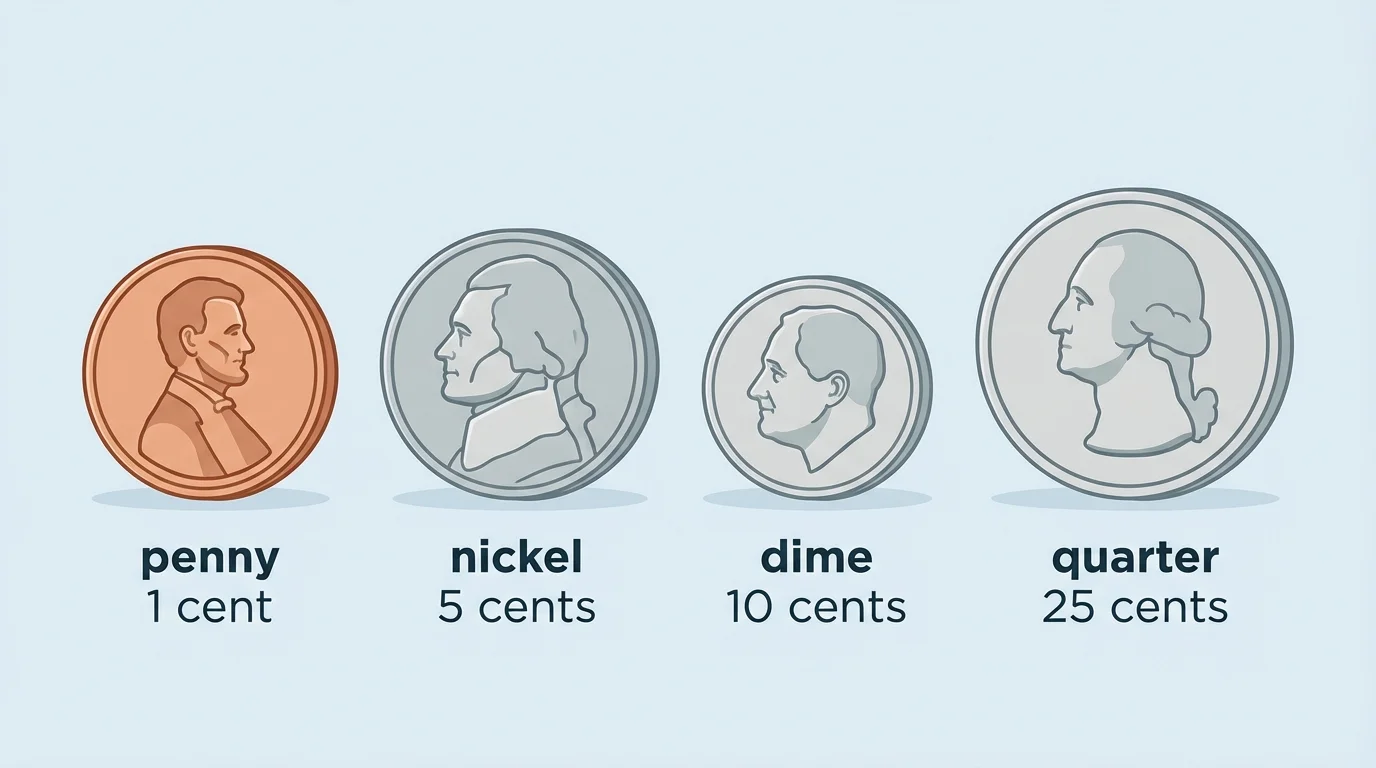
Even though a dime is smaller than a nickel, the dime is worth more. That is why we must count by value, not by size.
| Coin | Value |
|---|---|
| Penny | \(1\) cent |
| Nickel | \(5\) cents |
| Dime | \(10\) cents |
| Quarter | \(25\) cents |
Table 1. The names of common coins and the value of each coin in cents.
When we see a group of mixed coins, it helps to remember these values first. Then we can add carefully.
A quarter is worth the same as \(25\) pennies. That means one coin can have the value of many smaller coins.
This is why [Figure 1] is useful. It reminds us that each kind of coin stands for a different number of cents.
When coins are mixed together, we do not have to count one by one in a messy pile. A collection of coins is easier to count when we sort the coins by kind first.
First, put all the quarters together, all the dimes together, all the nickels together, and all the pennies together. Then count each group by its value. Last, add all the group totals.
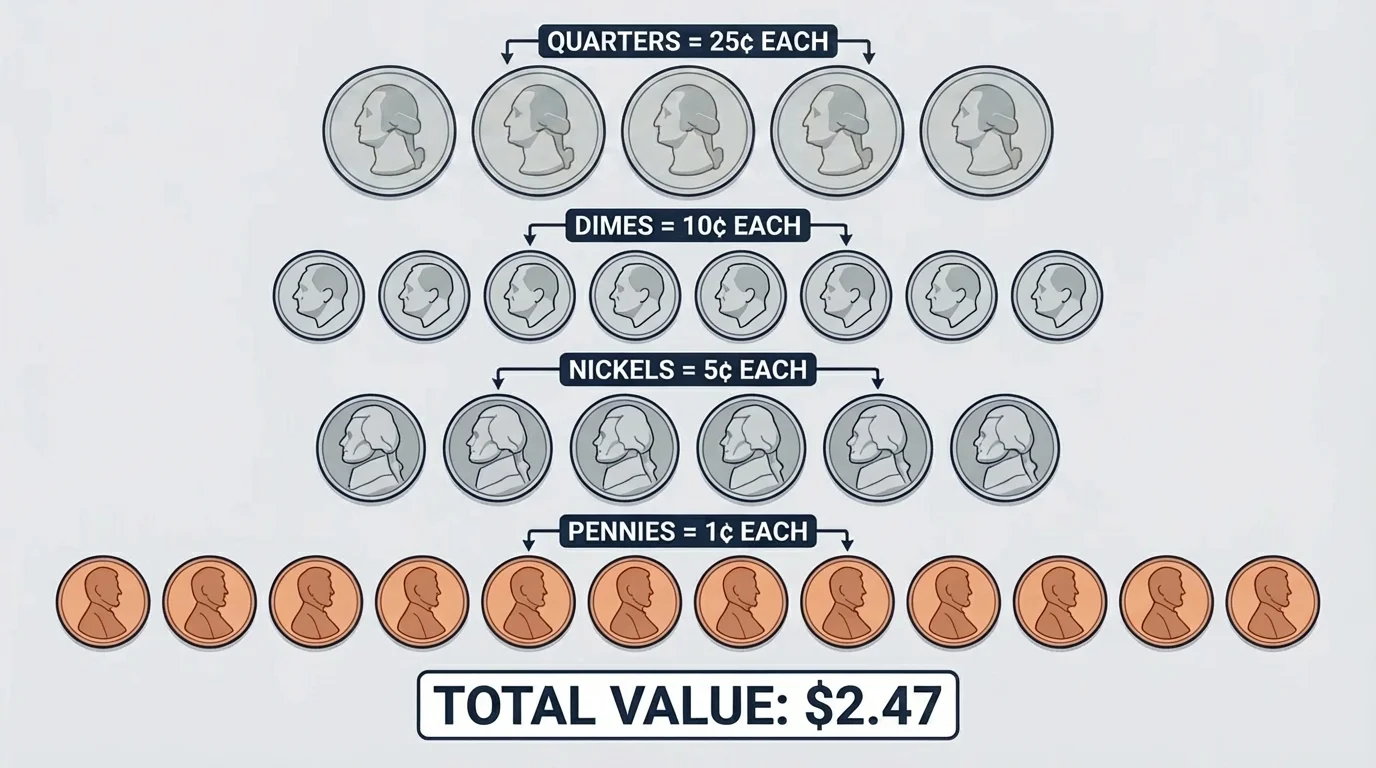
We can use skip-counting for coins that have the same value. For nickels, count by \(5\): \(5, 10, 15, 20\). For dimes, count by \(10\): \(10, 20, 30\). For quarters, count by \(25\): \(25, 50, 75\).
You already know how to add numbers. Counting coins uses the same skill. We just add coin values, such as \(10 + 10 + 5 + 1\).
Pennies are simple because each penny is worth \(1\) cent. If you have \(4\) pennies, the value is \(4\) cents.
Sorting coins, like the groups shown in [Figure 2], helps our eyes and brain stay organized. It also helps us make fewer mistakes.
Let's find the value of a small group of coins.
Worked example
Find the value of \(3\) pennies and \(2\) nickels.
Step 1: Find the value of the pennies.
\(3\) pennies are worth \(3\) cents.
Step 2: Find the value of the nickels.
\(2\) nickels are worth \(5 + 5 = 10\) cents.
Step 3: Add the values.
\(10 + 3 = 13\)
The collection is worth \[13 \textrm{ cents}\]
We can also say the total is \(\$0.13\). For first-grade coin counting, it is often easiest to say the amount in cents.
Now try a group with dimes and pennies.
Worked example
Find the value of \(2\) dimes and \(4\) pennies.
Step 1: Count the dimes.
\(2\) dimes are worth \(10 + 10 = 20\) cents.
Step 2: Count the pennies.
\(4\) pennies are worth \(4\) cents.
Step 3: Add the values.
\(20 + 4 = 24\)
The collection is worth \[24 \textrm{ cents}\]
Dimes are helpful because we can count them by tens. Tens are fast to add.
Sometimes a collection has many different coins. We can still solve it one step at a time.
Worked example
Find the value of \(1\) quarter, \(1\) dime, \(2\) nickels, and \(3\) pennies.
Step 1: Find each group value.
\(1\) quarter \(= 25\) cents, \(1\) dime \(= 10\) cents, \(2\) nickels \(= 10\) cents, and \(3\) pennies \(= 3\) cents.
Step 2: Add the values.
First add the larger values: \(25 + 10 = 35\).
Then add the nickels: \(35 + 10 = 45\).
Then add the pennies: \(45 + 3 = 48\).
The collection is worth \[48 \textrm{ cents}\]
Starting with the greatest-value coins can make counting easier. Many students like to count quarters first, then dimes, then nickels, then pennies.
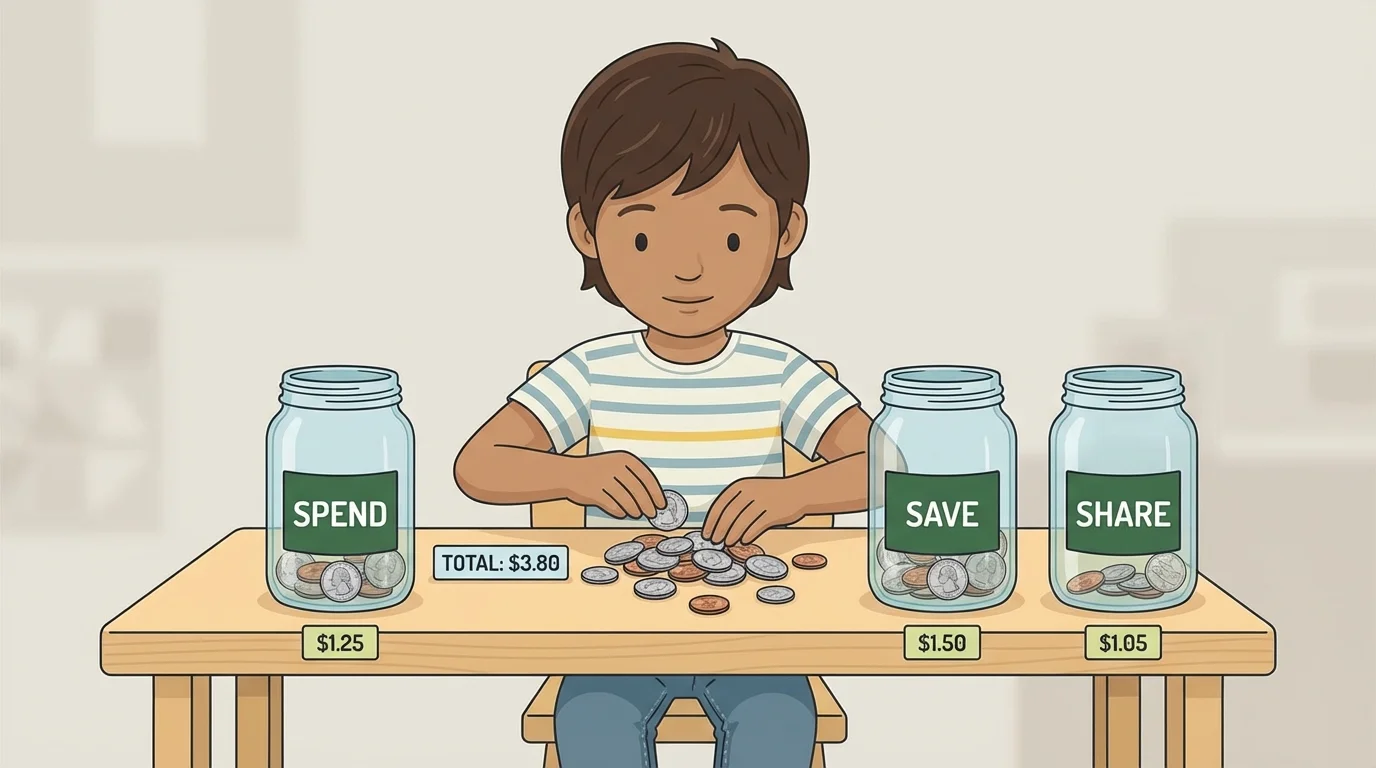
Knowing the value of coins helps us make real money choices. A child might count coins to see whether there is enough money to buy a pencil, save for a toy, or give some coins to a classroom fundraiser. The jars show how one group of coins can be used in different ways.
If you have \(30\) cents, you might spend \(10\) cents, save \(15\) cents, and share \(5\) cents. We can check that with addition: \(10 + 15 + 5 = 30\).
Counting coins helps you know what choices are possible. If a snack costs \(\$0.25\), then a quarter is enough. If you only have \(2\) dimes, you have \(20\) cents, so you need \(5\) more cents.
Coins help with planning
When we know how much money we have, we can decide what to do with it. We may spend money now, save money for later, or share money to help others. Counting coins helps us make those choices carefully.
The idea from [Figure 3] is important: the same total amount can be split in different ways. Good money habits begin with knowing the total correctly.
Sometimes students make mistakes by counting the number of coins instead of the value of the coins. For example, \(3\) coins do not always mean \(3\) cents. A dime, a nickel, and a penny are \(10 + 5 + 1 = 16\) cents.
Another good check is to ask, "Does my answer make sense?" If you have a quarter and a penny, the total must be more than \(25\) cents. Since \(25 + 1 = 26\), the answer is \(26\) cents.
You can also count the larger coins first and then count again a different way. If both ways give the same total, your answer is likely correct.
"Count the value, not just the coins."
When you learn coin values well, counting money becomes quicker and easier every time you do it.
