Have you ever seen someone pick up trash at a park, bring food to a neighbor, or help at a school event? Those actions may seem small, but they can make a big difference. Communities grow stronger when people help one another. A place is not just buildings and streets. It is also the people who care for it.
A community is a group of people who live, learn, work, or play together. Your class is a community. Your neighborhood is a community too. A civic responsibility is something people should do to help their community stay safe, fair, and caring. These are actions that show we care about other people, not just ourselves.
Civic responsibility means helping your community by acting in ways that are safe, kind, fair, and helpful. Volunteering means choosing to help without being paid.
Some civic responsibilities are things adults do, like voting or serving on a town board. Other civic responsibilities are things children can do too, such as following school rules, sharing supplies, helping clean up, and being kind to neighbors. When people do their part, life is better for everyone.
Helping a community is not only about big jobs. Small acts matter. Returning library books, taking turns, helping a younger child, and caring for shared spaces are all ways to be responsible. These actions build trust. Trust helps people feel that they belong.
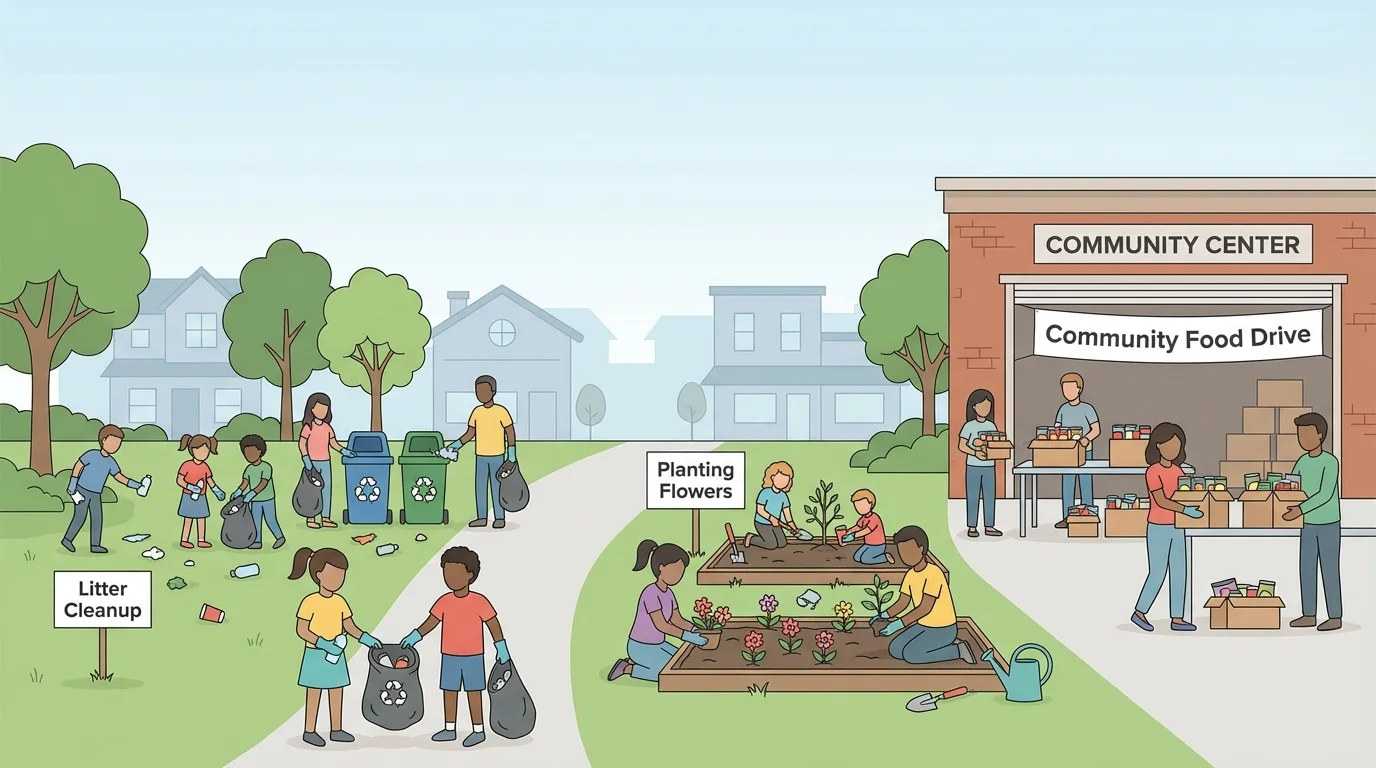
People volunteering in many ways, as [Figure 1] shows in a busy neighborhood scene. A person might serve food at a pantry. Another might help plant flowers at a park. A group of students might collect books for a classroom. All of these actions support the community.
Some people help by keeping shared places clean and safe. They pick up litter, recycle, or help paint a playground fence. Others help by visiting older neighbors, reading to children, or gathering coats in winter. Helping can happen at school, at home, at a park, at a library, or at a community center.
There are also responsibilities that are not called volunteering but still help everyone. Following rules, listening to crossing guards, waiting your turn, and treating others with respect keep communities orderly and safe. Being honest and kind matters too. A strong community needs both action and good behavior.
Many community helpers are volunteers. They give their time because they want others to feel safe, healthy, and welcome.
When many people each do a little, a lot gets done. One person may donate one can of food. Another person may donate one book. Someone else may help carry supplies. Together, those small acts become something big.
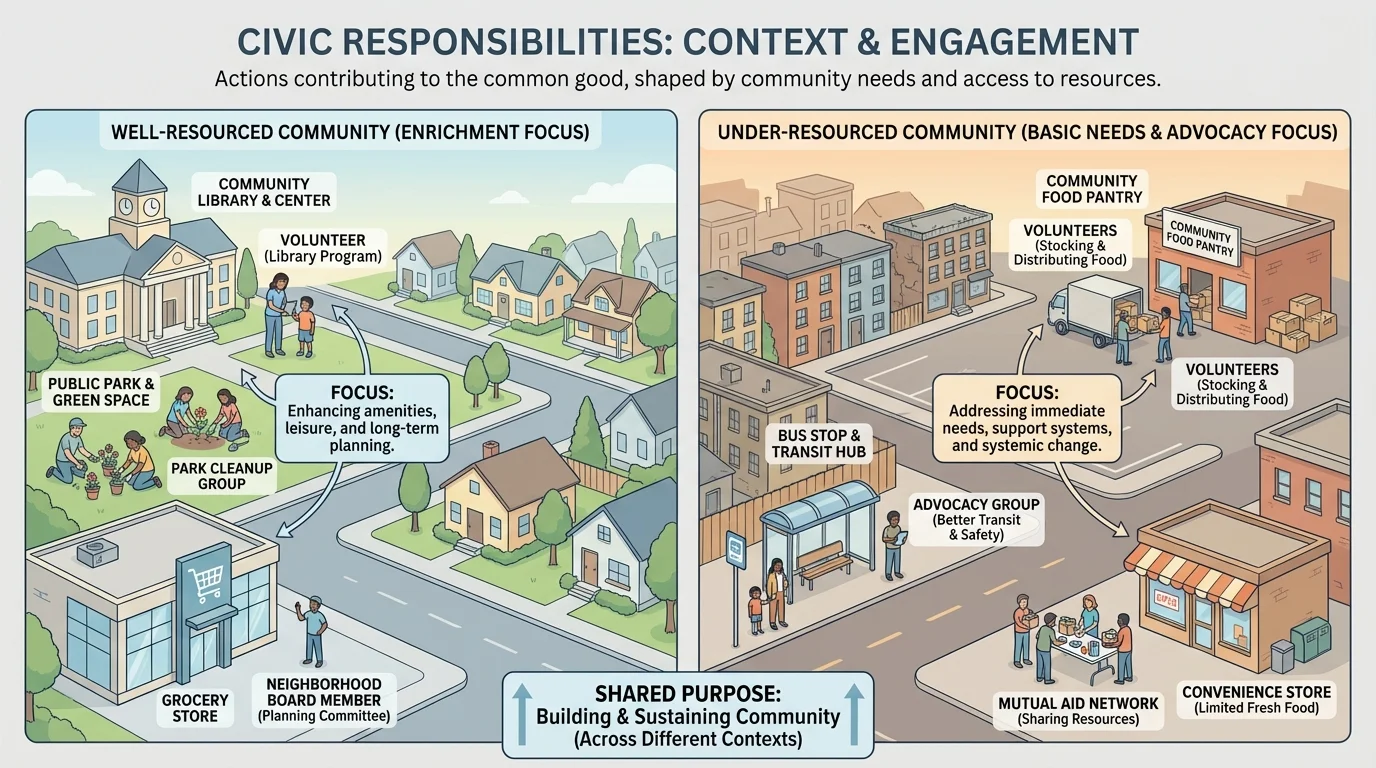
Not every person or family has the same needs. Some people have more advantages, and some face harder challenges. A person who is privileged has advantages or easier access to things like food, transportation, good housing, or safe parks. A person who is marginalized may be left out or may have fewer chances to get what they need.
As [Figure 2] shows, one family may have a car, a nearby grocery store, and plenty of books at home. Another family may live far from a store or library, may not have transportation, or may need extra help getting food, school supplies, or medical care. Both families are important. Both deserve respect. But they may need different kinds of support.
This is why civic responsibilities matter so much. Helping is not just about doing the same thing for everyone. Sometimes it means noticing who needs extra support. Fairness does not always mean everyone gets the exact same thing. Fairness can mean giving people what they need so they can do well.
Why needs can be different
People are not all starting from the same place. Some have more resources, and some have fewer. A caring community pays attention to those differences and tries to remove barriers so more people can participate, feel safe, and succeed.
A barrier is something that gets in the way. A broken sidewalk can be a barrier. No books in a home can be a barrier to reading practice. No warm coat in winter can be a barrier to comfort and health. Civic responsibility includes seeing barriers and helping reduce them.
The same helpful action can matter in different ways, and [Figure 3] shows this clearly. A park cleanup helps everyone because the park looks nice and feels safer. It may help a privileged family enjoy a cleaner place to play. It may help a marginalized family even more if that park is one of the few safe play spaces nearby.
A food drive also helps different people in different ways. Some families may join the drive by donating food. Other families may need to receive food. Both groups are part of the same community. The responsibility is important to all because it teaches sharing, care, and teamwork. But it can be especially important to families who do not always have enough to eat.
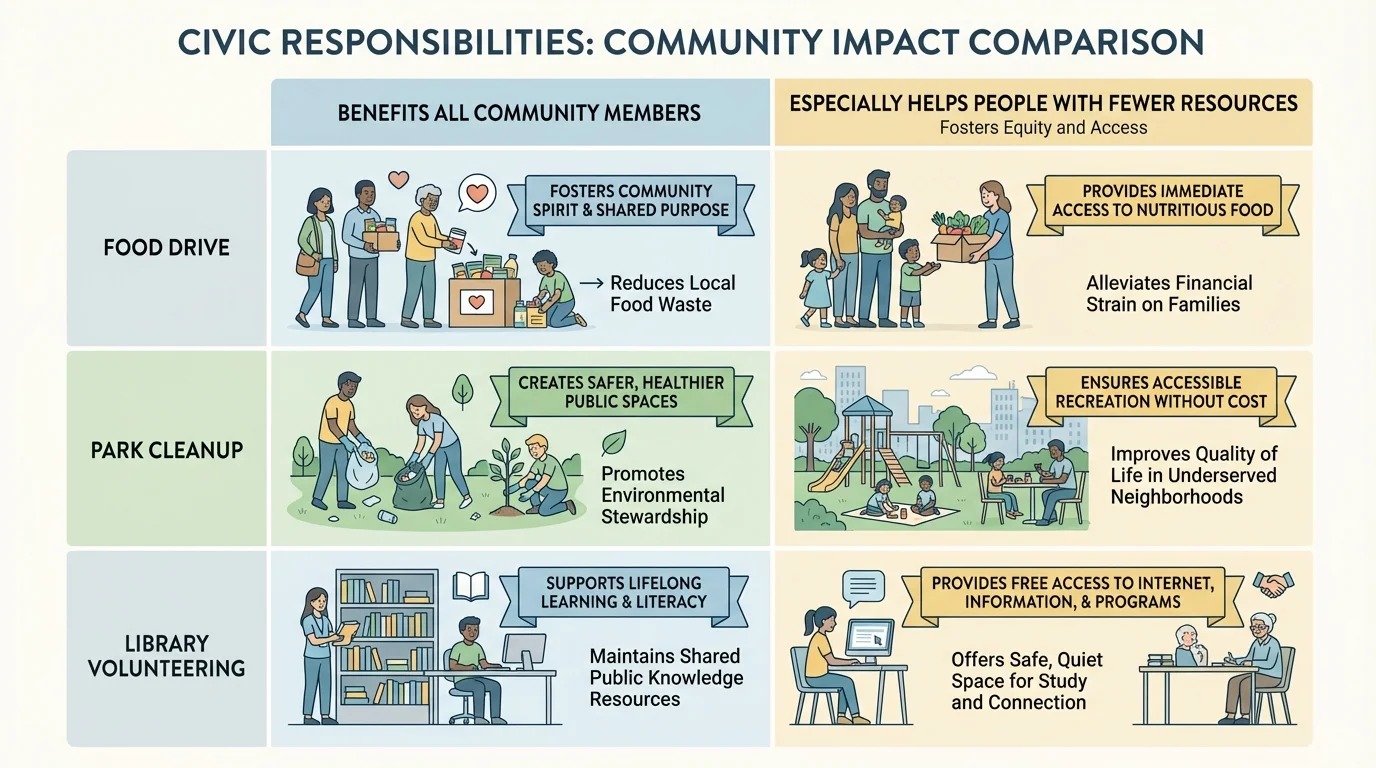
Helping at a library is another example. It helps all children enjoy books and learning. Yet it may be especially important for children who do not have many books at home. One action can support everyone while also giving extra support where it is needed most.
| Community action | How it helps many people | Why it may matter even more to some people |
|---|---|---|
| Food drive | Encourages sharing and care | Helps families who need more food |
| Park cleanup | Makes shared spaces cleaner and safer | Supports people who rely on that park the most |
| Library help | Gives access to reading and learning | Supports children with fewer books at home |
| Coat collection | Shows kindness in cold weather | Helps people who do not have warm clothing |
Table 1. A comparison of community actions and how they help different groups.
Comparing examples helps us think carefully. We can ask: Who is helped? How are they helped? Does this action help everyone, or does it especially help people who have fewer resources? Good civic thinking includes asking these questions.
Being helpful also means being respectful. Sometimes people think they know what others need, but the best way to help is often to listen. If a school is collecting donations, it should gather things people truly need. If a playground is being improved, it helps to ask families what would make it safer and more welcoming.
Listening matters because people understand their own lives. A family might need school supplies more than toys. A neighbor might need a ride more than extra food. A child might need a quiet place to read. Civic responsibility is stronger when it is guided by kindness and by listening carefully.
Case study: One school, two helpful projects
A class wants to help the community. The students think about two projects: cleaning the school garden and collecting backpacks.
Step 1: Think about who is helped.
The garden cleanup helps everyone enjoy a beautiful outdoor space at school.
Step 2: Think about special needs.
The backpack collection especially helps students who may not have enough school supplies.
Step 3: Compare the projects.
Both are good civic actions. One improves a shared place for all. The other gives extra support to children who may need it most.
This comparison shows that communities need many kinds of help.
Fairness and kindness work together. A fair community notices when some people are left out. A kind community chooses to help. When people do both, communities become stronger, safer, and more welcoming.
Children do not need to wait until they are grown up to help. You can be a good community member right now. You can include others in games, pick up trash, share classroom tools, and use kind words. You can help carry books, make welcome cards, or donate gently used coats and books with an adult.
You can also notice who may need extra care. Is someone sitting alone? Is a younger child confused? Is a shared space messy or unsafe? Paying attention is part of civic responsibility. Helping begins when we notice.
Back in the neighborhood scene in [Figure 1], people work together because communities are built by many hands. The family comparison in [Figure 2] reminds us that people do not all have the same advantages. When we remember both ideas, we become wiser helpers.
"A community grows strong when people help each other."
When you act with care, you help create a place where more people can belong. That is what civic responsibility is all about. It is not only helping when it is easy. It is also helping with fairness, respect, and understanding.
