If you travel just a short distance, you may notice big changes. One place may have tall buildings and busy streets, while another has open fields and barns. A place near water may feel different from a place on dry land. Geographers study these patterns to understand how places are connected. That is how we learn about regions.
A region is an area that has features in common, as [Figure 1] shows with different nearby areas grouped by shared traits. A region can be large, like the Midwest, or small, like one part of your county. We call places part of the same region when they are similar in important ways.
Some regions are based on physical features. These include land, water, plants, and weather. For example, a mountain region has high land and steep slopes. A coastal region is next to an ocean or sea. A desert region is dry and gets little rain.
Other regions are based on human features. These include how people live, work, build, and travel. A farming region may have many fields, tractors, and grain elevators. A city region may have apartment buildings, stores, buses, and many people living close together.
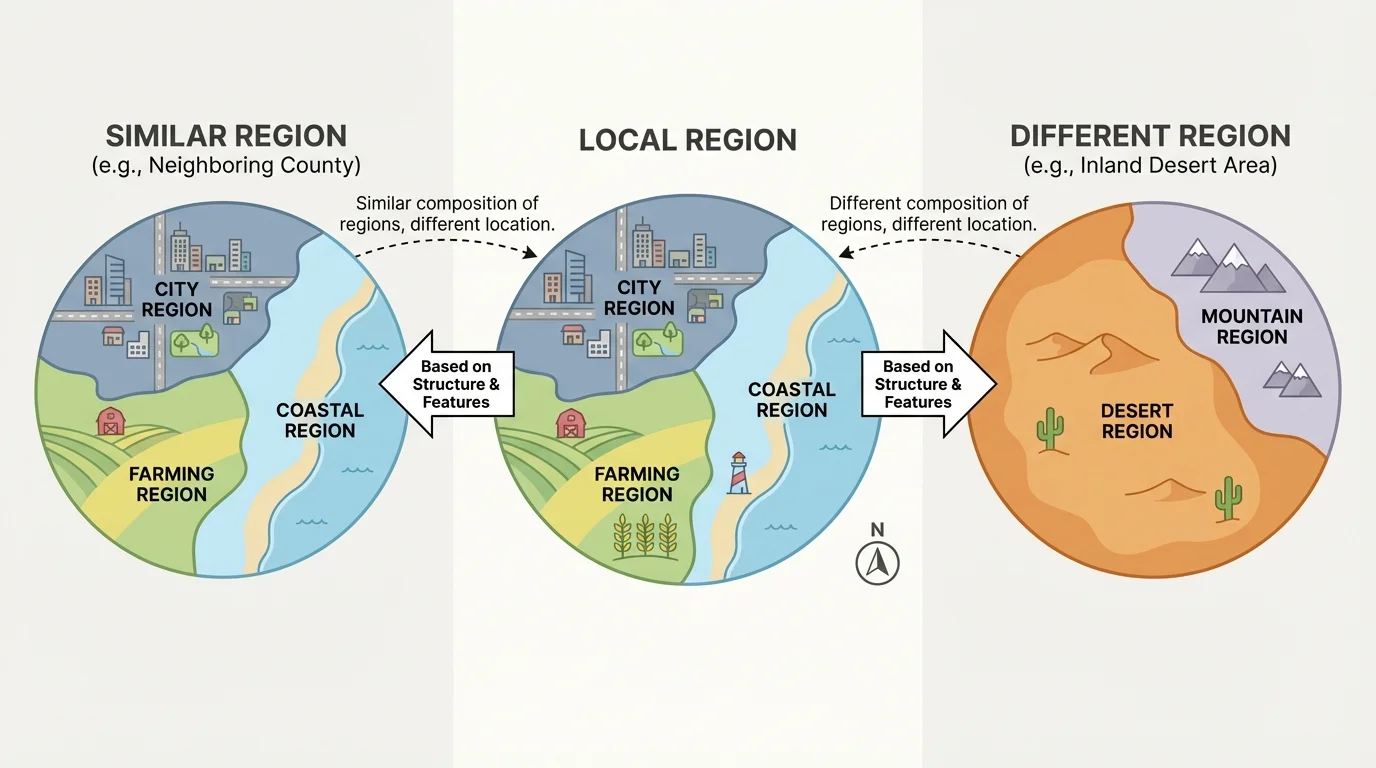
A place can belong to more than one region at the same time. A town might be in a river region because it is near a river, and it might also be in a farming region because many people grow crops there. Regions help us organize the world so we can describe places clearly.
Region means an area with one or more features that are alike. The shared features may be natural, such as land and weather, or human, such as jobs and buildings.
When geographers compare places, they ask, "What is alike?" and "What is different?" Those questions help us see patterns. Patterns make it easier to understand why people live in certain ways in different places.
To compare places, geographers look at both natural surroundings and people's activities. In [Figure 2], the same kinds of features are compared across communities. Looking carefully at these features helps us decide whether places belong to the same region.
One important way to compare places is by climate. Climate is the usual weather a place has over time. Some places are warm most of the year. Some are cold for many months. Some are rainy, and some are dry. Climate affects what plants grow there, what people wear, and what kinds of homes they build.
Another way is by looking at landforms. Landforms are the shapes of the land, such as plains, hills, mountains, valleys, and beaches. Flat plains are good for large farms. Mountains may have winding roads and smaller towns. Coastal beaches may attract visitors and jobs related to fishing or tourism.
We also compare places by population, transportation, jobs, and buildings. A crowded city has many roads, buses, and stores. A rural area may have fewer roads, more open land, and homes spread far apart. These differences help us understand different communities.
| Feature | Questions to Ask | Example |
|---|---|---|
| Land | Is it flat, hilly, or mountainous? | Plains are flatter than mountains. |
| Water | Is it near a river, lake, or ocean? | A coastal town is near the ocean. |
| Climate | Is it usually warm, cold, wet, or dry? | A desert is usually dry. |
| Jobs | What kinds of work do people do? | Farmers work in agricultural regions. |
| Buildings | Are there farms, houses, or tall buildings? | Cities often have tall buildings. |
| Transportation | Do people travel by car, bus, boat, or train? | Large cities may have subways. |
Table 1. Questions and examples geographers use when comparing places and communities.
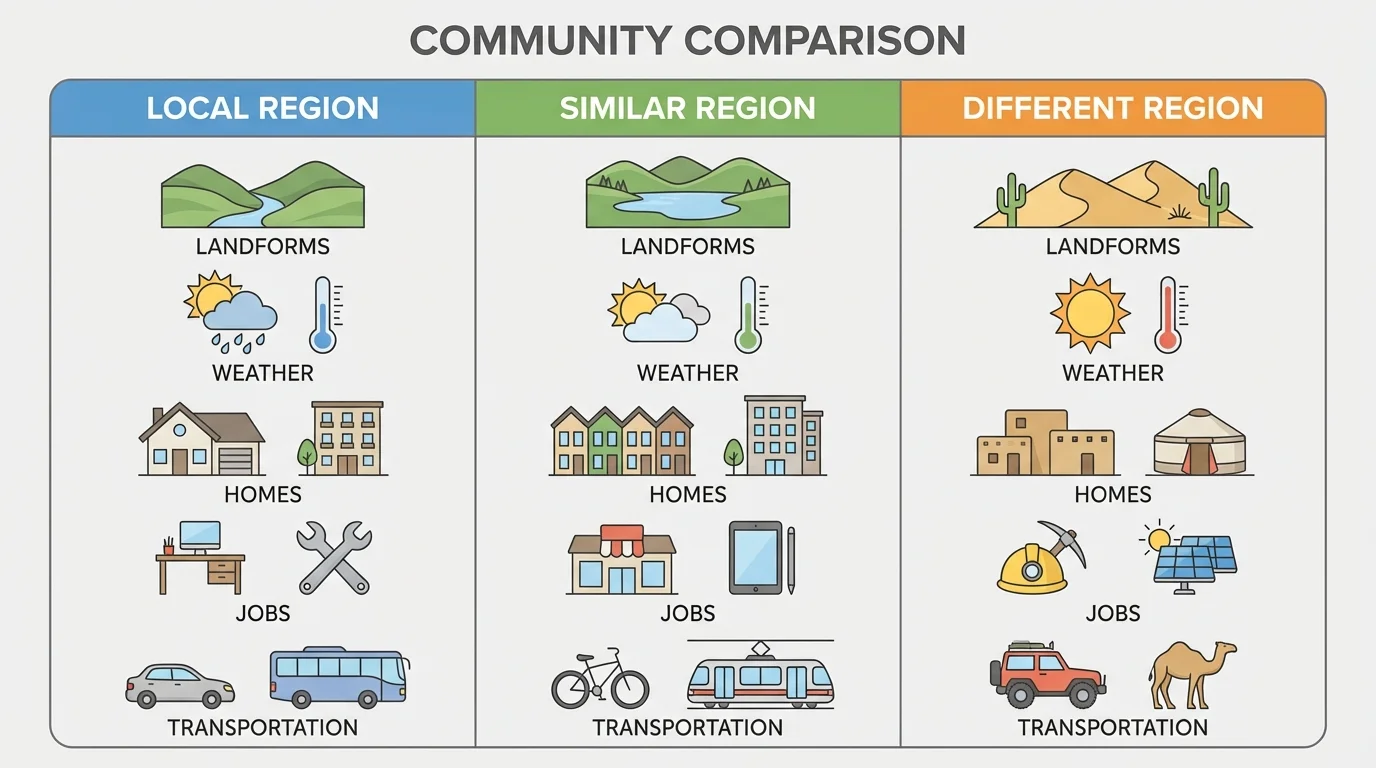
When we use these clues together, we get a fuller picture of a place. A town with beaches, boats, and warm weather may fit into a coastal region. A community with fields, barns, and tractors may fit into a farming region. As we saw in [Figure 2], one feature alone is not always enough. We often need several features to understand a region.
Your local region is the area where you live and the nearby places around it. It may be a town, a city neighborhood, a farming area, or a suburban community. Even if students in the same class live close to one another, they may notice different details about the local region.
If your local region has many houses, schools, parks, and stores, it may be part of a suburban or city region. If it has fields, barns, and livestock, it may be part of a rural farming region. If it is close to a river, lake, or ocean, water may be an important feature of the region.
People in a local region often share routines. They may shop at similar stores, use the same roads, and take part in the same kinds of community events. They may also deal with the same weather patterns. These shared experiences help shape a region.
Remember that a community is a place where people live, work, and do things together. A region is bigger than one community, but it can include several communities that are alike in some way.
Thinking about your local region gives you a starting point. Once you understand the place you know best, it becomes easier to compare it with places that are near or far away.
Some places are similar to your local region because they share climate, land, or ways of life. If you live in a farming area, another farming area in a different state may seem familiar. Both may have flat land, fields of crops, silos, and small towns. Even if the names are different, the pattern of life may feel much the same.
For example, a student who lives in eastern Nebraska might see similarities with parts of Kansas or Iowa. These places often have rich soil, farms, and communities connected to agriculture. People may grow corn or soybeans, raise animals, and use trucks and tractors for work.
If you live in a coastal town, you may notice similarities with another coastal town far away. Both places may have beaches, harbors, fishing boats, and jobs related to tourism. Salt water, sea breezes, and storms from the ocean may affect both places.
A student from a busy city neighborhood may find that another large city has many of the same features: apartment buildings, traffic, sidewalks, stores, schools, and public transportation. Cities may differ in size, but they can still be part of similar urban regions because many people live and work close together.
Case example: Similar farming regions
Compare a local farming region in Nebraska with a farming region in Iowa.
Step 1: Look at land and climate.
Both places have broad plains and good soil for crops.
Step 2: Look at jobs.
Many people in both places work in farming, ranching, or businesses that support farms.
Step 3: Look at communities.
Both regions may have small towns, grain elevators, county roads, and school communities connected to agriculture.
These similarities help geographers place both areas in a farming region.
Places do not need to be exactly the same to be similar. They just need to share important characteristics. That is one of the main ideas in geography: regions are about patterns, not perfect matches.
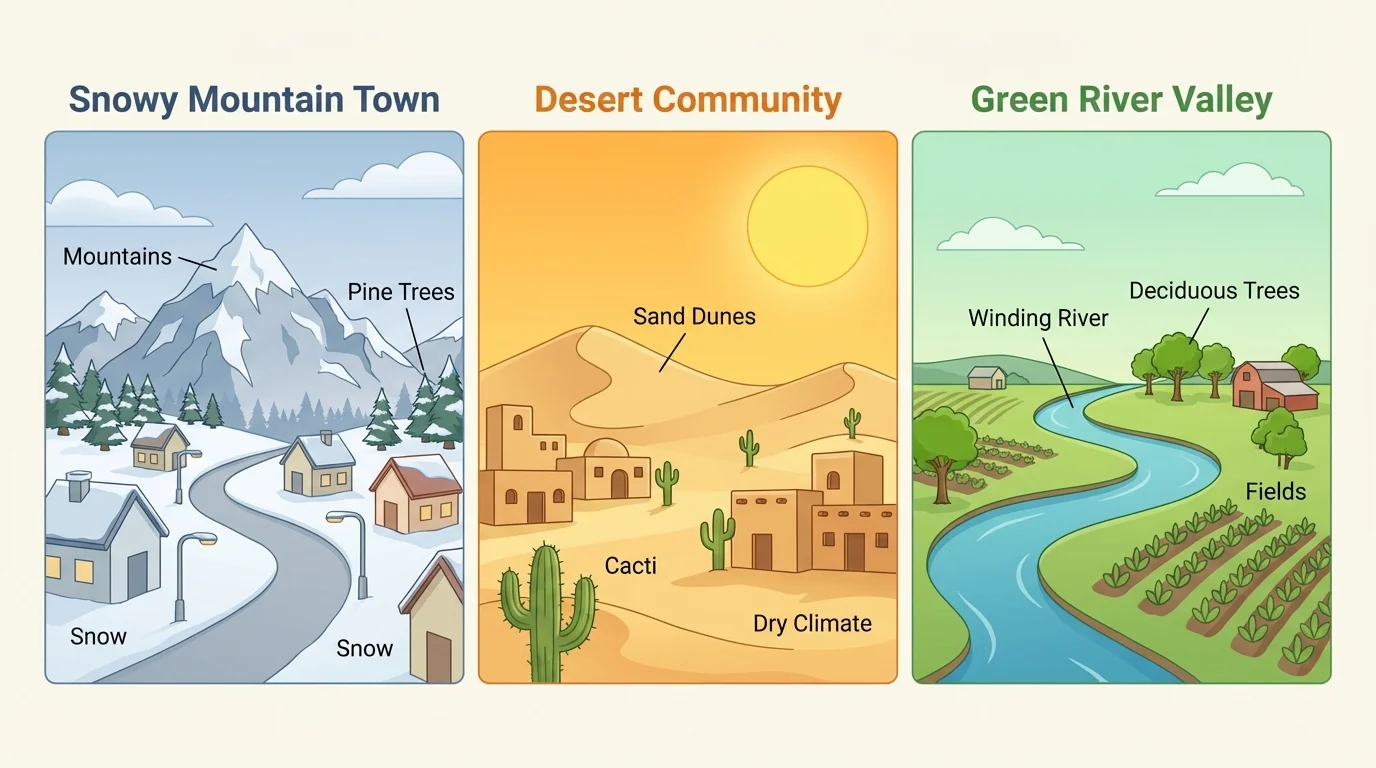
Some places feel very different because of climate, land, and daily life, as [Figure 3] illustrates with sharply different environments. A flat farming region may be very different from a snowy mountain town or a hot desert community.
If your local region has green fields and regular rainfall, a desert region may seem surprising. Desert regions often have sandy or rocky land, little rainfall, and plants that can live with less water. Homes, clothing, and jobs may be different because people must adapt to dry conditions.
If your local region is warm and flat, a mountain region may be different in many ways. Mountain communities may have colder temperatures, steep roads, forests, and winter sports. Travel may be harder because roads curve around hills or become snowy in winter.
A big city can also be very different from a rural area. In a rural region, houses may be far apart, and people may drive long distances. In a city region, buildings are close together, traffic is heavy, and more people may walk or ride buses and trains.
A coastal region may differ from an inland region too. Coastal communities often deal with tides, beaches, ports, and storms from the ocean. Inland communities may depend more on rivers, highways, farming, or factories. As shown earlier in [Figure 3], different natural settings often lead to different ways of living.
Some regions get so much snow in winter that schools, roads, and jobs must plan for it every year, while other regions may go for years without seeing any snow at all.
Differences do not make one region better than another. They show how people and places adapt to different environments. Geography helps us understand and respect these differences.
Regions are useful, but they are not always exact. Borders between regions can be fuzzy. One place may have features of two different regions. A town at the edge of a city may still have some farms nearby. A river town may also be part of an industrial region if many factories are there.
Regions can change over time. A small town may grow into a suburban area if more people move there and more houses are built. A farming area may add factories or stores. New roads can connect places and change how people live and work.
This means geographers keep observing places. They do not just memorize names on a map. They study how land, people, and activities fit together and how those patterns may change.
Why overlap matters
A region is a tool for understanding the world. Because real places are complex, a single community may fit into several regions at once. That overlap helps us describe a place more accurately instead of forcing it into only one category.
Thinking this way helps students become careful observers. You start to notice that places are connected by similarities, but they also stay unique because of their differences.
Across the United States, students can compare regions that share some features and differ in others. Looking at these examples helps show how geography shapes communities, and [Figure 4] marks four example regions in different parts of the country so their locations are easier to compare.
One example is the Great Plains farming region. This area has wide open land, many farms, and towns that often depend on agriculture. The land is mostly flat, which helps with planting and harvesting crops.
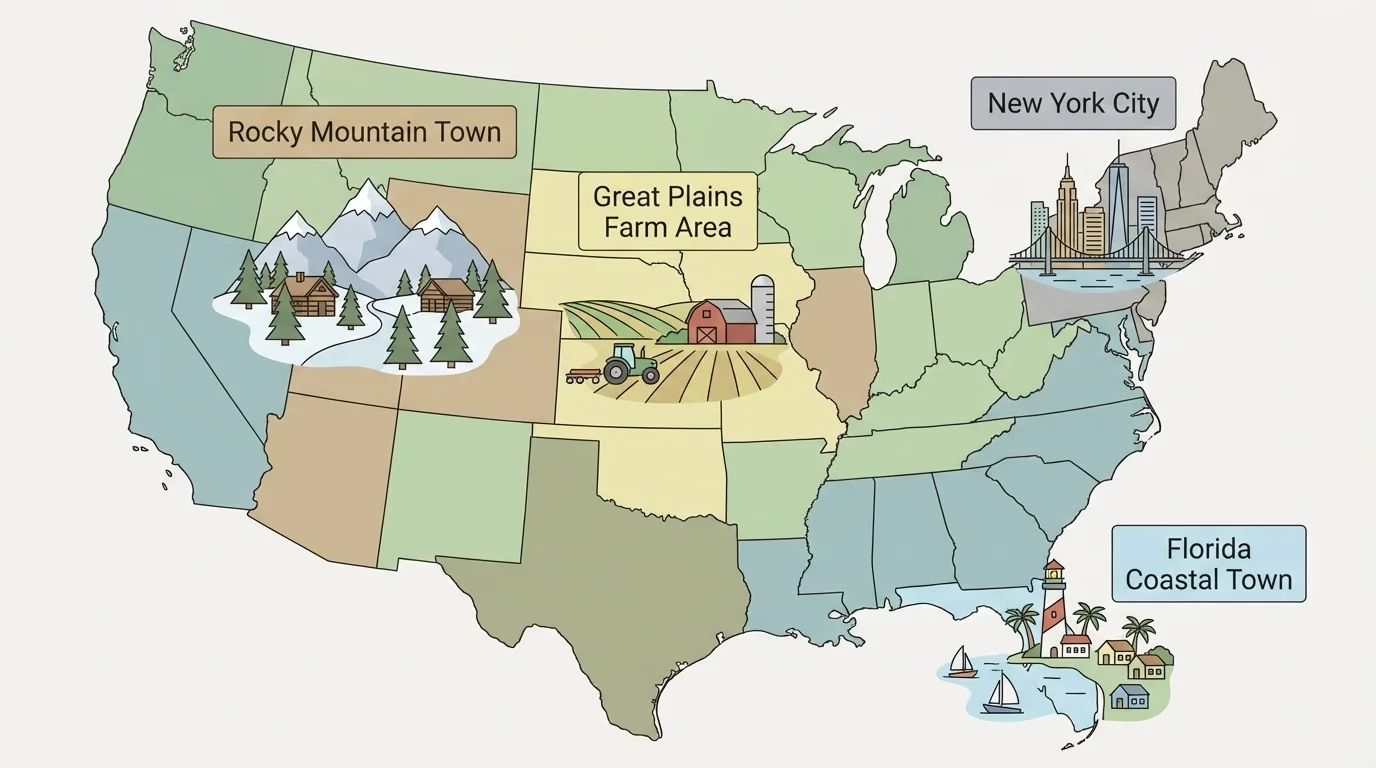
Another example is a coastal town in Florida. This region has warm weather, beaches, and access to the ocean. Fishing, tourism, and boating may be important parts of life there. Compared with the Great Plains, it has more coastal features and different weather risks, such as hurricanes.
A third example is a mountain community in Colorado. It has high elevation, cooler temperatures, and steep land. Skiing and outdoor recreation may be important. Compared with both the Great Plains and Florida coast, travel and building can be affected more by slopes and snow.
A fourth example is New York City. It is a dense urban region with very tall buildings, many people, and many kinds of transportation. Compared with a rural farming community, it has less open land and a much larger population. Compared with a mountain town, it has a very different landform and daily pace of life.
These four places are all in the same country, yet they are not the same kind of region. [Figure 4] shows that distance and location matter, but shared features matter too. Two coastal towns may be more alike than a coastal town and an inland farm area, even if they are in different states.
| Place | Main Features | How It Compares to a Local Region |
|---|---|---|
| Great Plains farm area | Flat land, crops, small towns | Similar to other farming regions |
| Florida coastal town | Ocean, beaches, tourism, warm climate | Similar to other coastal regions, different from inland areas |
| Colorado mountain town | High land, cooler weather, steep roads | Different from flat plains or large cities |
| New York City | Tall buildings, dense population, public transit | Similar to other large cities, different from rural areas |
Table 2. Four example regions and the features that make them similar to or different from other places.
Knowing about regions helps people make decisions. Farmers need to know about soil, rainfall, and seasons. Builders need to know whether land is flat or steep. Travelers need to know what weather to expect. Communities also plan roads, schools, and businesses based on where they are.
Regions also help us understand other people. If we know a place has a cold climate, we can understand why warm clothing, snowplows, and heated buildings matter there. If we know a place is near the ocean, we can understand why boats, ports, and storm planning are important.
Geography is not only about maps. It is about noticing how places work. When you compare your local region to other places, you learn to ask strong questions and look for evidence. That helps you describe the world more clearly.
"Places can be different in many ways, but patterns help us understand them."
The more you compare places, the more you see that every region has a story. Some stories are told by rivers, mountains, and climate. Others are told by people, jobs, homes, and transportation. Together, these details help us explain why places are similar and different.
