What if you went to a store with a basket of apples and tried to trade them for a backpack? The store worker might smile, but they would probably ask you to pay with money instead. That is because money makes buying and selling much easier. All over the world, people use money every day to get the things they need and want.
Money helps people exchange goods, which are things you can touch like shoes, books, or bananas, and services, which are jobs people do for others like cutting hair, fixing a bike, or teaching a class. People who make or sell goods and services are part of the economy. Money is one of the main tools that helps the economy work.
Money is something people use to buy goods and services. Currency is the kind of money used in a place or country. A producer is a person or business that makes or sells goods or services. A consumer is a person who buys and uses goods or services.
When we learn about money, we also learn how people exchange things in different ways. Long ago, people often traded items directly. Today, money is the most common way people exchange goods and services because it is simpler, faster, and fairer.
Before money was widely used, people often used barter. Barter means trading one good or service for another without using money. For example, one person might trade eggs for bread, or someone might trade help fixing a fence for a basket of vegetables.
Barter can work, but it can also be hard. Suppose one child has a toy and wants a sandwich. The other child may want a pencil instead of a toy. Then the trade does not work. People need a better way to exchange things when they do not want the same items at the same time.
Money solves that problem. Instead of trading apples for a backpack, a farmer can sell apples for money. Then the farmer can use that money to buy the backpack. This makes exchange easier for both producers and consumers.
Why money replaced much barter
Money is widely accepted, so people do not have to search for someone who wants exactly what they have. It also helps people compare prices and save purchasing power for later. That is why money became a powerful tool in communities and countries.
Even today, barter still happens sometimes. Two neighbors might trade chores, or friends might swap books. But most buying and selling in stores, markets, and online happens with money.
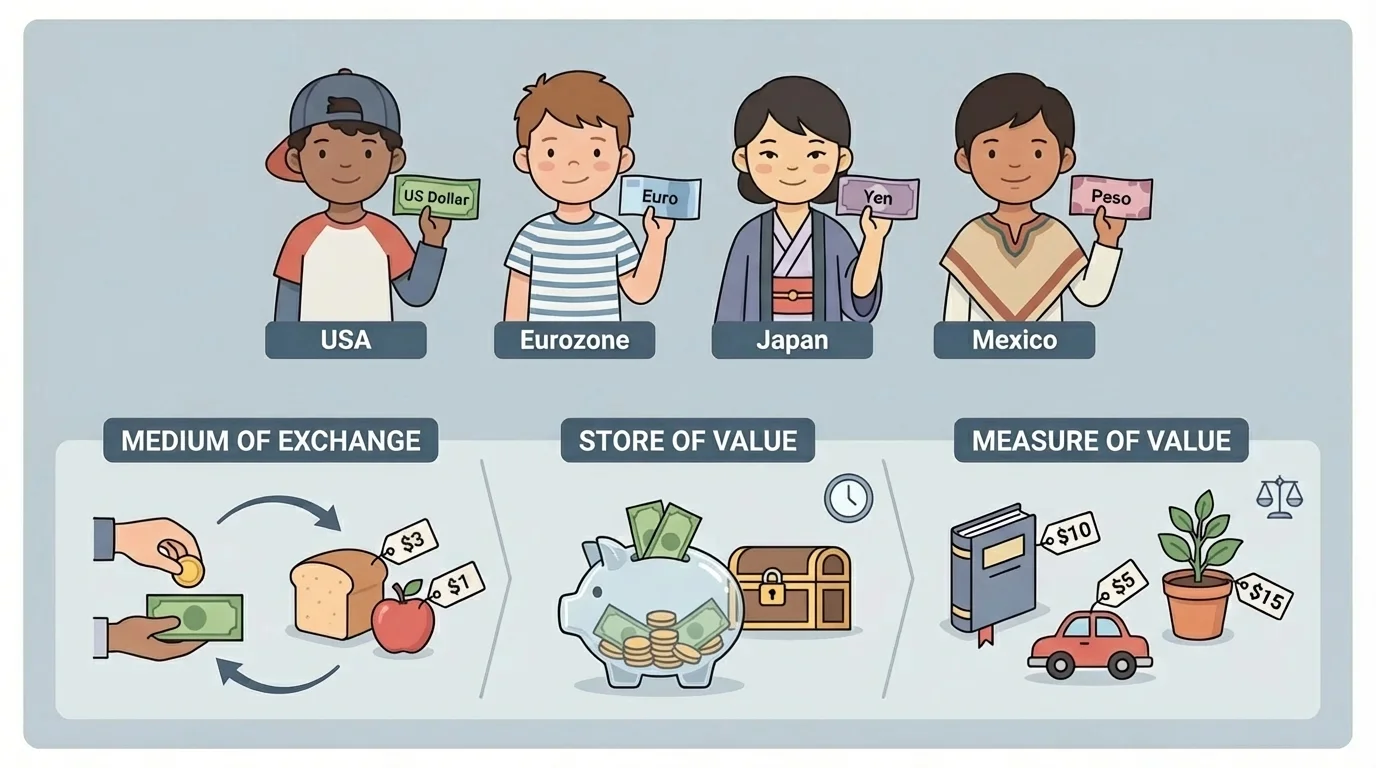
People in different countries use different kinds of currencies, as [Figure 1] shows. In the United States, people use dollars. In many countries in Europe, people use euros. In Japan, people use yen. In Mexico, people use pesos. These are all forms of money, but they are not exactly the same.
A dollar in one country is not always worth the same as money in another country. That is why travelers often exchange one currency for another when they visit a different place. If a family travels from the United States to Japan, they may need to change dollars into yen before buying food or tickets there.
Different currencies may look different too. They can have different colors, sizes, numbers, and pictures. Some show important leaders, animals, buildings, or symbols from that country. Even though currencies look different, they all do important jobs in the economy.
Coins and bills are easy to notice, but money can also exist in bank accounts. When people use a debit card, a credit card, or an app, they are still using money. The form looks different, but the purpose is the same.
Some countries use the same currency. For example, many European countries use the euro, which helps people buy and sell more easily across those countries.
Whether money is in your hand or on a screen, it helps people pay for goods and services. That is why learning about different currencies helps us understand how people around the world exchange what they make and what they need.
Money has three very important jobs. Economists call these the functions of money. They are medium of exchange, store of value, and measure of value. These ideas help explain why money is so useful in everyday life.
The first function is medium of exchange. This means money can be used to buy and sell things, as [Figure 2] illustrates. Instead of trading one item for another, a buyer gives money and the seller gives the good or service. For example, you can buy a pencil, a sandwich, or a bus ride with money.
This function helps producers and consumers meet each other's needs. A baker can sell bread for money. Then the baker can use that money to buy flour, pay workers, or get a haircut. Money moves from one person to another as goods and services are exchanged.
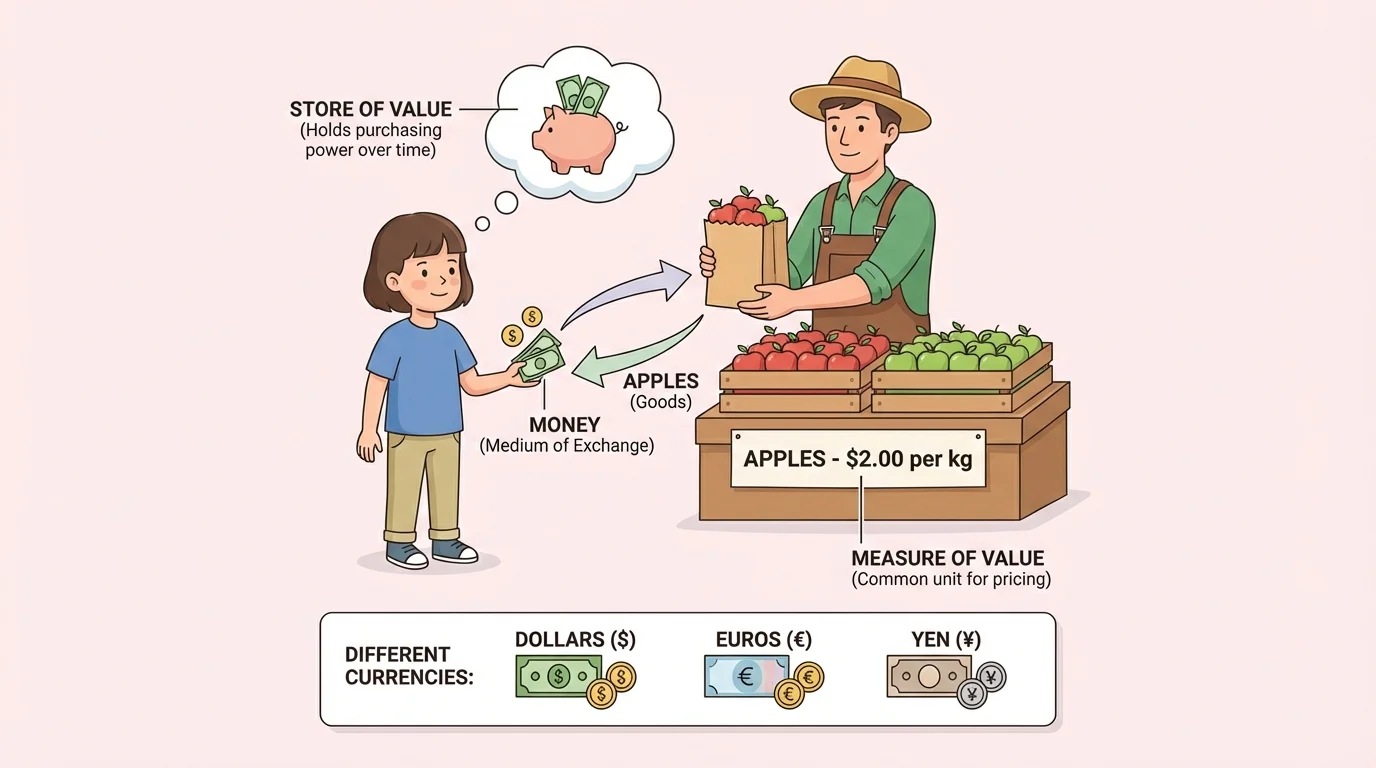
The second function is store of value. This means money can be saved and used later. If you earn $10 today and do not spend it, you can keep it and use it another day. Money lets people store buying power over time.
A store of value is helpful because people do not always want to spend money right away. A child might save allowance for several weeks to buy a game. A family might save money for school supplies or a trip. Money makes saving easier than trying to save goods like milk or bread, which can spoil.
The third function is measure of value. This means money helps us tell how much something is worth. Prices are written in money, so we can compare items. If one notebook costs $2 and another costs $5, we know the second notebook costs more.
We can even compare simple amounts with math. If one marker costs $3 and one eraser costs $1, then the marker costs $2 more because \(3 - 1 = 2\). Money gives us a common way to measure value, just as a ruler gives us a common way to measure length.
Everyday example of the three functions
Think about a school book fair.
Step 1: A student brings $8 to the fair.
The money can be used to buy a book, so it works as a medium of exchange.
Step 2: The student decides to wait until tomorrow.
The $8 is kept for later, so it works as a store of value.
Step 3: The student compares two books.
One book costs $6 and one costs $8, so the prices show which book is worth more money. This is a measure of value.
When people understand these three jobs of money, they understand why money is such an important part of exchanging goods and services.
Every day, producers and consumers depend on each other. A farmer grows strawberries. A mechanic repairs cars. A doctor helps patients. A store sells backpacks and snacks. These producers offer goods or services that consumers want or need.
Consumers use money to buy from producers. Producers receive money for their work and can then buy what they need from other producers. This creates a circle of exchange. One person's spending becomes another person's earnings.
Think about a pizza shop. The pizza shop is a producer because it sells food. The family buying dinner is the consumer. The family pays money for pizza. Then the pizza shop uses some of that money to buy cheese, pay workers, and keep the ovens running. Money helps all these exchanges happen smoothly.
You already know that goods are things people can touch and services are actions people do for others. Money helps people exchange both kinds more easily.
This is one reason communities need money. Without it, producers and consumers would have a much harder time trading fairly and quickly.
When you look at a price tag, you are seeing money act as a measure of value. Prices help people compare choices, as [Figure 3] shows. If a juice box costs $2, a notebook costs $3, and a toy car costs $6, you can tell which item costs the most and which costs the least.
Prices also help people make decisions. If you have $5, you know that you can buy the notebook and the juice box because \(\$3 + \$2 = \$5\). But you cannot buy the toy car and the notebook together because \(\$6 + \$3 = \$9\), and $9 is greater than $5.
For producers, prices matter too. A producer wants the price to cover the cost of making or selling something. If a lemonade stand spends $4 on lemons and cups, it must charge enough so the sales bring in more than $4. Prices help both buyers and sellers make plans.
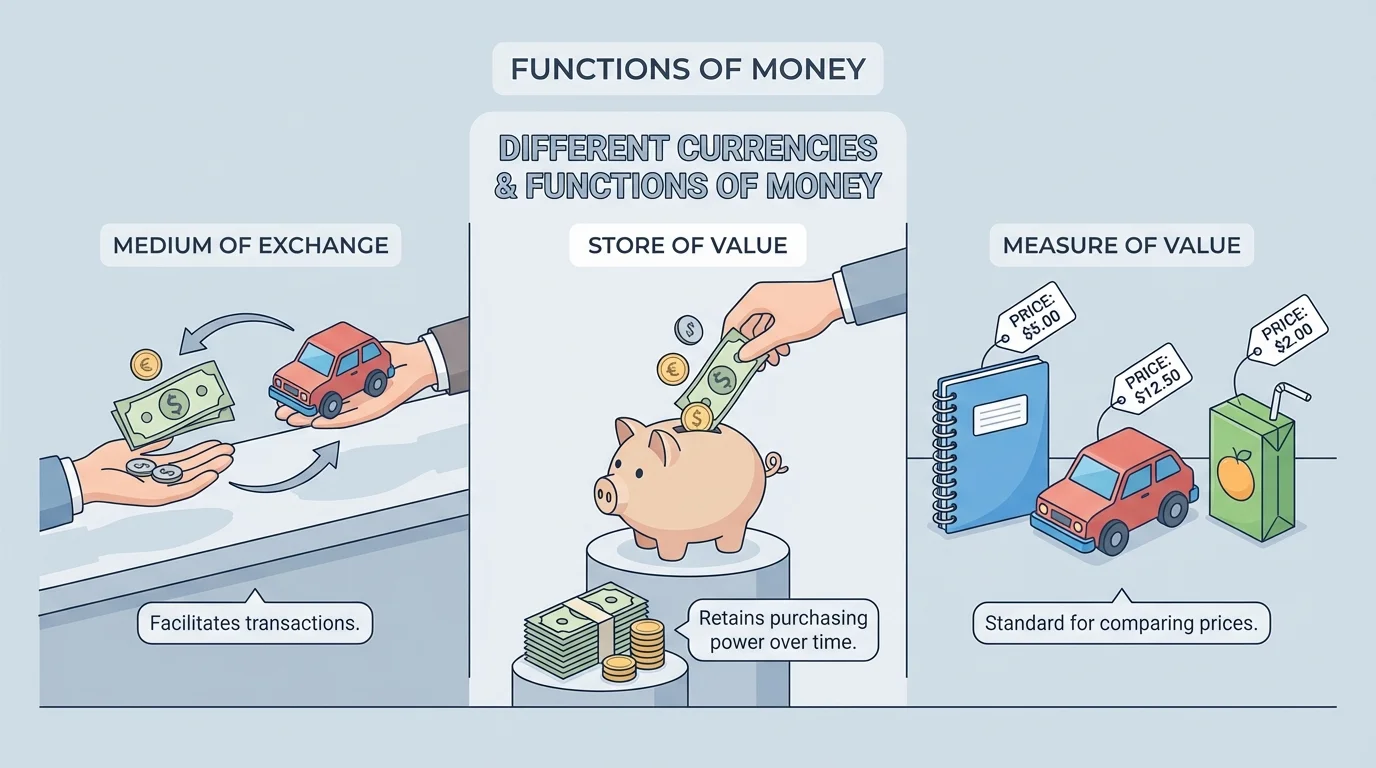
Prices can change. A coat may cost more in winter because more people want one. Strawberries may cost less when many strawberries are in season. Even when prices change, money still helps us measure value in a common way.
Later, when you compare choices again, [Figure 3] still helps you see how prices make value easier to understand. Money gives everyone a shared way to talk about cost.
Because money is a store of value, people often make choices about saving and spending. Saving means keeping money to use later. Spending means using money to buy something now.
Sometimes spending right away makes sense, especially for needs like food, clothing, or school supplies. Other times saving is smarter, such as when someone wants to buy something larger in the future. A person might save $2 each week. After four weeks, the total is \(2 + 2 + 2 + 2 = 8\), so they would have $8.
Needs and wants
A need is something important for living and growing, such as food, water, clothing, and shelter. A want is something you would like to have, such as a game or a toy. Money helps people choose how to spend on needs first and wants after that.
Using money wisely also means thinking before buying. If two stores sell similar crayons, and one pack costs $4 while another costs $6, many consumers may choose the lower price if the quality is about the same. Money helps people compare, plan, and decide.
Today, people do not always hand over coins or bills. They may swipe a card, tap a phone, or buy something online. These are all ways to transfer money from the buyer to the seller.
Even though the payment method has changed, the functions of money stay the same. It is still a medium of exchange because it is used to buy something. It can still be a store of value because money in a bank account can be saved. It is still a measure of value because prices are still shown in money.
That means the important idea is not only what money looks like. The important idea is what money does. Whether it is a coin, a bill, or numbers in an account, money helps producers and consumers exchange goods and services.
"Money works best when people trust that others will accept it in exchange for goods and services."
Trust matters. People accept money because they believe others will accept it too. That shared trust helps stores sell products, workers get paid, and families buy what they need.
Across the world, currencies may be different, but the basic ideas are the same. People use money to trade more easily, save for later, and compare the value of things. As we saw earlier in [Figure 1], the money may look different from country to country, but its main jobs stay very similar.
