Why does one person buy a product right away while another person waits, chooses a cheaper version, or decides not to buy it at all? Spending decisions may seem personal, but many choices are shaped by forces outside a person. A sale sign, a social media ad, a storm that damages crops, or the opinions of friends can all change what someone decides to buy. Learning how these outside influences work helps people become smarter consumers.
Every day, people make choices about money. They may spend on food, clothes, transportation, entertainment, school supplies, or saving for the future. Businesses also make spending decisions when they buy supplies, pay workers, advertise products, or set prices. In countries throughout the Western Hemisphere, consumers and businesses affect each other constantly. A shopper's decision can help a business grow, and a business's decision can change what shoppers see, want, or can afford.
A spending decision is a choice about whether to buy something, when to buy it, how much to spend, and which option to choose. Some decisions are based on needs, such as food, water, and medicine. Others are based on wants, such as a new video game, trendy shoes, or concert tickets. Even when two people want the same item, they may make different choices because outside conditions are not the same for both of them.
An external factor is an outside influence that affects a person's or business's choices. External factors can include price changes, advertising, location, family expectations, cultural traditions, product availability, and economic conditions. These factors matter because they shape what people think is worth buying and what they can actually buy.
Consumer means a person who buys or uses goods and services. Business means an organization that sells goods or services. Budget is a plan for how money will be spent or saved. Income is money a person or family receives, often from work. Advertising is a message designed to persuade people to buy a product or service.
Understanding these ideas makes it easier to see how decisions are connected. A consumer may want a product, but a business decides the price, the advertisement, the store location, and the amount available. At the same time, businesses monitor what consumers buy so they can adjust what they sell. This back-and-forth relationship is a major part of economic life in the Western Hemisphere.
[Figure 1] shows how one of the strongest outside influences on spending is price. A person may want a backpack, but if one store sells it for $25 and another store sells a similar one for $18, the lower price may affect the decision. If the cheaper backpack is out of stock, the person may wait, choose a different brand, or spend more than planned.
Availability means whether a product is easy to find. Sometimes items become harder to get because of weather problems, transportation delays, or high demand. If a hurricane damages roads, stores may receive fewer supplies. If many people suddenly want the same toy before a holiday, stores may sell out quickly. When availability changes, spending decisions change too.
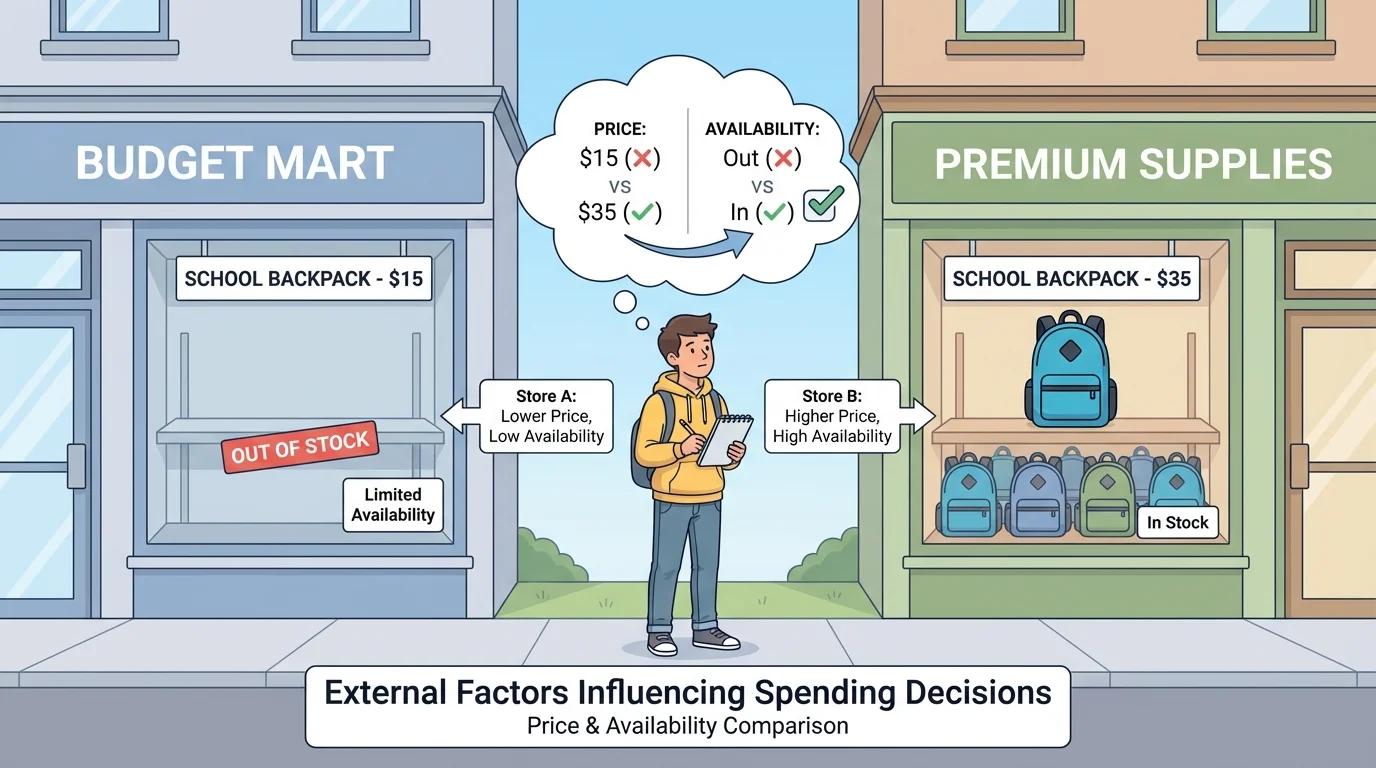
Businesses pay close attention to prices and availability because they affect profits. If a store buys apples at a higher cost, it may raise the selling price. Then some shoppers may buy fewer apples, choose another fruit, or shop at a different store. This shows that consumers and businesses influence each other.
Not all people react to prices in the same way. A person with a small amount of money may need to choose the lowest price every time. A person with more money may care more about quality or brand name. For example, one shopper may buy plain notebooks because they cost less, while another shopper may choose a more expensive notebook because it has stronger paper and lasts longer.
Case study: Two students buying school supplies
Step 1: Ava has $20 for supplies and needs notebooks, pencils, and folders.
Step 2: One store has a sale, so her total is $17. Another store sells the same items for $22.
Step 3: Ava chooses the first store because the lower price fits her budget.
Ava's decision is influenced by the external factor of price, not just by what she likes best.
Price can also change over time. Gasoline, food, and clothing prices may rise or fall. When prices rise, families may switch to cheaper products or buy less often. When prices fall during a sale, people may buy sooner than they planned.
[Figure 2] illustrates how another powerful outside influence is advertising. Companies use television, websites, apps, billboards, and social media to persuade people to spend. A persuasive message may make a product seem exciting, useful, or popular. Even when people do not need an item, repeated advertising can make them want it.
Media messages often use bright colors, catchy music, famous athletes, or limited-time offers. These strategies are designed to catch attention and create a feeling of urgency. A message such as "Only today" or "Last chance" can pressure a shopper to act quickly instead of thinking carefully.
Social media adds another layer. Influencers, streamers, and content creators may show products during videos or posts. Young consumers may feel that owning the same product will help them fit in or look successful. But it is important to remember that many of these messages are meant to sell something, not simply to share information.
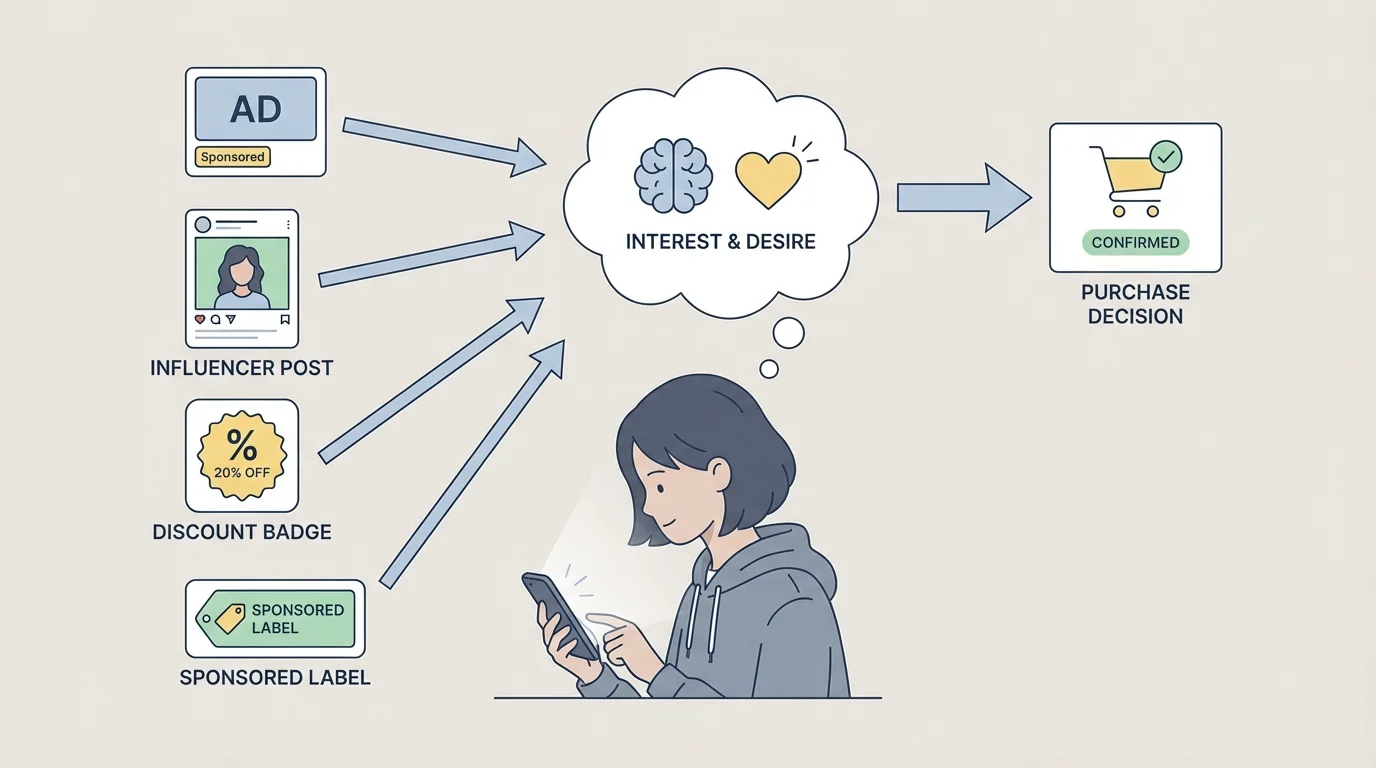
Businesses spend money on advertising because it can increase sales. If more people buy a product after seeing an ad, the business may earn more money. This is another example of how businesses and consumers interact. The business sends out a message, and the consumer responds with a spending choice.
Some stores place candy, drinks, or small gadgets near the checkout line because people often make quick purchases while waiting. This is called impulse buying, and it happens when outside cues influence a fast decision.
Smart consumers ask questions before buying because of an ad. Is this product truly useful? Is the ad giving complete information? Is someone being paid to recommend it? These questions help people avoid spending money just because a message is persuasive.
People do not make spending choices alone. Family members, friends, and cultural traditions shape decisions in many ways. A child may want a certain brand of shoes because classmates wear it. A family may spend extra money on food and decorations during an important holiday because those traditions matter to them.
Culture includes shared beliefs, customs, foods, clothing, music, and celebrations. In different parts of the Western Hemisphere, spending may reflect local customs. A family in Mexico may spend money for a special celebration in a way that is different from a family in Canada or Brazil. Neither choice is "wrong"; each reflects values and traditions.
Family rules also matter. Some families compare prices carefully and avoid buying things that are not needed. Others may be willing to spend more on sports, travel, education, or technology. A person's spending habits often grow out of what they see at home.
Friends can influence spending too. If a group of friends buys the same lunch, app, game, or clothing style, someone may feel pressure to do the same. This pressure is an external factor because it comes from the social environment. Understanding that pressure can help people make choices based on reason, not just popularity.
Why social influence matters
Humans are social. People often want to belong, be accepted, and avoid feeling left out. Businesses know this and sometimes connect products with popularity, status, or group identity. When people notice this pattern, they can slow down and ask whether a purchase matches their true needs and values.
Social influence is not always negative. Family members may encourage smart spending, such as saving for a goal, comparing products, or avoiding waste. Friends may share useful information about lower prices or better quality. External factors can push people toward wise choices as well as poor ones.
[Figure 3] shows how where people live has a major effect on what they buy. In the Western Hemisphere, climate, distance, transportation, and local resources differ greatly from place to place. Someone living in a cold part of Canada may spend more on winter coats and heating, while someone living in a tropical part of the Caribbean may spend more on fans, light clothing, or rain gear.
Location also affects which products are common and which are expensive. If a community is far from large stores or shipping centers, some items may cost more because transporting them takes time and money. In farming areas, fresh local produce may be easier to get. In big cities, people may spend more on public transportation, apartment rent, or prepared food from nearby shops.
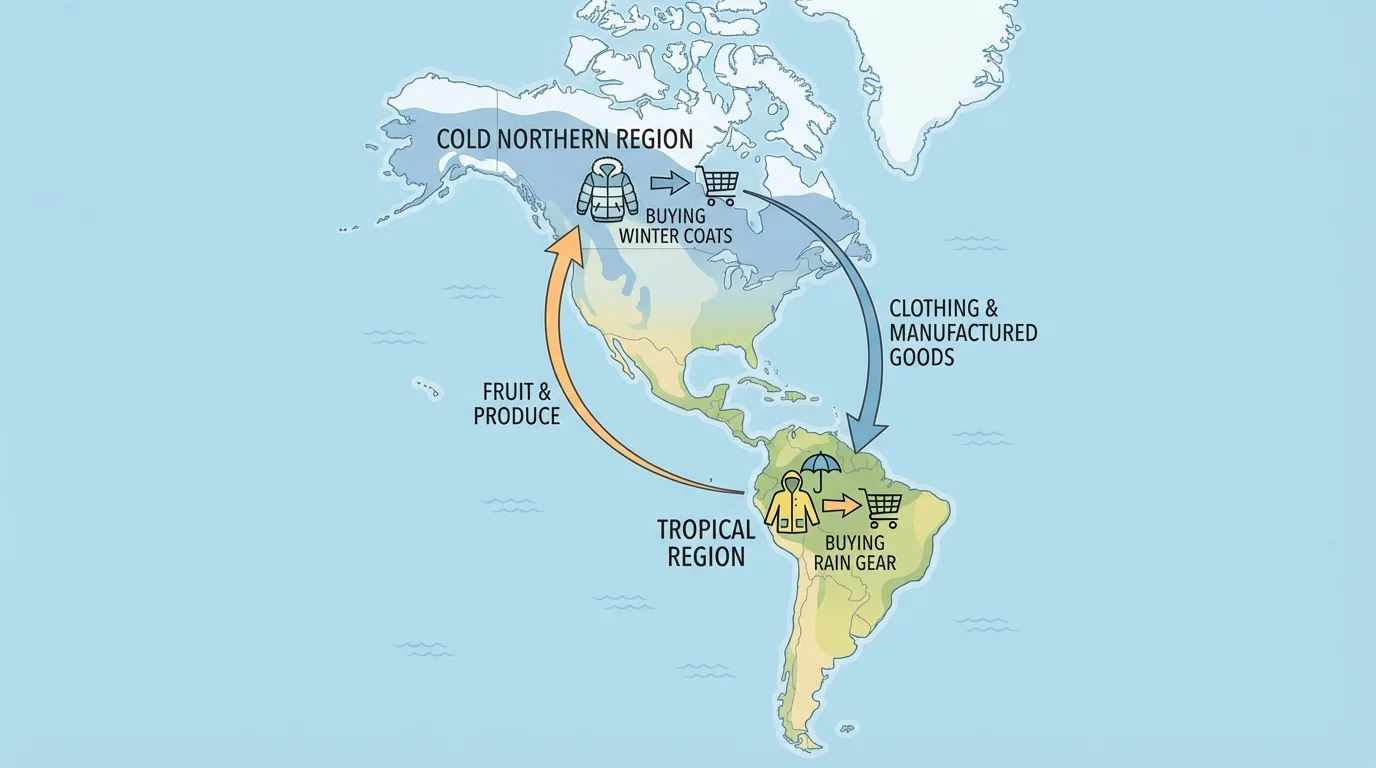
Trade links places together across the Western Hemisphere. Bananas grown in Central America may be sold in U.S. grocery stores. Coffee from South America may be sold in Canada. Winter clothing designed in one country may be manufactured in another and sold somewhere else. Because businesses operate across regions, consumers often depend on products from far away.
Natural events can also affect regional spending. Droughts, floods, and storms may reduce the supply of crops and raise prices. If orange harvests are damaged, juice prices may rise. Then families may buy less juice or choose a different drink. As seen earlier with store supply in [Figure 1], outside conditions can change both availability and price.
| Location Factor | Possible Effect on Spending | Example |
|---|---|---|
| Cold climate | More money spent on heat and warm clothes | Winter boots in Canada |
| Tropical climate | More money spent on cooling and rain gear | Rain jackets in the Caribbean |
| Rural area | Higher transportation costs for some goods | Imported electronics cost more |
| Large city | More spending on transport, rent, or convenience | Bus passes and prepared meals |
Table 1. Examples of how location can influence spending decisions.
Businesses study location carefully. A company may open a store in a busy city, sell weather-related products in certain regions, or change prices depending on transportation costs. This shows again that businesses respond to external factors just as consumers do.
The economy is the way money, goods, and services move through a society. When the economy changes, spending decisions change too. If many people lose jobs or work fewer hours, families may cut back on restaurant meals, vacations, or entertainment. They may focus mostly on essentials.
When jobs are steady and income is stronger, people may feel more comfortable spending on wants. Businesses then may hire more workers, stock more products, or expand services. In this way, family income and business activity are connected.
One important economic idea is inflation, which means that prices rise over time. If a loaf of bread used to cost $2 and now costs $3, a family must spend more money for the same item. When inflation affects many products at once, families often adjust their budgets and businesses may also change prices.
Remember that a budget is a plan for spending and saving money. When outside conditions change, a budget helps people decide what matters most and what can wait.
Economic conditions affect businesses too. If supplies cost more, a business may raise prices, reduce the size of a product, or look for cheaper materials. If customers stop buying as much, the business may offer discounts. Consumers notice these changes and respond with new spending choices.
[Figure 4] illustrates how the same outside event can lead to very different choices. Suppose food prices rise in a city. A student buying snacks with limited money may choose cheaper brands. A parent shopping for a family may buy fewer treats and more basic foods. A restaurant owner may raise menu prices. A tourist may eat out less often. One external factor creates several different responses.
This happens because people have different incomes, responsibilities, goals, and needs. A business owner thinks about costs and profits. A parent may think about feeding several people. A child may think about how far allowance money can go. A traveler may think about convenience and time. Spending decisions are shaped by both the outside factor and the person's situation.
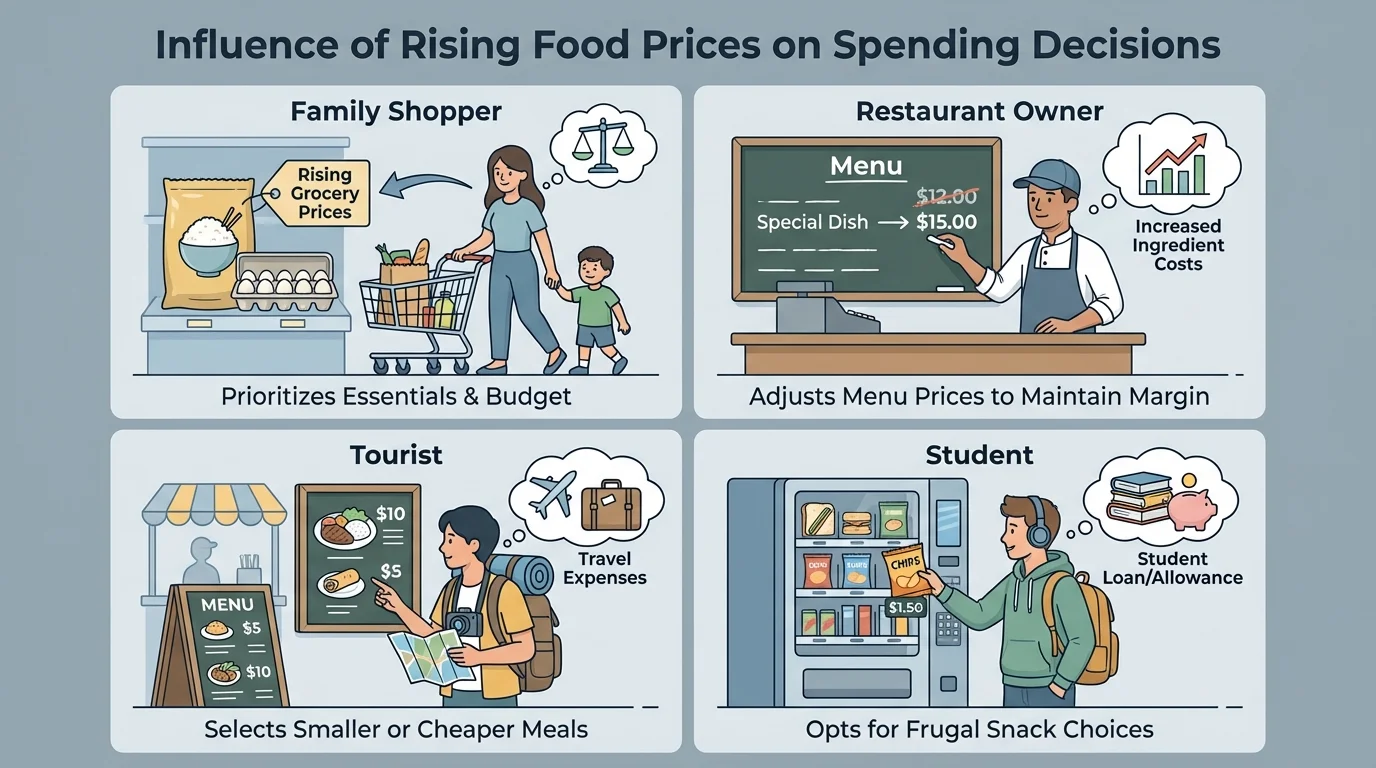
Age can matter too. A sixth grader may spend mainly on snacks, games, or school items. An adult may have to pay rent, bills, and transportation. Because responsibilities differ, the same advertisement, sale, or price increase may not matter in the same way to everyone.
We can also compare consumers and businesses. If the cost of cotton rises, a clothing company may raise shirt prices. Then a shopper may wait for a sale. If many shoppers wait, the business may lower prices later. This chain of decisions shows the close relationship between consumers and businesses throughout the Western Hemisphere.
Case study: One sale, different reactions
Step 1: A sports store offers shoes at $40 instead of $60.
Step 2: A student athlete may buy them right away because the shoes are needed for practice.
Step 3: Another student may still not buy them because $40 is too expensive.
Step 4: A parent may compare quality and decide whether the sale is truly a good value.
The same sale affects each person differently because their needs and resources are different.
Looking back at media influence in [Figure 2], an ad may persuade one person strongly and hardly affect another. Looking back at regional differences in [Figure 3], weather and location may shape spending in one place but not in another. Context matters.
External factors will always exist, but people can learn to respond wisely. The first step is to notice the influence. Ask: What is affecting this choice? Is it price, an ad, my friends, my location, or changes in the economy? Naming the factor helps make the decision clearer.
Next, compare choices. A smart consumer may look at quality, price, need, and timing. Waiting can be powerful. If a product is being pushed by a flashy ad, a person can pause for a day and think again. If prices are unusually high, it may make sense to buy later or choose a substitute.
Using a budget also helps. If a student has $30 for the month and spends $12 on one game accessory, only $18 remains for other wants. The relationship is \(30 - 12 = 18\). A budget does not stop people from spending; it helps them spend on purpose.
Consumers can also look for trustworthy information. They can read reviews, compare stores, and ask whether a product is worth its cost. Businesses do something similar when they compare suppliers, transportation costs, and customer demand. Good decisions often come from slowing down and gathering facts.
"Smart spending is not about buying nothing. It is about knowing why you are buying."
When people understand external factors, they become more careful and confident. They see that spending decisions are not random. They are shaped by prices, messages, places, people, and economic conditions. Recognizing these influences helps consumers make better choices and helps us understand how businesses and consumers interact across the Western Hemisphere.
