By the middle of the 1800s, the United States stretched from the Atlantic Ocean to the Pacific Ocean. That sounds like a story of success and growth, but it is also a story of war, forced removal, political arguments, and human suffering. Expansion made the country larger and richer, yet it also deepened the conflicts that led to the Civil War. To understand U.S. history, you have to understand why the nation expanded and what that expansion cost.
After the American Revolution, the United States was a new nation with big ambitions and serious problems. Leaders wanted security, access to trade, more farmland, and stronger control over the continent. Ordinary citizens wanted land, jobs, and opportunity. At the same time, many Americans believed their republic was special and should spread. These goals pushed the nation toward territorial expansion, the growth of national land and influence.
Expansion was not only about maps. It was also about power. Every new territory raised questions: Who would govern it? Would slavery be allowed there? Which groups would gain rights, and which would lose them? Because of those questions, expansion shaped politics and the economy as much as geography.
Expansion means growth in size, influence, or power. In U.S. history, expansion can be territorial when land is added, political when government power and representation change, and economic when markets, trade, and production grow.
The story of expansion reaches from the presidency of Thomas Jefferson to the years after the Civil War. It includes purchases, treaties, migration, wars, diplomacy, and technology. It also includes resistance from people who did not want to lose their land, freedom, or political voice.
One of the biggest early turning points came in 1803, when President Jefferson approved the Louisiana Purchase. As [Figure 1] shows, this event dramatically changed the shape of the nation by doubling its size. The United States bought the Louisiana Territory from France, gaining control of land west of the Mississippi River and the important port of New Orleans.
The purchase had several causes. France, under Napoleon, needed money and was losing interest in rebuilding a North American empire. American leaders wanted secure trade on the Mississippi River and feared that a strong European power nearby could threaten U.S. safety. Jefferson was not fully sure that the Constitution clearly gave him the power to buy land, but he decided the opportunity was too important to ignore.
Jefferson then sent Meriwether Lewis and William Clark to explore the new territory. Their journey gave the government valuable information about rivers, plants, animals, and Native nations. It also showed that expansion depended on knowledge, mapping, and contact with people already living in the West.
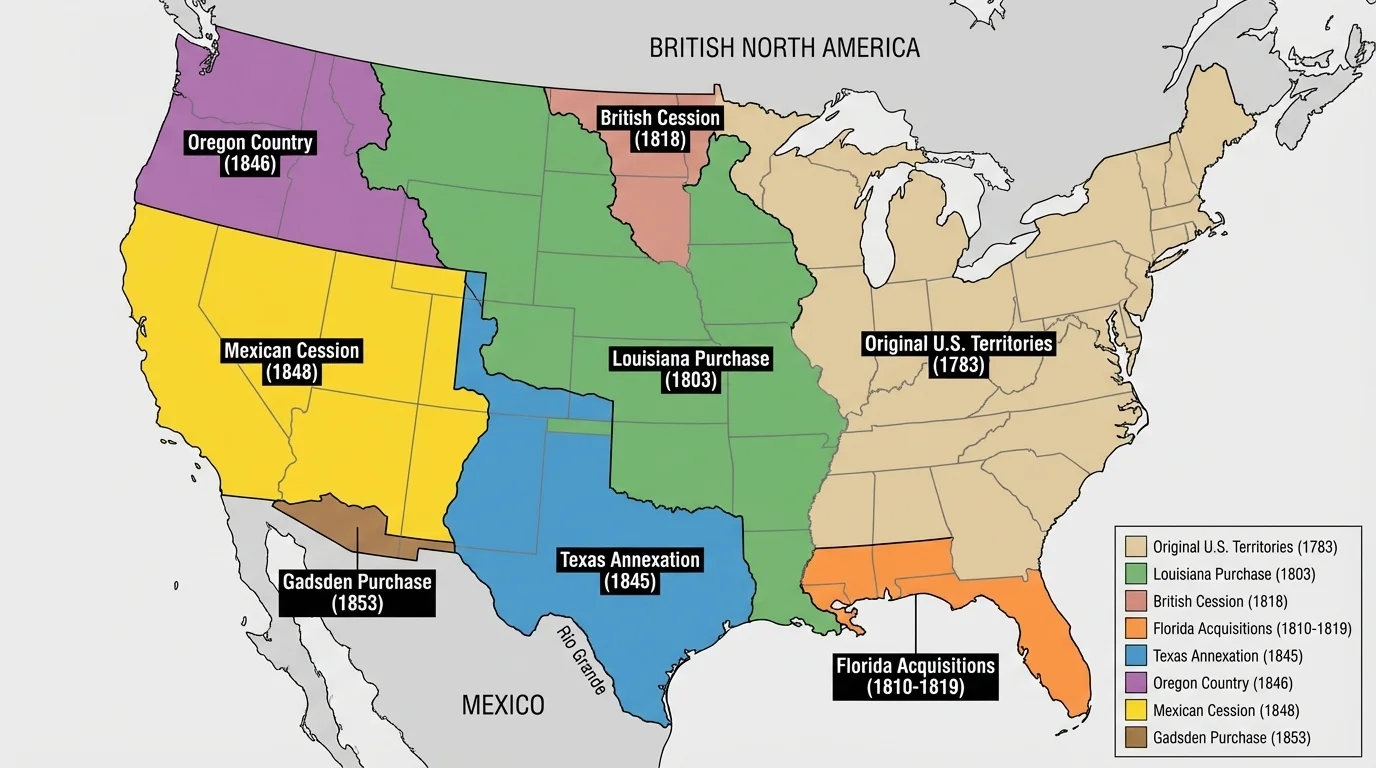
Other additions followed. In 1819, Spain gave Florida to the United States in the Adams-Onís Treaty. In the 1840s, the United States added Texas, reached a settlement with Britain over Oregon Country, and then gained a vast region from Mexico after the Mexican-American War. In 1853, the Gadsden Purchase added land needed for a possible southern railroad route.
These acquisitions did not happen by accident. Leaders used diplomacy when possible and force when they thought it necessary. The nation's size grew quickly, but so did tension over what to do with all that land.
Many Americans believed the nation had a special mission to spread across the continent. This belief became known as Manifest Destiny, and [Figure 2] illustrates how it connected migration, farming, transportation, and national pride. Supporters argued that expansion would spread democracy, economic opportunity, and American culture.
Several causes fed this belief. One was nationalism, or pride in the nation and confidence in its future. Another was rapid population growth. As more people arrived and families grew, demand for land increased. Cheap western land seemed to offer a fresh start for farmers and settlers. Some business leaders saw new markets and resources in the West. Others wanted ports on the Pacific for trade with Asia.
Religion also shaped expansion. Some Americans believed they were doing God's work by moving west and building communities. But ideas of racial superiority also played a major role. Many white Americans wrongly believed their culture was better than Native, Mexican, or African cultures. That prejudice helped justify unfair treatment, conquest, and removal.
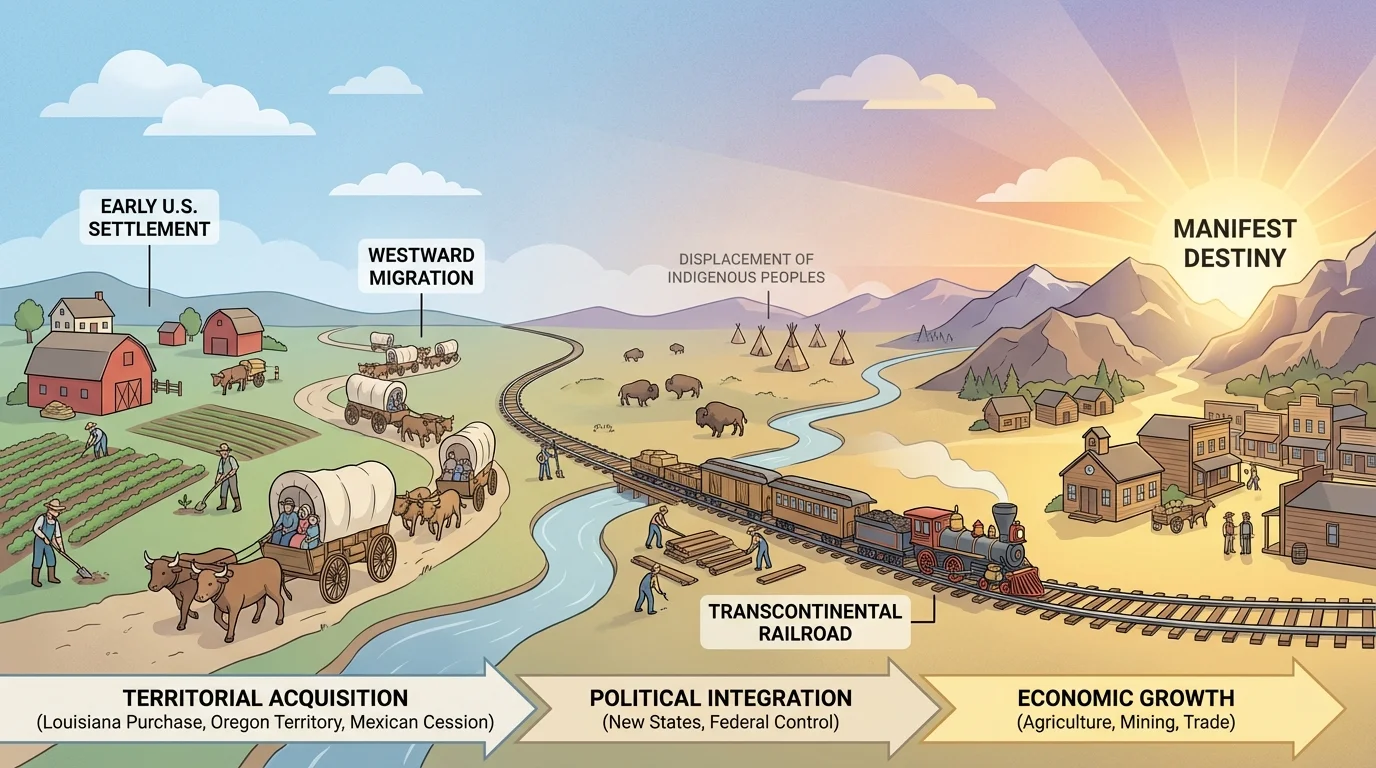
The phrase Manifest Destiny became popular in 1845, but the ideas behind it had been growing for years. A slogan can spread quickly when it matches beliefs people already hold.
Economic motives were just as important as ideals. Western lands could produce crops, timber, and minerals. Merchants wanted trade routes. Railroads and roads could connect distant regions. Expansion looked to many Americans like a chance to become stronger, richer, and more independent.
Expansion often involved conflict. Native nations had lived across North America for centuries, and they did not simply disappear when Americans wanted their land. Many groups negotiated, adapted, or fought back. Leaders such as Tecumseh tried to unite Native peoples against U.S. settlement. Even so, the growing power of the United States and the pressure of settlers led to repeated land losses for Native nations.
One major example was the Indian Removal Act of 1830. Under President Andrew Jackson, the federal government forced many Native peoples in the Southeast to move west of the Mississippi River. The Cherokee removal became known as the Trail of Tears because thousands died from disease, hunger, and exhaustion. This was a direct effect of expansion: white settlers wanted Native land for farming, especially cotton.
Texas shows another path to expansion. American settlers moved into Mexican Texas during the 1820s and 1830s. Tensions grew between the Mexican government and many settlers, partly because of immigration rules, political control, and slavery. In 1836, Texas declared independence from Mexico. The United States annexed Texas in 1845, a decision that angered Mexico and increased sectional debate in the United States.
The dispute with Mexico soon turned into the Mexican-American War from 1846 to 1848. President James K. Polk strongly supported expansion and wanted California and New Mexico. After the war, the Treaty of Guadalupe Hidalgo gave the United States a huge area in the West, including present-day California, Nevada, Utah, and parts of several other states.
Case study: Why the Mexican-American War mattered
Step 1: Identify the causes.
The annexation of Texas, a border dispute over the Rio Grande, and President Polk's desire for more western land pushed the two nations toward war.
Step 2: Identify the immediate result.
The United States won the war and gained a massive amount of territory through the Treaty of Guadalupe Hidalgo.
Step 3: Identify the long-term effect.
The new territory reopened the national argument over slavery and helped push the country closer to the Civil War.
To many Americans, the war looked like a triumph. To critics, it looked like an unjust war meant to seize land. Some antislavery leaders argued that expansion was being used to strengthen slaveholding power. Former president John Quincy Adams and writer Henry David Thoreau were among those who criticized it.
Every new territory raised the same political question again and again: would slavery spread westward or be limited?
The Missouri Compromise of 1820 tried to maintain balance by admitting Missouri as a slave state and Maine as a free state, while limiting slavery north of a certain line in the Louisiana Territory. For a time, this seemed like a solution. But each new piece of land made the problem return in a new form.
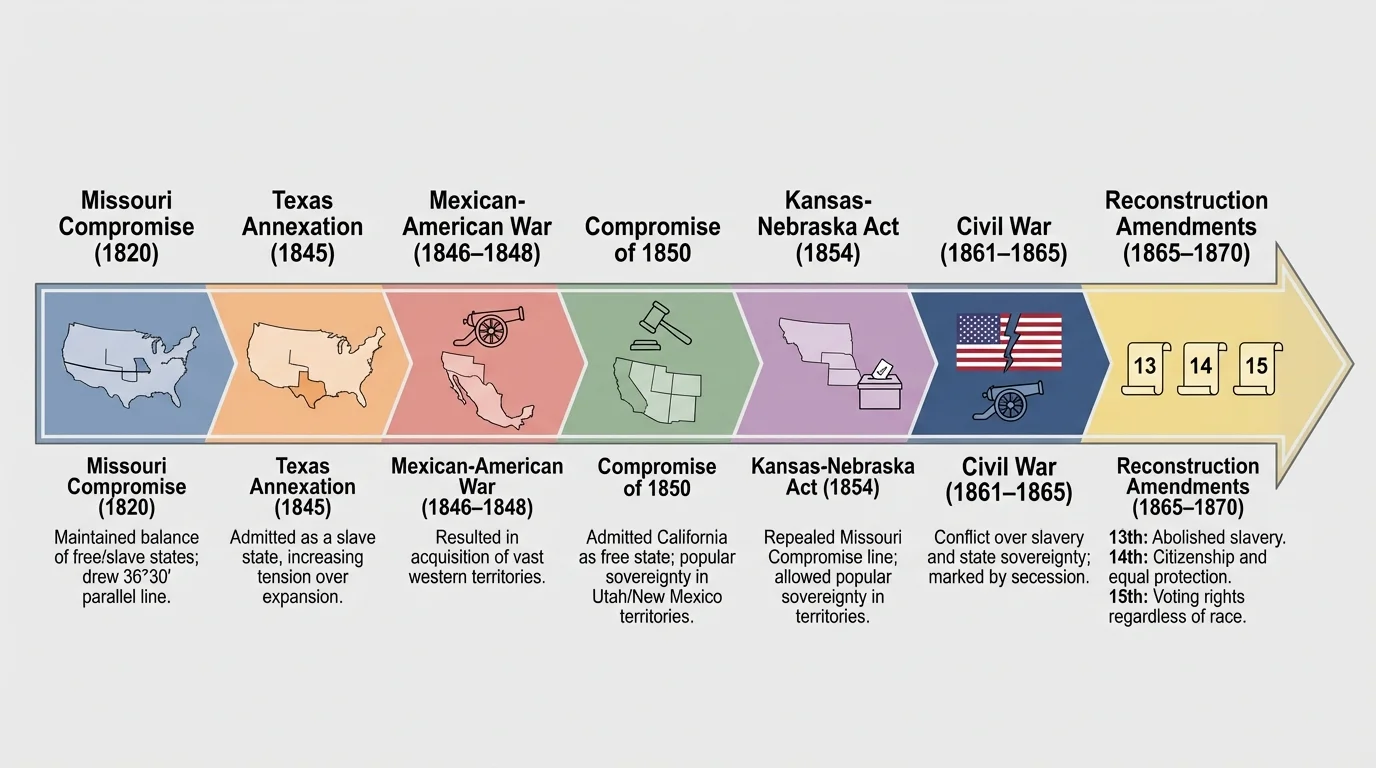
After the Mexican-American War, the debate exploded again. The Wilmot Proviso tried, unsuccessfully, to ban slavery in land gained from Mexico. The Compromise of 1850 admitted California as a free state but also included a stronger Fugitive Slave Act, which required the return of escaped enslaved people. Instead of solving the problem, the compromise increased anger in both North and South.
The Kansas-Nebraska Act of 1854 made matters worse by letting settlers decide the slavery issue through popular sovereignty. Proslavery and antislavery groups rushed into Kansas, and violence followed. This period became known as "Bleeding Kansas." Expansion had turned into armed conflict even before the Civil War officially began.
Political expansion also changed party systems. The old Whig Party collapsed, and the Republican Party rose in opposition to the spread of slavery. Southern leaders increasingly feared losing influence in the federal government. Northern leaders increasingly opposed what they called the "Slave Power." The election of Abraham Lincoln in 1860 and the secession of Southern states followed this long chain of expansion-related conflicts, a pattern made clear by the sequence in [Figure 3].
"A house divided against itself cannot stand."
— Abraham Lincoln, 1858
Lincoln's words captured the problem: the United States had become too large and too divided to keep avoiding the issue. Expansion brought wealth and land, but it also made compromise harder and disagreement more dangerous.
Land was one of the strongest economic reasons for expansion. Farmers wanted rich soil for crops. Planters wanted large areas for cotton production. Speculators bought land hoping to sell it later for profit. As settlement spread west, the economy changed with it.
This growth was linked to the Market Revolution, a period when transportation, technology, and trade expanded rapidly. Roads, canals, steamboats, and later railroads connected regions that had once been far apart. Farmers could sell crops to distant markets more easily. Factories in the Northeast could receive raw materials and ship out finished goods. A larger country became a more connected economy.
Cotton was especially important. The invention of the cotton gin made it faster to process short-staple cotton, and southern planters moved west into Alabama, Mississippi, Louisiana, and Texas. This growth increased the demand for enslaved labor. So while expansion helped the economy grow, it also strengthened the brutal system of slavery in the South.
Gold and other resources also drew people westward. The California Gold Rush of 1849 brought a sudden population boom. Mining, transportation, stores, and shipping all expanded. Some people became wealthy, but many did not. Even so, the rush helped tie California quickly to the national economy and increased pressure to organize it as a state.
| Cause of expansion | Economic effect | Political or social effect |
|---|---|---|
| Desire for farmland | More crop production and land sales | More settlement on Native lands |
| Growth of cotton | Higher profits for planters and traders | Expansion of slavery |
| New transportation routes | Faster trade and movement of goods | Stronger ties between regions |
| Gold and mineral discoveries | Population growth and new businesses | Faster statehood debates |
| Pacific trade goals | New ports and overseas connections | Greater interest in western territory |
Table 1. Major causes of expansion and some of their economic, political, and social effects.
Why economic growth created conflict
Economic expansion did not help everyone equally. A new railroad or a new cotton region could enrich investors and settlers while dispossessing Native communities, increasing slavery, or creating labor exploitation. Growth and injustice often happened at the same time.
The federal government supported economic growth through land policies, military protection, and infrastructure projects. In this way, economic expansion and political power worked together. The government did not just observe expansion; it actively helped shape it.
Some Americans gained enormous opportunities from expansion. Small farmers found land. Merchants found customers. Railroad builders, miners, and traders found work. The nation gained ports, resources, and routes that increased its power in North America and beyond.
But the costs were severe. Native Americans lost land, political independence, and often their lives. Many Mexican residents in lands taken after 1848 faced discrimination, legal battles over land ownership, and loss of status. Enslaved African Americans suffered as slavery expanded into new areas. Even among white settlers, not everyone prospered; many faced debt, dangerous travel, crop failure, and conflict.
When you study a historical event, ask two questions at the same time: Who gains? and Who loses? Expansion looks very different depending on whose point of view you examine.
Primary sources help us see these different viewpoints. A government treaty might describe land transfer in formal language, but a Cherokee account of removal reveals fear, grief, and injustice. A speech praising Manifest Destiny sounds confident and patriotic, while a Mexican writer describing invasion tells a story of loss. Historians compare these sources to build a fuller picture.
A primary source is something created during the time being studied, such as a letter, speech, law, treaty, map, or diary. A secondary source is a later explanation or interpretation written by historians. Both matter, but they serve different purposes.
Territorial expansion helped set the stage for the Civil War because it made the slavery question impossible to avoid. As the nation grew, leaders kept trying to balance free and slave regions. Those compromises failed. The war that followed decided that states could not leave the Union, but it did not erase all the inequalities tied to expansion.
During Reconstruction, the United States tried to rebuild the South and define freedom after slavery. The 13th Amendment ended slavery, the 14th Amendment defined citizenship, and the 15th Amendment aimed to protect voting rights for men regardless of race. These were major political changes that expanded rights in law, even though many of those rights were later denied in practice through violence and discrimination.
Expansion also continued after the Civil War. Railroads pushed farther west, settlers kept moving, and conflicts with Native nations continued. In other words, Reconstruction did not end expansion. It changed the nation's legal and political structure while the struggle over land, rights, and power went on.
Looking back, U.S. expansion was never a simple march of progress. It was a process driven by ambition, belief, and economic desire. It created a larger and more powerful nation, but it also produced war, forced removal, and sectional conflict. Understanding both sides is essential to understanding American history.
