One of the biggest reasons people fought in early American history was surprisingly simple: they wanted the same places. A river that meant food, transportation, and trade for one group could also look like the perfect settlement site to another. Forests meant hunting and fur. Coastlines meant ports and wealth. Fertile valleys meant crops and survival. When human migration brought different peoples into the same spaces, their interactions could lead to cooperation, conflict, or both at the same time.
In early America, migration was the movement of people from one place to another. Native peoples had been moving, trading, and adapting across North America for thousands of years before Europeans arrived. Later, Europeans crossed the Atlantic seeking land, wealth, religious freedom, or power. Africans were also brought across the ocean through the forced migration of the Atlantic slave trade. These movements changed the continent deeply.
To understand these changes, historians look at patterns. A pattern is something that happens again and again in similar ways. In early American history, one pattern was that migration often brought competition for land and resources. Another pattern was that groups still found ways to trade, negotiate, and build alliances when cooperation helped them survive or gain advantage.
People rarely move for only one reason. Some Europeans came for economic opportunity. Spain searched for wealth and empire. England wanted colonies that could produce valuable goods and expand its power. France wanted trade, especially in fur. Some migrants came for religious reasons, such as the Pilgrims and Puritans in New England. Enslaved Africans, however, did not choose to migrate; they were violently forced into a system that treated people as property.
These movements brought together peoples with different languages, beliefs, technologies, and political systems. Contact created opportunities for exchange, but it also created tension. When people entered lands already occupied and used by Native nations, questions quickly arose: Who controls the land? Who may hunt, plant, fish, or trade there? Who has political authority?
Conflict is a struggle between groups with different goals, interests, or beliefs. Cooperation is working together for mutual benefit. Resources are useful materials or conditions people depend on, such as land, water, timber, fertile soil, and animal populations.
Those questions mattered because geography was not just background scenery. It shaped every decision. Colonists settled near harbors and rivers for transportation. Native nations defended homelands that supported farming, hunting, fishing, and trade. Control of land also meant control of future wealth.
Geography directed movement and conflict from the start, as [Figure 1] shows through the relationship among coastlines, rivers, mountains, and settlement zones. The Atlantic coast offered access to Europe. Major rivers such as the Hudson, St. Lawrence, and Mississippi connected inland regions to trade networks. The Appalachian Mountains formed a barrier, but also marked the edge of colonial expansion for a time.
Different regions offered different resources. New England had rocky soil but valuable harbors, forests, and fishing grounds. The Chesapeake had fertile land for tobacco. The Southeast supported rice and indigo in some areas. The interior and Great Lakes region became central to the fur trade. Because these resources were unevenly spread, groups competed intensely for strategic places.
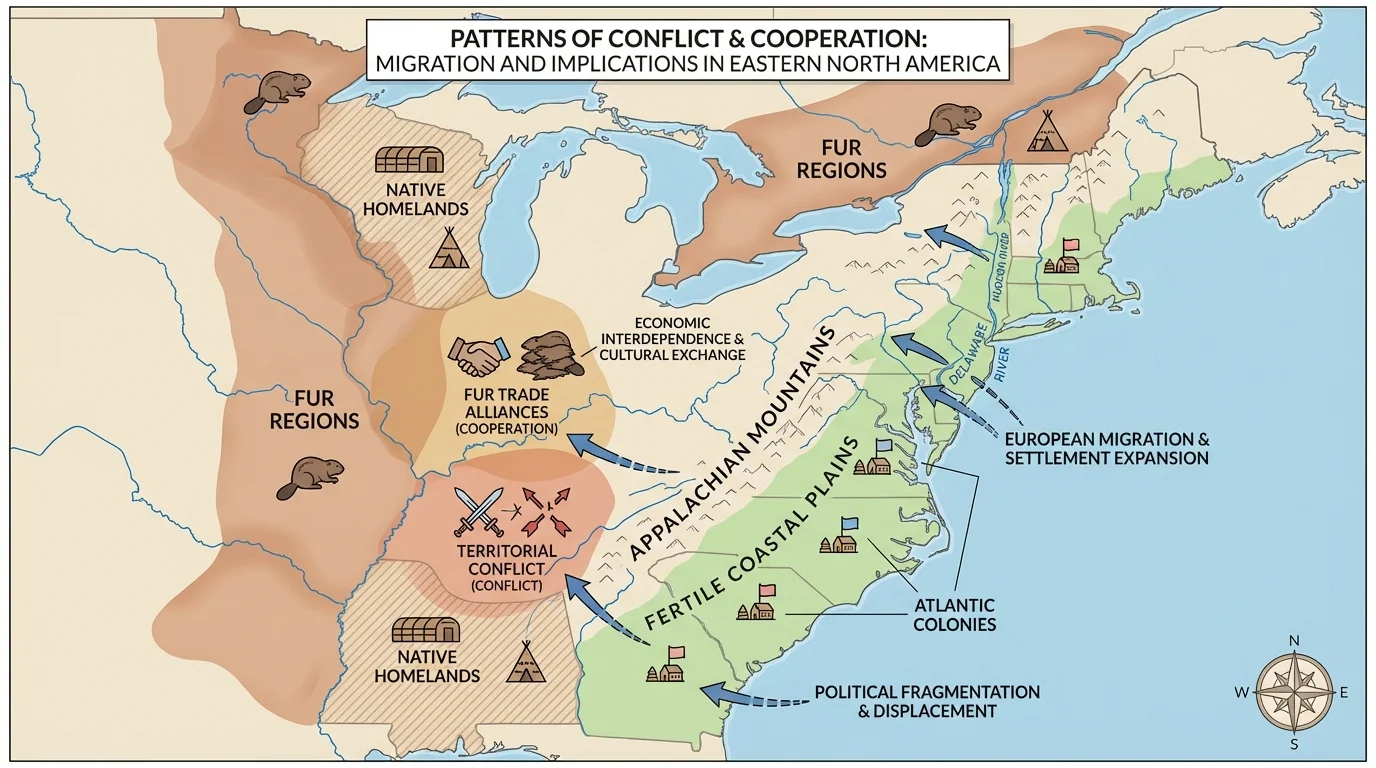
Native nations did not think of land in exactly the same way Europeans often did. Many Native communities understood land as shared through use, kinship, and tradition, though systems varied widely across nations. Many Europeans used ideas of private ownership, fixed boundaries, and royal charters. This difference caused misunderstandings and deliberate abuses. Colonists sometimes claimed they had "bought" land that Native communities believed they were sharing or allowing others to use.
Competition for land was really competition for survival and power. A village near a river could support crops, fishing, and travel. A trading post near fur-rich territory could make a colony profitable. A harbor could connect settlers to Atlantic markets. That is why settlement expansion often produced immediate resistance.
It is important not to treat Native peoples as one single group. North America contained hundreds of nations with different languages, governments, economies, and alliances. The Powhatan Confederacy in the Chesapeake, the Haudenosaunee in the Northeast, the Pueblo peoples in the Southwest, and many others each had their own histories.
Long before permanent European settlement, Native nations had extensive trade networks. They exchanged food, shells, tools, and ideas across long distances. They also had political rivalries and alliances of their own. Europeans entered this already complex world. They did not create all conflict, but their arrival greatly intensified it by introducing new weapons, diseases, goods, and imperial competition.
Some Native trade networks in North America stretched across hundreds of miles before Europeans established colonies. Objects such as shells, copper, and stone moved through exchange systems that connected distant regions.
Disease was one of the most devastating effects of migration. Smallpox, measles, and other illnesses carried by Europeans spread rapidly among Native populations, who had no previous exposure to them. In many places, disease killed huge numbers of people, weakening communities before they could resist military pressure. This made later conflicts even more unequal.
Not every encounter led directly to war. In many places, cooperation was practical, strategic, and necessary, as [Figure 2] illustrates through exchange at the frontier. Early English settlers at Jamestown survived partly because the Powhatan people traded food with them. French colonists built strong trading relationships with several Native groups in the St. Lawrence Valley and Great Lakes region. Spanish colonists, missionaries, and Native communities in the Southwest also formed working relationships, though often unequal ones.
Trade was one major form of cooperation. Native peoples exchanged corn, furs, local knowledge, and transportation routes. Europeans traded metal tools, cloth, firearms, and other manufactured goods. Each side saw possible benefits, though not always equally. Native communities could use trade to strengthen their own power. European colonies depended on it for survival and profit.
Cooperation also included diplomacy and military alliances. European empires often allied with Native nations against rival empires or rival Native groups. During imperial wars between Britain and France, Native allies played crucial roles. These alliances were not signs of weakness. They were strategic choices made by leaders trying to protect their people or increase influence.
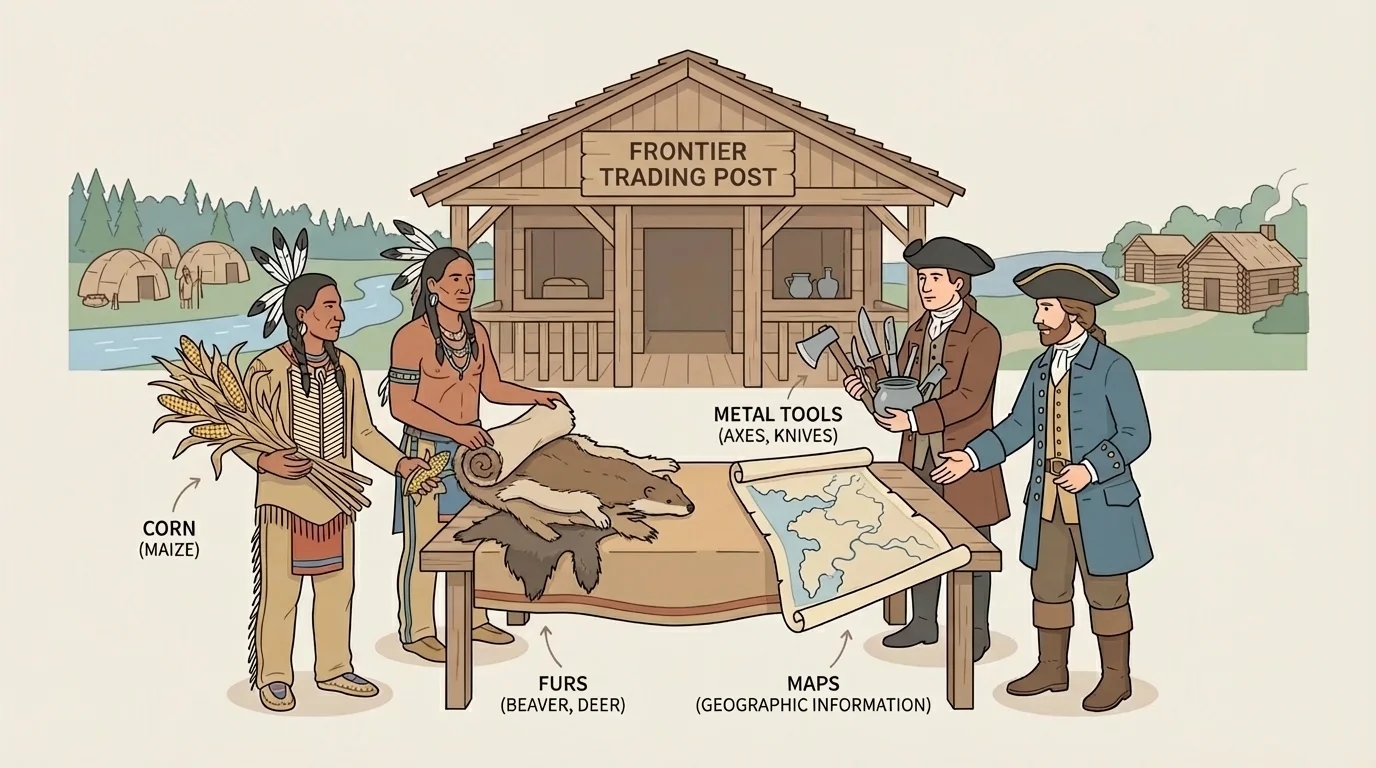
Cultural exchange was another result. Europeans learned from Native agricultural knowledge, including ways to grow corn and adapt to local environments. Native peoples sometimes adopted European goods into daily life. New communities also developed, especially in areas of French settlement, where trade and intermarriage connected peoples across cultural lines.
Still, cooperation was often fragile. A trade agreement could break down if one side demanded more land. An alliance could collapse if promises were broken. The same relationship might include both friendship and mistrust.
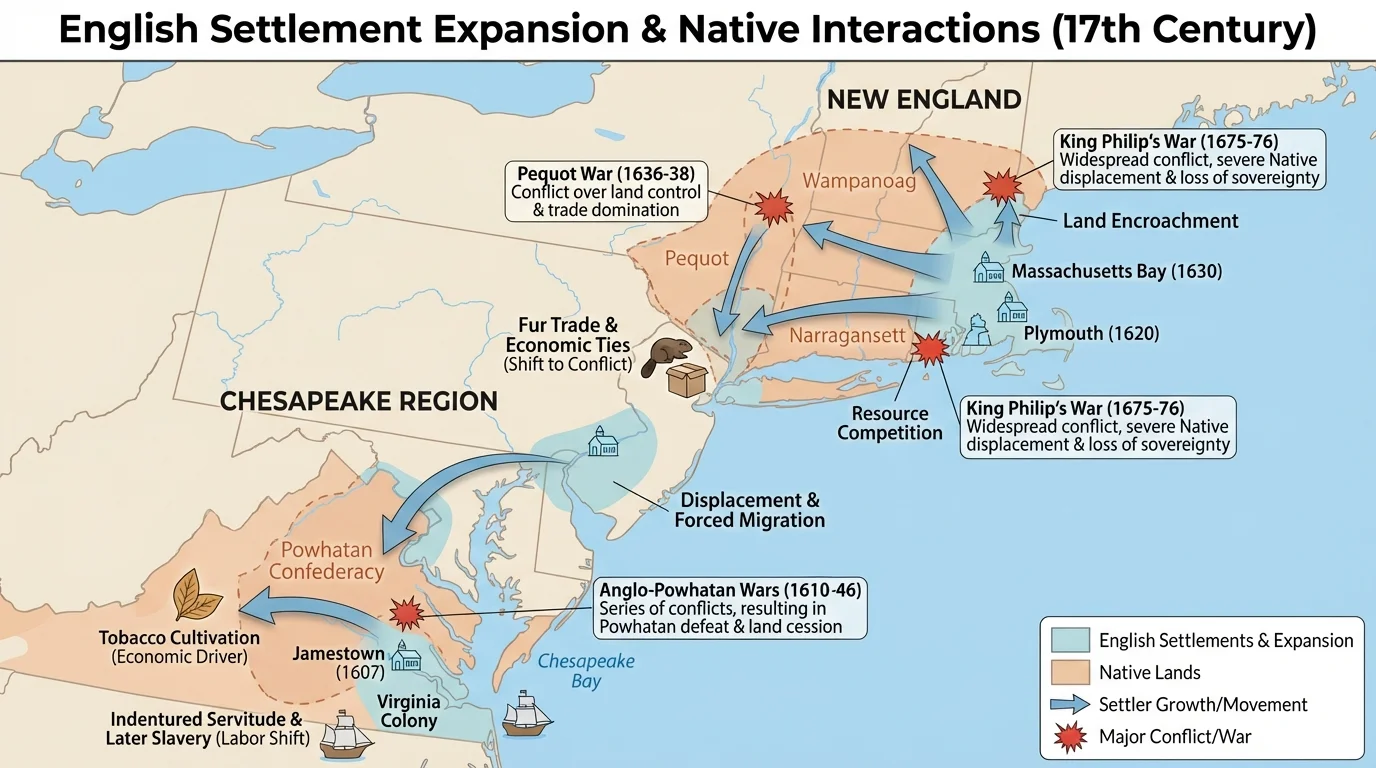
Conflict often grew where settler expansion pressed into Native homelands, as [Figure 3] makes clear through the spread of colonial settlement. Europeans wanted more farmland, more towns, and more control. Native communities wanted to defend the places where their ancestors had lived, farmed, hunted, and governed. Because land could not easily be shared under competing systems of authority, tensions rose.
In the Chesapeake, relations between the English at Jamestown and the Powhatan Confederacy shifted from cautious trade to repeated war. In New England, English expansion contributed to the Pequot War in the 1630s and King Philip's War in the 1670s. These were not small local disagreements. They were brutal struggles over land, power, and survival.
Violence also appeared in the Spanish borderlands. Mission systems tried to control Native labor and religious life. In 1680, Pueblo peoples led the Pueblo Revolt, driving the Spanish out of Santa Fe for a time. This event shows that Native resistance could be organized, powerful, and effective.
Conflict was intensified by technology and disease. Firearms could shift military balance, though Native groups also acquired guns through trade. Disease reduced populations and made recovery harder. Broken treaties made future peace less likely. When one side repeatedly ignored agreements, trust disappeared.
Forced migration was another major form of conflict. Enslaved Africans were violently transported to the Americas to provide labor. Their forced movement was tied directly to economic systems based on land and resources, especially plantation agriculture. This added another layer of suffering and inequality to early American society.
Why conflict and cooperation often happened together
Groups in early America did not choose between perfect peace and constant war. They often traded with one another during one period and fought in another. A colony might depend on a Native nation for food, then later push into that nation's land. An alliance in wartime could be followed by betrayal in peacetime. Understanding this mixed pattern helps explain why early American history is so complex.
Even when wars ended, the results usually changed the balance of power. Colonists often gained land. Native survivors were pushed into smaller spaces or forced to relocate. Social divisions hardened, especially as colonies linked ideas of race to systems of labor and law.
The economic effects of migration were enormous. Colonies were built to make wealth. Land became a source of profit through farming, timber, and trade. In the South, plantations producing tobacco, rice, and later other cash crops demanded large amounts of labor. That labor demand helped drive the expansion of slavery.
A cash crop is a crop grown mainly to be sold for profit rather than used only by the people who grow it. Tobacco in the Chesapeake is a major example. As demand grew in Europe, colonists wanted more land and workers. This pushed settlement outward and increased conflict with Native nations.
The fur trade was especially important in French North America and around the Great Lakes. European demand for beaver hats and other fur products connected distant forests to global markets. As we saw earlier in [Figure 2], exchange relationships could bring mutual benefit for a time, but they could also create dependency on imported goods and draw Native groups into imperial rivalries.
The Atlantic economy connected Europe, Africa, and the Americas. Goods, people, and wealth moved across the ocean. Enslaved Africans produced labor that enriched colonies and European merchants. This system created prosperity for some while causing terrible human suffering for others. Economic growth in the colonies was therefore tied to coercion, inequality, and displacement.
| Group | Economic Goals | Economic Effects |
|---|---|---|
| European colonists | Land ownership, trade, profit, empire | Growth of plantations, ports, and export economies |
| Native nations | Protect homelands, sustain communities, control trade | Some gained power through trade, many lost land and autonomy |
| Enslaved Africans | Forced into labor systems without choice | Built colonial wealth while enduring violence and loss of freedom |
Table 1. Economic goals and effects for major groups involved in early American migration.
Migration changed politics because every colony needed rules about land, labor, religion, and defense. Colonial governments made laws that decided who could vote, who could own land, and who counted as free. These laws often favored European settlers and excluded Native peoples, Africans, women, and poorer colonists from power.
A alliance is an agreement between groups to help one another for political or military reasons. Alliances shaped wars and diplomacy across North America. For example, French and British officials each tried to win Native allies. Native leaders used these rivalries to protect their own interests when possible.
Migration also changed ethnic identity. An ethnic group is a group of people who share common cultural traditions, language, ancestry, or history. In early America, people from England, France, Spain, the Netherlands, West and Central Africa, and many Native nations interacted. Sometimes this created blended communities. At other times it led to prejudice, exclusion, and racial hierarchy.
Socially, these interactions reshaped family life, religion, language, and daily customs. Missions, schools, trade posts, and towns became places of cultural exchange and conflict. Laws about slavery and race hardened over time, making inequality more permanent. The struggle over who belonged and who held power became part of the social fabric of colonial life.
The pressure on land also affected ordinary people. Poor settlers wanted western land. Wealthy landowners wanted to expand their claims. Native communities fought to remain on their ancestral lands. These competing goals meant that migration was not just about moving; it was about deciding whose future would be protected.
Looking closely at specific examples helps reveal larger patterns. In Jamestown, founded in 1607, English colonists entered the territory of the Powhatan Confederacy. At first, trade and diplomacy helped the colony survive. Over time, however, English demand for food and land increased. Warfare followed, showing how cooperation could shift into conflict.
Case study: Jamestown and the Powhatan Confederacy
Step 1: Early contact involved exchange.
The English needed food and local knowledge. The Powhatan people evaluated whether trade or limited cooperation served their interests.
Step 2: Settlement expanded.
As tobacco became profitable, the English wanted more farmland. This meant taking over more territory.
Step 3: Conflict increased.
Competition over land and authority led to repeated wars, weakening Native control in the region.
This case shows a repeating pattern: survival cooperation first, land conflict later.
In New England, English settlements expanded rapidly. The Pequot War and later King Philip's War were especially destructive. King Philip's War, led by Metacom, was one of the deadliest wars per person in North American history. Entire towns were attacked, Native communities were devastated, and colonial expansion accelerated afterward. The settlement pressure shown earlier in [Figure 3] helps explain why conflict became so intense in these regions.
In French-controlled areas, the pattern was somewhat different. French colonists were fewer in number than English colonists in many regions, and French power relied heavily on trade alliances. This often led to closer diplomatic and commercial ties with Native nations, though these relationships still served imperial goals and could still bring conflict.
In the Spanish Southwest, missionaries and colonial officials tried to reorganize Native life around missions and labor demands. The Pueblo Revolt of 1680 showed resistance to religious and political control. It reminds us that Native nations were not simply reacting; they were making organized choices to defend their societies.
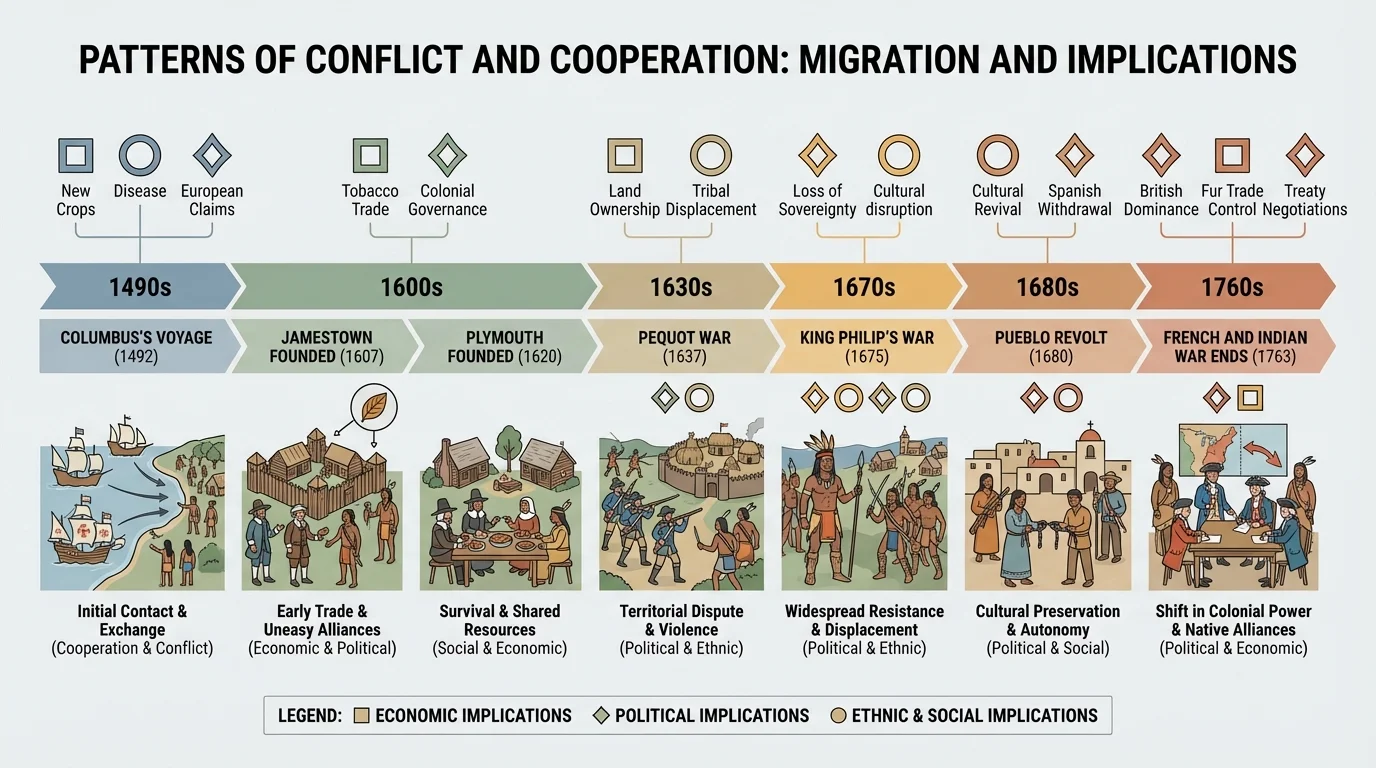
[Figure 4] helps show the sequence of events because each new migration and conflict built on earlier ones. Early encounters set patterns that continued for centuries: contact, exchange, competition, conflict, and changing power.
| Year | Event | Historical Importance |
|---|---|---|
| 1492 | Columbus's voyage | Began sustained contact between Europe and the Americas |
| 1607 | Jamestown founded | Created lasting English settlement in the Chesapeake |
| 1620 | Plymouth founded | Expanded English settlement in New England |
| 1636–1638 | Pequot War | Showed the violence of conflict over land and power |
| 1675–1676 | King Philip's War | Weakened Native power in southern New England |
| 1680 | Pueblo Revolt | Demonstrated successful Native resistance to Spanish rule |
| 1754–1763 | French and Indian War | Redrew control of territory in North America |
Table 2. Major events that shaped migration, conflict, and cooperation in early American history.
By 1763, Britain gained vast territory after the French and Indian War, but this victory also increased tensions over western lands. Native nations continued to resist expansion, and colonists continued to push beyond earlier boundaries. These struggles were not isolated events; they were part of a long chain.
Historians study these patterns using both primary sources and secondary sources. A primary source is something created during the time being studied, such as a treaty, letter, speech, map, or diary. A secondary source is created later by someone analyzing the past, such as a textbook or historical article.
Primary sources can be powerful, but they also have limits. A colonist's diary may describe Native peoples unfairly. A Spanish official may exaggerate success. A treaty may reflect the language of one side more than the other. Historians compare sources to find bias, missing voices, and evidence.
"History is not just what happened. It is also how we know what happened."
For example, an English settler might describe a conflict as a "defensive war," while a Native oral tradition might remember it as an invasion. Reading both helps historians understand that the same event can look very different depending on perspective.
The effects of early migration lasted far beyond the colonial period. Patterns of land seizure, forced labor, racial inequality, and political exclusion continued to shape the future United States. So did patterns of exchange, adaptation, and resilience. Native nations survived despite enormous loss and continued to defend sovereignty and culture. African-descended communities preserved traditions and resisted oppression even under slavery.
Many debates in later American history grew from these early experiences: who controls land, who has rights, who benefits from economic growth, and how different peoples can live together justly. The geography shown in [Figure 1] and the exchange patterns shown in [Figure 2] remind us that the physical environment and human choices were always linked.
When we analyze conflict and cooperation in early American migration, we see more than a list of wars and settlements. We see repeated struggles over resources, power, and identity. We also see that people made decisions within specific geographic conditions. Rivers, coastlines, forests, and fertile lands were not just places on a map. They were the foundation of economies, governments, and everyday life.
