A historian studying the past is not just reading old stories. In many cases, the work looks surprisingly similar to detective work, journalism, and data analysis at the same time. To understand a war, an election, a protest movement, or an economic crisis, historians might read a soldier's letter, compare census totals, inspect newspaper headlines, track wages, and examine voting returns. The past leaves behind voices, numbers, and patterns. Learning how to gather and analyze all of them is one of the most important skills in historical inquiry.
Historical knowledge becomes stronger when it rests on more than one kind of evidence. A diary can reveal emotion and perspective. A census can show how many people lived in a city. A speech can show political goals. Factory wage data can reveal whether workers' lives were improving or getting harder. When these pieces are brought together carefully, historians can move beyond simple opinion and develop well-supported interpretations.
History is the study of change, continuity, and human experience over time. To study those things well, historians must ask strong questions: Who had power? Who was excluded? What changed? What stayed the same? Why did events happen when they did? No single source can answer all of these. That is why historians use a wide range of evidence and compare it closely.
Some evidence tells us what people thought, feared, wanted, or believed. Other evidence shows broader patterns in a population. The first kind is often found in words and images; the second is often found in counts, tables, and percentages. Historians combine both because human societies are made up of lived experiences as well as measurable trends.
Qualitative sources provide descriptive, non-numerical evidence such as letters, speeches, photographs, interviews, and newspaper articles. Quantitative data provides numerical evidence such as population totals, wage records, tax receipts, election returns, and trade statistics.
Primary sources come from the time being studied, while secondary sources are later interpretations created by historians or other scholars using evidence from the past.
Using many kinds of sources also helps historians test claims. If a government report says life was improving, but personal letters describe hunger and fear, there is a question worth investigating. If political leaders claim wide public support, election data may confirm or challenge that claim. Historical thinking depends on this habit of checking one source against others rather than accepting any single piece of evidence as complete.
Historians work with both primary sources and secondary sources. A primary source may be a census schedule, a court document, a campaign poster, a photograph, an interview, a factory ledger, or a law passed during the period under study. A secondary source may be a scholarly article, a textbook chapter, a documentary, or a historical monograph that interprets those primary records.
Neither kind of source is automatically better in every situation. Primary sources provide direct evidence from the time, but they can be incomplete, biased, or limited in perspective. Secondary sources may offer broader context, comparison, and expert interpretation, but they depend on the historian's methods and choices. Strong historical analysis usually uses both.
For example, if historians want to study women's work during World War II, they might use wartime propaganda posters, oral histories, payroll records, photographs from factories, and later scholarly research on gender roles. Each source answers a different question. Posters reveal official messaging. Oral histories reveal personal memory. Payroll records provide measurable evidence. Scholarly writing helps connect those details to larger historical debates.
One of the most useful distinctions in historical analysis is the difference between qualitative sources and quantitative data. Historians often combine stories and numbers, as [Figure 1] illustrates, because each type of evidence reveals something the other may miss. A speech may show what a leader wanted citizens to believe, while voting totals can indicate how far that message actually succeeded.
Qualitative evidence is especially useful for understanding perspective, language, motive, values, and emotion. It helps historians hear voices from the past. Quantitative evidence is especially useful for identifying scale, comparison, and change over time. It can answer questions such as whether a city doubled in size, whether wages rose more slowly than prices, or whether voter participation declined.
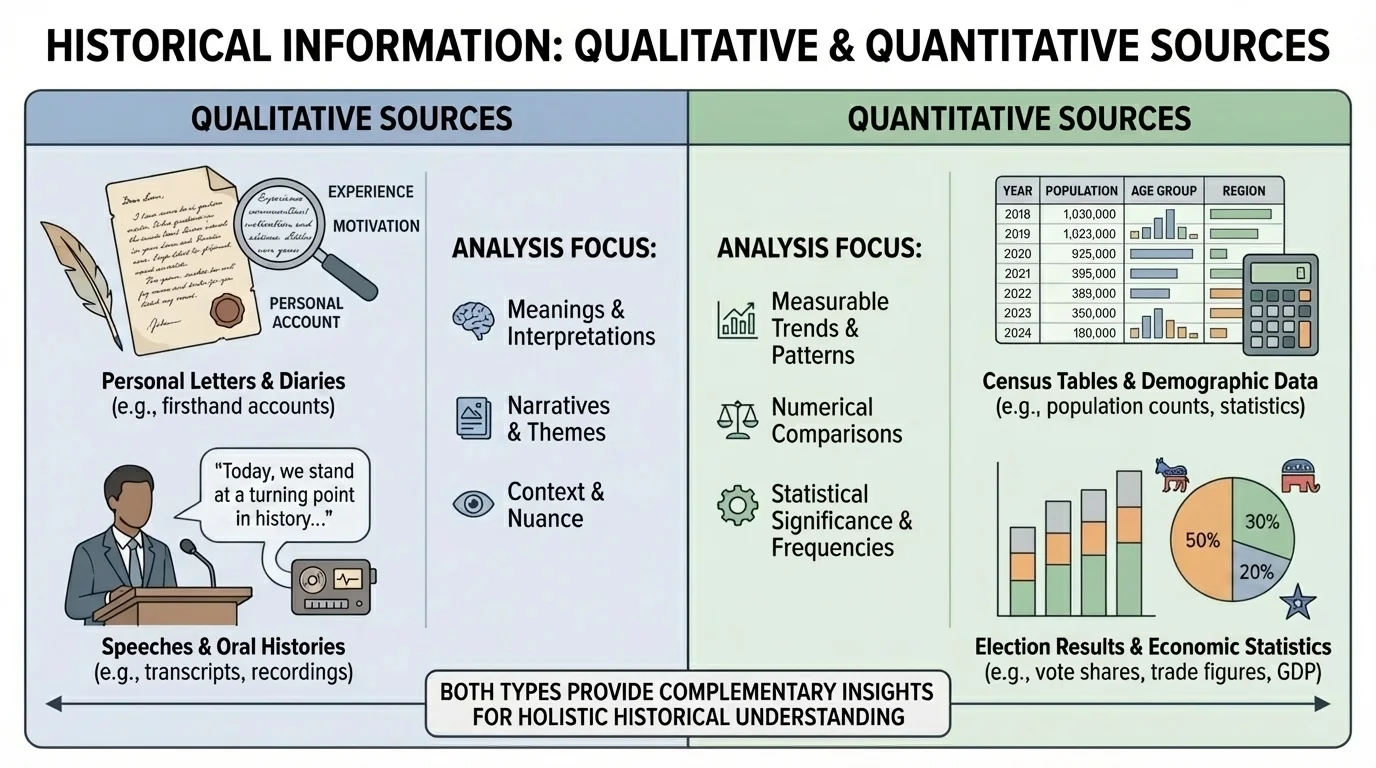
A strong historian does not treat these as competing methods. Instead, the best analysis often comes from putting them together. A newspaper might describe rising anger among workers. Wage records and unemployment figures can test whether economic pressure was severe enough to support that description. A memoir might say migration transformed a neighborhood; census records can help measure how many people moved and when.
Each type has limits. Qualitative sources may be vivid but unrepresentative. One person's letter cannot speak for an entire nation. Quantitative sources may look precise but still reflect bias in how data was collected. A census may undercount certain populations, and official reports may exclude people with little power. Historians must therefore ask not only what a source says, but also who created it, for what purpose, and who may be missing from it.
Some of the most important historical discoveries come from comparing sources that seem unrelated at first. A ship manifest, a church register, and a tax record can sometimes be combined to reconstruct the life of a person who never wrote a diary or published a speech.
This is one reason historical inquiry is both challenging and powerful. The past does not arrive in a neat package. It must be assembled from fragments, and the quality of the interpretation depends on how carefully those fragments are gathered and compared.
Many historical investigations rely on four major categories of evidence: demographic data, economic data, social data, and political data. These categories help historians ask different kinds of questions about the same event or period.
[Figure 2] Demographic data concerns populations. It includes age, sex, birth rate, death rate, family size, migration, ethnicity, and urban or rural residence. Census reports are among the most common demographic sources. Historians use them to trace population growth, migration patterns, and changes in settlement.
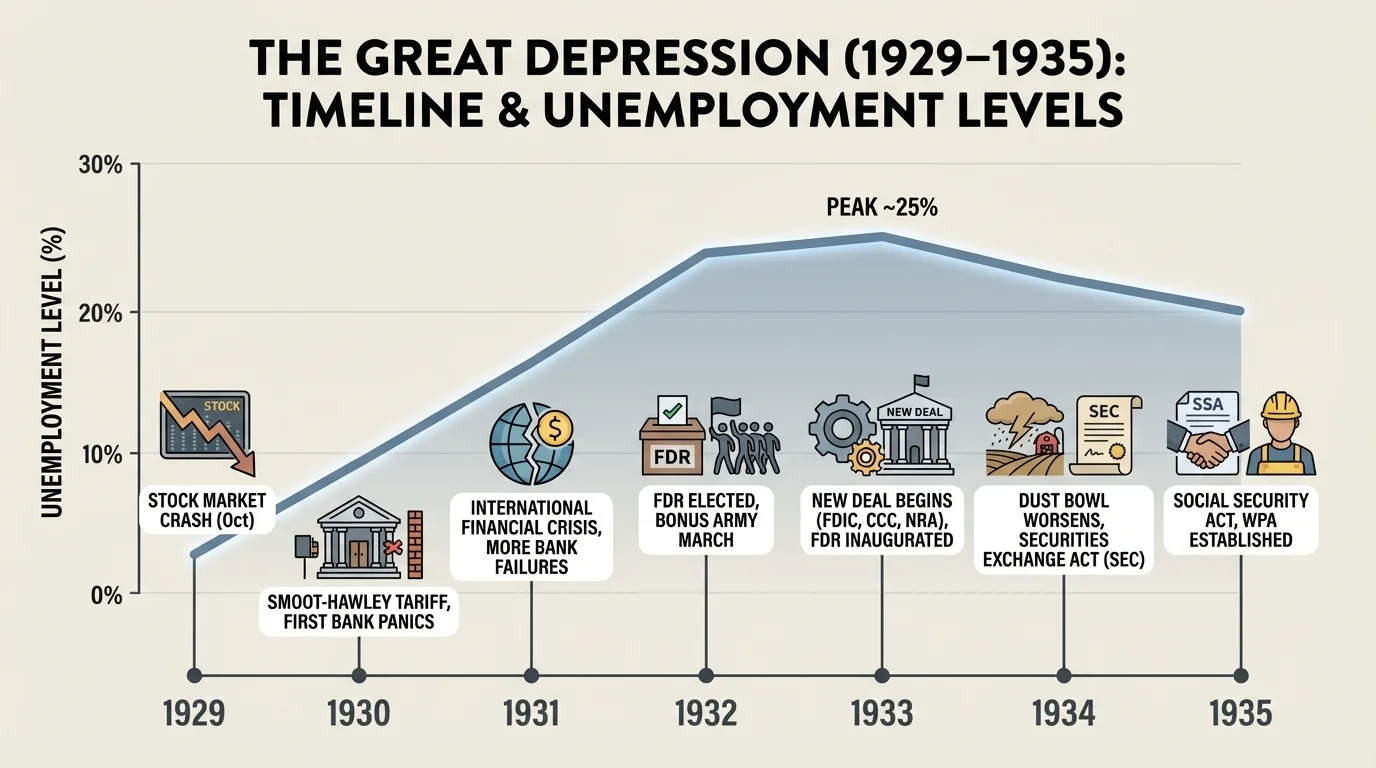
Economic data concerns production, labor, trade, wages, prices, taxes, land ownership, and wealth. Economic records can reveal whether a society was becoming more industrial, more unequal, or more connected to global trade. During the Great Depression, for example, unemployment rates, bank failure counts, and farm prices helped historians measure the depth of the crisis.
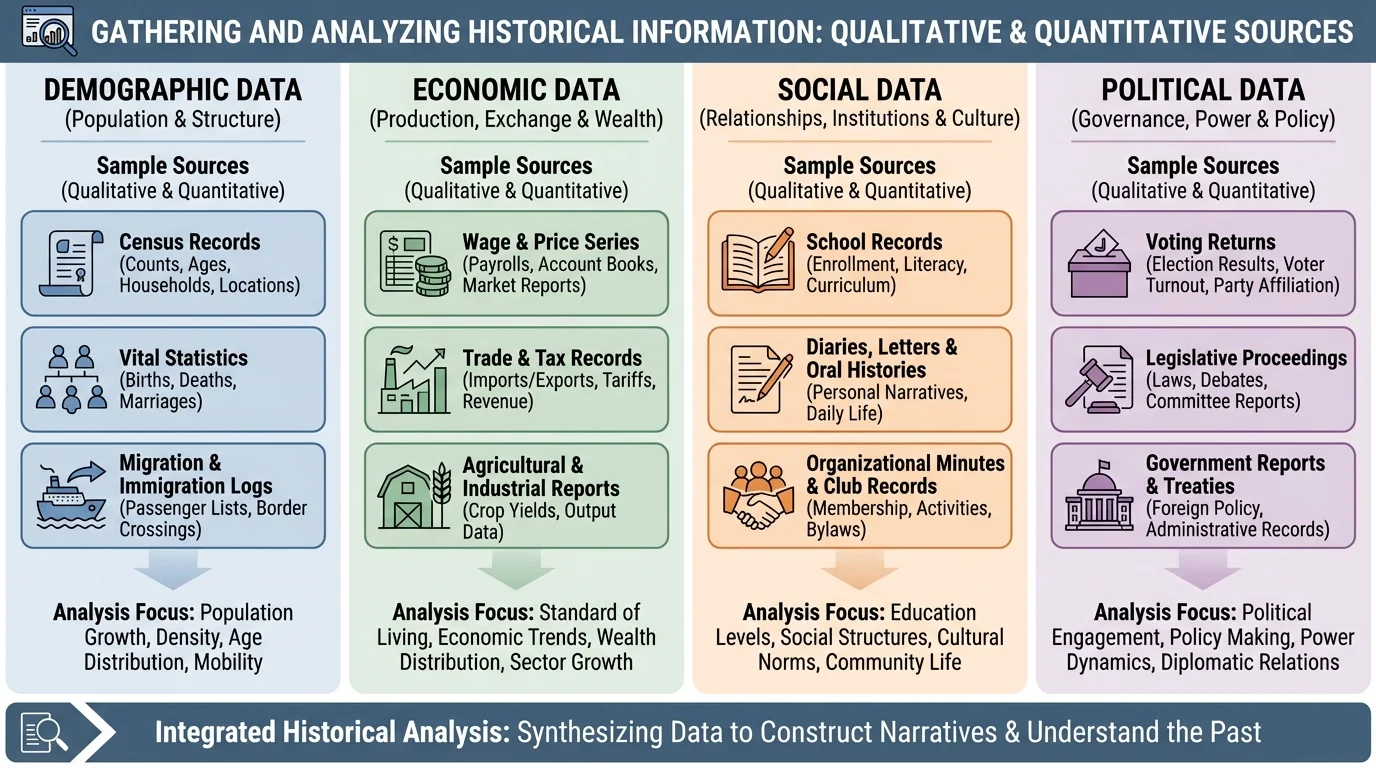
Social data concerns everyday life and social structures. It may include school attendance, literacy rates, marriage records, housing conditions, crime reports, religious affiliation, and access to health care. Social data can show who benefited from change and who did not. It often helps historians study class, race, gender, and community life.
Political data concerns government, power, law, and public participation. Examples include election returns, laws, court cases, party membership, legislative debates, military service records, and protest petitions. Political data can reveal whether a reform had broad support, whether voting rights expanded, or whether a government relied more on persuasion or force.
| Category | What It Studies | Example Sources | Questions It Can Answer |
|---|---|---|---|
| Demographic | Population patterns | Census records, birth records, migration logs | Who lived where, and how did that change? |
| Economic | Work, wealth, production | Payrolls, price lists, tax records, trade statistics | Who had resources, and how were they distributed? |
| Social | Daily life and social conditions | School records, housing reports, newspapers, interviews | How did people live, learn, and interact? |
| Political | Power and government | Election results, laws, speeches, court records | Who ruled, who participated, and how decisions were made? |
Table 1. Four major categories of historical data and the kinds of questions each can help answer.
These categories often overlap. A migration study may involve demographic counts, wage comparisons, newspaper editorials, and voting laws all at once. Good historians move across categories rather than staying inside only one.
Historical information comes from many places: archives, libraries, museums, government databases, local courthouses, university collections, historical societies, and oral history projects. In the digital age, many records once available only in person are now searchable online. Census data, newspapers, legislative documents, maps, and photographs can often be accessed through digitized collections.
Gathering sources begins with a compelling question. Suppose a historian asks why northern cities changed so rapidly during the early twentieth century. That question suggests several kinds of evidence: census records for population growth, railroad data, job advertisements, housing reports, letters from migrants, and local newspaper coverage. The question guides the search.
Historians also think about whose voices are present and whose are missing. Official records may preserve the decisions of governments and businesses, but not always the experiences of workers, immigrants, women, or children. Oral histories, community archives, church records, neighborhood newspapers, and personal correspondence can help recover those perspectives.
Corroboration means checking one source against another. Historians use corroboration to see whether different kinds of evidence support the same conclusion, complicate it, or contradict it. The goal is not to force every source to agree, but to understand why they differ.
Gathering historical information is therefore an active process. Historians do not merely collect whatever is easiest to find. They select sources strategically, looking for breadth, depth, and variety.
Once sources are gathered, historians evaluate them. A source must be placed in context: who created it, when, where, why, and for whom? This process is called sourcing. A speech given during an election campaign has a different purpose from a private diary entry. A government report may aim to persuade as much as to inform.
Bias does not automatically make a source useless. In fact, bias can be historically valuable because it reveals perspective and interest. A plantation owner's records, an abolitionist newspaper, and the testimony of formerly enslaved people all contain viewpoints shaped by position and experience. The historian's task is to recognize those perspectives, not ignore them.
Reliability also depends on method. Was the information observed firsthand or repeated from rumor? Was the sample broad or narrow? Were some groups excluded from the count? A census taken under confusing conditions may produce weak data. A memoir written decades later may contain memory errors. Historians must weigh such issues carefully.
Another key question is what the source cannot tell us. Silence matters in history. If official documents rarely mention poor families, that absence may reflect power rather than irrelevance. Missing records are themselves clues about whose lives were preserved and whose were overlooked.
"The most effective way to destroy people is to deny and obliterate their own understanding of their history."
— George Orwell
This is why evaluating sources is not only a technical skill but also an ethical one. Historical research should avoid repeating the exclusions built into old records.
After gathering and evaluating evidence, historians begin analysis. They look for patterns, relationships, and change over time. They may compare one year to another, one region to another, or one social group to another. In this kind of work, a timeline tied to measurable shifts helps historians connect events to trends instead of treating them as isolated facts.
[Figure 3] One common method is comparison. Historians might compare factory wages in two cities, literacy rates before and after a reform, or voting patterns across different states. Another method is tracking continuity and change. What remained stable? What transformed? During industrialization, for example, production methods changed rapidly, but many inequalities persisted.
Historians also analyze cause and effect, but they do so carefully. Major events usually have multiple causes. The outbreak of a revolution may involve economic hardship, political exclusion, social tension, and immediate triggers. A useful interpretation often explains how these causes interacted rather than reducing everything to one factor.
Quantitative analysis often involves simple comparison rather than advanced mathematics. If the population of a city rises from 500,000 to 800,000 over a period, historians ask what migration, industry, or policy changes might explain that increase. If voter turnout falls while literacy rises, historians look for other causes such as disenfranchisement laws or political distrust. Numbers become meaningful only when placed in context.
Qualitative analysis focuses on language, tone, symbolism, and perspective. Historians examine how a speech frames an issue, how a newspaper labels different groups, or how a photograph directs the viewer's attention. As with the source comparison in [Figure 1], the point is to connect lived experience with measurable evidence rather than separating them.
Case analysis: unemployment during the Great Depression
A historian wants to understand how Americans experienced the economic collapse after 1929.
Step 1: Gather quantitative evidence.
The historian collects unemployment rates, bank failure data, farm prices, and industrial output figures from the early 1930s.
Step 2: Gather qualitative evidence.
The historian reads letters to public officials, newspaper interviews, photographs, and diaries describing hunger, job loss, and migration.
Step 3: Compare and interpret.
If unemployment rises sharply while personal letters describe fear and insecurity, the two kinds of evidence reinforce each other. If official reports sound optimistic while local accounts describe severe suffering, the historian investigates the gap.
The result is a stronger interpretation than either statistics or personal testimony could provide alone.
Analysis is where historians move from collection to explanation. Facts matter, but historical thinking asks what those facts mean together.
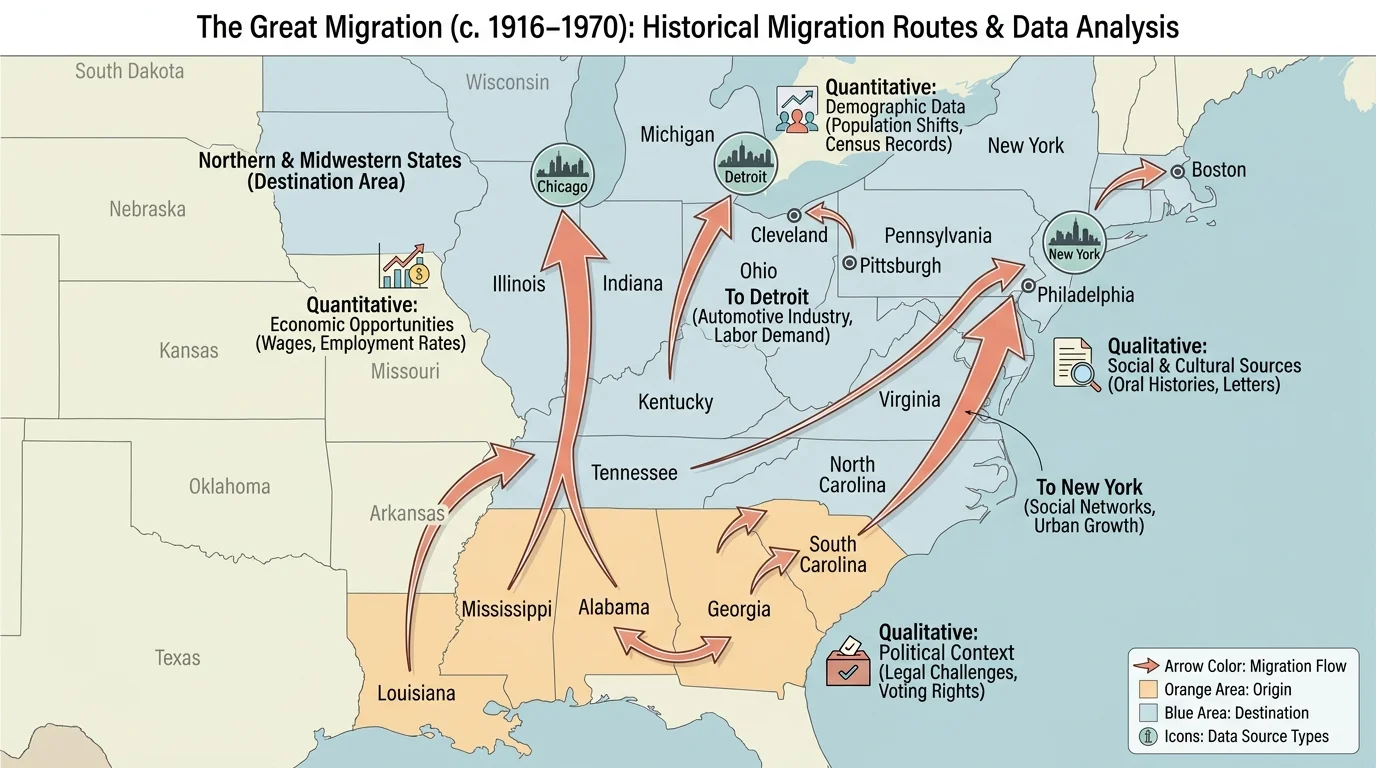
The Great Migration offers a clear example of mixed-source historical analysis. Between the early twentieth century and the decades that followed, millions of African Americans moved from the South to northern and midwestern cities. Historians trace this movement using demographic and social evidence, and these routes show that this was not random movement but a major historical pattern.
[Figure 4] Census records reveal population changes in cities such as Chicago, Detroit, and New York. Employment records show the attraction of industrial jobs. Southern laws and racial violence help explain the push factors. Newspapers, letters, church records, and oral histories reveal hopes for safety, work, education, and dignity. Together, these sources show both the scale and the human meaning of migration.
The Civil Rights Movement is another example. Historians use court decisions, voter registration figures, television footage, speeches, FBI files, local newspapers, and memoirs. Political data shows changes in law and voting participation. Social data shows segregation in schools and housing. Qualitative sources reveal the courage, strategy, and danger involved in activism.
Consider the Montgomery Bus Boycott from 1955 to 1956. A historian might examine bus company records, court rulings, boycott leaflets, interviews, and photographs. Economic data can show the financial impact on the bus system. Political data can show how city authorities responded. Personal accounts reveal the discipline and determination of ordinary people. This combination helps explain why the boycott mattered beyond one city.
Looking back to [Figure 4], migration patterns also help explain later political and cultural changes in the cities that received new residents. Demographic change often reshapes voting, labor, music, religion, and neighborhood life.
After analyzing sources, historians form an interpretation. An interpretation is not just a guess. It is a claim supported by evidence and reasoning. A strong historical claim is specific, arguable, and grounded in sources. For example, instead of saying "the New Deal helped people," a stronger claim might argue that New Deal programs reduced some economic suffering but benefited groups unevenly depending on race, region, and occupation.
To defend such a claim, historians cite both textual evidence and data. They may quote a speech, compare employment figures, refer to a court ruling, and analyze a photograph. The goal is not simply to pile up facts but to connect evidence to the argument clearly.
Good historical writing also acknowledges complexity. Different sources may point in different directions. A reform may improve conditions for some people while leaving others behind. An election victory may reflect both popular enthusiasm and the exclusion of voters. Mature historical interpretation makes room for such complications.
Evidence does not speak for itself. A fact becomes historically meaningful when it is connected to a question, placed in context, and interpreted alongside other evidence.
This is why historians often disagree even when using some of the same sources. They may assign different weight to evidence, define causation differently, or ask different questions. Historical argument is not a weakness of the field; it is part of how understanding grows.
One common mistake is presentism, judging the past only by today's values without first understanding historical context. Context does not excuse injustice, but it is necessary for explanation. Another mistake is cherry-picking, selecting only the evidence that supports one view while ignoring conflicting sources.
Overgeneralizing from a single source is also risky. One diary entry may be powerful, but it does not automatically represent an entire population. The same is true for statistics. A national average may hide major regional differences. Historians must ask who is included, who is excluded, and whether the evidence is representative.
Good historical habits include asking compelling questions, gathering varied evidence, checking credibility, comparing sources, looking for patterns, and writing claims that can be defended. The most convincing historical work shows both rigor and humility: rigor in handling evidence carefully, and humility in recognizing that no source gives a complete picture of the past.
When students learn to gather and analyze historical information from a range of qualitative and quantitative sources, they are doing far more than memorizing dates. They are learning how knowledge is built, how evidence is tested, and how interpretations are defended. Those skills matter not only in history class, but in civic life, media literacy, and any serious attempt to understand the world.
