Every day, people act as if they have unlimited plans but limited time, money, space, and energy. A student may want to earn money, sleep more, join a team, keep grades high, and spend time with friends—all in the same week. A city may want better roads, smaller class sizes, cleaner parks, and lower taxes at the same time. Economics begins with a simple but powerful fact: human wants are wide, but resources are limited. That gap between unlimited wants and limited resources is what makes economics necessary.
Economics is the study of how people make choices when resources are limited. The central condition behind those choices is scarcity. Scarcity does not mean that something is rare in an absolute sense. It means there is not enough of a resource to satisfy all the uses people want from it. Clean water may be abundant in one place and scarce in another. Time is scarce for every person because each day has only 24 hours.
Scarcity affects almost everything people value: money, time, land, skilled workers, tools, energy, and raw materials. Because these things are limited, people cannot have everything they want. That is why economics is often described as the study of choice under conditions of scarcity.
Scarcity means limited resources are not enough to satisfy all wants.
Choice means selecting one option from among alternatives.
Opportunity cost is the value of the next-best alternative given up when a choice is made.
Scarcity is not the same as poverty. Even wealthy individuals, successful businesses, and powerful governments face scarcity because their resources are still limited relative to all the things they could do. A country with a large budget still must decide whether to spend more on transportation, health care, defense, or education. The basic problem never disappears.
To understand scarcity more clearly, economists group the resources used to produce goods and services into broad categories, as [Figure 1] shows. These are often called productive resources or factors of production. In this lesson, the main categories are land, labor, and capital.
Land includes natural resources provided by nature. This category includes farmland, forests, rivers, oil, minerals, sunlight, and the physical space where production happens. A farmer needs soil and water. A construction company needs a building site. A solar company depends on access to sunlight. Land is limited because the amount and quality of natural resources are not infinite.
Labor means human effort—both physical and mental—used in production. Teachers, mechanics, surgeons, coders, delivery drivers, and engineers all provide labor. Labor is scarce because people have limited time, limited skills, and limited energy. Training more workers takes time and money, and not everyone can instantly fill every needed role.
Capital means tools, machines, buildings, and equipment used to produce other goods and services. A bakery's ovens, a school's computers, a factory's robots, and a hospital's scanners are forms of capital. Capital is not just money. In economics, capital refers to produced resources that help create output. Capital is scarce because it must be built, maintained, and replaced.
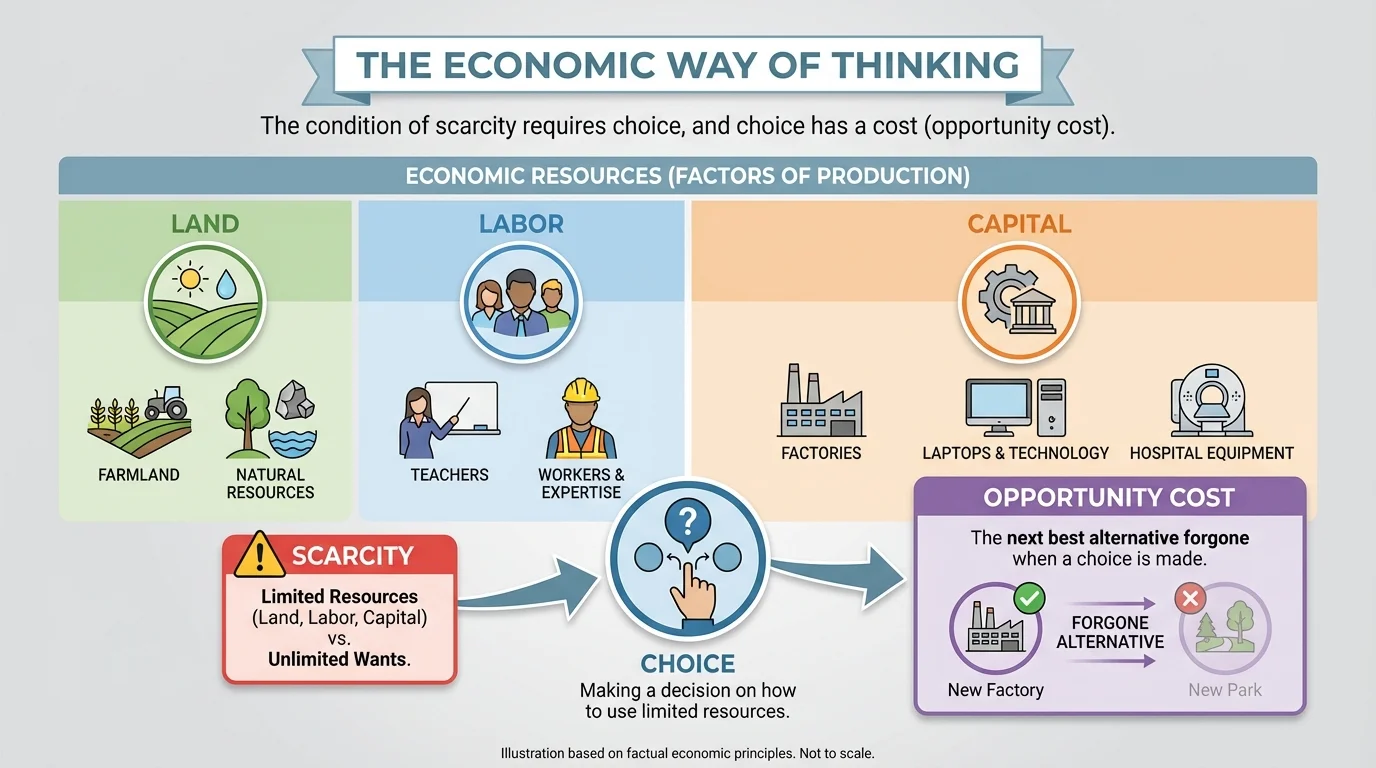
When any of these resources are limited, choices must be made. A town with limited land may need to decide whether open space should become housing, farmland, or a shopping area. A business with limited labor hours must decide which products to make first. A school with limited capital may need to choose between new science lab equipment and upgraded computers.
The scarcity of productive resources explains why societies cannot produce unlimited amounts of every good and service. Producing more of one thing often means producing less of something else because the same land, labor, and capital cannot be used in two places at the same time. This idea will become especially important when we discuss opportunity cost later, and [Figure 1] remains useful because it reminds us that all economic tradeoffs begin with limited resources.
Once scarcity exists, choice becomes unavoidable. Individuals choose how to spend time and money. Households choose what to buy, save, and postpone. Businesses choose what to produce, whom to hire, and which technology to invest in. Governments choose which programs to fund and which projects to delay.
These choices are examples of allocation, the process of deciding how scarce resources will be distributed or used. An individual allocates hours between homework, sleep, work, and leisure. A household allocates income among rent, food, transportation, and savings. A business allocates employees and machines among competing tasks. A government allocates tax revenue across public needs.
Allocation is not random. It reflects goals, priorities, constraints, and incentives. A student preparing for college entrance exams may allocate more time to studying than to entertainment. A family facing higher grocery prices may allocate less income to restaurant meals. A company expecting strong demand for electric vehicles may shift labor and capital away from older product lines.
Why scarcity forces choice
If resources were unlimited, people could say yes to every option. Scarcity changes that. Using a resource for one purpose means it cannot be fully used for another at the same time. This creates tradeoffs, and tradeoffs are at the center of economic thinking.
Even when people do not notice it, they are constantly making tradeoffs. Choosing to stay up late streaming a show may reduce sleep and lower performance the next day. Choosing to save money for a car may mean spending less on entertainment now. The key insight is that every meaningful choice closes off another possibility.
The most important cost in economics is often not the money paid at the register. It is the opportunity cost: when a person picks one option, the cost is the value of the next-best alternative that is given up. If a student spends Saturday working a shift, the opportunity cost might be the basketball tournament, study time, or rest that could not happen instead.
[Figure 2] Opportunity cost is not the value of all alternatives combined. It is specifically the most valuable alternative that was not chosen. If you choose Option A over Options B, C, and D, the opportunity cost is the value of whichever of B, C, or D you valued most.
This idea matters because every decision uses scarce resources. If a school spends money on a new stadium, the opportunity cost may be smaller class sizes or updated textbooks. If a government uses land for an airport expansion, the opportunity cost may be housing, farmland, or preserved wetlands.
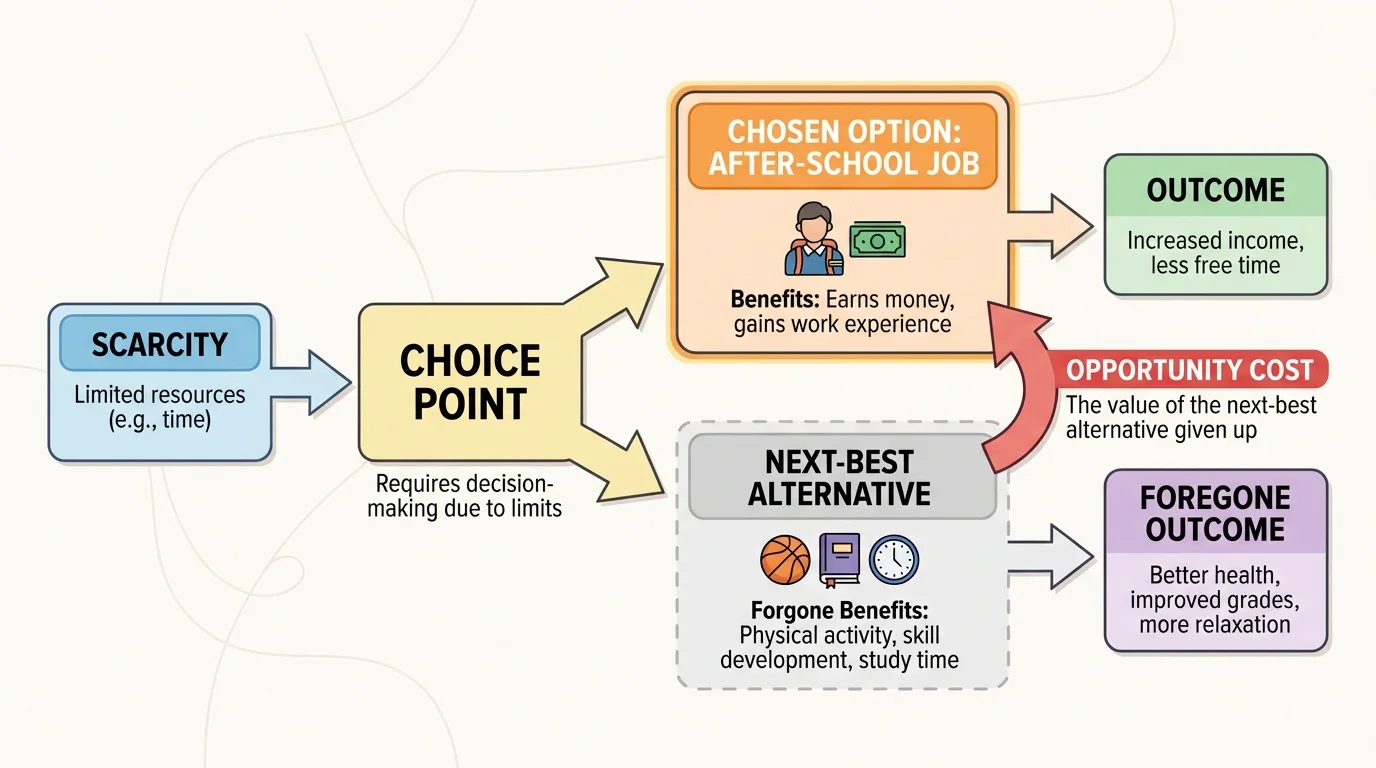
Opportunity cost can be measured in different ways. Sometimes it is measured in money, but often it is measured in time, experiences, or benefits. Suppose a concert ticket is free because a friend gives it to you. The event is not costless. If attending means missing a paid work shift worth $60, then the opportunity cost includes that lost income. If it also means missing important study time before an exam, the opportunity cost may be even higher.
This is why economists say there is no truly "free" choice when scarce resources are involved. A free app may still cost you time, attention, or privacy. A free school event may still cost transportation time or missed work. The money price may be zero, but the opportunity cost is not.
Case study: A student with one free evening
A student can use Friday evening in only one main way: preparing for a chemistry test, working a shift at a café, or attending a friend's birthday party.
Step 1: Identify the chosen option.
Suppose the student chooses to work the café shift.
Step 2: Rank the alternatives not chosen.
If the student values studying more than the party, then studying is the next-best alternative.
Step 3: State the opportunity cost.
The opportunity cost of working is not "studying plus the party." It is the value of the chemistry study time alone, because that is the highest-valued option given up.
This example shows why opportunity cost depends on preferences. Different people may face the same options but have different opportunity costs.
Notice that opportunity cost is personal as well as economic. For one student, missing a practice session before a championship game might be the biggest sacrifice. For another, missing time to complete a scholarship application might matter more. The same choice can have different costs for different people because they value alternatives differently.
Students encounter opportunity cost constantly. Choosing an advanced class may create the benefit of stronger preparation for college, but the opportunity cost may be less free time. Choosing to spend $30 on shoes may mean giving up three movie tickets or part of a savings goal. Choosing to scroll through social media for two hours may mean giving up sleep, homework quality, or time with family.
Households face similar decisions. A family that spends more on a vacation may need to postpone replacing a refrigerator. A household that moves to a larger apartment may gain space but give up the chance to save more each month. Parents may choose jobs with lower pay if those jobs offer more time at home. In that case, the opportunity cost of extra family time is some lost income, but the family may decide that tradeoff is worth it.
Opportunity cost also appears in less obvious ways. Consider cooking at home versus ordering takeout. Cooking may save money, but it uses time and effort. Ordering takeout may cost more money, but it saves time. The "best" choice depends on what the decision-maker values most in that moment.
Professional athletes, musicians, and entrepreneurs often talk about what they had to give up to succeed. Their stories are really stories about opportunity cost: hours spent training or building a business were hours not spent on other activities.
Economics does not tell people what they should value. Instead, it helps them recognize that every decision has a real tradeoff. Thinking in terms of opportunity cost can improve decisions because it forces people to ask, "What am I giving up by choosing this?"
[Figure 3] Businesses also face unavoidable tradeoffs, and these tradeoffs in production appear clearly in production decisions. A company with limited factory space, worker hours, and machine time cannot produce unlimited amounts of every product. If an electronics firm uses more chips, engineers, and assembly lines to make laptops, it may have fewer resources left to make tablets.
Businesses compare expected benefits and costs when deciding how to allocate scarce resources. A restaurant may decide whether to hire another cook, buy a faster oven, or expand delivery service. Each decision uses money and time that cannot be used elsewhere. The opportunity cost of buying new equipment might be delaying renovation. The opportunity cost of hiring more workers might be lower short-term profits.
Governments face some of the largest and most visible opportunity costs because public budgets are limited. If a city spends more on public transit, it may have less to spend on road repair or parks. If a national government increases defense spending, it may have to reduce spending somewhere else, borrow more, or raise taxes. None of those options is costless, as [Figure 3] helps illustrate.
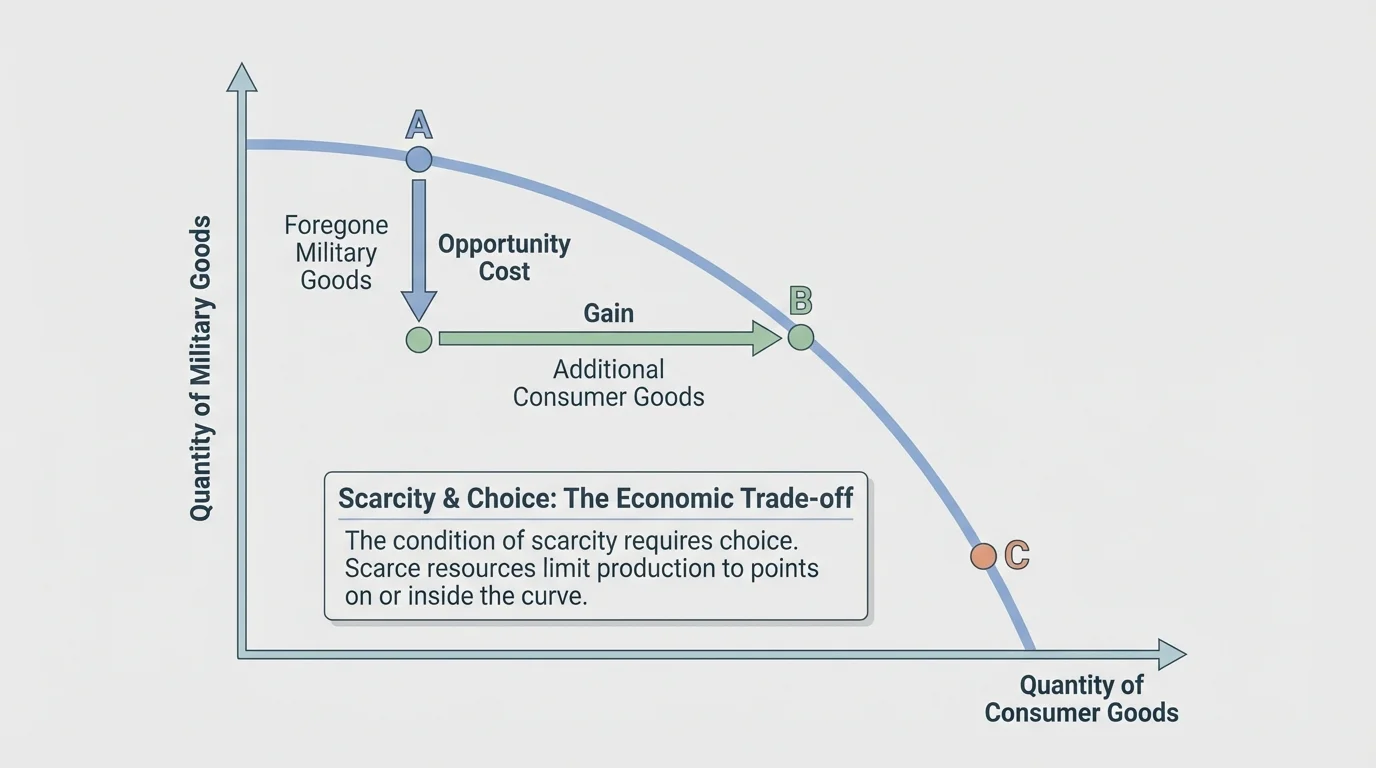
One classic way economists illustrate this is with a tradeoff between "guns and butter," meaning military goods and consumer goods. The point is not about those exact products; it is about limited resources. If land, labor, and capital shift toward one goal, fewer remain for another goal. Producing more in one direction usually requires giving up some output in another direction.
Policy choices affect everyday life. A decision to fund more job training may increase workers' skills over time, but the opportunity cost may be less money available for immediate tax cuts. A decision to preserve natural land may limit commercial development today, but it may protect water quality, tourism, and biodiversity for the future. Economic thinking helps people evaluate these tradeoffs more clearly.
| Decision-maker | Scarce resource | Choice | Possible opportunity cost |
|---|---|---|---|
| Student | Time | Work after school | Sports practice or study time |
| Household | Income | Take a vacation | Saving for emergencies |
| Business | Machine time | Produce more laptops | Fewer tablets produced |
| Government | Tax revenue | Expand transit | Less spending on other services |
Table 1. Examples of how different decision-makers face scarcity, make choices, and incur opportunity costs.
Many economic decisions are not all-or-nothing. People often decide whether to do a little more or a little less of something. This is called marginal thinking. Instead of asking, "Should I study or not study?" a student might ask, "Should I study one more hour tonight?" Instead of asking, "Should the company produce cars?" a business might ask, "Should we produce 500 more cars this month?"
Economists often say a rational decision-maker compares marginal benefit with marginal cost. If the added benefit of one more unit of an activity is greater than the added cost, then doing more may make sense. If the added cost is greater, then doing more may not be worth it.
Marginal decisions and scarcity
Scarcity does not just force big choices. It shapes small adjustments too. Because time, money, and resources are limited, people regularly compare the extra benefit of one more action with the extra opportunity cost of that action.
For example, suppose a student has already studied for two hours. A third hour may still help, but if the student is exhausted, the benefit of that extra hour may be lower than the cost in sleep. A business may find that producing the first 1,000 units is efficient, but producing another 100 units requires overtime pay and may not be profitable. Marginal thinking helps explain why people stop at some point instead of always doing more.
Scarcity, choice, and opportunity cost are not just ideas for classrooms. They shape how entire economies function. Markets, prices, wages, and budgets all help coordinate the use of scarce resources. When a product becomes more desired but remains limited, its price often rises. That higher price signals scarcity and encourages buyers and sellers to adjust their choices.
In a market economy, prices help allocate resources. If skilled nurses are in short supply, higher wages may attract more workers into training. If farmland is scarce in a growing city, land prices may rise and force hard choices about housing, business, and agriculture. These signals do not remove scarcity; they help society respond to it.
Governments also try to influence how scarce resources are used. They may subsidize certain industries, regulate pollution, or invest in infrastructure and education. Each policy has tradeoffs. Building a new highway may reduce travel time but increase noise and pollution. Funding free school meals may improve student well-being, but it still uses tax revenue that could have been spent elsewhere. Sound policy requires recognizing opportunity cost rather than pretending every good goal can be fully achieved at once.
"There is no such thing as a free lunch."
— Common economic principle
This famous line does not mean people never receive gifts. It means resources used to provide anything always come from somewhere. If lunch is free to the student, someone else paid for the ingredients, labor, equipment, and space. Scarcity and opportunity cost are still present, even when the price tag is hidden.
One common mistake is confusing money cost with opportunity cost. If two activities each cost $20, they may still have very different opportunity costs depending on what else you must give up to do them. Another mistake is assuming that if something is available, there is no scarcity. Scarcity exists whenever limited resources cannot satisfy all desired uses, even if store shelves are full.
A second mistake is ignoring time as a scarce resource. People often think carefully about money but less carefully about hours. Yet time may be the most limited resource of all. Once an hour is spent, it cannot be recovered. For many choices, especially for students, the opportunity cost measured in time is more important than the money cost.
A third mistake is focusing on past costs that cannot be recovered. Economists call these sunk costs. If you already spent money on a nonrefundable ticket for an event you no longer want to attend, that past payment should not control your decision. What matters now is the current benefit of going compared with the current opportunity cost of your time. Good economic thinking looks forward, not backward.
Resources are limited even when technology improves. Innovation can reduce scarcity in some areas by making production more efficient, but it does not eliminate the need for choice. New technology creates new opportunities, yet it also creates new tradeoffs about time, skills, energy, and investment.
The economic way of thinking is powerful because it applies to everyday decisions, business strategy, and public policy. When people recognize scarcity, identify alternatives, and consider opportunity cost, they make more informed choices. They may still disagree about values and goals, but they are less likely to ignore the real tradeoffs involved.
