A single city council vote can change what books are available in a school library, where a bike lane is built, or how police body-camera footage is released to the public. That decision may look like it came from government alone, but it often begins much earlier—with citizens who vote, speak at meetings, sign petitions, organize online, contact representatives, or march in the streets. Public policy is not just made in government buildings and courtrooms. In a democracy, it is constantly shaped by the people who choose to participate.
Civil society includes the voluntary groups and associations that exist outside government and business, such as community organizations, student groups, labor unions, religious organizations, neighborhood associations, advocacy groups, and nonprofit organizations. These groups connect individuals to public life. They help people share concerns, gather information, and act together.
Public policy is the set of decisions, laws, rules, and actions that governments use to address public problems. A school dress code adopted by a school board, a state law on voting procedures, a federal immigration policy, and an international agreement on climate change are all examples of public policy.
Civic participation is the action people take to influence public life and government decisions. It can include voting, attending meetings, joining organizations, contacting officials, signing petitions, protesting, volunteering, serving on committees, or helping inform other citizens.
Political institutions such as legislatures, courts, executives, city councils, and school boards do not operate in isolation. They respond to public pressure, public opinion, elections, and organized advocacy. Sometimes citizens push institutions to create a new policy. Other times, they try to block a proposal, change an existing rule, or demand stronger enforcement of a law already on the books.
For high school students, this topic is not abstract. Policies about graduation requirements, transportation, internet access, lunch programs, environmental rules, and voting age discussions all affect daily life. Even students who are not yet old enough to vote can still influence policy by speaking at meetings, joining campaigns, organizing others, or contacting decision-makers.
Democratic participation depends on both rights and responsibilities. Civic rights protect people's ability to take part in public life. These include freedom of speech, freedom of assembly, freedom of the press, freedom to petition the government, and the right to vote for eligible citizens. Without these rights, participation would be severely limited.
But rights alone are not enough. Citizens also have responsibilities. They should stay informed, consider evidence, respect the rights of others, obey laws, serve on juries when called, and participate in ways that strengthen constitutional government rather than weaken it. Responsible civic action does not require everyone to agree. In fact, disagreement is normal in a democracy. What matters is using lawful and informed methods to express those disagreements.
Rights and responsibilities work together
A healthy democracy depends on citizens who use their freedoms thoughtfully. The right to speak publicly matters more when people check sources, understand the issue, and listen to opposing views. The right to vote matters more when voters learn about candidates and policies instead of choosing based only on slogans or rumors.
One reason civic participation matters so much is that government choices involve tradeoffs. A city budget cannot fund every project at the same level. A state law on water use may help one group and burden another. A national security policy may raise questions about privacy and civil liberties. Citizens help shape which values and priorities guide those decisions.
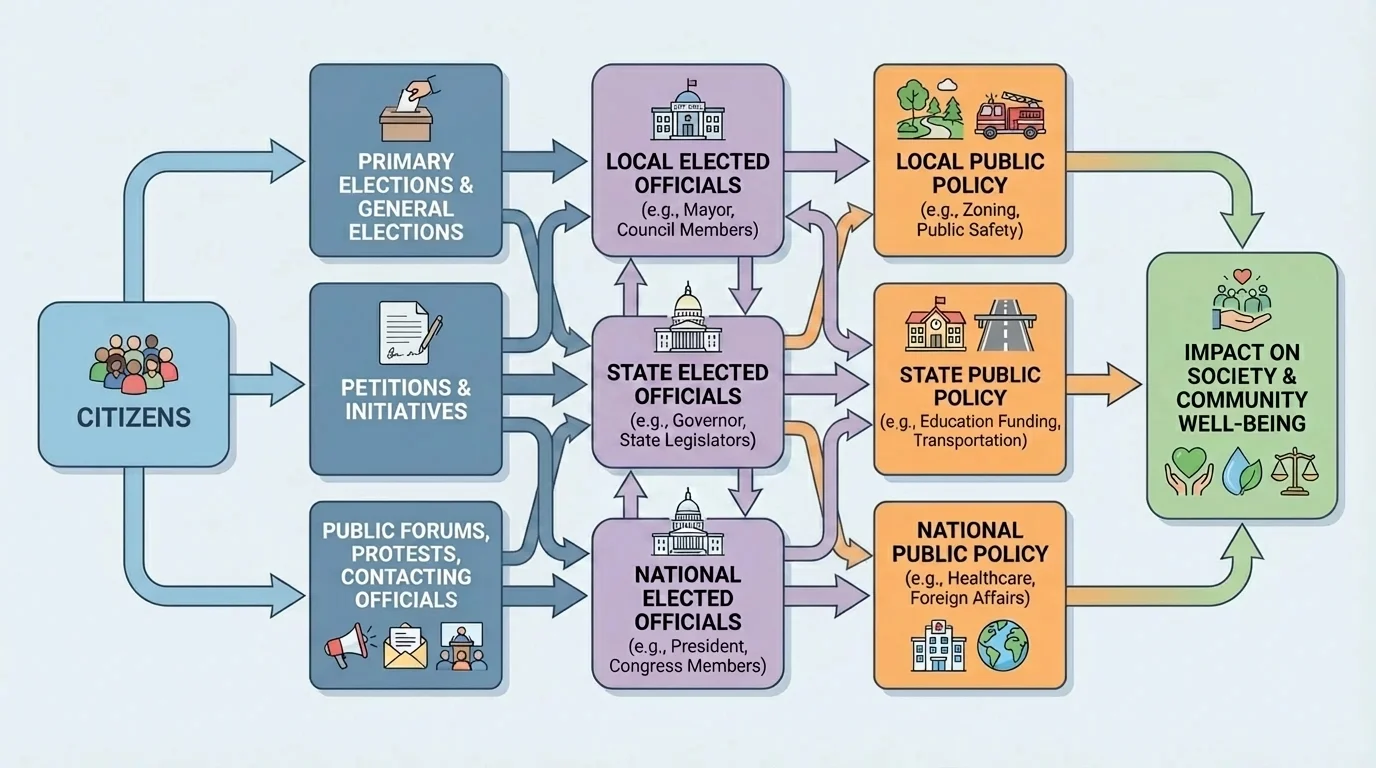
One of the most powerful ways citizens influence government is through primary elections and general elections. Elections connect citizens to policy because voters help choose the people who will write laws, enforce them, interpret them, and manage public institutions. If people want change in tax policy, environmental regulation, policing, education funding, or foreign policy, elections often determine who will make those decisions.
[Figure 1] In a primary election, voters in a political party, and in some states independent voters as well, help choose that party's candidate for the general election. Primaries matter because they can shape the choices available later. If turnout is low, a small number of people may strongly influence who appears on the final ballot.
General elections then decide who will hold office. These offices may be local, such as mayor, sheriff, or school board member; state, such as governor or legislator; or national, such as members of Congress and the president. Each office affects different areas of public policy. A school board may determine curriculum materials and disciplinary policies, while Congress may decide funding levels for transportation, defense, or health programs.
Voting is important not only because it selects leaders, but also because it signals public priorities. High turnout among certain age groups or communities can push candidates to address those voters' concerns. Low turnout can have the opposite effect, leaving some interests underrepresented. This is one reason many civic organizations work to register voters, explain ballot issues, and encourage participation.
Elections also include ballot measures in some places. Citizens may vote directly on tax proposals, constitutional amendments, or local bond issues. For example, voters in a district might approve funding for school facilities, or a state might vote on rules related to marijuana legalization, minimum wage, or public transportation.
Later debates often trace back to earlier election choices. The connection shown in [Figure 1] matters because elected officials do not just represent opinions; they appoint agency leaders, propose budgets, sign or veto bills, and influence court appointments. A vote is therefore not a one-time opinion. It helps shape the institutions that will make many future decisions.
Local elections sometimes have a stronger direct effect on daily life than national elections. Decisions about school calendars, zoning, libraries, parks, and local policing are often made by officials whose names many voters do not know.
Citizens do not have to wait for election day to make their voices heard. They can contact representatives through letters, emails, phone calls, petitions, social media campaigns, or in-person meetings. These channels matter because elected officials and their staffs often track what issues constituents raise through several common forms of communication.
[Figure 2] Contact with elected officials can be especially effective when it is specific, respectful, and informed. A message that explains a local problem, identifies the policy involved, and proposes a realistic action is usually more persuasive than a vague complaint. For example, a resident might write to a city council member about dangerous traffic near a school and ask for a crosswalk, speed bumps, or a traffic study.
Public forums offer another avenue for influence. Town halls, school board meetings, city council sessions, county commission meetings, and legislative hearings allow citizens to speak directly to decision-makers. When people testify publicly, they place information and community concerns into the official record. That can shape debate, media attention, and later votes.
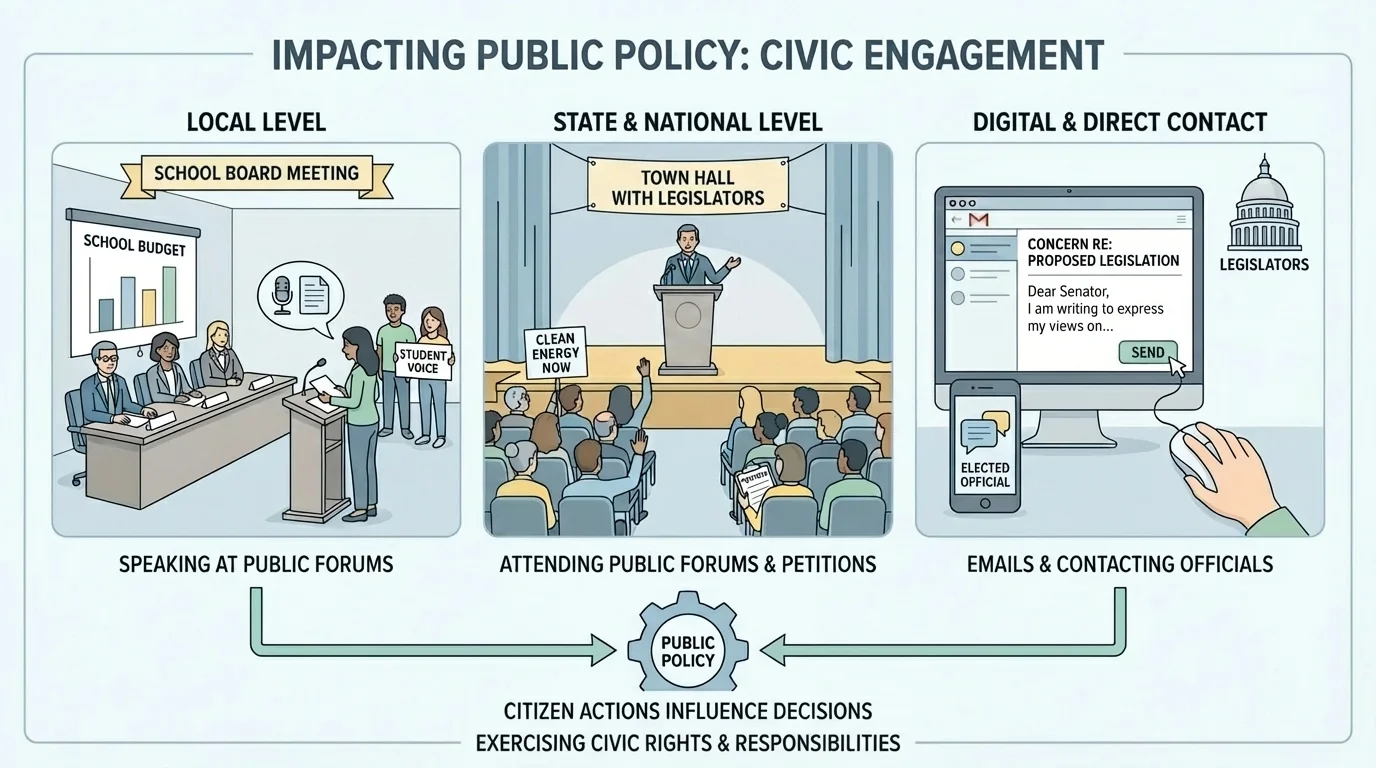
Students have used this method in many places. They have spoken at school board meetings about mental health resources, curriculum access, dress code enforcement, and safety policies. Even when students cannot vote yet, their testimony may affect officials because it comes from people directly affected by the issue.
Interest groups and nonprofit organizations often help citizens communicate more effectively. They may provide research, organize meetings, train people to testify, or coordinate letter-writing campaigns. This can increase participation, but it can also raise concerns about unequal influence if wealthy or powerful groups have more resources than others.
Effective communication is not only about speaking. It is also about listening, asking questions, and understanding how a decision will actually be made. The scene in [Figure 2] reflects an important truth: public policy is often influenced by ordinary interactions between citizens and institutions, not only by dramatic national events.
When individuals work together, their influence often grows. A petition allows citizens to show that many people support or oppose a policy. While a petition does not always force officials to act, it can demonstrate public concern, attract media coverage, and open the door to further action.
Protests and demonstrations are another form of collective action. Public protest can draw attention to issues that government has ignored or minimized. Marches, rallies, sit-ins, and boycotts have been used throughout history to challenge discrimination, oppose wars, demand labor protections, and call for environmental safeguards. Peaceful protest is protected in the United States, but it still must follow certain rules about time, place, and manner.
Collective action can also happen online. Hashtag campaigns, digital petitions, livestreamed public meetings, and youth-led issue networks can spread information quickly. However, online activism has limits. A post can raise awareness, but real policy change usually requires sustained action such as voting, lobbying, organizing, meeting with officials, and following up over time.
Advocacy groups are often part of civil society as well. Some focus on one issue, such as gun safety, disability rights, criminal justice reform, or clean water. Others represent broader interests, such as businesses, workers, or professional associations. These groups may research policy, support candidates, challenge laws in court, or mobilize members to contact lawmakers.
Case study: A local environmental campaign
A community learns that a factory expansion may increase pollution near homes and a river.
Step 1: Residents gather information from public records, local news, and environmental reports.
Step 2: They organize a petition and attend a county meeting to ask questions about permits and health effects.
Step 3: They contact state environmental officials and elected representatives.
Step 4: They continue monitoring the issue and propose stricter inspection rules.
Even if the expansion still happens, citizen action can change permit conditions, increase transparency, or require stronger protections.
Collective action is most effective when it combines visibility with strategy. Large crowds can draw attention, but long-term influence often depends on whether organizers can turn public pressure into hearings, votes, legal action, or administrative changes.
In some states and localities, citizens can influence policy more directly through initiatives and referenda. These are forms of direct democracy in which voters help make policy choices themselves rather than relying only on elected representatives.
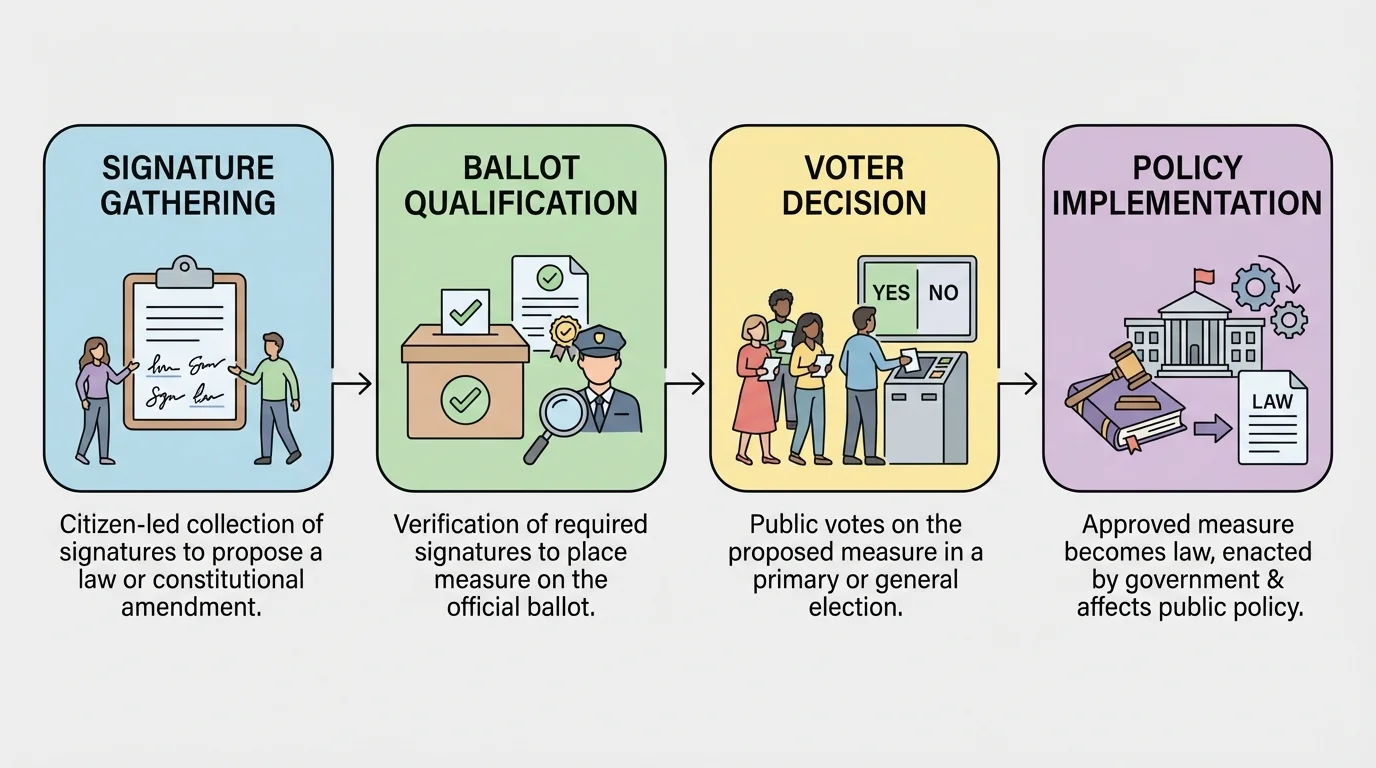
[Figure 3] An initiative usually allows citizens to propose a new law or constitutional amendment by gathering enough valid signatures to place it on the ballot. A referendum usually allows voters to approve or reject a law passed by a legislature, or in some cases a local ordinance. Rules vary widely by state, including how many signatures are required and what kinds of issues may appear on the ballot.
This process can be powerful because it gives citizens another route to policy change when legislatures are unwilling to act. For example, ballot initiatives in different states have addressed issues such as minimum wage increases, Medicaid expansion, election rules, tax limits, and drug policy.
At the same time, direct democracy has challenges. Ballot measures can be complex, and voters may receive misleading advertisements. Wealthy donors may spend large amounts of money to shape the campaign. The wording of a proposal can strongly affect how the public understands it. For that reason, citizens need to read carefully, compare sources, and understand the long-term consequences of a measure.
The process in [Figure 3] also shows that direct democracy still depends on organization. Gathering signatures, qualifying a measure, educating voters, and implementing the result all require sustained civic effort.
Public policy exists at multiple levels, and citizens can act at each of them. The same issue may appear differently depending on whether it is local, state, national, or international. For example, housing policy may involve local zoning boards, state landlord-tenant laws, national tax policy, and international discussions about migration and urban development.
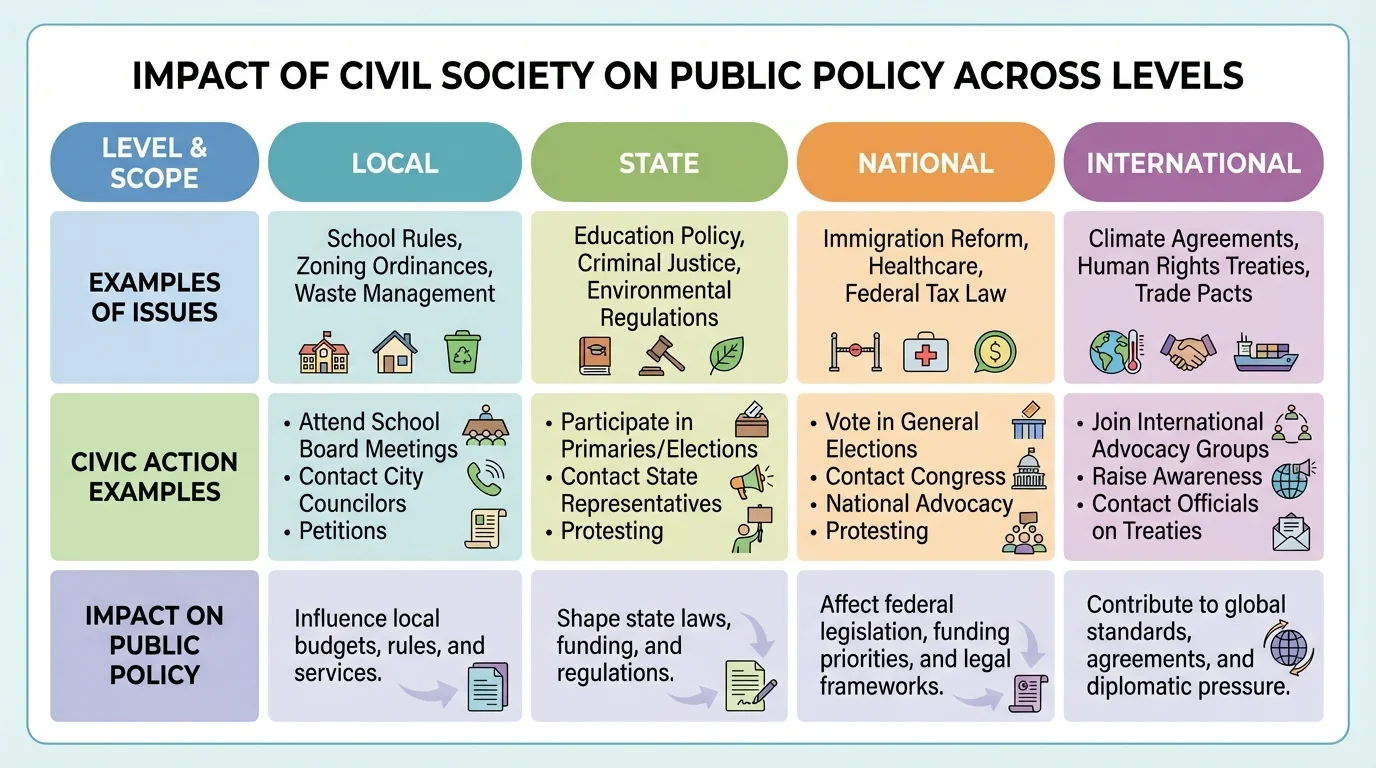
[Figure 4] At the local level, civic participation may focus on school policies, policing, transportation routes, zoning, waste disposal, or park development. At the state level, people may influence education standards, health policy, election administration, criminal law, or environmental regulation. At the national level, issues include immigration, military policy, trade, civil rights enforcement, and federal budgets. At the international level, citizens may try to influence foreign aid, human rights campaigns, climate agreements, or global public health responses.
These levels often overlap. A local protest against water contamination might push a state agency to investigate, lead national media to cover the issue, and draw attention from international environmental groups. Similarly, a global climate agreement may lead national legislation, state regulations, and local changes in energy planning.
This overlap means effective civic action often requires understanding where power actually lies. If a student wants to change a school discipline policy, the target might be the principal or school board, not Congress. If citizens want to change federal immigration law, a city petition alone may raise awareness but cannot directly rewrite national statutes. Knowing which institution controls the issue makes participation more effective.
| Level of policy | Common decision-makers | Examples of citizen action | Sample issues |
|---|---|---|---|
| Local | School boards, mayors, city councils, county officials | Attend meetings, speak at hearings, contact local officials | School rules, zoning, roads, policing |
| State | Governors, state legislators, state agencies | Vote in state elections, support ballot measures, testify at hearings | Education standards, public health, voting laws |
| National | Congress, president, federal agencies, federal courts | Vote, lobby representatives, join advocacy campaigns | Immigration, taxes, defense, civil rights |
| International | National leaders, international organizations, treaty bodies | Join global campaigns, pressure national leaders, support NGOs | Climate change, human rights, refugee policy |
Table 1. Comparison of how citizens can influence public policy at different levels of government.
Looking again at [Figure 4], it becomes clear that civic participation is not one single action. It is a set of choices that must fit the issue, the level of government, and the institution responsible for the decision.
Civic participation does not guarantee immediate success. Some voices are amplified by money, fame, or media access. Others face barriers such as voter suppression, limited transportation, language obstacles, lack of internet access, or work schedules that make attendance at public meetings difficult. These inequalities can distort whose interests are heard.
Misinformation is another major challenge. False claims spread quickly, especially online. If citizens act on inaccurate information, they may pressure government in harmful ways or lose trust in institutions without evidence. Media literacy therefore becomes a civic skill. Responsible participants verify claims, compare sources, examine evidence, and distinguish news reporting from opinion or propaganda.
Rights such as free speech and assembly are constitutional protections, but they are not unlimited in every setting. Time, place, and manner restrictions, anti-violence laws, and public safety rules still apply. Understanding these boundaries helps citizens act effectively and lawfully.
Polarization can also weaken civic life when people stop seeing opponents as fellow citizens and begin treating them as enemies. Democracy requires conflict over ideas, but it also requires a willingness to use procedures, accept lawful outcomes, and continue engaging. Compromise is not always possible, yet institutions work best when citizens can distinguish strong disagreement from refusal to participate in democratic rules.
Finally, civic responsibility includes persistence. One email rarely changes policy by itself. One march may start a conversation but not complete the work. Public policy often changes through repeated pressure: gathering evidence, building coalitions, meeting officials, voting, revising proposals, and returning to the issue over time.
History offers many examples of citizens reshaping public policy. The civil rights movement used litigation, boycotts, marches, voter registration drives, speeches, and media strategy to challenge segregation and discrimination. This activism helped lead to major national policy changes, including the Civil Rights Act of 1964 and the Voting Rights Act of 1965.
The women's suffrage movement also shows the power of long-term civic action. Activists organized conventions, published arguments, lobbied lawmakers, protested, and built state-by-state support over decades. Their efforts helped secure the Nineteenth Amendment, expanding voting rights for women.
More recently, students and youth organizations have influenced debates over gun violence, climate policy, racial justice, and education. Youth-led climate strikes, for example, have pushed governments and international institutions to face public pressure over emissions, energy use, and environmental planning. Even when young activists do not have formal power, they can influence public opinion, campaign agendas, and legislative debate.
"The future depends on what you do today."
— Mahatma Gandhi
Consider a specific local example: parents, students, and teachers may organize to demand safer school buildings. They gather data on broken ventilation, testify before the school board, contact local media, and vote in board elections. If successful, they may influence budget priorities and construction policy. The issue is local, but the methods—information, organization, public pressure, and voting—reflect the same democratic principles seen in larger national movements.
At the international level, citizens may pressure national governments to support sanctions against human rights violators, increase refugee aid, or join climate agreements. They usually do this indirectly, through advocacy groups, public campaigns, elections, media attention, and pressure on national leaders. International issues may seem distant, but they are still shaped by civic action at home.
When citizens participate thoughtfully, they do more than express opinions. They help determine what problems receive attention, which solutions seem legitimate, and which institutions are held accountable. Public policy is therefore not only something government makes. It is something democratic societies debate, challenge, revise, and shape through civic life.
