Have you ever wanted two things at the same time, like a cookie and a toy, but you could only get one? That happens to everyone. People make choices every day. When we choose one thing, we often do not choose something else. Learning how to think about a choice helps us make good decisions.
A choice is picking one thing from two or more things. People choose what to eat, what to wear, and what to buy. Sometimes a choice is easy. Sometimes it is hard. A person may want many items, but they may not have enough money, time, or space for all of them.
When someone gets an item, they are making a decision. They may ask, "Is this a good thing for me to get now?" Thinking before choosing is an important part of economics. Economics is about how people use what they have to get what they need and want.
Need means something people must have to live safely and well, like food, water, clothing, and shelter.
Want means something people would like to have, but do not need to live, like many toys, treats, or games.
Cost is what a person gives up to get something.
Benefit is the good thing a person gets from a choice.
Some choices are about needs. Some choices are about wants. Both are real choices, but needs usually come first, as shown in [Figure 1].
People often think about needs before wants. Food helps our bodies grow. A warm coat helps keep us safe when it is cold. A toy can be fun, but it is not as important as something that keeps us healthy or safe.
If a family can get only one item, they may choose the item they need most. For example, rain boots may be chosen before a bubble wand if the weather is wet. That does not mean fun things are bad. It means people often choose the most important thing first.
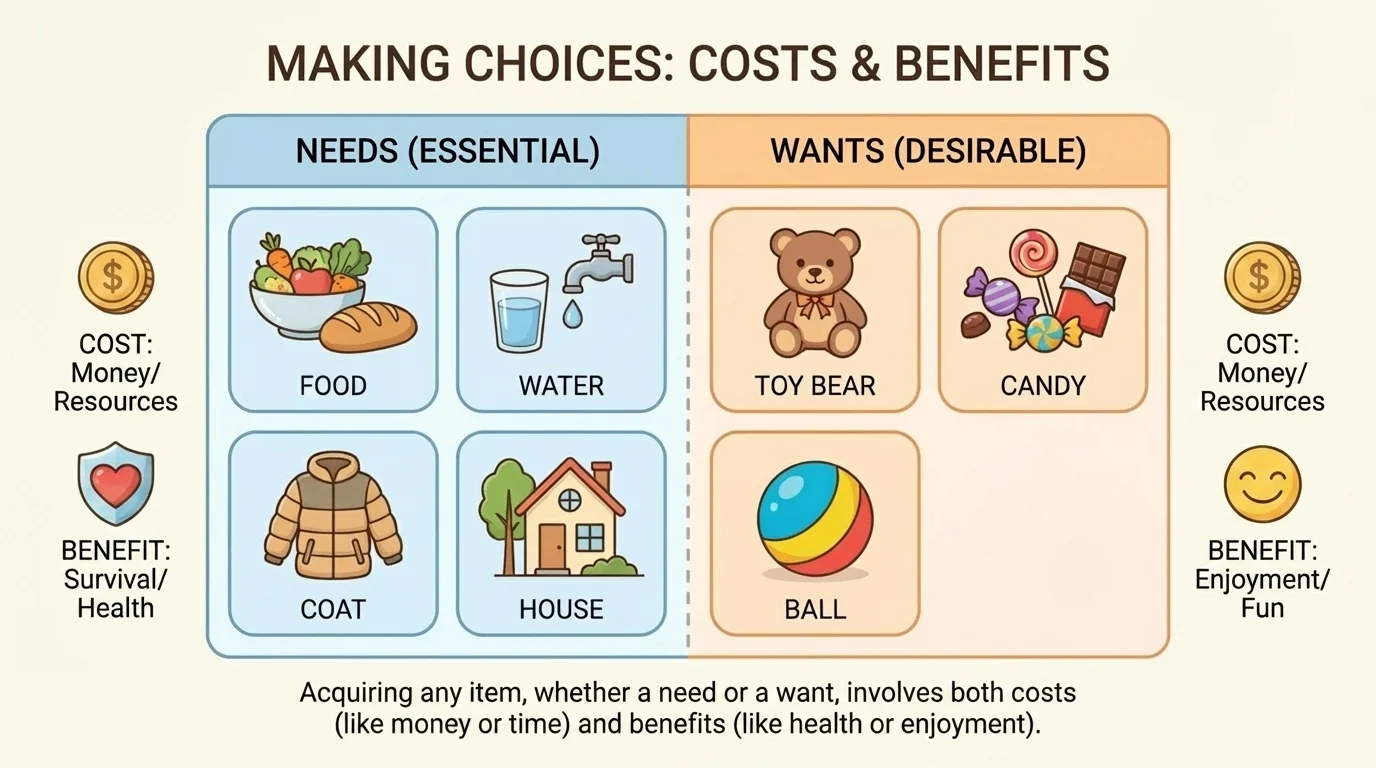
Needs and wants can look different for different people. One child may need new shoes because the old ones are too small. Another child may want sparkly shoes because they like how they look. Thinking about needs and wants helps us understand why people make different choices.
A favorite toy can feel very important, but people can still live without it. Food, water, and shelter are the things our bodies need most.
When we know whether an item is a need or a want, we are ready to think about the benefits and costs of the choice.
As [Figure 2] shows, every choice has a cost and a benefit. The benefit is the good part of getting the item, and the cost is what is given up. The cost may be money. The cost may also be not getting something else.
For example, if a child uses coins to buy a sticker, the sticker is the benefit because it brings joy. The cost is the coins that are spent. Another cost is that the child cannot use those same coins to buy a snack later. One choice closes the door to another choice.
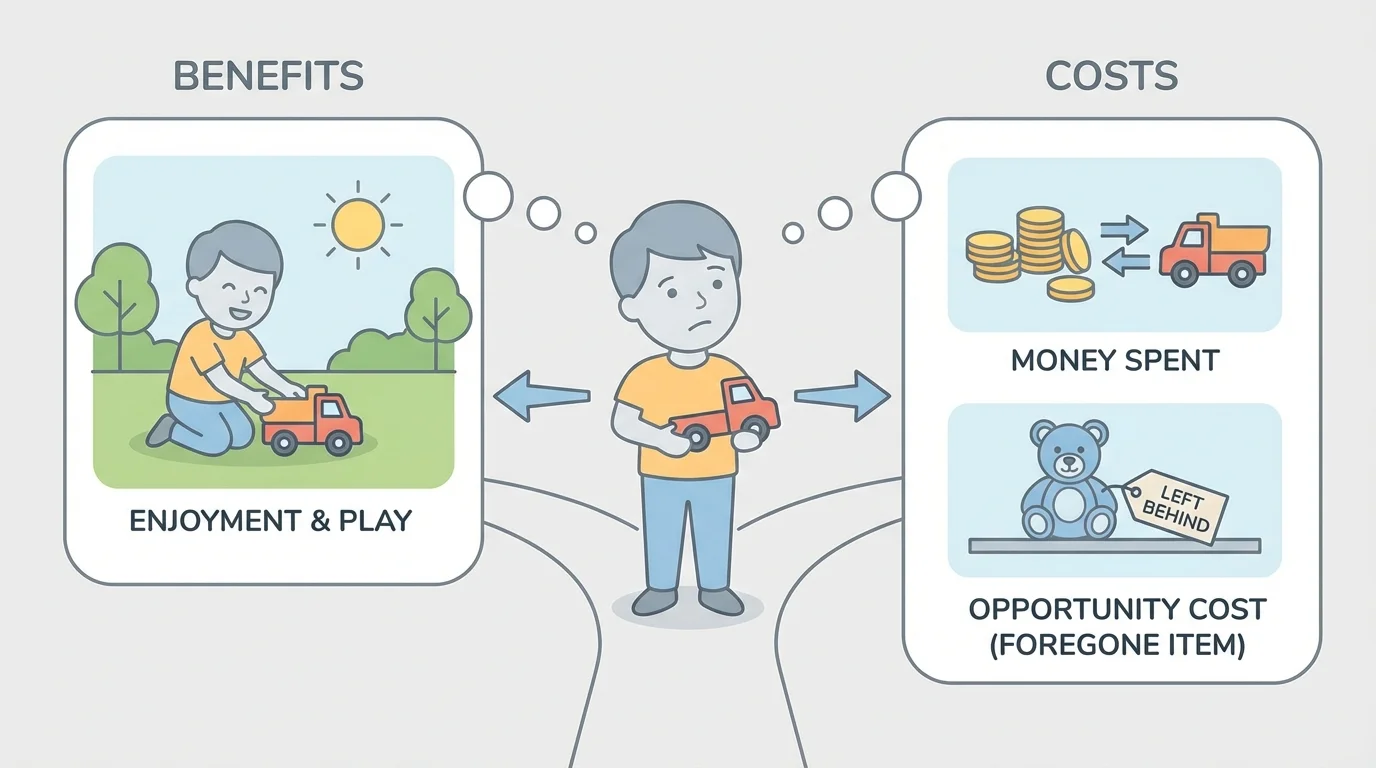
Benefits can be different too. Some benefits help right away, like getting a drink when thirsty. Some benefits last longer, like getting a backpack that can be used every school day. Looking at both costs and benefits helps people make smarter choices.
One item, two sides
When a person gets an item, they can ask two simple questions: "What good thing do I get?" and "What do I give up?" These questions help people see the whole choice, not just the fun part.
Sometimes the cost is small and the benefit is big. Sometimes the cost is big and the benefit is small. A careful decision-maker tries to notice both.
Here is a simple way to think about getting an item. First, look at the item. Next, ask if it is a need or a want. Then ask what good thing it gives. Last, ask what must be given up to get it. This could be money, time, or another item.
For a kindergartener, the questions can be very simple: "Do I need it now?" "Will it help me?" "Will I still have enough for something important?" These questions slow us down and help us think.
Example: Getting crayons
Step 1: Think about the item.
The item is a new box of crayons.
Step 2: Think about the benefit.
The child can color pictures and use the crayons at school or home.
Step 3: Think about the cost.
The family spends money on the crayons and cannot use that same money for a different item.
If the child needs crayons for school, this choice may be a very good one.
Thinking in this way helps children see why adults sometimes say yes and sometimes say not now.
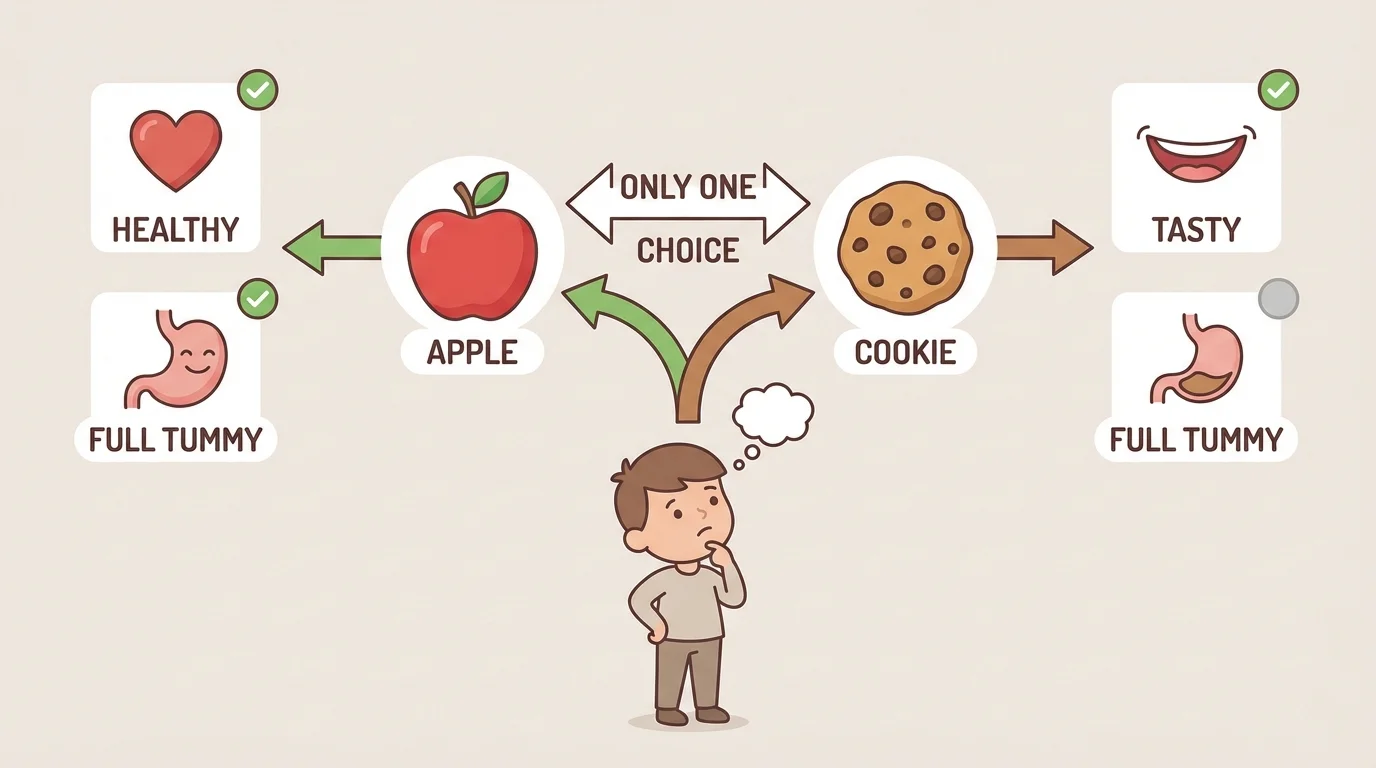
As shown in [Figure 3], a child may choose between an apple and a cookie for snack time. Each choice has good parts and costs. The apple may help the body grow and keep the tummy full. The cookie may taste sweet. But if the child can pick only one, choosing one means not choosing the other.
A family may choose to buy rain boots. The benefit is staying dry in puddles and rain. The cost is the money spent on the boots. The family may wait to buy a toy because the boots are more important right now.
A child may want a large stuffed animal at a store. The benefit is comfort and fun during playtime. The cost is the money used to get it and the fact that the child may not be able to get coloring paper too. This is like the toy choice we saw earlier in [Figure 2], where getting one item means another item must be left behind.
Even borrowing can involve choice. If a child picks one library book, they may not have room to carry more books. The benefit is a fun story. The cost is giving up the chance to bring a different book home that day.
People cannot always get everything they want at once. That is why choosing is important.
These examples show that choices happen at home, at school, in stores, and even at the library. They are part of everyday life.
Smart choices do not always mean picking the most fun thing. Sometimes a smart choice is picking the thing that helps most. As we saw with needs and wants in [Figure 1], people often choose what they need before what they simply want.
It is helpful to stop and think: "What is the benefit?" "What is the cost?" "Is this a need or a want?" These questions help children begin to understand how individuals make choices.
When we learn to notice costs and benefits, we become careful thinkers. We understand that every item has a story: what we gain and what we give up. That helps us choose wisely.
