Have you ever noticed that morning comes after night every single day? That is not a random surprise. It is a pattern. The world is full of patterns: stripes on a zebra, days on a calendar, tiles on a floor, and the sun shining in the sky. When we look carefully, patterns help us describe what we see and help us know what may happen next.
A pattern is something that repeats in a way we can notice. A song might go clap, clap, tap, clap, clap, tap. A scarf might have red, blue, red, blue. Nature has patterns too. Some flowers have petals arranged in special ways, and many animals have spots, stripes, or shapes that repeat.
Pattern means something that repeats in a recognizable way. We can observe patterns with our eyes, and sometimes we can use them to predict what comes next.
[Figure 1] People also make patterns on purpose. We see them in windows, brick walls, fences, roads, and classroom schedules. If school starts in the morning each day, that is a pattern too. Patterns can be natural or human-designed.
The sky gives us some of the easiest patterns to observe with the repeating change from daytime to nighttime. In the daytime, we usually see the sun. At night, we usually see the stars. This happens over and over, so we can predict that after daytime comes nighttime, and after nighttime comes daytime.
These sky patterns are important because they help people decide when to wake up, work, play outside, and sleep. Farmers, pilots, sailors, and families all pay attention to the sky. Even young students use sky patterns when they know recess happens during daylight and bedtime happens after dark.
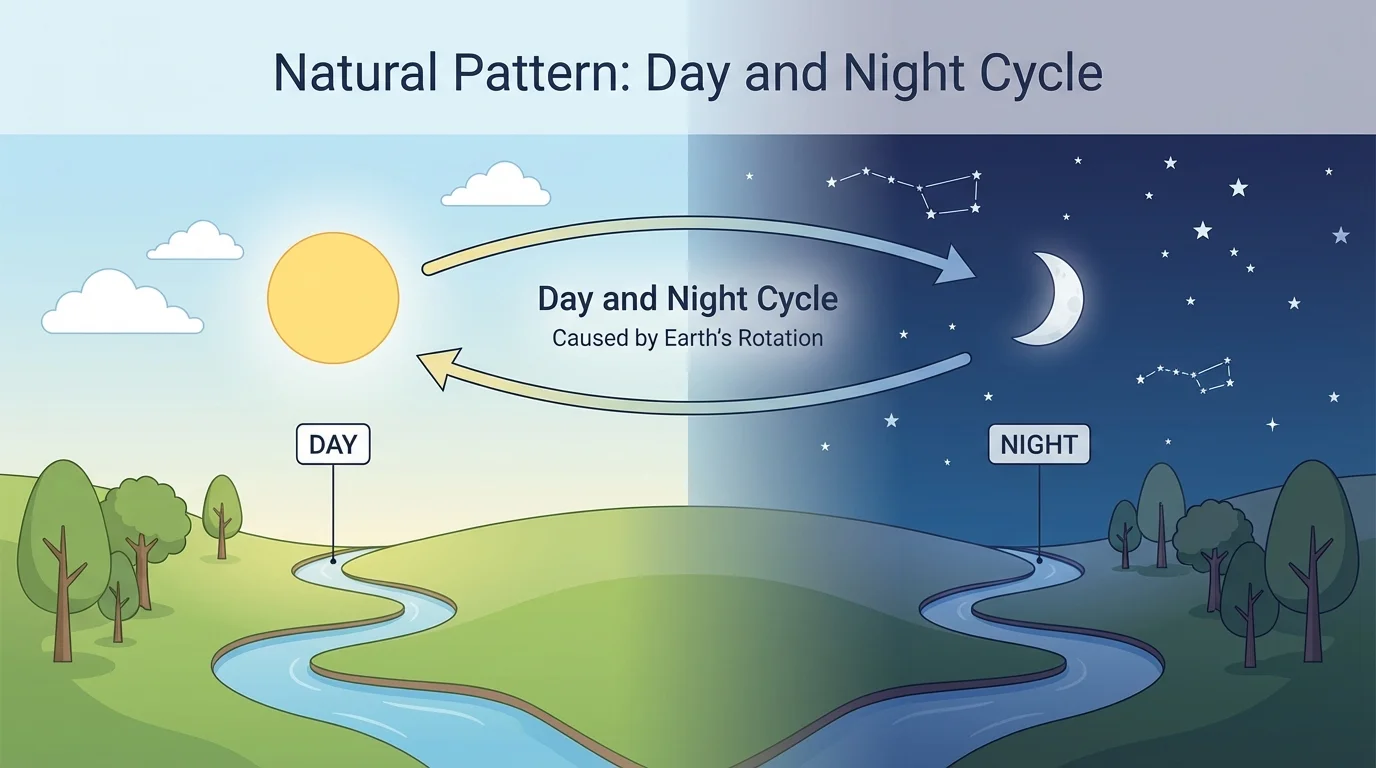
Sometimes the moon can be seen in the daytime, and sometimes it is seen at night. That tells us another important idea: not every pattern means things look exactly the same all the time. A pattern is about a repeated way things happen, even if small details can change.
The sun is a star, but it looks much bigger and brighter than the other stars because it is much closer to Earth.
When we keep observing for many days, we gather evidence. Evidence means information that helps us know something is true. If we see day turn to night again and again, that repeated observation is evidence of a pattern.
Each day, the sun seems to move across the sky, as [Figure 2] illustrates. In many places, it appears in one part of the sky in the morning, climbs higher later, and is lower again by evening. Because this happens in a repeated way, we can use it to describe the time of day.
The sun's pattern also changes shadows. In the morning, a shadow may look long. Around the middle of the day, it may look shorter. Later, it becomes long again. If you stand in the same place and look carefully, you can observe this repeating change.
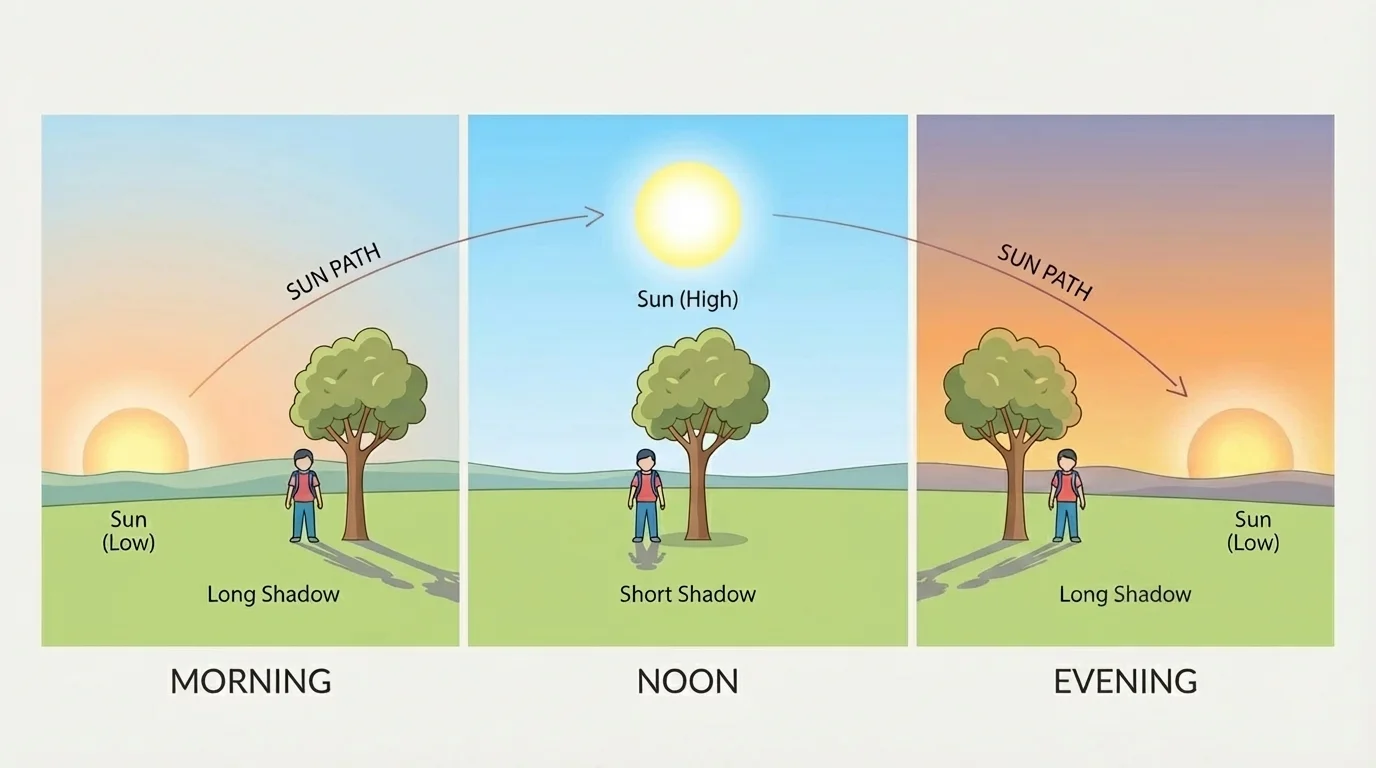
People use the sun's pattern in real life. Builders plan work times, families choose times for outdoor play, and gardeners watch sunlight to help plants grow. Long ago, people even used shadow sticks to help tell time. The changing shadow was evidence that the sun's position appeared to change through the day.
Real-world example: Using the sun to plan a day
Step 1: A class notices the playground is cool in the morning.
Step 2: In the middle of the day, the sun is higher and the playground feels hotter.
Step 3: The class uses this repeating pattern to choose hats and water bottles before recess.
The class is using observations of a sky pattern to make a smart choice.
Later, when students talk about morning, noon, and evening, they are using the same pattern from [Figure 2] to connect sky observations with everyday life.
The moon also shows patterns, and [Figure 3] helps us notice that its shape seems to change over time. Some nights it looks rounder, and some nights it looks like a thin curved slice. If we observe for many nights, we see these changes happen in a repeating cycle.
The stars are usually easier to see at night than during the day. They seem to appear after the sky gets dark. Some stars make groups or shapes that people notice again and again. These star patterns can help people describe the night sky.
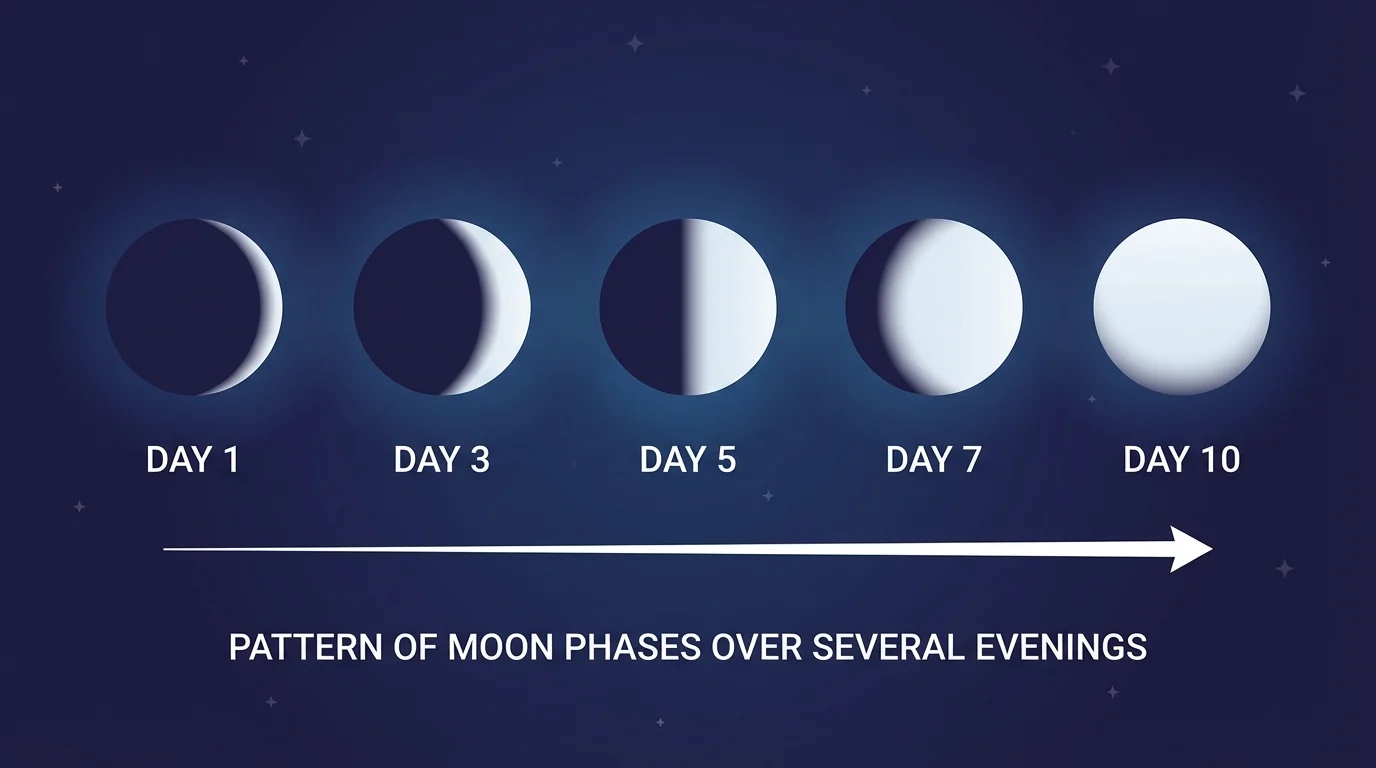
When children say, "I saw a big moon last night, but a small one a few days before," they are making an observation. When they notice this happens in a repeating way, they are identifying a pattern. That pattern becomes evidence that the moon's appearance changes over time.
Patterns help prediction
If something repeats, we can make a careful guess about what may happen next. We call this a prediction. A prediction is not magic. It is based on observations of a pattern.
Because of these observations, we can predict simple things such as: stars will likely be visible tonight if the sky is dark and clear, and the moon may look different next week than it does today. The repeating moon pattern in [Figure 3] reminds us that careful watching over time matters.
People depend on patterns every day. Clocks follow a repeating cycle. Calendars show repeating days and months. Bedtime routines often follow the same order: wash, brush, read, sleep. These patterns help people stay organized.
Sky patterns help people too. If we know it will get dark after sunset, we can turn on lights or head home. If we know the sun will be bright at midday, we can wear a hat. If we know stars appear at night, we can plan stargazing after dark. Patterns are useful because they help us prepare.
You already know how to notice repeating colors, sounds, and shapes. Science uses that same skill to notice repeating events in nature.
Patterns in human-designed objects are often made on purpose. A row of windows may repeat square after square. A tiled floor may repeat shapes in lines. A music beat may repeat sounds in order. People create these patterns because repetition can make things beautiful, strong, easy to build, or easy to use.
An observation is something we notice using our senses. When we make many observations and the same thing happens again and again, those observations become evidence of a pattern. Evidence helps us explain why we think something is true.
For example, if you look outside for many evenings and notice the sky gets dark, then stars appear, you have evidence for a nighttime pattern. If you notice the sun is up during the day for many days in a row, you have evidence for a daytime pattern. One quick look can help, but many observations are stronger evidence.
| What we observe | The pattern | What we can predict |
|---|---|---|
| The sky is bright with the sun in daytime | Day follows night | After night, daytime will come again |
| Stars appear when the sky is dark | Stars are easier to see at night | On a dark, clear night, stars will likely be visible |
| The moon looks different on different nights | The moon's appearance changes in a cycle | The moon may not look the same next week |
| Shadows change during the day | Shadow length changes with the sun's position | A shadow at noon may be shorter than in the morning |
Table 1. Examples of observations, the patterns they show, and simple predictions based on those patterns.
Scientists use patterns as evidence all the time. Young students can do this too by drawing what they see, talking about changes, and comparing one day to another. When a pattern repeats, it helps us trust our prediction more.
[Figure 4] Nature and people both create repeating designs, and this comparison shows these patterns side by side. A leaf may have lines that branch again and again. A brick wall may repeat rectangles. A honeycomb has repeating shapes, and a tiled floor can also repeat shapes. Looking at both kinds of patterns helps us see that repetition is a big idea in our world.
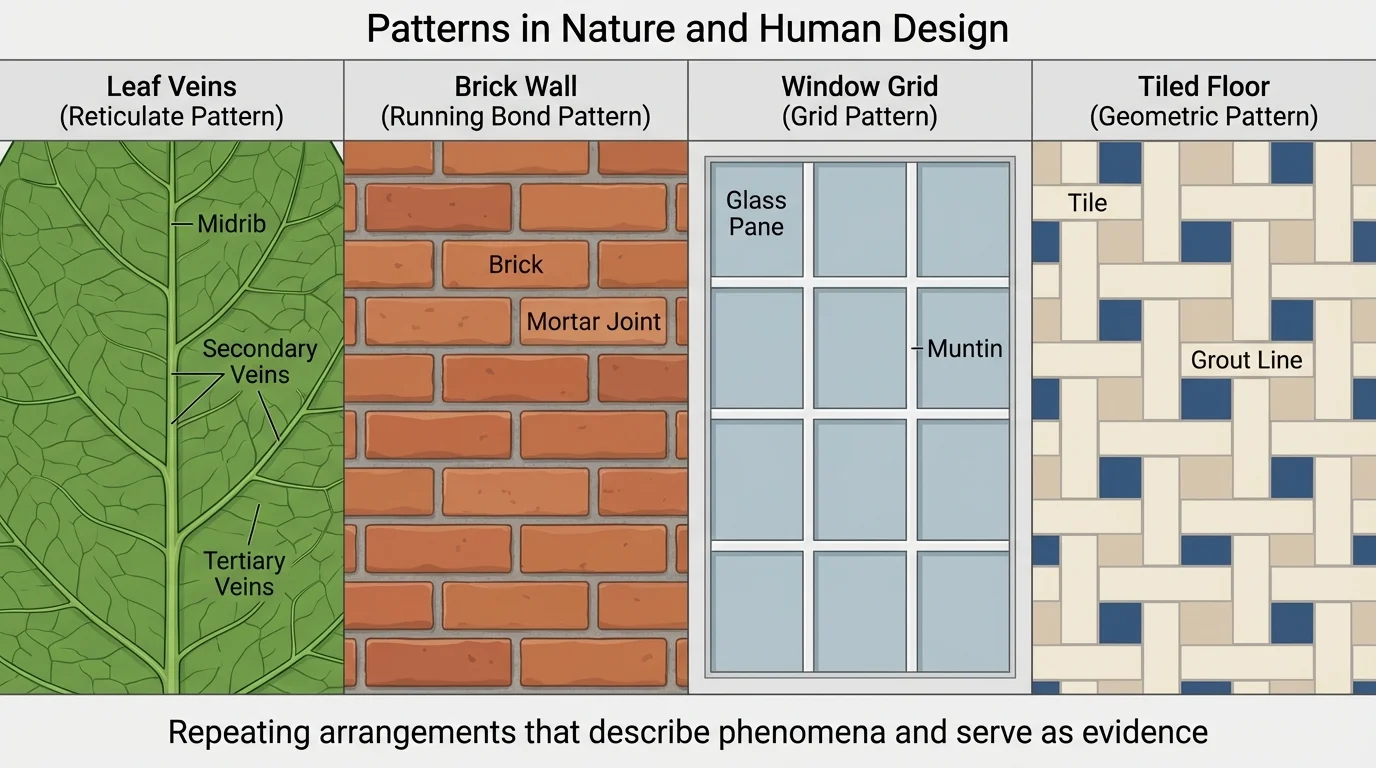
These patterns help us describe what we see. We might say a leaf has branching lines, a fence has repeating posts, or a window has rows and columns. Careful description is part of science because it helps us compare objects and notice what stays the same.
Later, if students study animal coats, snowflakes, shells, or buildings, they can return to the same idea: patterns help us organize what we notice and explain how things are alike or different.
A scientist does not just glance once and stop. A scientist watches carefully, notices details, and keeps track of changes over time. Children can do this by looking at the sky in the morning and evening, noticing where the sun appears, and paying attention to the moon at night.
When we observe patterns in the natural world and in things people design, we learn more than names. We learn how to describe phenomena, which means things that happen. We also learn how to use repeated observations as evidence. That is a powerful science habit: look, notice, compare, and predict.
