A single word can change what we do. If someone says, "Bring the tiny spoon," we do not grab the big one. If someone says, "Put the bear under the chair," we know where it goes. As children grow, they hear more words and more kinds of words, and that helps them understand stories, directions, songs, and conversations.
Words are like labels for the world around us. Some words name things we can see, like ball, dog, and cup. Some words tell actions, like run, jump, and wash. Some words tell more about something, like soft, sleepy, and gigantic. When children understand more words, they can understand more of what they hear.
Listening is not only hearing sounds. Listening means connecting words to meaning. A child who understands "coat," "zipper," "pocket," and "hood" can follow talk about getting ready to go outside much more easily than a child who knows only "coat."
Vocabulary means the words a person understands and uses. Receptive language means the words a child understands when listening, even if the child is not saying all of those words yet.
Children often understand many more words than they can say. That is a good sign of growth. First, a child may understand "drink." Later, the child may understand "sip," "gulp," "pour," and "spill." These words are all related, but each one has its own meaning.
Words are easier to understand when they are connected in groups, as [Figure 1] shows with familiar categories. A child may learn that apple, banana, and cracker are all foods. Dog, cat, and bird are animals. Sock, hat, and shirt are clothes. Grouping words helps the brain organize meaning.
Children also learn action groups. Eat, chew, lick, and swallow are all connected to mealtime. Push, pull, carry, and lift are movement words. Wash, scrub, rinse, and dry are action words used during cleanup. The more variety children hear, the richer their understanding becomes.
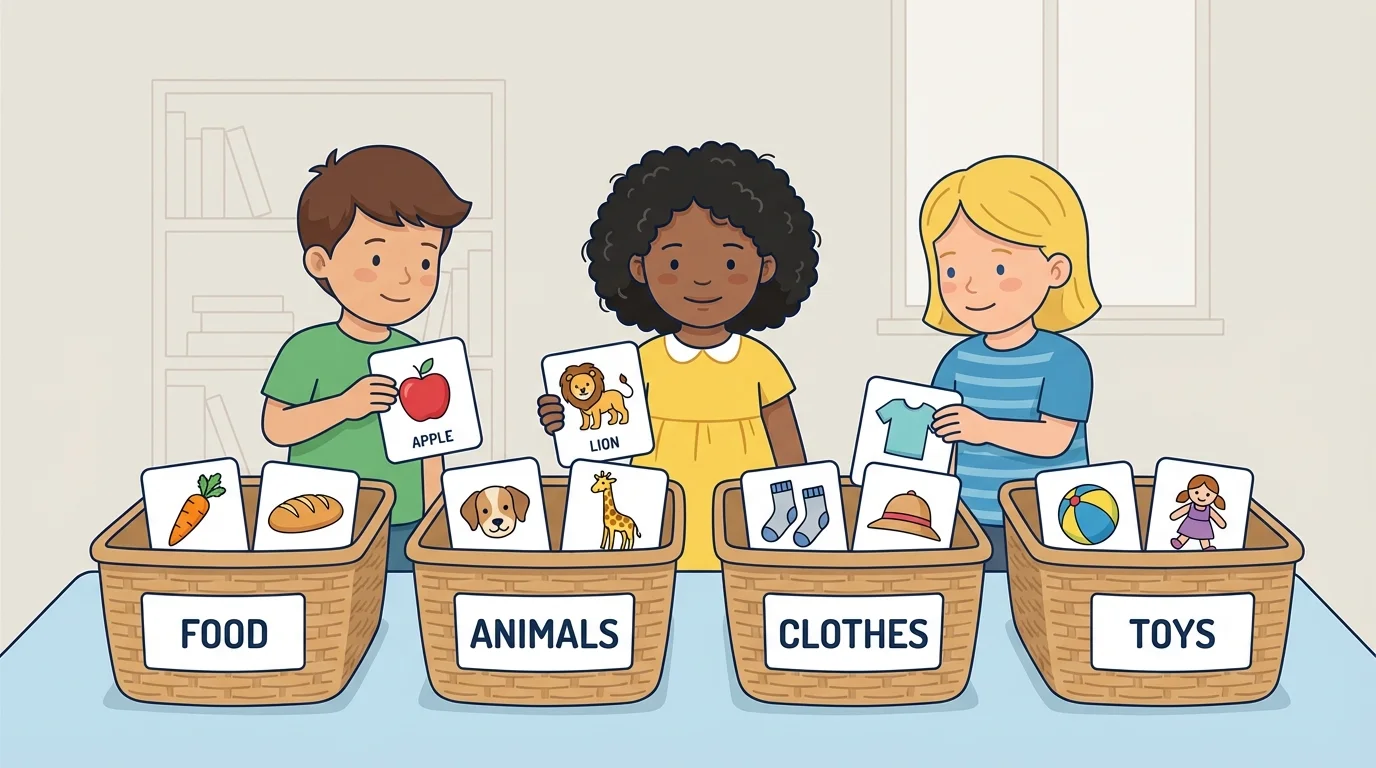
Some words are very broad. Toy can mean many things. More exact words are doll, block, puzzle, drum, or truck. Learning both broad words and exact words helps children understand speech in many situations.
Children can understand a surprising number of words before they are able to say them clearly. Hearing rich, repeated language helps those words become familiar and meaningful.
As children hear words again and again in play, books, and routines, they start to connect them to objects, actions, and events. That is why everyday talk matters so much.
Adjectives add important details. A ball can be big or small. A blanket can be soft or rough. The weather can be rainy or sunny. These words help children understand exactly what someone means.
[Figure 2] Children need many kinds of adjectives. Size words include big, tiny, tall, and short. Color words include red, blue, green, and yellow. Feeling words include happy, sad, angry, and calm. Position words include in, on, under, behind, and beside.
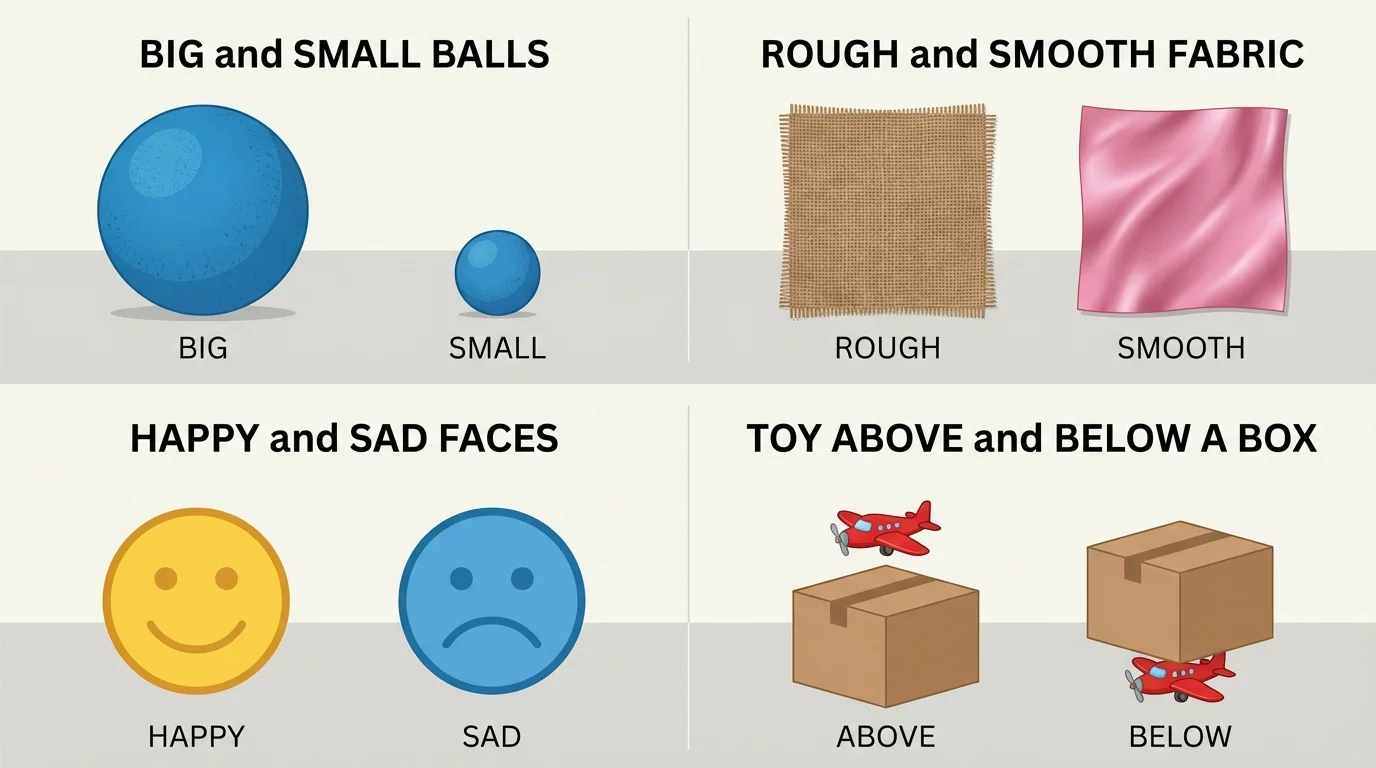
Describing words can also compare. A child may hear fast and slow, warm and cool, empty and full, clean and dirty. These words help children notice differences. Later, they understand more precise words such as freezing, enormous, or slippery.
When adults say, "Get the striped sock," "Find the round lid," or "Touch the sticky glue," children are learning to connect words to features. This deeper understanding helps with listening and with later reading.
How children figure out a new word
Children do not always need a full definition. They often use clues. They look at the object, watch what someone does, listen to the rest of the sentence, and notice the speaker's face or pointing. If an adult says, "This peach is juicy," while juice drips down, the child can connect juicy to what is happening.
Clues are powerful. If someone says, "Please hop to the door," a child may not know hop at first. But seeing another child bounce on two feet gives the meaning. Hearing the word in action makes it easier to understand next time.
A new word often makes sense because of what happens around it. If a teacher says, "Put the book on the shelf," and points to the shelf, the child learns shelf. If a parent says, "Your hands are damp," after washing, the child can connect damp to a little wet.
Children also learn from routines. During snack time they hear peel, slice, pour, stir, and wipe. During cleanup they hear gather, stack, sort, and return. During outdoor play they hear climb, balance, scoop, and dig. Repeated routines build strong understanding.
Tone of voice matters too. A calm voice, an excited voice, or a warning voice gives extra information. The words "Be careful, that is fragile" may be new, but careful tone and slow handling help a child understand that fragile means something that can break easily.
As children understand richer spoken language, they can follow longer directions, and [Figure 3] shows how one direction can include more than one action. Instead of hearing only "Sit down," they may hear, "Pick up the red cup and put it on the table." That sentence includes a verb, a color word, and a position word.
Longer directions can have two steps. "Find your shoes and bring them to the door." "Wash your hands, then sit at the table." "Take the book from the basket and give it to Maya." Understanding these directions shows that a child knows many words working together.
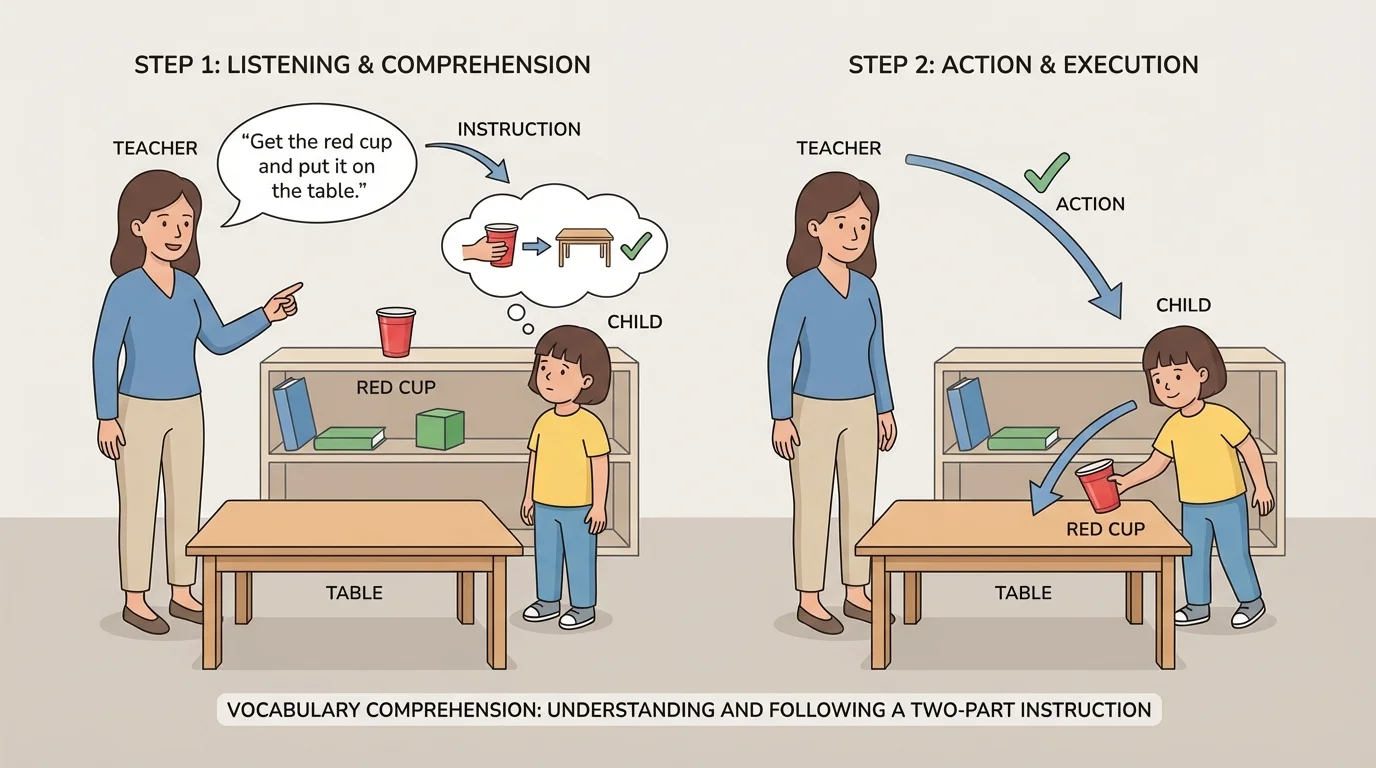
Children also begin to understand little differences in meaning. "Put it in the box" is not the same as "Put it next to the box." "Walk quickly" is not the same as "walk quietly." Rich vocabulary helps children notice these differences and act correctly.
Listening example
A teacher says, "Please bring the fuzzy brown bear from under the shelf."
Step 1: The child hears the noun bear.
Step 2: The child uses the adjectives fuzzy and brown to choose the right bear.
Step 3: The child uses the position words from under the shelf to know where to find it.
Many kinds of words work together to make the message clear.
As seen earlier in [Figure 2], describing words help narrow down meaning. Without those details, a child may know the object but not know which one to choose.
Some words are connected because they are close in meaning. Big and huge are similar, but huge is stronger. Mad and angry are similar, but angry may sound more exact. Learning words with related meanings helps children understand stories and conversations that use different word choices.
Other words are opposites. Up and down, open and closed, day and night, wet and dry. Opposites help children understand contrast. If a child knows one word, the opposite word often becomes easier to learn.
Children also hear words that belong together in sequences or sets: first and last, before and after, morning and night. These words support understanding during routines and transitions.
Vocabulary grows through everyday experiences. During cooking, children hear mix, stir, scoop, and sprinkle. At the park, they hear slide, swing, chase, and balance. In books, they hear interesting words they may not hear in ordinary talk, such as enormous, whisper, peeking, or exhausted.
Songs and rhymes help too. Repeated language makes words memorable. Pretend play adds even more. A child playing store may hear customer, basket, choose, and pay. A child playing doctor may hear patient, bandage, heartbeat, and thermometer.
When adults use rich language naturally, children build understanding. Saying "Please place your boots beside the mat" gives more language than "Put them there." Saying "The soup is steaming" gives more meaning than simply "hot." Over time, these words become familiar.
The grouping idea from [Figure 1] stays useful as vocabulary grows. Children keep learning new words by linking them to things they already know. They build a bigger and bigger word web in their minds.
Understanding comes before speaking many words clearly. A child may show understanding by looking, pointing, choosing, moving, or following a direction.
Strong receptive language gives children a powerful foundation. It helps them understand directions, enjoy books, take part in conversations, and learn new ideas across all parts of life.
