Why does a soccer ball race across the field after a strong kick, but stop when no one keeps pushing it? Questions like this are exactly the kind scientists investigate. When scientists want trustworthy answers, they do not just try something once and guess. They plan carefully, work together, and collect data that can be used as evidence. Learning how to investigate fairly helps us understand how forces change motion.
A science investigation is a careful way to answer a question. In this topic, the question is often about how a force changes the motion of an object. A force is a push or a pull. If you push a toy car, pull a wagon, or kick a ball, you are using force.
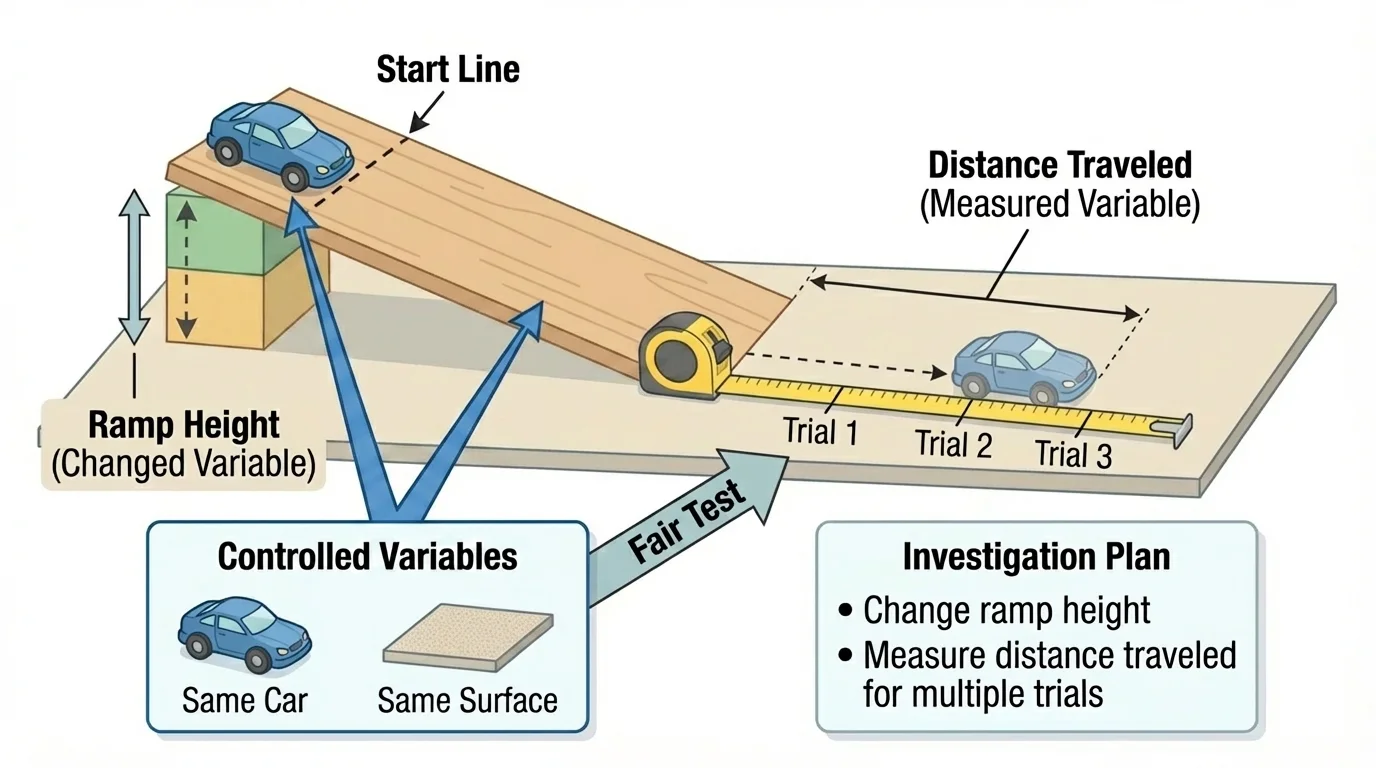
Scientists try to make tests fair. A fair test means you change only one thing at a time and keep other important things the same. This helps you know what caused the result. If many things change at once, you cannot tell which change mattered, as shown in [Figure 1].
You already know that objects can move in different ways. They can start moving, stop moving, speed up, slow down, or change direction. Forces are often the reason these motion changes happen.
Working with others is also important. In a group, one student might measure, another might release the object, another might record data, and another might watch for mistakes. Good teamwork helps a class gather better evidence.
When scientists investigate motion, they use some special ideas. Motion is the way an object moves. It may move fast, slow, straight, or in a curve. Balanced forces occur when forces on an object are equal and do not change its motion. Unbalanced forces occur when one force is stronger than another, causing the object to start moving, stop, speed up, slow down, or turn.
You will also hear the word evidence. Evidence is information that helps support an idea or answer a question. In science, evidence often comes from observations and measurements. If a toy car goes farther when the ramp is steeper in several tests, those measurements are evidence.
Variable means something that can change in an investigation. The independent variable is the one you choose to change. The dependent variable is what you measure or observe. Controlled variables are the things you keep the same so the test stays fair.
Another important word is trial. A trial is one test in an investigation. Scientists usually do more than one trial because a single test can be unusual. Repeating a test helps make the results more dependable.
In a fair investigation, students decide what one variable to change and what result to measure. For example, if you are testing a toy car on a ramp, you might change the height of the ramp. Then you might measure how far the car travels. To make the test fair, you would keep the same car, the same ramp, the same floor surface, and the same starting point each time.
Keeping important things the same means using controlled variables. If one group used a heavy car in one test and a light car in another, that would not be fair because the car changed too. Then the class would not know whether ramp height or car type caused the difference.
Scientists often ask three simple questions when they plan a fair test:
These questions help a group stay organized. They also make it easier for another class or another scientist to repeat the same investigation. When others can repeat a test and get similar results, the evidence becomes stronger.
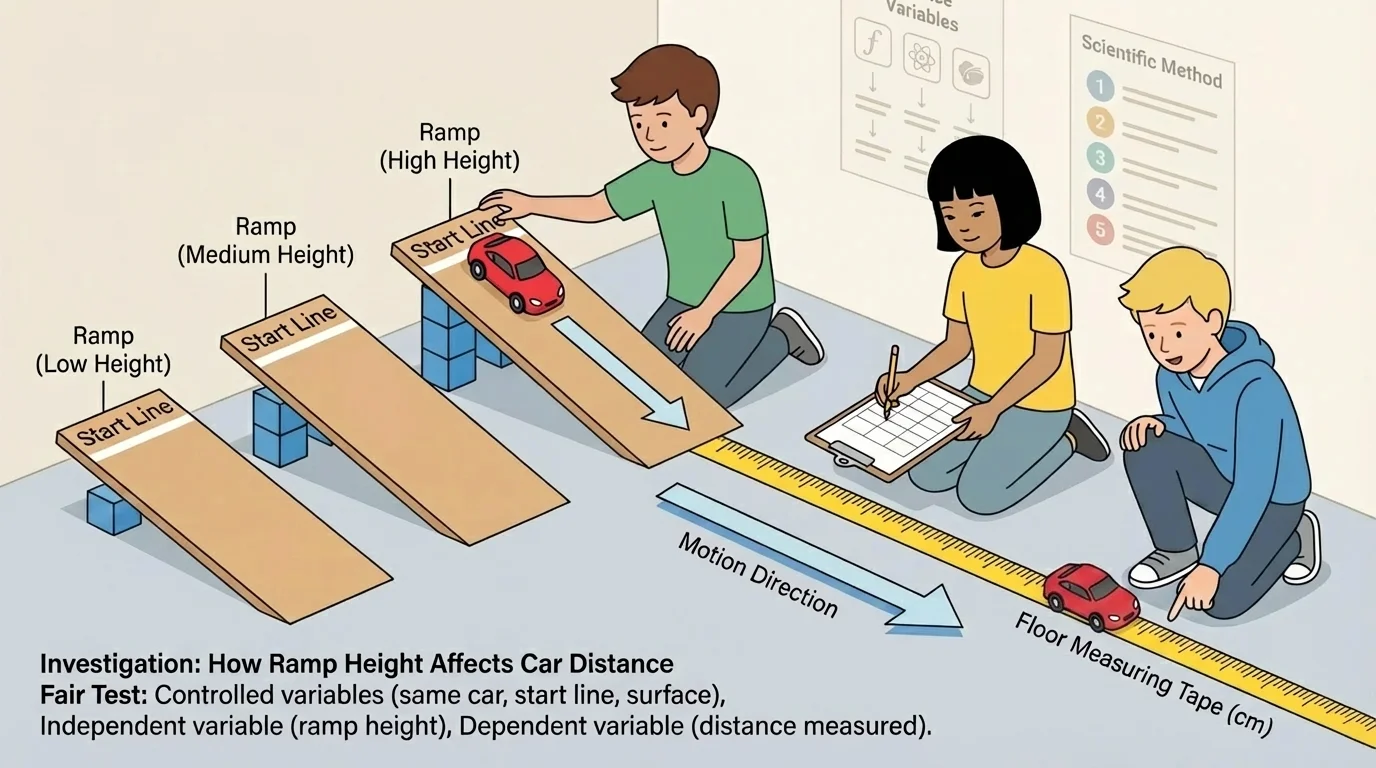
A good investigation does not begin with random testing. It begins with a plan. First, the group chooses a question. A question should be clear and testable, such as, How does ramp height affect how far a toy car travels? That question works because it can be tested and measured, as shown in [Figure 2].
Next, the group makes a prediction. A prediction is what you think will happen based on what you already know. A group might predict that a higher ramp will make the car travel farther because gravity helps the car speed up more on the way down.
How collaboration improves science
Collaboration means working together toward a shared goal. In a science investigation, collaboration helps students notice mistakes, check measurements, and share ideas. One person may miss something that another person sees. Scientists often work in teams for this reason.
Then the group lists materials, writes steps, and plans how to collect data. The steps should be in order and easy to follow. Safety matters too. Students should make sure ramps are steady, walk carefully around the testing area, and keep materials organized.
A class may also assign jobs. One student can release the car without pushing it. One can measure distance. One can record the result. One can check that the setup stays the same. Rotating jobs can help everyone learn each part of the investigation.
A strong way to study forces is to test how a toy car moves down a ramp. This investigation connects directly to pushes, pulls, and the effect of gravity on motion. The question is: How does ramp height affect the distance a toy car travels?
In this investigation, the independent variable is ramp height. The dependent variable is the distance the car travels after leaving the ramp. The controlled variables include the same toy car, the same ramp, the same surface, the same release point, and the same way of letting go of the car.
A group might test three ramp heights: low, medium, and high. For each height, the group releases the car from the same spot and measures how far it travels. To avoid adding an extra push, the student should simply let go of the car.
Sample investigation procedure
Step 1: Set up the ramp at a low height and place a start mark on the ramp.
Step 2: Release the toy car from the start mark without pushing it.
Step 3: Measure the distance traveled on the floor.
Step 4: Record the result and repeat for several trials.
Step 5: Change only the ramp height and repeat the investigation.
This procedure helps the group gather data that can be compared fairly.
Suppose the class chooses to do three trials at each ramp height. If the low ramp gives distances of \(40 \textrm{ cm}, 42 \textrm{ cm}, 41 \textrm{ cm}\), the results are close together. If the high ramp gives \(78 \textrm{ cm}, 80 \textrm{ cm}, 79 \textrm{ cm}\), that pattern suggests the higher ramp makes the car travel farther.
Data are the information you collect during an investigation. Some data are numbers, such as distance in centimeters. Some data are observations, such as whether the car moved straight or wobbled. Good data recording is important because it helps you study patterns later.
Using a table can make data easy to read. Here is an example of how a group could organize ramp-test results.
| Ramp Height | Trial \(1\) | Trial \(2\) | Trial \(3\) | Typical Result |
|---|---|---|---|---|
| Low | \(40 \textrm{ cm}\) | \(42 \textrm{ cm}\) | \(41 \textrm{ cm}\) | About \(41 \textrm{ cm}\) |
| Medium | \(60 \textrm{ cm}\) | \(62 \textrm{ cm}\) | \(61 \textrm{ cm}\) | About \(61 \textrm{ cm}\) |
| High | \(78 \textrm{ cm}\) | \(80 \textrm{ cm}\) | \(79 \textrm{ cm}\) | About \(79 \textrm{ cm}\) |
Table 1. Sample data from a toy car investigation showing distances traveled at three ramp heights.
Sometimes students use a simple average to describe a typical result. For the low ramp, the average is \((40 + 42 + 41) \div 3 = 123 \div 3 = 41\). That means the low-ramp distance is about \(41 \textrm{ cm}\). For the high ramp, the average is \((78 + 80 + 79) \div 3 = 237 \div 3 = 79\), or about \(79 \textrm{ cm}\). Even without calculating, students can often see the pattern because all three high-ramp trials are much larger than all three low-ramp trials, as shown in [Figure 3].
Professional scientists and engineers also repeat tests many times. A bicycle helmet, a shoe design, or a toy may be tested again and again so people can trust the results.
If one trial looks very different from the others, the group should think carefully. Maybe the car was bumped, the ruler was moved, or the release was not done the same way. Repeating the test can help check whether that trial was unusual.
Data become evidence when you use them to answer the question. If opposite forces are balanced, the motion of the object does not change because the pushes or pulls cancel each other. If the forces are unbalanced, the object's motion changes.
Think about a box on the floor. If two students push with equal strength from opposite sides, the box may stay still. Those are balanced forces. But if one student pushes harder than the other, the box moves in the direction of the stronger push. That is an unbalanced force.
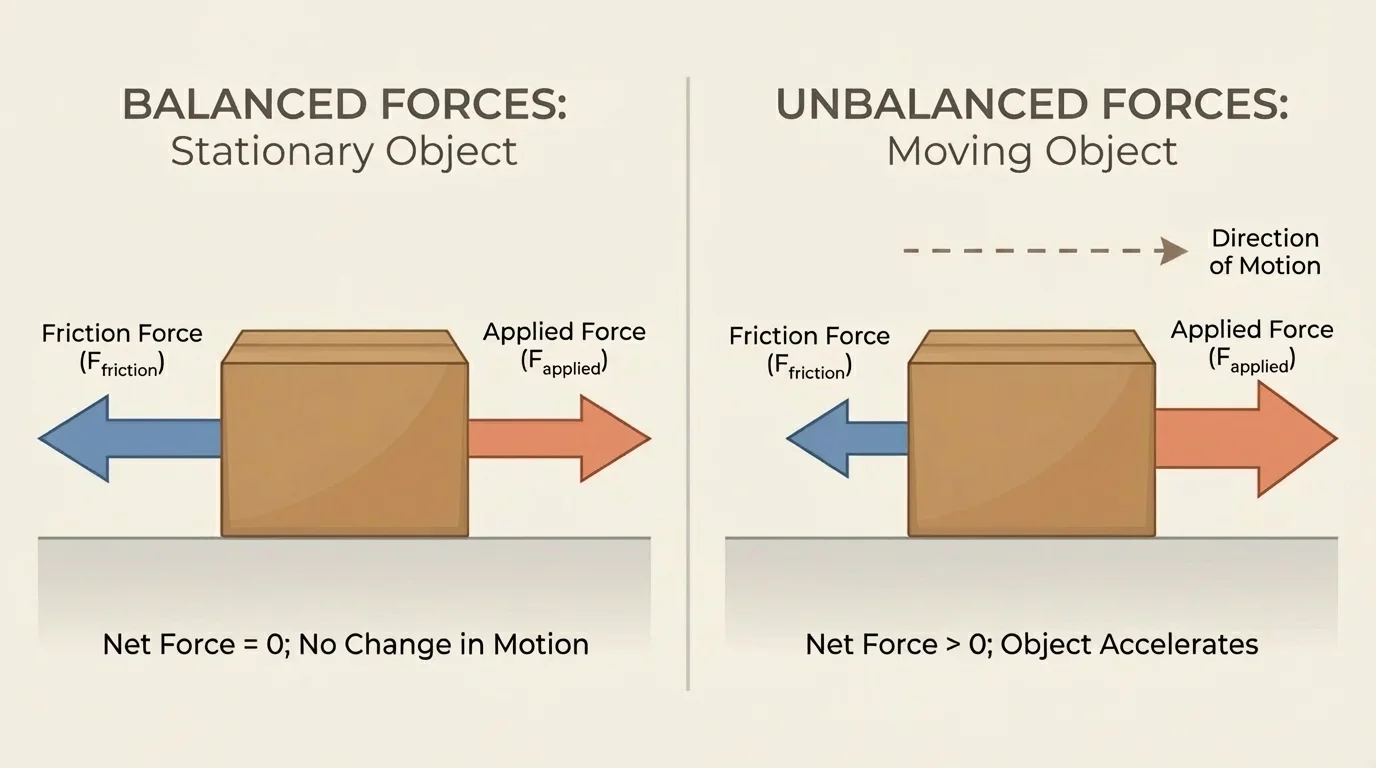
In the ramp investigation, the car's motion changes because there is an unbalanced force affecting it as it rolls down the ramp. The evidence comes from the distances measured. If the data show that the car consistently travels farther from a higher ramp, the group can make a claim that changing the ramp height changes the car's motion.
A strong scientific claim includes both the answer and the evidence. For example, a student might say, The higher ramp caused the toy car to travel farther because the distances increased from about \(41 \textrm{ cm}\) at the low ramp to about \(79 \textrm{ cm}\) at the high ramp. That statement is stronger than simply saying, The high ramp was better.
The idea of balanced and unbalanced forces from [Figure 3] also explains everyday motion. A book resting on a table does not move because the forces are balanced. A skateboard starts rolling when an unbalanced push acts on it. Evidence from observations and measurements helps us decide which kind of force situation is happening.
Fair investigations are used in the real world all the time. In sports, coaches and athletes may test how a change in equipment affects motion. For example, they might compare how different soccer balls move on the same field. To keep the test fair, they would need the same kicking distance and similar kicking strength.
Engineers use fair tests when designing playground slides, bikes, and cars. If they want to know whether one shape works better than another, they try to change only one feature at a time. This helps them learn which design change causes a different result.
Real-world case
A company testing scooter wheels might ask whether wheel size changes how far a scooter rolls after one push. The company would keep the same scooter body, same rider mass, same floor surface, and same starting point. Then the test results would be more trustworthy.
Scientists who study weather, plants, and materials also depend on careful tests. Even when they are not studying motion, the idea is similar: change one factor, keep others controlled, repeat trials, and use data as evidence.
One common mistake is changing too many things at once. If you test a different ramp height and a different toy car at the same time, you will not know which change caused the result. The fix is simple: change only one variable.
Another mistake is doing too few trials. A single trial might be affected by chance. Maybe the car hit a bump or the ruler slipped. Doing several trials gives a clearer picture of what usually happens.
A third mistake is measuring in different ways. If one student measures from the front of the car and another measures from the back, the data will not match well. The group should agree on one measuring method before beginning.
Why repeated trials matter
Repeated trials help scientists tell the difference between a real pattern and a lucky accident. When results are similar again and again, the evidence is stronger. When results are very different, scientists know they may need to improve the procedure.
Students should also make sure the procedure is written clearly. If someone else cannot follow the steps, the investigation is not well planned. Clear procedures are part of good science.
There are many ways to investigate forces besides ramps. Another useful question is: How does the surface affect how far a toy car moves after the same push? In this test, the group could try tile, carpet, and cardboard.
Here, the independent variable is the type of surface. The dependent variable is the distance traveled. Controlled variables include the same car, the same starting point, and the same amount of push as much as possible. Students may use a simple method, such as releasing the car from the same stretched rubber band mark or the same ramp, so the push stays more consistent.
If the car rolls farther on tile than on carpet, the data suggest that the surface affects motion. This is another example of using fair testing to gather evidence. It also helps explain why bikes, balls, and shoes behave differently on different ground surfaces.
By planning carefully, controlling variables, repeating trials, and working together, students can turn observations into evidence. That is how science moves from guessing to knowing.
