A magnet can pull a paper clip without touching it. A balloon rubbed on hair can make small bits of paper jump up. These events may seem surprising, but they can be explained by science. They are examples of forces acting from a distance, and they give scientists a great place to begin: with a question. Science often starts when we notice something surprising and ask, "Why did that happen?" or "What will happen if I change one thing?"
Science is not just about knowing facts. It is also about asking good questions and gathering evidence. A strong science question leads to an investigation. That means you can test it by observing, measuring, comparing, or trying something out.
When scientists ask questions, they are often looking for a cause-and-effect relationship. A cause is something that makes another thing happen. The effect is what happens because of that cause. If you move a magnet closer to a paper clip and the clip moves, the change in distance is the cause, and the clip's motion is the effect.
Questions also help us make predictions. A prediction is not just a wild guess. It is an idea about what will probably happen based on patterns we already notice. If a magnet picks up more clips when it is closer, you can predict that moving it even closer may make the pull stronger.
You already know that a force is a push or a pull. Some forces happen when objects touch, like kicking a ball. Other forces can happen without contact, like magnetic and electric interactions.
Careful questions and careful predictions work together. First, you ask something you can investigate. Then you use what you know to predict a reasonable outcome. After that, you observe what really happens and compare it with your prediction.
An investigable question, as [Figure 1] illustrates, is a question that can be answered by doing a test, making observations, or taking measurements. It is not a question about opinions, and it is not a question that is too big or too vague to test in a simple investigation.
For example, "Which magnet picks up more paper clips?" is investigable. You can test different magnets and count the clips. "Are magnets cool?" is not investigable because people may have different opinions, and there is no measurement for "cool" in that question.
A good investigable question usually changes one thing and watches for what happens. The thing you change is a variable. In a fair test, you try to keep other things the same. If you are testing how distance affects a magnet's pull, you should use the same magnet and the same paper clips each time.
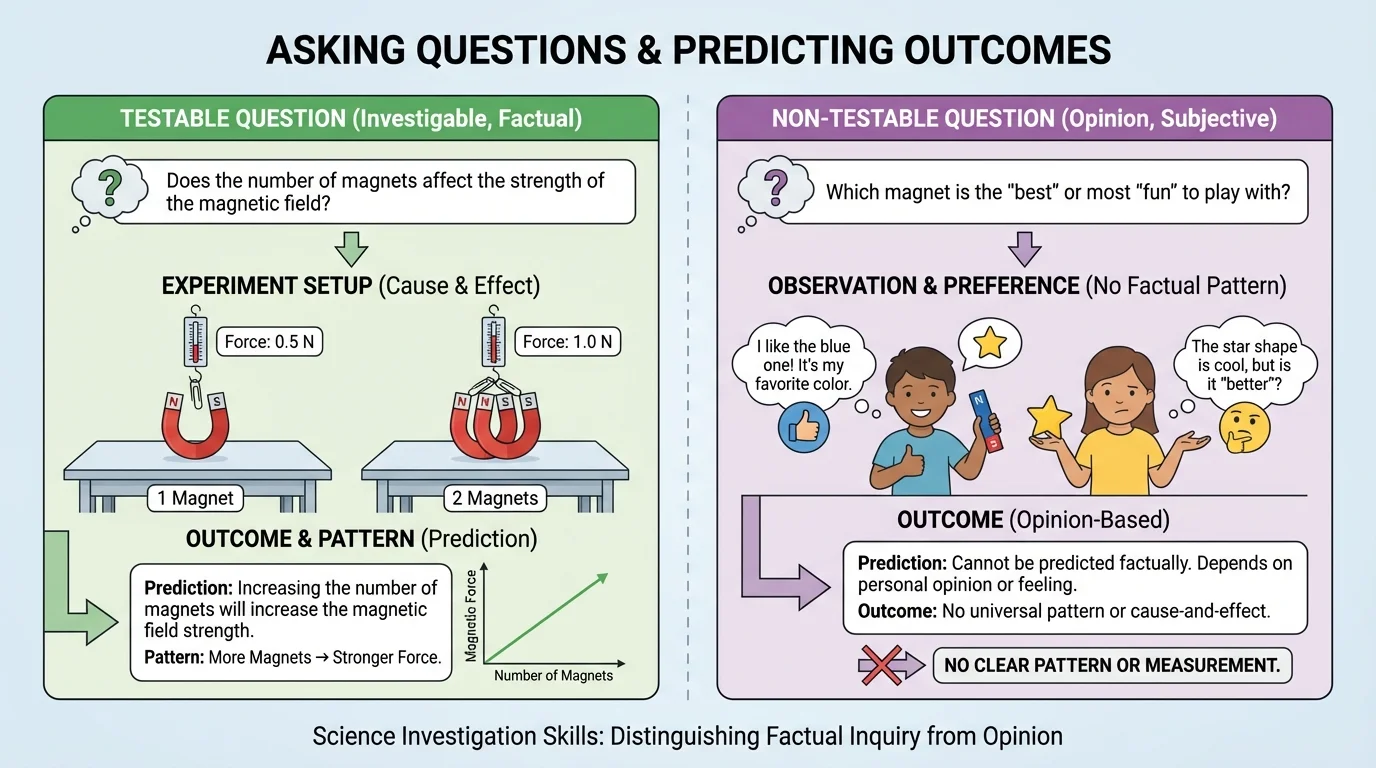
Here are some examples of investigable questions:
Notice that each question can be tested. You can observe motion, count objects, compare results, or describe what happens clearly. That is what makes the question useful in science.
An interaction happens when one object affects another. Some interactions happen through touch, but electric and magnetic interactions can happen across space, as [Figure 2] shows. Even when two objects are not touching, one object can still cause the other object to move.
A magnetic force is the push or pull caused by a magnet. Magnets can attract, which means pull objects together, or repel, which means push objects apart. Opposite magnetic poles attract. Like poles repel.
An electric force is a push or pull caused by electric charge. A charged balloon can attract small bits of paper without touching them. This is an electric interaction. The cause is the electric charge on the balloon, and the effect is the movement of the paper.
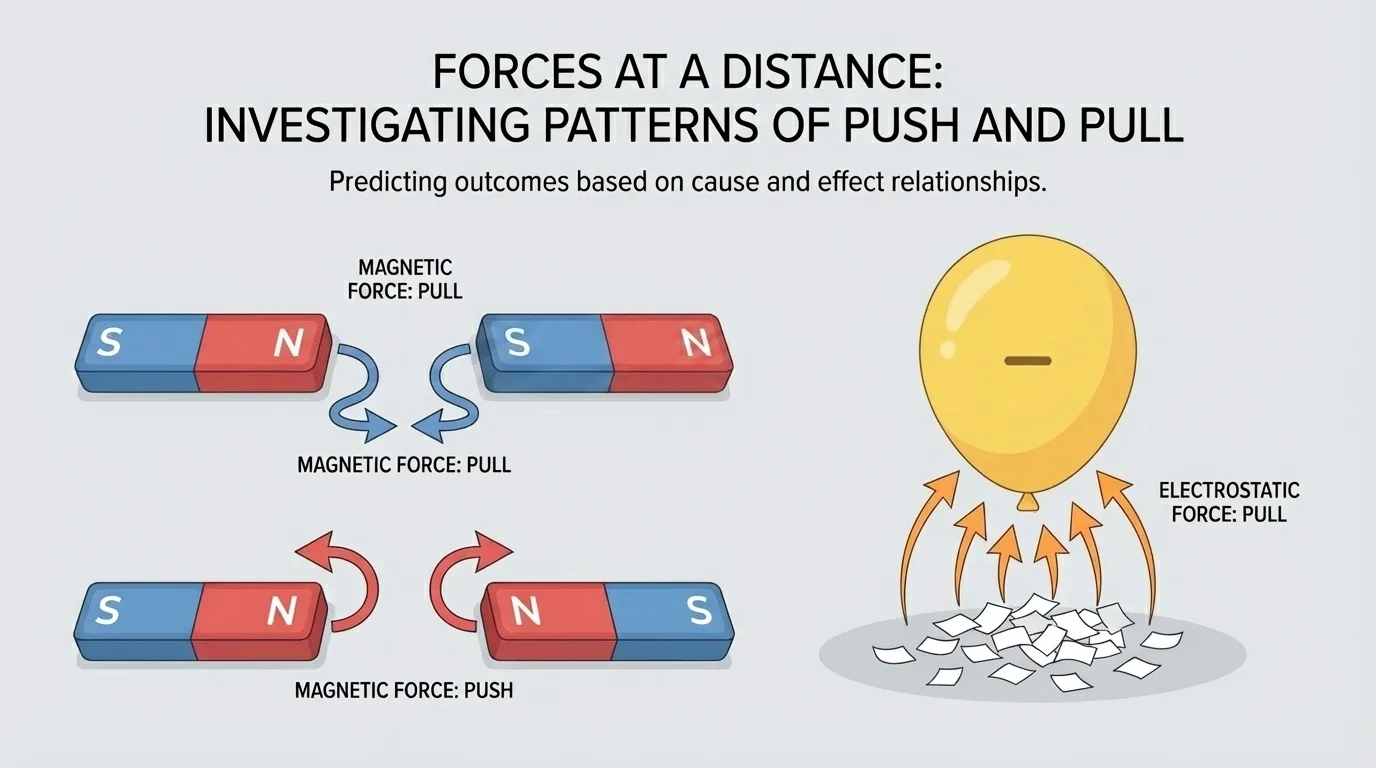
These interactions are important because they show that not every force needs direct contact. If two magnets push away from each other when the same poles face, the cause is the way the poles are arranged. The effect is the motion away from each other.
Distance matters too. Usually, when objects are closer, electric and magnetic interactions are stronger and easier to observe. When they are farther apart, the force is often weaker. That pattern helps scientists ask stronger questions, such as, "How does changing the distance affect the strength of the interaction?"
Attract means to pull together. Repel means to push apart. Cause and effect means one change leads to another result. Evidence is the information we collect from observations and measurements.
We can also describe these ideas with simple comparison language. If a magnet at a distance of \(1 \textrm{ cm}\) pulls a paper clip, but the same magnet at \(5 \textrm{ cm}\) does not, the pattern suggests that the magnetic effect is stronger at the shorter distance.
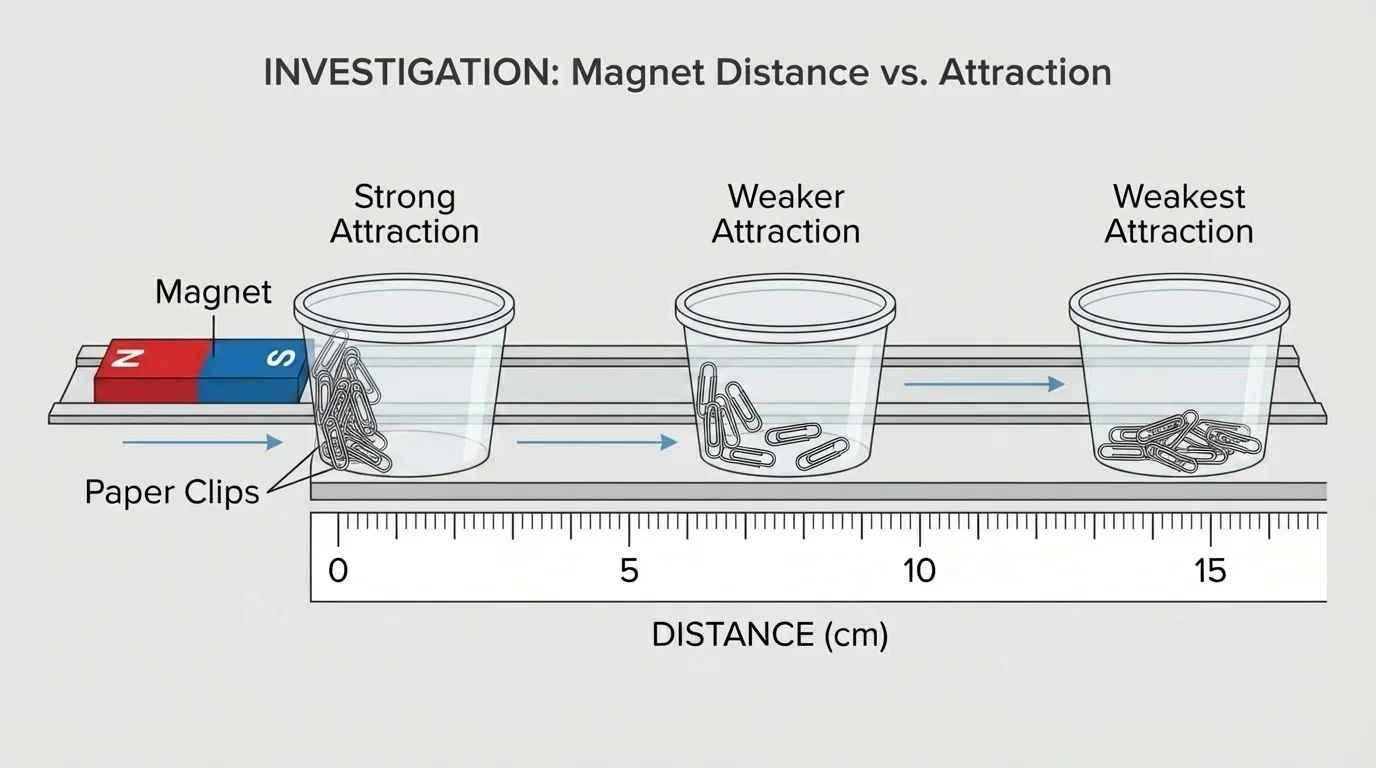
Scientists do not base predictions on one observation alone. They look for a pattern, and [Figure 3] helps show how repeated observations can reveal one. A pattern is something that happens in a similar way again and again.
Suppose you test a magnet at several distances from a group of paper clips. At \(1 \textrm{ cm}\), it picks up \(6\) clips. At \(2 \textrm{ cm}\), it picks up \(4\). At \(3 \textrm{ cm}\), it picks up \(2\). That repeated change gives you a pattern: as distance increases, the number of clips picked up decreases.
From that pattern, you can make a reasonable prediction. You might predict that at \(4 \textrm{ cm}\), the magnet will pick up even fewer clips, maybe \(1\) or even \(0\), depending on the magnet and the clips. You are not guaranteed to be exactly right, but your prediction is based on evidence, not guessing.
Patterns can also help with electric interactions. If rubbing a balloon on a sweater for \(5\) seconds lets it pick up \(3\) paper bits, and rubbing for \(10\) seconds lets it pick up \(6\), you may predict that rubbing it longer could increase the effect. The cause is the amount of rubbing, and the effect is how strongly the balloon attracts paper.
Sometimes patterns are simple, but sometimes they are not perfect. One trial may be a little different from another. That is why scientists repeat tests. Repeating helps them see whether the pattern is real.
| Observation | Possible Pattern | Reasonable Prediction |
|---|---|---|
| Magnet closer to clip | Closer distance gives stronger pull | Moving even closer may make the clip move faster |
| Same poles face each other | Like poles push apart | They will repel again in another test |
| Balloon rubbed longer | More rubbing increases attraction | The balloon may lift more paper bits |
| Wood near magnet | Wood is not attracted | Another wooden object will likely not be attracted |
Table 1. Examples of observations, patterns, and predictions for electric and magnetic interactions.
Now let us look at how scientists turn observations into questions and questions into predictions. The best questions are clear and specific. The best predictions connect to evidence.
Example 1: Magnet distance
Question: How does the distance between a magnet and a paper clip affect whether the clip moves?
Step 1: Change one thing.
Move the same magnet to different distances, such as \(1 \textrm{ cm}\), \(2 \textrm{ cm}\), and \(3 \textrm{ cm}\).
Step 2: Keep other things the same.
Use the same paper clip, same magnet, and same surface each time.
Step 3: Predict from a pattern.
If the clip moved at \(1 \textrm{ cm}\) and \(2 \textrm{ cm}\), but not at \(3 \textrm{ cm}\), predict that the magnet's pull becomes weaker as distance increases.
This is a reasonable prediction because it uses evidence from earlier observations.
Another useful example involves magnetic poles. If north and north push apart in repeated tests, then it is reasonable to predict that south and south will also push apart because like poles repel.
We can connect back to [Figure 2] here. The arrows of motion in the figure make it easier to see how changing the arrangement of poles changes the effect, even though the magnets do not touch.
Example 2: Charged balloon and paper bits
Question: How does the amount of rubbing affect the balloon's ability to attract paper bits?
Step 1: Set up the test.
Rub one balloon on the same type of cloth for different times, such as \(5\), \(10\), and \(15\) seconds.
Step 2: Observe the effect.
Count how many paper bits jump toward the balloon each time.
Step 3: Predict what comes next.
If more rubbing leads to more paper bits moving, predict that increasing rubbing time will increase the electric effect, at least up to a point.
This prediction is reasonable because it is based on a pattern in the data.
Questions can also connect to electric interactions. For example, if a charged balloon attracts paper bits after being rubbed, you can ask whether rubbing it for a longer time changes how many bits it attracts. That question is investigable because you can observe and count the effect.
Example 3: Sorting materials with a magnet
Question: Which classroom materials are attracted to a magnet?
Step 1: Choose objects.
Test items such as a steel paper clip, plastic ruler, wooden pencil, aluminum foil, and coin.
Step 2: Observe carefully.
Bring the same magnet near each object and record whether it is attracted.
Step 3: Make a prediction.
If several metal objects made with iron or steel are attracted, predict that another iron or steel object will also be attracted.
The pattern helps you make a stronger prediction about new objects.
These ideas are not only for science class. Many everyday tools use non-contact interactions, and [Figure 4] connects these ideas to familiar objects. A compass works because Earth acts like a giant magnet. The compass needle lines up with Earth's magnetic field.
Speakers and headphones use magnets and electric forces to make parts vibrate, which creates sound. Clothes can cling together from static electricity after being in a dryer. Refrigerator magnets stay attached because of magnetic attraction.
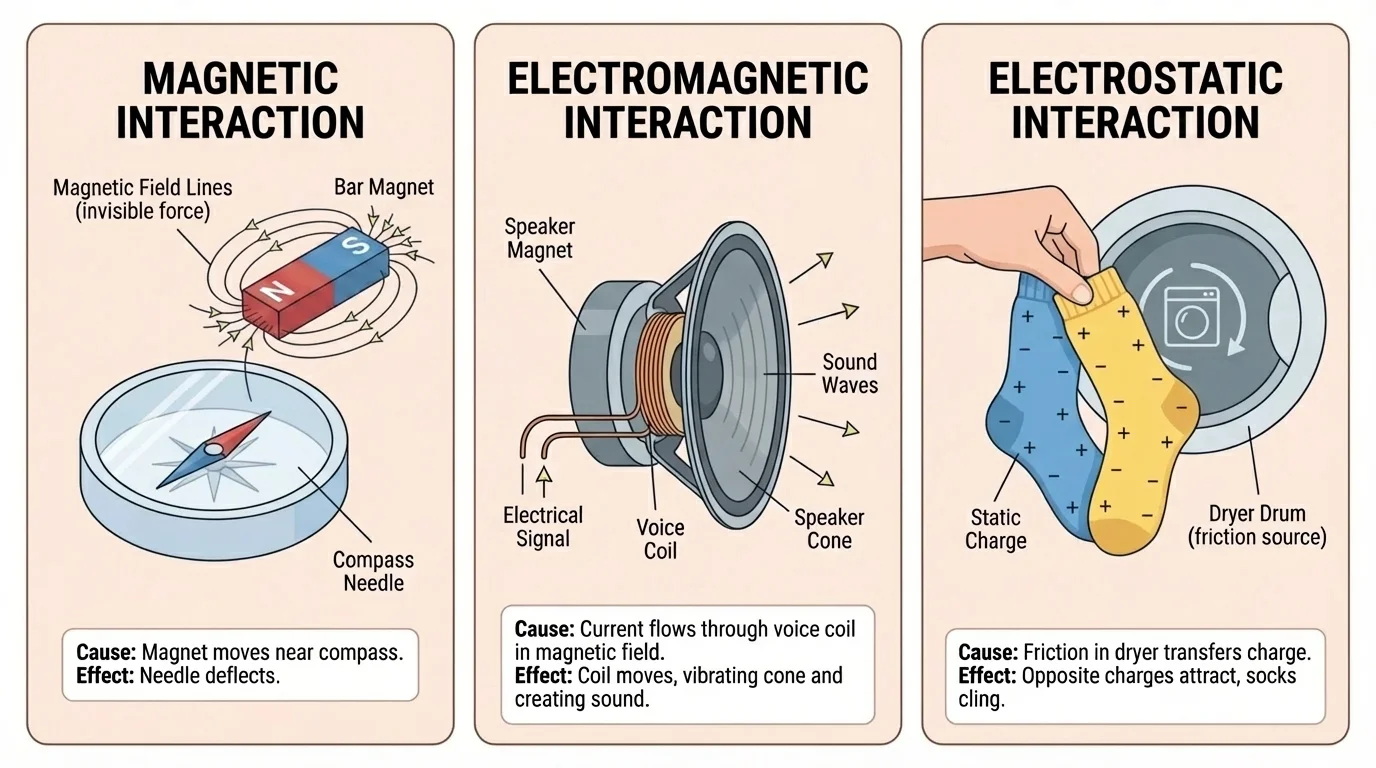
Engineers and inventors ask investigable questions too. They may ask, "Which magnet arrangement makes a motor spin better?" or "How can we reduce unwanted static electricity in a machine?" They test ideas, look for patterns, and make predictions before building new technology.
We also see these patterns in safety and design. If a scientist notices that a stronger magnetic field causes a stronger effect in a device, that pattern can help them predict how the device will work under different conditions. As with the distance pattern in [Figure 3], changing one condition at a time helps people understand what causes what.
Earth itself behaves like a huge magnet. That is why a compass needle can point north even though Earth is much larger and much farther away than a classroom magnet.
A reasonable prediction is connected to evidence. It uses patterns, observations, or what is already known about how things behave. A random guess might accidentally be correct, but it is not as strong as a prediction built from evidence.
Suppose you already know that like poles repel and opposite poles attract. Then if someone turns one magnet so that opposite poles face, you can reasonably predict that the magnets will move together. If there is no evidence and no pattern, then the prediction is weak.
Scientists are also willing to change their thinking. If the result does not match the prediction, they do not just ignore it. They look again at the evidence. Maybe they need more tests. Maybe another variable changed. Maybe their original idea needs improving.
Predictions grow from patterns. A prediction should answer, "What do I think will happen next, and why?" The "why" part matters. It connects the prediction to an observed pattern or a cause-and-effect relationship.
This is one reason scientists record observations carefully. Good records make patterns easier to notice. Better patterns lead to better predictions.
One common mistake is asking a question that cannot really be tested. "Why are magnets interesting?" may lead to discussion, but it is too broad for a simple investigation. "Which of these three magnets attracts the most paper clips?" is much easier to test.
Another mistake is changing too many things at once. If you switch the magnet, the distance, and the kind of object all in one test, you will not know which change caused the effect. A fair investigation changes one main variable at a time.
A third mistake is making predictions with no evidence. A prediction should connect to a pattern. If your earlier tests show that a balloon rubbed longer attracts more paper, your next prediction should use that pattern. That is much stronger than guessing.
Scientists also use clear words. Instead of saying a magnet is "better," they might say it attracts more clips, works at a greater distance, or causes faster movement. Clear language helps others understand exactly what effect was observed.
When you describe an investigation, each word matters. If you say two magnets attract, you mean they move toward each other. If you say they repel, you mean they move apart. If you say there is a pattern, you mean something repeated in a way you can notice and use.
Evidence may include counts, notes, drawings, and measurements. For younger scientists, even a simple count can be powerful. If one magnet picks up \(8\) clips and another picks up \(3\), that difference gives evidence for comparison.
Careful questions lead to careful investigations. Careful investigations reveal patterns. Patterns help us explain cause and effect and make reasonable predictions about what will happen next.
