Have you ever used a globe to understand Earth, a map to find a place, or a drawing to explain how something works? If so, you have already used a model. People cannot hold the whole Earth in their hands, watch water move through every cloud, or see inside a seed as it starts to grow. So we build tools that help us think. In science, a model is one of the most powerful tools we have for explaining how the world works.
A model is a simplified representation of something in the real world. It helps us describe, explain, or predict what happens in a system. A model is not the real thing. It is a version that keeps the most important parts so we can study them more easily.
Model means a simplified way to represent an object, system, or process so people can understand it better. A model may be a drawing, an object, a mathematical rule, a map, or a computer program.
Phenomenon means something that happens or can be observed, such as rain falling, shadows changing, plants growing, or ice melting.
Scientists develop models because many things are too big, too small, too fast, too slow, or too complicated to study directly all at once. Earth is too large to carry around, atoms are too tiny to see with our eyes, and weather changes in many places at the same time. A model makes these things easier to explore.
A model can help answer questions like: Why does day turn to night? Why does a puddle disappear after sunshine? Why do some plants bend toward light? These are all examples of a phenomenon that can be described with a model.
When scientists look at the world, they notice patterns. A ball falls downward every time it is dropped. The Moon seems to change shape through the month. Wet clothes dry faster on a warm, windy day. These repeated patterns help people build explanations. A model connects what we observe to an idea about why it happens.
Models help in several ways. First, they help us describe what is happening. Second, they help us explain why it happens. Third, they help us predict what may happen next. If a weather model shows storm clouds moving toward a town, people can predict rain. If a plant growth model shows that light matters, people can predict that changing the light source may change the direction of growth.
Models are tools for thinking
A good model focuses on important parts and relationships. It leaves out some details on purpose so the main idea becomes easier to see. Scientists then compare the model with observations. If the model matches evidence well, it is useful. If it does not, it needs to be revised.
This is important: a model does not need to include every tiny detail to be useful. A map of a city does not show every blade of grass, but it still helps you find roads and buildings. In the same way, a science model keeps the details that matter most for the question being asked.
There are different kinds of scientific models, and each type can be useful in a different way. As [Figure 1] shows, scientists may use a physical object, a labeled drawing, a mathematical rule, or a computer simulation to study the same idea from different angles.
A physical model is something you can touch. A globe is a physical model of Earth. A ball-and-stick model can represent molecules. A model bridge can help engineers test shapes before building a full-sized bridge.
A diagram model is a drawing or picture that shows parts and how they connect. A water cycle diagram can show evaporation, condensation, and precipitation. A food web diagram can show which living things eat other living things.
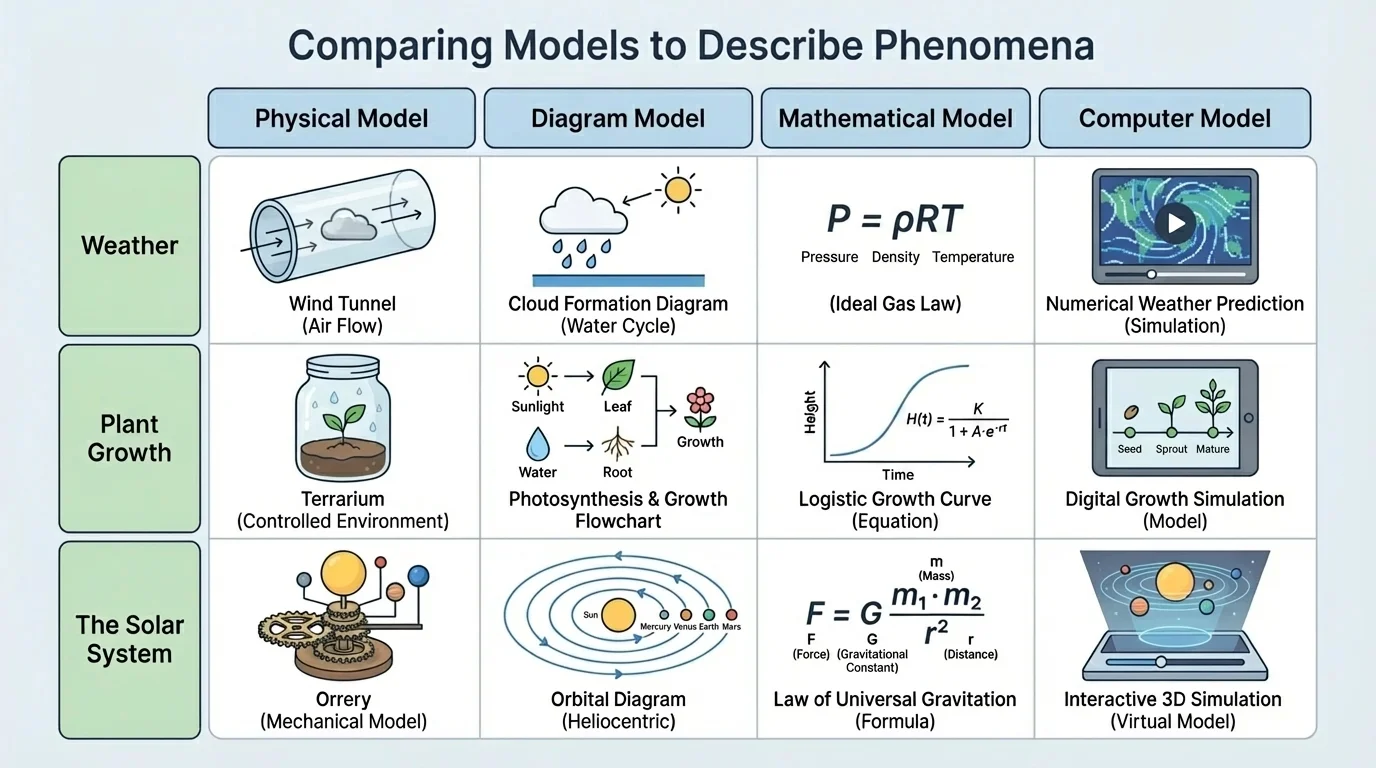
A mathematical model uses numbers, measurements, or equations to describe a pattern. For example, if a plant grows by about the same amount each week, you can model its height with a simple rule. If a plant starts at \(10 \textrm{ cm}\) and grows \(2 \textrm{ cm}\) each week, then after \(w\) weeks its height can be modeled by \(h = 10 + 2w\).
A simulation is a model that acts out a process, often on a computer. Weather forecasts use simulations to study air, water, temperature, and wind. Flight simulators help pilots practice safely. Video games also use simple simulations to make motion and collisions seem realistic.
Each type of model has strengths. A globe helps you see shape. A diagram helps you see parts. A mathematical model helps you measure change. A simulation helps you test many situations quickly. That is why scientists often use more than one model for the same topic, just as [Figure 1] compares different model types for a single phenomenon.
Weather forecasts depend on models that process huge amounts of data. Even then, forecasts can change because Earth's weather system is very complex.
Developing a model is a step-by-step process. It presents the main path: observe a phenomenon, identify important parts, decide how those parts interact, test the model with evidence, and revise it if needed.
[Figure 2] First, choose the phenomenon you want to explain. Maybe you want to explain why shadows change size during the day. Then observe carefully. What changes? What stays the same? What parts seem important? In this case, the Sun, the object making the shadow, and the ground all matter.
Next, decide which parts belong in the model and which details can be left out. You do not need every cloud in the sky to explain a shadow. You do need the light source and the position of the object. Then think about relationships. Does moving the light change the shadow length? Does changing the object size change the shadow shape?
Scientists also make assumptions. An assumption is something accepted for the moment so the model can work. For a shadow model, one assumption might be that the ground is flat. Assumptions can be helpful, but they can also limit the model.
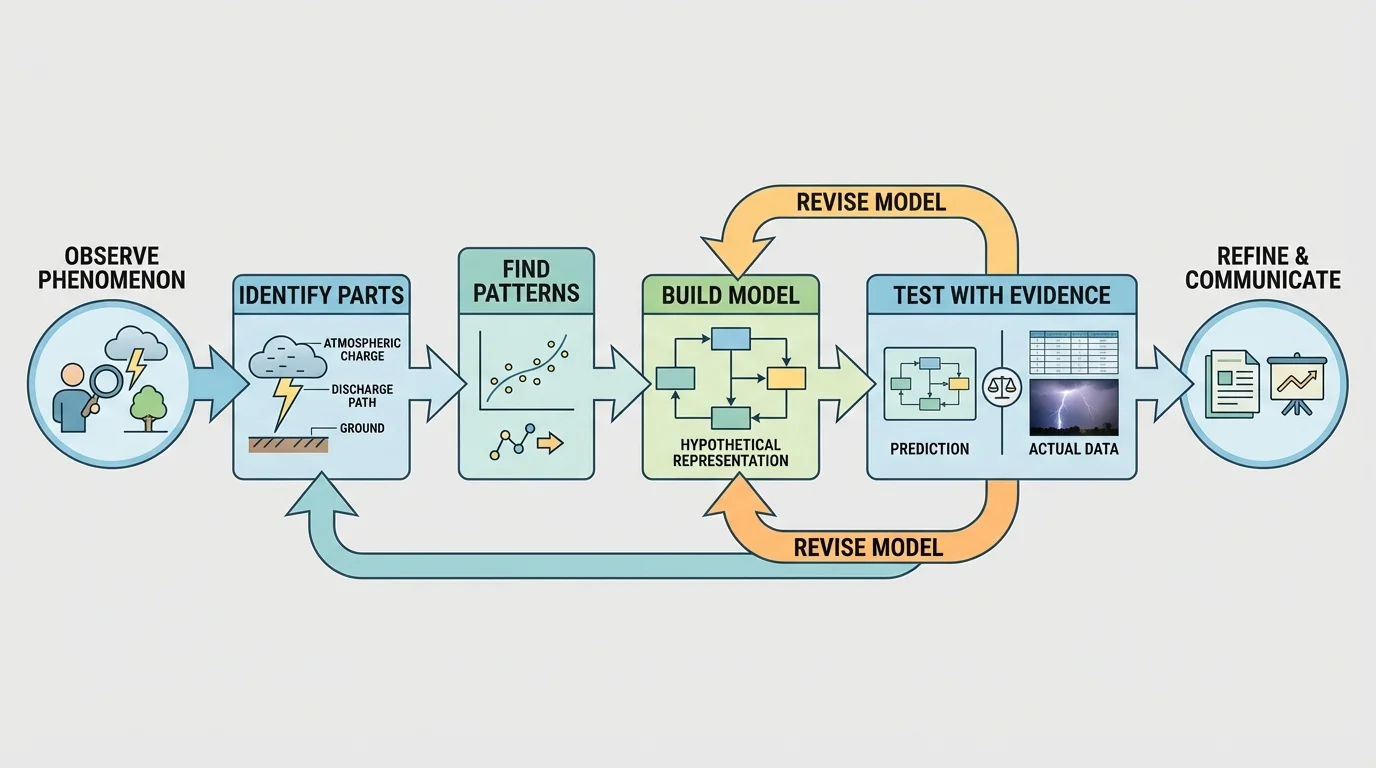
After building the model, scientists compare it with real observations. If the model predicts a long morning shadow and observations show the same thing, that is a good sign. If the model does not match, then something is missing or incorrect. The model must be changed.
Example: Building a simple plant growth model
Step 1: Observe the phenomenon
A seedling near a window bends toward the light.
Step 2: Identify important parts
The plant, the light source, and the direction of growth are important.
Step 3: Build the model
Draw the plant and arrows showing light coming from one side. Show the stem bending toward the light.
Step 4: Test the model
Turn the plant around for several days. If the plant bends again toward the light, the model matches the evidence.
This model helps explain that light direction affects plant growth.
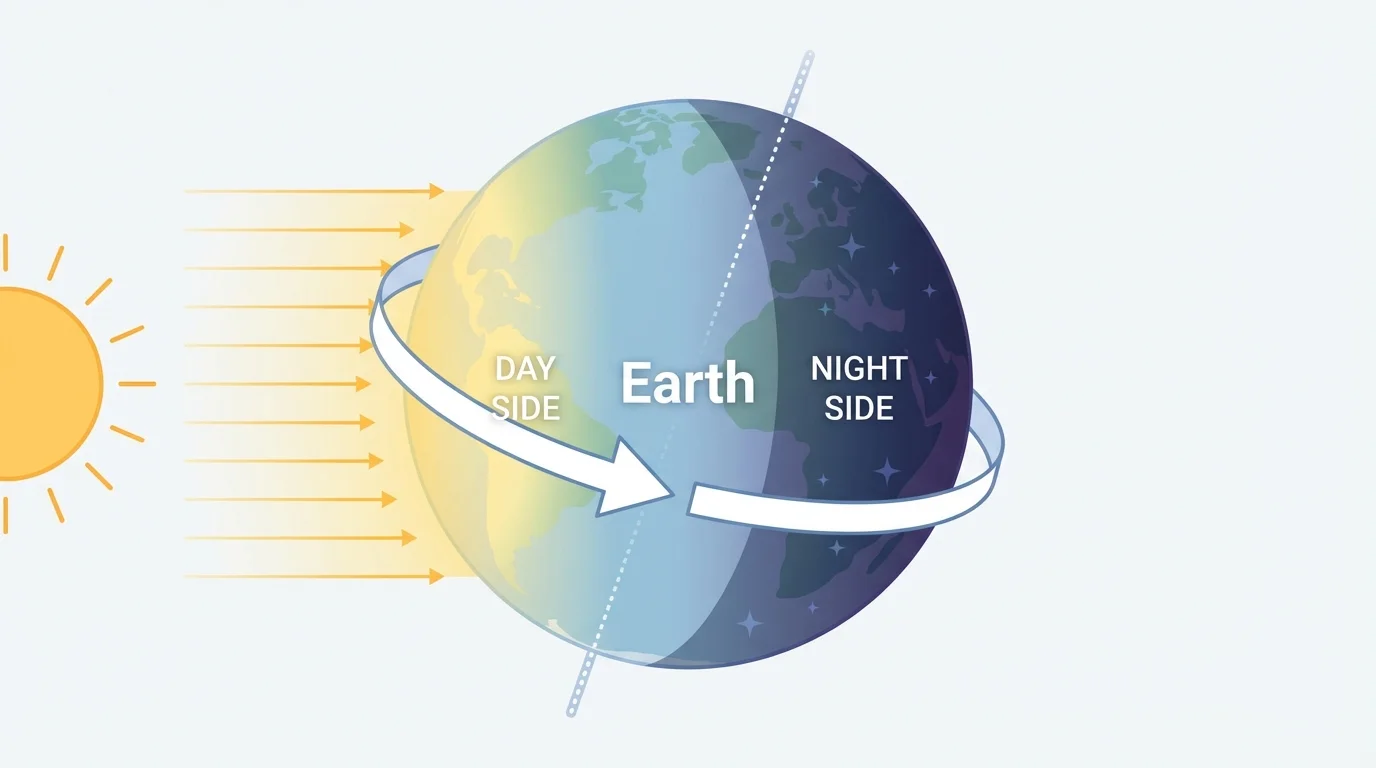
Many science ideas become much clearer when a model is used. One classic example is day and night. This phenomenon can be explained by showing Earth rotating while sunlight lights only one half at a time.
[Figure 3] Earth spins on its axis once every day. The side facing the Sun has daytime, and the side turned away has nighttime. A model with a lamp for the Sun and a ball for Earth helps students see why different places move into and out of sunlight.
This model is useful because it shows motion and position. It helps explain why day and night happen again and again in a regular pattern. It also helps explain why places on Earth do not all have noon at the same time.
Another everyday example is the water cycle. Water from oceans, lakes, and puddles can evaporate into the air. Later it condenses into tiny droplets in clouds and may fall as rain or snow. A diagram model shows these parts and arrows between them, making the cycle easier to understand.
A third example is melting ice. If an ice cube is left on a plate in a warm room, it changes from solid water to liquid water. A particle model can describe this by showing particles packed closely in ice and moving more freely in liquid water. We cannot see the particles directly, but the model helps explain the change.
You may already know that matter can be solid, liquid, or gas. Models help connect those states to particle behavior, which is too small to see directly.
Models can also include measurements. If the temperature of water changes by the same amount each hour while it is heated, a simple mathematical model can describe that trend. For example, if the temperature starts at \(20\,^{\circ}\textrm{C}\) and rises by \(5\,^{\circ}\textrm{C}\) each hour, then after \(t\) hours the model is \(T = 20 + 5t\). If \(t = 3\), then \(T = 20 + 5(3) = 35\), so the predicted temperature is \(35\,^{\circ}\textrm{C}\).
No model is perfect the first time. Scientists improve models by checking them against evidence. A model may begin as a simple idea and then change when observations reveal something new.
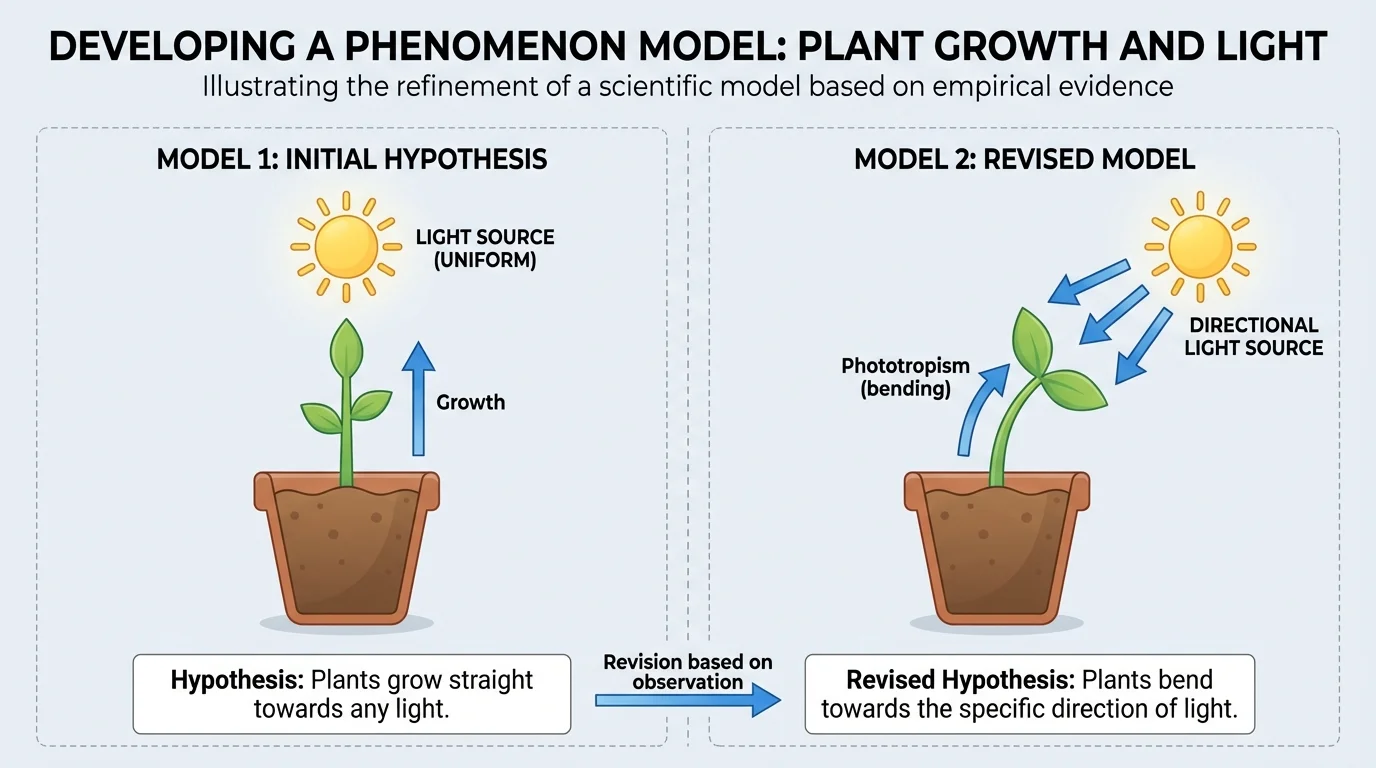
[Figure 4] Suppose a student makes a plant model that says plants always grow straight upward. Then the student observes a plant near a window bending sideways toward light. The observation does not match the model. That mismatch is important. It tells the student to revise the model by adding the effect of light direction.
Revising a model is not failure. It is part of science. Better evidence leads to better explanations. Over time, models can become stronger, more accurate, and more useful.
Scientists have revised models many times in history. People once used simpler models of the solar system, and later evidence led to better ones. Weather models also improve when satellites, radar, and measurements give more information. The flow of revision we saw in [Figure 2] is a normal part of scientific work.
Why evidence matters
A model must connect to observations. If it cannot explain what people actually see, it needs to be adjusted. Evidence does not just support ideas; it also helps scientists notice what is missing.
A good model is clear, useful, and connected to evidence. It includes the parts that matter most and shows the important relationships among those parts. It helps explain a phenomenon and can often make a prediction.
But every model has limitations. A globe shows Earth well, but it does not show every street. A map shows roads, but not mountain heights unless that information is added. A drawing of the water cycle helps explain movement of water, but it does not show every drop or every local weather change.
Scale is another issue. In some models, sizes or distances are changed to make them easier to see. On a classroom model of the solar system, the planets may be much closer together than they are in real space. This does not make the model useless. It means we must understand what the model is designed to show.
When using a model, it is smart to ask: What does this model explain well? What does it leave out? Which parts are simplified? Those questions help you use models carefully and thoughtfully.
Models are everywhere. Meteorologists use weather models to predict storms. Engineers test model buildings and bridges before construction. Doctors use body models and computer images to understand organs. Pilots train with flight simulators. Game designers use simulations to create believable motion.
Maps are models too. A road map does not contain the real roads, but it represents them in a useful way. A subway map may change distances and angles so the routes are easier to read. Even though it is not perfectly realistic, it can still be the best model for helping people travel.
Students use models often without noticing. A diagram of the digestive system, a fraction strip, a globe, a bar graph, and a life cycle drawing are all models. In each case, the purpose is the same: make an idea easier to understand by showing the important parts and relationships.
The day-and-night model from earlier, shown in [Figure 3], is a strong example of how a simple model can explain a pattern we experience every day. The revised plant model in [Figure 4] also reminds us that models improve when new evidence is added.
Real-world application: Weather forecasting
Step 1: Gather data
Scientists measure temperature, wind, air pressure, and moisture in many places.
Step 2: Build and run models
Computer simulations use the data to estimate how air and water may move.
Step 3: Compare with new observations
If the forecast differs from what happens, the model is updated.
This shows how models are used to describe a complex phenomenon and to improve predictions over time.
Developing and using models is a major part of science because it helps people move from simple observations to stronger explanations. A careful model can turn a confusing event into something understandable.
