A forest, a coral reef, a pond, and a desert may look completely different, yet they often follow surprisingly similar rules. Predators are usually less common than the animals they eat. Plants or algae form the base of nearly every food web. When one important species suddenly declines, many other populations change too. These repeated observations are not random coincidences. They are patterns, and patterns are one of the most powerful tools scientists use to figure out cause-and-effect relationships.
In science, a pattern is something that repeats in a reliable way. It might be a repeated shape, a repeated sequence of events, or a repeated relationship between two things. When scientists notice a pattern, they ask an important question: What is causing this to happen again and again? If the same kind of result appears in many places and under many conditions, that pattern can point toward a cause.
For example, if ponds with more algae also tend to have more snails, that is a pattern. Scientists might infer that the algae provide food for the snails. But they must be careful. Two things happening together do not always mean one causes the other. Maybe warmer water helps both algae and snails increase. Good science means looking for evidence, comparing many cases, and testing ideas.
Pattern is a repeated and recognizable occurrence or arrangement.
Cause-and-effect relationship is a connection in which one event, condition, or action produces another effect.
Interaction is a way in which organisms affect one another or their environment.
Scientists use patterns because nature is full of repeated outcomes. If a certain kind of change is followed again and again by a similar result, the repeated result gives clues about the cause. This is true in living systems, weather systems, and even in astronomy.
Across a ecosystem, living things interact in ways that often repeat from place to place. In a grassland, rabbits eat plants and foxes eat rabbits. In an ocean, small fish eat plankton and larger fish eat the small fish. In a forest, insects eat leaves and birds eat the insects. As [Figure 1] illustrates, these ecosystems contain different organisms, but the interaction pattern is similar: food resources support consumers, and consumers are often controlled by predators.
One major repeating pattern is predator-prey relationships. When prey populations increase, predator populations may later increase because there is more food. Then, as predator numbers rise, prey may decrease. Later, predator numbers may also fall because food becomes harder to find. This does not always happen in a perfect cycle, but the pattern appears in many ecosystems.
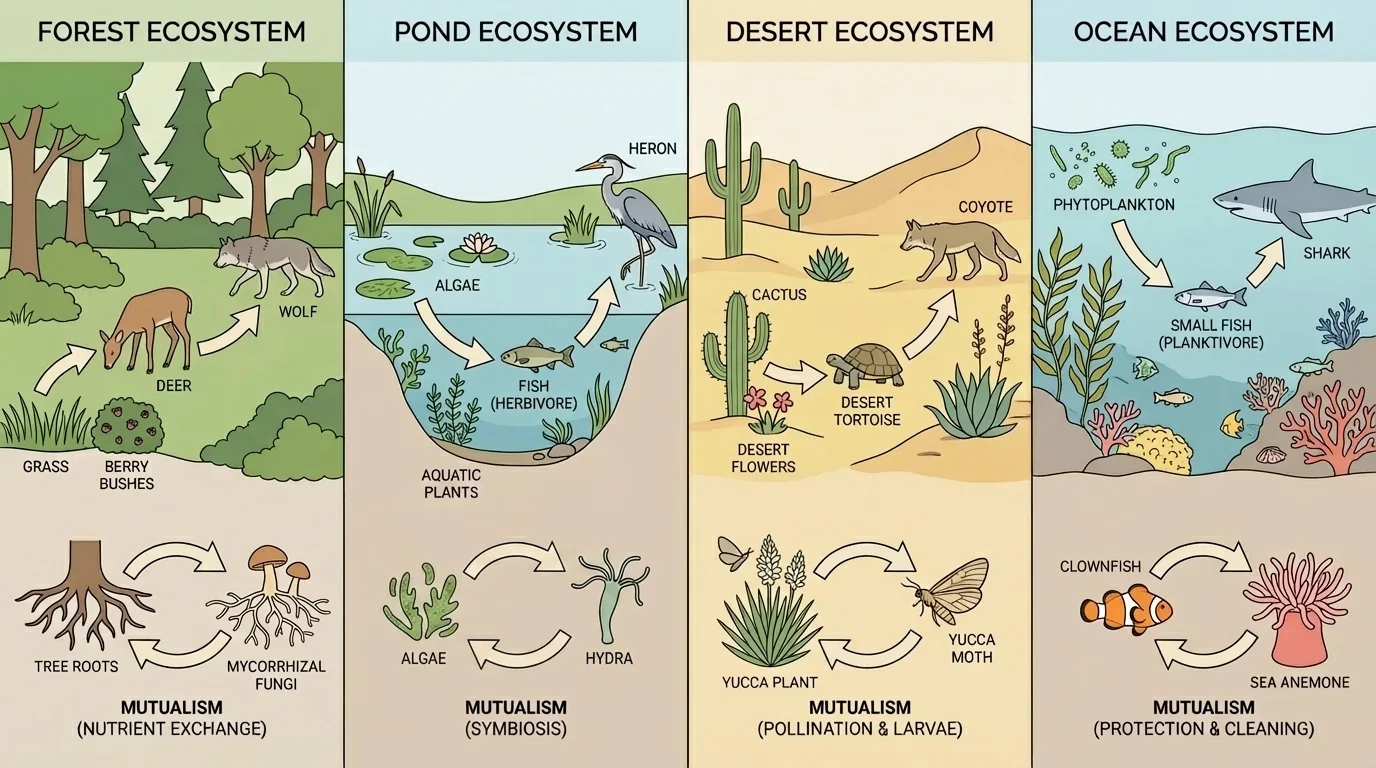
Another repeating pattern is competition. Organisms that need the same food, water, space, or sunlight often compete. In a desert, plants with deeper roots may survive better during drought. In a crowded pond, fish may compete for oxygen and food. If resources become limited, some species decrease, move away, or change behavior. The effect follows the cause: fewer resources lead to stronger competition.
A third pattern involves mutualism, a relationship in which both organisms benefit. Bees and flowering plants are a classic example. Bees get nectar, and flowers get pollinated. Similar patterns appear elsewhere: birds remove parasites from large mammals, and some reef fish clean larger fish. These repeated beneficial interactions help scientists explain why certain species are often found together.
Patterns also appear in where organisms live. For instance, plants grow densely where water and sunlight are available, and herbivores are more common where plant life is abundant. This means the physical environment often causes a pattern in the kinds of organisms found there. A swamp, a tundra, and a coral reef all support different communities, but each still shows repeated links between available resources and the organisms that can survive.
Patterns across different ecosystems
Scientists do not need two ecosystems to have the same species in order to compare them. They look for repeating roles and relationships. Producers make food, consumers eat other organisms, decomposers break down dead matter, and populations respond to resource availability. These repeated roles help scientists build explanations that work across many ecosystems.
This comparison makes an important idea clear: the exact organisms change, but the interaction structure often stays similar. That is why ecologists can study one system and use what they learn to ask questions about another.
To understand why these interaction patterns exist, scientists trace energy flow. Energy enters most ecosystems through sunlight. Plants, algae, and some bacteria capture that energy and store it in food molecules. Then herbivores eat producers, carnivores eat herbivores, and decomposers break down remains. As [Figure 2] shows, the amount of available energy decreases as it moves upward through feeding levels.
This creates a very common pattern: ecosystems usually have many producers, fewer herbivores, and even fewer top predators. A meadow can support many grasses, fewer rabbits, and only a small number of hawks. The same pattern appears in oceans, where huge numbers of microscopic producers support fewer fish and still fewer sharks or tuna. The cause is energy loss at each step of transfer.
Scientists often model this with the idea that only about \(\dfrac{1}{10}\) of energy is passed from one feeding level to the next. If producers store about \(10{,}000\) units of energy, primary consumers may receive about \(1{,}000\) units, secondary consumers about \(100\) units, and tertiary consumers about \(10\) units. The pattern of shrinking energy helps explain why top predators are rare.
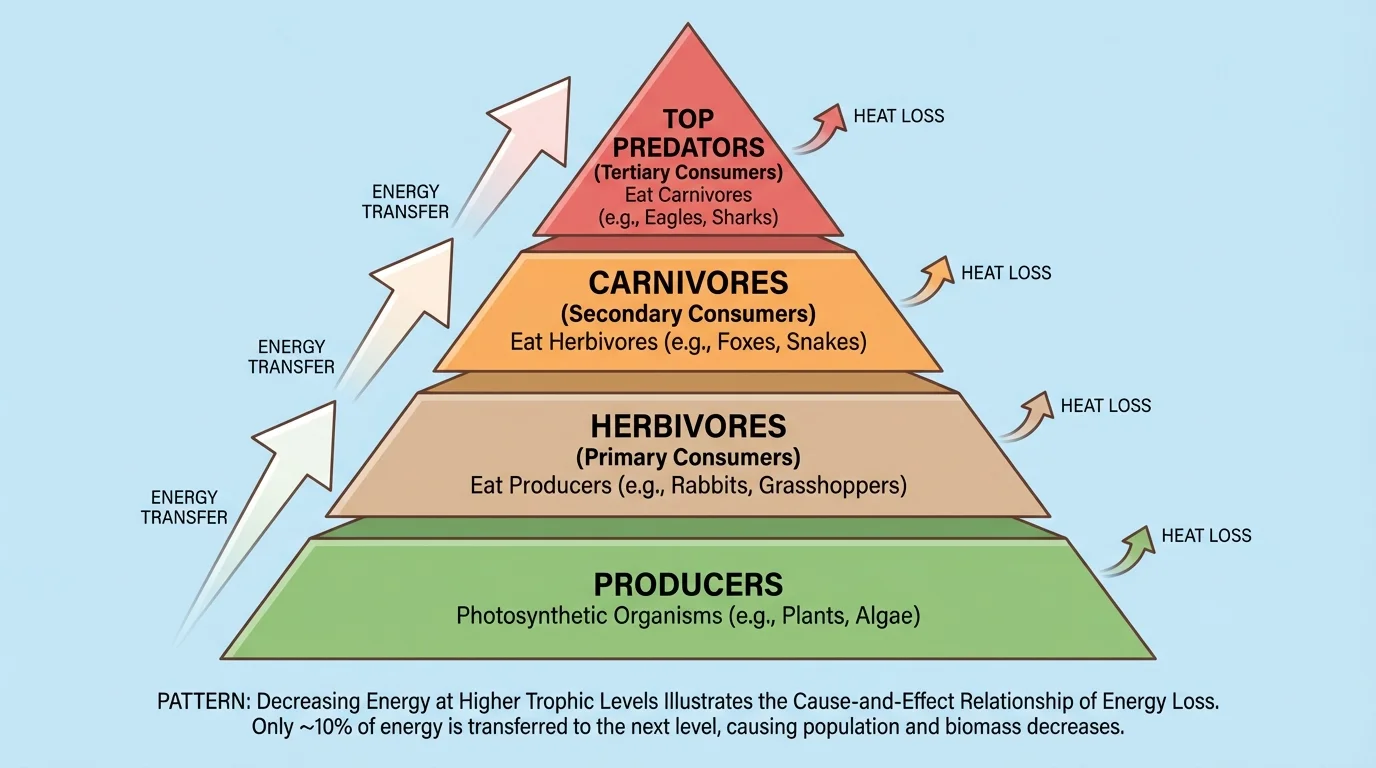
Because energy becomes less available at higher levels, ecosystems usually cannot support large populations of top predators. A single owl needs many mice over time. A wolf pack needs many deer in its hunting range. This cause-and-effect pattern matters in conservation. If prey species decline, predator populations often decline later.
Food webs are more complex than simple chains, but they still show patterns. Organisms often eat more than one type of food, which can make ecosystems more stable. If one food source drops, a consumer may switch to another. Scientists look for these patterns to predict which ecosystems are more vulnerable to change.
Energy pattern example
Suppose an ecosystem has about \(5{,}000\) units of energy stored in producers.
Step 1: Estimate energy available to primary consumers.
Using the rough \(\dfrac{1}{10}\) rule, primary consumers receive about \(5{,}000 \times \dfrac{1}{10} = 500\) units.
Step 2: Estimate energy available to secondary consumers.
Secondary consumers receive about \(500 \times \dfrac{1}{10} = 50\) units.
Step 3: Connect the numbers to a pattern.
Because \(50\) is much smaller than \(5{,}000\), the ecosystem can support far fewer secondary consumers than producers.
The numeric pattern helps explain the population pattern.
The shape in [Figure 2] is not just a diagram; it represents a cause. Less available energy at each level causes smaller populations at higher levels in many ecosystems.
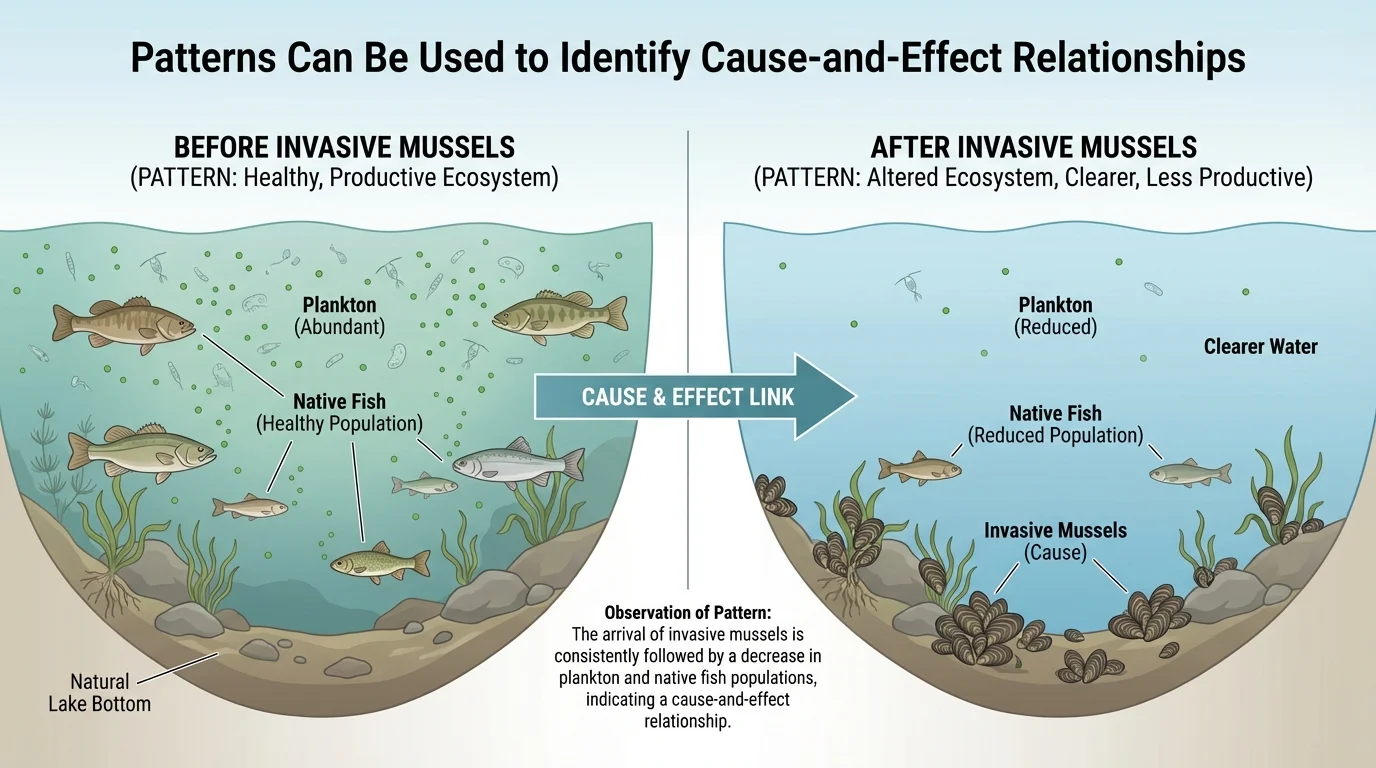
Patterns become especially useful when something disrupts an ecosystem. A disturbance is an event that changes living or nonliving parts of a system. Fires, floods, droughts, storms, disease outbreaks, pollution, and invasive species can all disturb ecosystems. When a familiar pattern suddenly changes, scientists ask what new cause may be responsible. As [Figure 3] illustrates, comparing the pattern before and after a disturbance can reveal the most likely explanation.
Consider a lake in which small fish numbers suddenly fall. Scientists might look for several possible causes: a drop in oxygen, a chemical pollutant, a new predator, or a disease. They gather data over time. If oxygen levels dropped sharply just before the fish decline, and similar fish losses happened in other lakes during low-oxygen periods, that repeating pattern points to a likely cause.
Invasive species provide another strong example. An invasive mussel introduced into a lake may filter huge amounts of plankton from the water. That causes less food for native organisms that depend on plankton. As a result, some native fish populations shrink, while water clarity may increase because fewer plankton remain suspended. One change causes several effects, and the whole set of effects forms a pattern.
Wildfire can also reveal patterns of cause and effect. Right after a severe fire, plant cover may decrease sharply, soil may erode more easily, and some animals may leave the area. But over time, some plants return quickly, especially species adapted to fire. Scientists observe repeating recovery patterns in many fire-prone ecosystems, which helps them predict regrowth.
Climate changes can create broad patterns across multiple ecosystems. If average temperatures rise, some species shift toward cooler places, such as higher elevations or latitudes. If rainfall patterns change, grasslands may expand or shrink. These large-scale patterns help scientists connect environmental causes to biological effects across regions.
After some forest fires, certain pine cones open only because of the heat. What first looks like complete destruction can trigger the next stage of growth in ecosystems adapted to regular fire.
Much later, the comparison in [Figure 3] still matters because it reminds us that scientists often identify causes by noticing which parts of a system changed together and which did not.
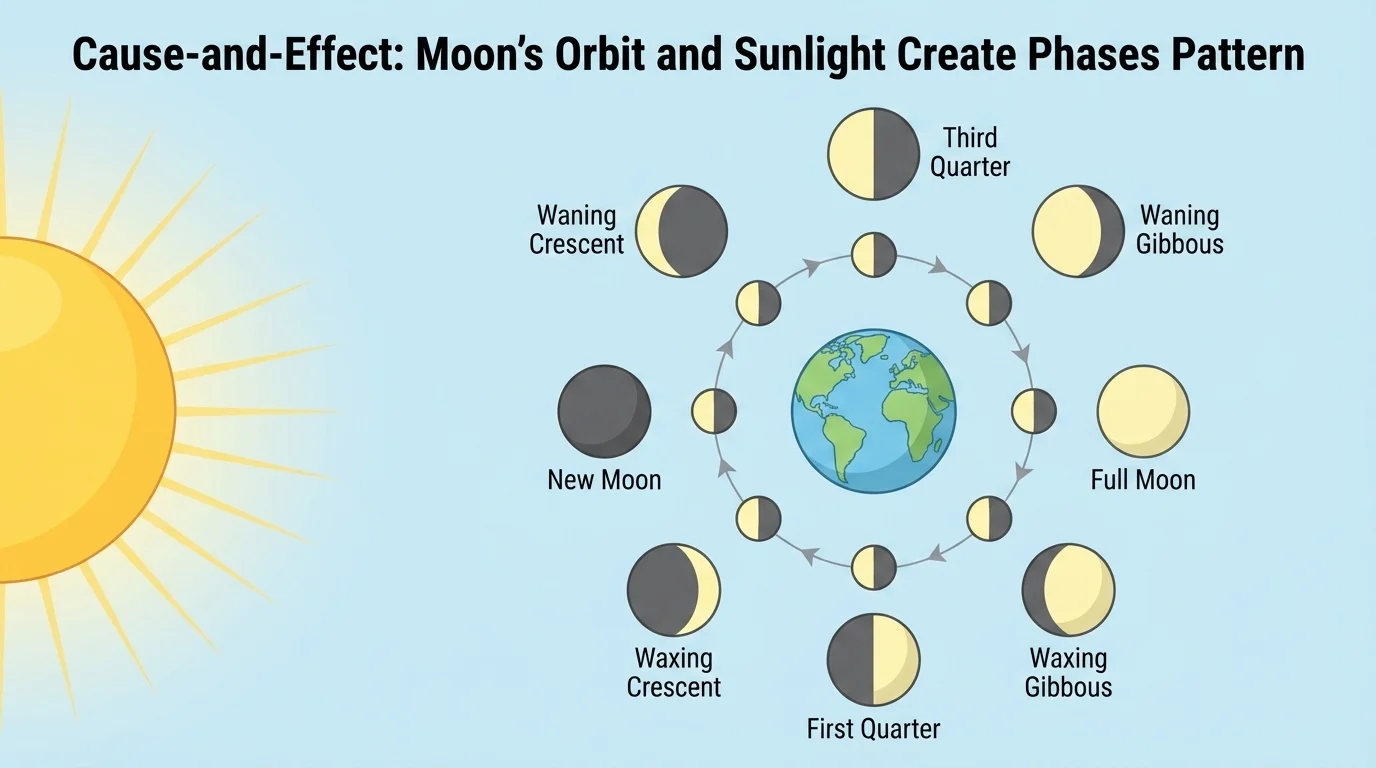
The idea of using patterns to identify causes is not limited to ecosystems. In space science, repeated patterns in motion and appearance help scientists explain what is happening in the Earth-Moon-Sun system. As [Figure 4] shows, the Moon's phases repeat in a predictable cycle because of the relative positions of the Moon, Earth, and Sun. The repeating pattern allows scientists to explain the cause rather than treating each phase as a separate event.
Day and night form another repeating pattern. Earth rotates once about every \(24\) hours, so sunlight reaches different parts of the planet in sequence. Seasons also follow a pattern caused by Earth's tilt and orbit around the Sun. In each case, scientists identify a regular pattern and then determine the mechanism producing it.
Surface patterns on planets and moons also provide clues. Cratered surfaces usually suggest frequent impacts or very old surfaces that have changed little. Smooth plains may suggest lava flows or other resurfacing processes. Scientists cannot always perform direct experiments in space, so patterns in observations become especially important evidence.
This matters because the same scientific habit of mind works in different fields. Whether studying wolves in a forest or the Moon in the night sky, scientists look for repeated relationships and use them to explain causes.
Not every pattern reveals a true cause, so scientists test their ideas carefully. First, they observe and measure. Then they compare different places, times, or conditions. Next, they ask whether a possible cause appears before the effect and whether the same relationship repeats.
Scientists also use variables. A variable is something that can change, such as temperature, rainfall, or predator number. If too many variables change at once, it becomes difficult to tell what caused the effect. That is why controlled experiments are useful when possible. In a lab or field study, scientists may change one variable while keeping others as similar as possible.
Earlier science learning about observation and evidence still matters here. An observation tells what happened. An explanation tells why it happened. Patterns help connect those two by showing whether the same result happens repeatedly under similar conditions.
For example, imagine students investigating whether fertilizer runoff causes algae growth in pond water. If containers with more fertilizer repeatedly grow more algae while similar containers without fertilizer do not, that pattern supports a cause-and-effect explanation. Scientists would still check for other variables, but repeated evidence strengthens the conclusion.
Cause-and-effect investigation example
A class studies two identical plant trays except for water amount.
Step 1: Keep most conditions constant.
Both trays use the same soil, same plant type, same light, and same temperature.
Step 2: Change one variable.
Tray A gets \(200\) milliliters of water per day, and Tray B gets \(50\) milliliters.
Step 3: Look for a repeated effect.
If Tray A plants repeatedly grow taller over many days while the other conditions stay the same, water amount is a strong candidate for the cause of the growth difference.
The key is not one observation but a repeated pattern under controlled conditions.
Scientists also look for exceptions. If the pattern fails under certain conditions, that can lead to a better explanation. Maybe water matters only up to a point, and then too much water harms the plants. Good explanations become more precise as evidence grows.
Understanding pattern-based cause and effect helps people make decisions. Ecologists use population patterns to protect endangered species. If a bird population declines whenever wetland area decreases, restoring wetlands may help the birds recover. Fisheries managers track patterns in fish numbers, water temperature, and breeding seasons to avoid overfishing.
Farmers also use these ideas. If insect outbreaks follow warm, dry conditions, growers can prepare earlier. If crop yield drops when pollinator numbers drop, that pattern highlights the importance of protecting pollinating insects. In medicine and public health, scientists track disease patterns to identify causes and prevent spread.
Even city planners use pattern recognition. If heavy rain repeatedly causes flooding in neighborhoods with little vegetation and lots of pavement, that pattern points to runoff as a major cause. Planting more vegetation or improving drainage can reduce the effect.
| Observed pattern | Likely cause | Possible effect or prediction |
|---|---|---|
| Many producers, fewer herbivores, very few top predators | Energy decreases at higher feeding levels | Top predator populations stay small |
| Predator numbers rise after prey numbers rise | More prey provides more food | Predators may increase after a time delay |
| Algae increase after fertilizer runoff | Extra nutrients enter water | Oxygen may later drop as decomposition increases |
| Species shift toward cooler regions | Average temperature increases | Community composition changes |
| Moon phases repeat in a cycle | Regular motion of Moon around Earth | Future phases can be predicted |
Table 1. Examples of observed patterns, likely causes, and predictions scientists can make from them.
Once students learn to look for patterns, they begin to see that science is not just collecting facts. It is building explanations from evidence. Repeated interactions, repeated motions, and repeated changes all help reveal the causes behind what we observe.
