A flock of birds suddenly twists across the sky as if it were a single organism. A school of fish tightens when a predator appears. A wolf pack hunts more successfully than a lone wolf. These scenes are dramatic, but the scientific question is deeper: does group behavior actually cause higher survival and reproduction, or does it simply happen alongside those outcomes? Biology depends on answering that question with evidence, not guesses.
In ecosystems, organisms constantly interact with one another and with their environment. Some patterns are obvious: species living in groups often seem safer, more successful at finding food, or better at defending territory. But a pattern is not automatically proof of cause. To say that one factor causes another, scientists need careful observations, measurements, and tests. That is why empirical evidence is essential in ecology, evolution, and genetics.
A correlation means that two things are associated: when one changes, the other also changes in a predictable way. As [Figure 1] shows, two variables may rise and fall together even if one does not directly produce the other. For example, suppose researchers notice that fish form tighter groups at the same time predator attacks increase. It would be easy to say, "Grouping causes predator attacks," or "Predator attacks cause grouping," but the full explanation may involve additional factors.
A hidden factor, called a confounding variable, may influence both. In the fish example, seasonal water temperature, migration timing, or food availability could affect both predator presence and fish grouping. If scientists do not control for those factors, they may mistake a coincidence or indirect relationship for a direct cause.
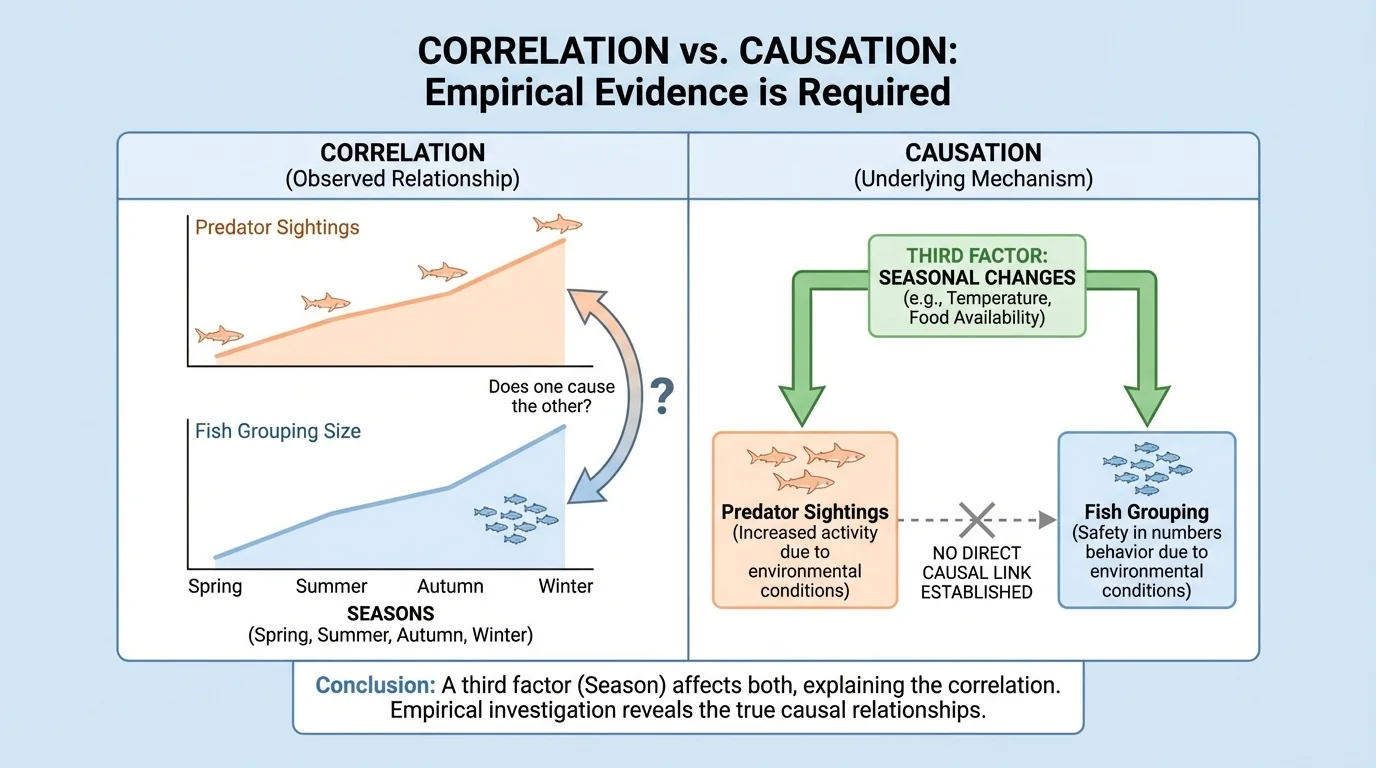
Humans are naturally drawn to patterns, and that is useful in science because patterns often point to real relationships. But patterns are only the beginning. If students, scientists, or the public assume that "associated with" means "caused by," then they may reach false conclusions. In biology, false conclusions can affect conservation decisions, medical research, and how we understand evolution.
Correlation is an observed relationship between two variables. Causation means that one factor directly produces a change in another. Empirical evidence is information gathered through observation, measurement, and experimentation rather than opinion or assumption.
One classic error is reversing cause and effect. If animals in larger groups survive better, grouping might improve survival. But it is also possible that healthier animals are more able to join or maintain groups. Another error is ignoring context. A behavior may help in one environment but not another. A herd may reduce predation risk in open grassland, yet in a crowded habitat the same group may attract more disease or competition.
Causation is more than a pattern. It means that changing one factor changes another in a reliable way. In biology, scientists usually look for several signs of causation: the effect happens after the cause, the relationship is consistent, there is a plausible biological mechanism, and the claim is supported by data from observation or experiment.
A mechanism explains how the cause produces the effect. Suppose living in a herd lowers each zebra's chance of being caught by a lion. A possible mechanism is the dilution effect: if one lion attacks a herd of many zebras, the risk to any one zebra may be lower than the risk to a zebra alone. Another mechanism is improved detection: more eyes and ears may detect predators sooner.
Biologists also ask whether the same cause produces similar effects in repeated studies. If multiple investigations in different habitats all show that alarm calls help nearby individuals escape predators, confidence in a causal claim increases. Strong evidence does not usually come from a single observation. It builds through repeated testing.
Why mechanism matters
If a scientist claims that a behavior causes survival or reproductive success, there should be a biological explanation for that effect. Mechanisms can involve energy savings, predator avoidance, division of labor, better mate attraction, or improved care of young. A convincing mechanism does not replace evidence, but it helps make the causal claim scientifically stronger.
Cause-and-effect claims in biology are often probabilistic rather than absolute. Group behavior may not guarantee survival, but it may change the probability of survival. If solitary fish survive predator attacks at a rate of about \(0.40\) and schooling fish survive at \(0.70\) under similar conditions, scientists infer that schooling is associated with higher survival. To argue that schooling causes that difference, they must still rule out alternative explanations.
Group behavior includes actions carried out by multiple individuals of the same species, such as flocking, schooling, herding, cooperative hunting, colony nesting, and alarm calling. In ecological systems, these behaviors can affect access to food, protection from predators, care of offspring, and opportunities to reproduce. As [Figure 2] illustrates, the effect of grouping is often different for individuals at the center of a group than for individuals at the edge.
Consider a school of fish. A predator approaching a tightly packed school may find it harder to focus on one target. This is sometimes called the confusion effect. At the same time, fish in the center of the school may have lower risk than fish at the edge. That means a group effect can operate at two levels: the group as a whole may gain protection, and individuals within the group may experience unequal benefits.
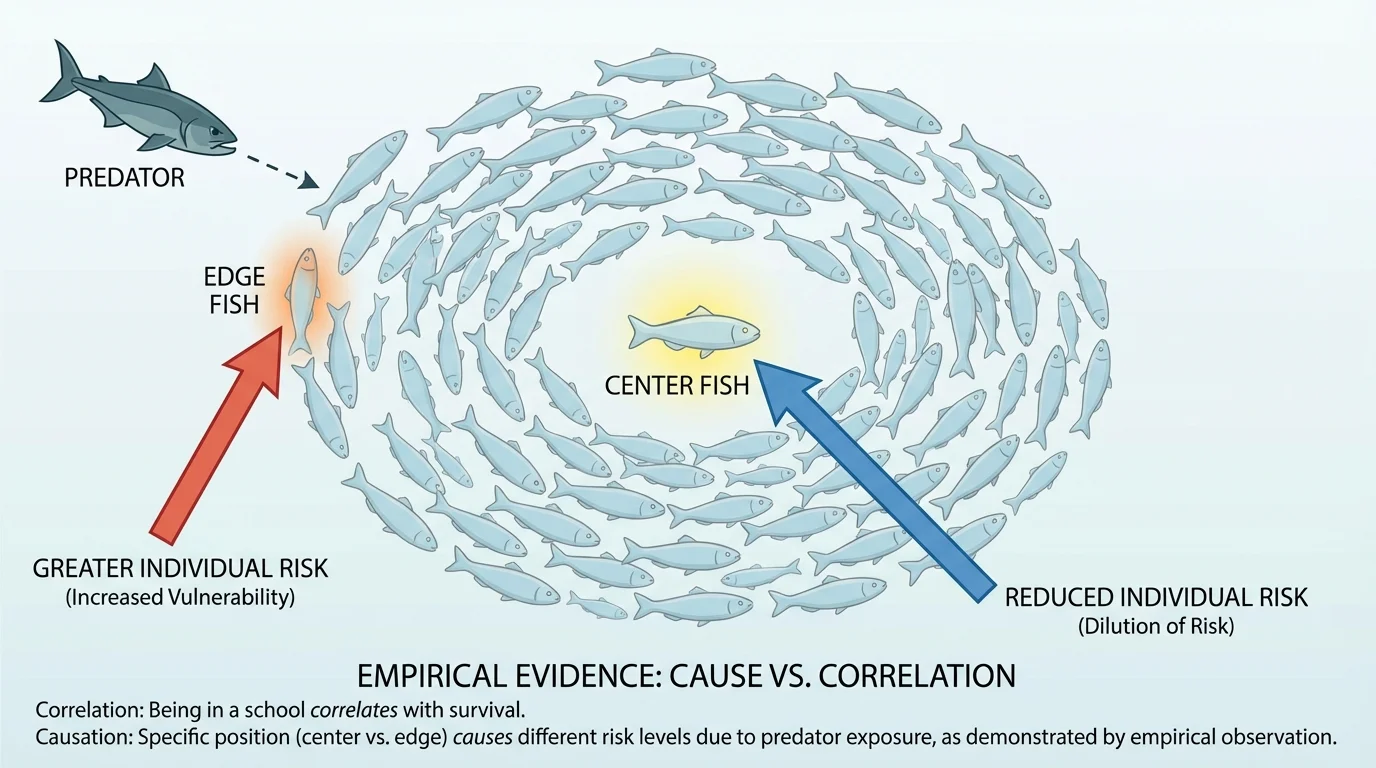
Bird flocks provide another example. Some birds feed in groups because many individuals can spot predators more quickly than a solitary bird can. In addition, time spent watching for danger may decrease, leaving more time for feeding. If extra feeding improves body condition, then group behavior may indirectly increase reproductive success by helping birds survive long enough to breed or by allowing them to produce healthier offspring.
Not all group behavior is cooperative in the same way. In a wolf pack, hunting together can help bring down larger prey. In meerkats, some individuals act as sentinels and give alarm calls. In social insects such as ants or bees, division of labor can make a colony highly efficient. Each case involves different mechanisms, so evidence for one kind of group behavior does not automatically apply to another.
Some seabirds nest in large colonies even though crowded nesting can increase noise, competition, and disease risk. The fact that group living has costs as well as benefits is one reason scientists must test claims carefully instead of assuming that bigger groups are always better.
Because group living can help in one way and harm in another, biologists often compare both survival and reproduction. A behavior that improves survival but greatly reduces access to food or mates may not increase overall fitness. In evolutionary biology, the important question is whether the behavior changes an individual's ability to leave offspring.
To move from correlation to causation, scientists collect empirical evidence through controlled studies, field observations, and repeated comparisons. [Figure 3] illustrates a basic strategy: keep as many conditions as possible the same, change one factor, and measure the outcome. That sounds simple, but ecosystems are complicated, so strong study design matters.
A controlled experiment changes one independent variable while holding other variables constant. For example, researchers might compare predator responses to simulated prey that appear alone versus in groups, under the same light, temperature, and habitat conditions. If the only major difference is group size, then a difference in attack rate is more likely to reflect a causal effect of grouping.
Scientists use control groups for comparison. They also use replication, meaning the test is repeated many times. A single event could be unusual, but repeated similar outcomes are more convincing. If grouped prey are attacked less often across many trials, confidence increases that group behavior affects predation risk.
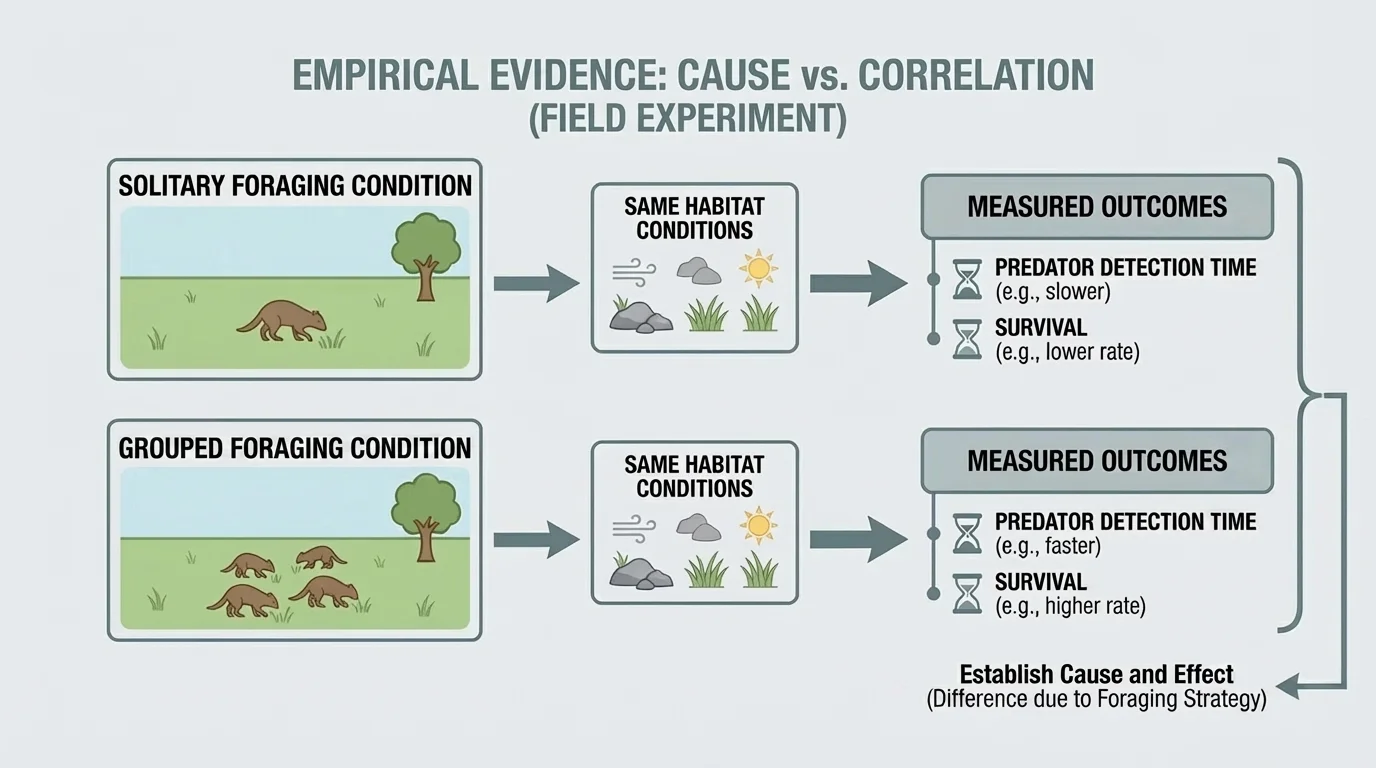
In many ecological situations, strict experiments are difficult or unethical. Scientists cannot always manipulate wild animal groups freely. In those cases, they rely on observational studies with careful controls. They may compare similar populations, track individuals over time, or use statistical methods to account for confounding variables. Even then, they remain cautious. Observational evidence can strongly suggest causation, but it is usually strongest when combined with experiments or multiple independent studies.
Researchers may also quantify risk or benefit. For instance, if out of \(100\) solitary foraging events predators attack \(30\) times, while out of \(100\) group foraging events predators attack \(12\) times, the attack rates are \(0.30\) and \(0.12\). That difference supports the idea that grouping reduces attack risk. But if habitats differed between the two cases, habitat could still be the real cause. Good evidence depends on good comparisons.
Case study: testing whether alarm calls improve survival
Researchers want to know whether alarm calls in a social mammal actually cause higher survival among nearby group members.
Step 1: State the hypothesis
If alarm calls are causal, then individuals exposed to alarm calls should respond faster to predators than individuals not exposed to them.
Step 2: Design the comparison
The scientists compare similar groups in similar habitats. In some trials, a recorded alarm call is played when a predator model appears. In other trials, no alarm call is played.
Step 3: Measure outcomes
They record time to seek cover, number of escapes, and later survival of marked individuals.
Step 4: Interpret carefully
If the alarm-call groups consistently seek cover sooner and survive more often, and other conditions are controlled, the evidence supports a causal claim.
This does not prove that every alarm call in every species has the same effect, but it provides strong evidence for that species under those conditions.
Another important tool is peer review and replication by other scientists. If only one team finds a result, caution is necessary. If many independent studies produce similar conclusions, the evidence becomes far more trustworthy.
Fish schools, bird flocks, wolf packs, and insect colonies all provide opportunities to test causal claims. The fish example returns us to [Figure 2]: if center fish survive more often than edge fish, researchers must still ask whether position itself causes the difference or whether stronger, faster fish tend to occupy safer positions. Tracking individual fish over time can help answer that.
In meerkats, alarm calls are often linked with predator avoidance. But scientists test more than whether calls and escapes occur together. They examine whether the calls happen before escape, whether nearby individuals change behavior immediately after the call, and whether survival rates improve under comparable predator conditions. This sequence of evidence is much stronger than simply noticing that groups with more calls also have more survivors.
Wolf packs illustrate how one behavior may influence both survival and reproduction. Cooperative hunting can increase access to prey, which can improve adult condition and help adults feed pups. If packs that hunt cooperatively raise more pups to maturity than less coordinated groups, that suggests a possible causal link. Yet researchers still need to consider territory quality, prey abundance, pack size, disease, and weather.
Colonial nesting birds show another twist: a group behavior may increase one kind of success while reducing another. Nesting in a colony may lower the chance that any one nest is found by a predator, but close nesting may increase parasite spread. Therefore, causal claims in ecology often involve trade-offs rather than simple good-or-bad outcomes.
| Group behavior | Possible benefit | Possible cost | Evidence needed |
|---|---|---|---|
| Schooling in fish | Reduced predation risk | Competition for food | Compare attack and survival rates under similar conditions |
| Flocking in birds | Earlier predator detection | More visible to predators | Measure detection time and survival in different group sizes |
| Cooperative hunting in wolves | Capture larger prey | Energy sharing among members | Compare prey capture and pup survival across packs |
| Colonial nesting | Safer nesting through many neighbors | Disease or parasite spread | Track nest success and health outcomes over time |
Table 1. Examples of group behaviors, their possible benefits and costs, and the kinds of evidence needed to test causal claims.
Behaviors are shaped by both environment and inheritance. A trait is a characteristic of an organism, and some traits that influence behavior can be inherited. As [Figure 4] shows, inherited variation can affect behavior, and behavior can affect survival and reproduction. But scientists must still avoid jumping too quickly from "this behavior runs in families" to "this gene causes this ecological outcome."
Suppose one bird population shows stronger flocking behavior than another. If that population also survives predators better, a student might conclude that inherited flocking behavior causes the survival advantage. That may be true, but only if evidence supports each step: first, that the behavioral difference is partly inherited; second, that it actually changes survival; and third, that other factors are not responsible.
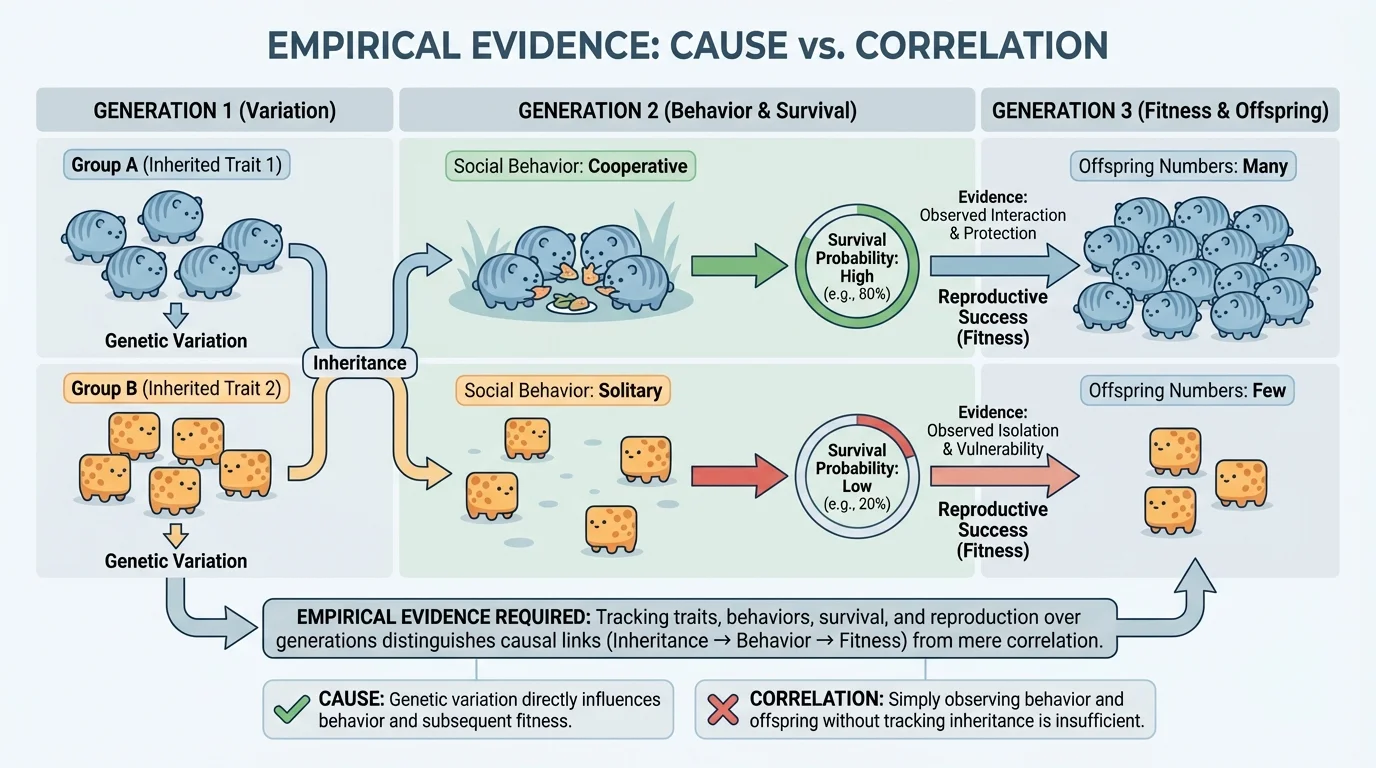
This matters because natural selection acts on heritable variation in traits that affect reproductive success. If a social behavior is inherited and truly increases the probability of survival or reproduction, then over generations that behavior may become more common. But if the observed success is really due to a richer habitat or fewer predators, then the evolutionary conclusion would be flawed.
Biologists therefore separate several claims that are often mixed together: "Individuals differ in behavior," "some of that difference is inherited," "the behavior changes survival," and "the behavior changes reproduction." Each claim requires evidence. One observation rarely proves all four.
Genes do not determine every behavior in a simple one-to-one way. Most behaviors result from interactions between inherited information and environmental conditions. That is why evidence about inheritance must be combined with evidence about actual ecological outcomes.
A useful concept here is fitness, meaning an organism's success in surviving and leaving offspring relative to others in its population. In ecology and evolution, fitness is not about strength alone. A behavior that helps organisms survive but prevents mating may lower fitness, while a behavior that slightly increases risk but greatly increases reproductive success may raise fitness overall.
Whenever you encounter a biological claim, ask several questions. What exactly is being measured? Is the relationship merely a correlation, like the one introduced in [Figure 1], or is there evidence that changing one factor changes the other? Were there control groups or matched comparisons? Could another variable explain the pattern?
It is also important to ask whether the sample size is large enough. A conclusion based on \(3\) observed predator attacks is weak. A conclusion based on hundreds of observations across different years is much stronger. Scientists also ask whether the evidence comes from one population or many, and whether the findings hold across different ecosystems.
Language matters too. Statements such as "grouping is linked to higher survival" are weaker and more cautious than "grouping causes higher survival." Good scientists match the strength of their conclusion to the strength of their evidence. Overstating a claim can mislead others and slow scientific progress.
"Extraordinary claims require extraordinary evidence."
— A principle often used in science
Students should also be alert to data cherry-picking. If someone reports only the examples where cooperation worked and ignores the cases where it failed, the conclusion will be biased. Reliable science includes the full pattern of evidence, not only the pieces that support a preferred idea.
Distinguishing cause from correlation matters far beyond the classroom. Conservation biologists may decide whether to protect migration corridors, breeding colonies, or pack territories based on claims about group behavior. If those claims are wrong, management plans may fail. For example, if colony size appears related to bird reproductive success, scientists must determine whether the colony itself helps reproduction or whether both are caused by habitat quality.
Wildlife disease management also depends on causal thinking. Large groups may correlate with disease outbreaks, but the true cause may involve water contamination, nutrition, or stress. Effective intervention depends on identifying the real mechanism, not just the visible pattern.
Even human biology and medicine use the same logic. A treatment may seem associated with recovery, but without controlled evidence scientists cannot know whether the treatment caused improvement. The same standard of evidence that helps us understand fish schools and wolf packs also protects people from false medical claims.
By using empirical evidence, scientists build explanations that are testable, revisable, and trustworthy. That approach allows biology to move beyond appearances and identify real causes in the living world, whether the question concerns ecosystems, inherited traits, or the survival and reproduction of species.
