Two people can look at the same set of numbers and reach different conclusions. One says a new school policy improved attendance; another says the change was too small to matter. Who is right? In science, history, economics, and everyday decision-making, the answer is not based on who speaks more confidently. It depends on who builds the stronger argument from evidence.
Engaging in argument from evidence means making a claim, supporting it with trustworthy information, and explaining clearly why that information supports the claim. It also means listening to other explanations, testing them against the evidence, and revising your thinking when the evidence demands it. This practice is central to science, but it also matters in debates about health, public policy, environmental issues, technology, and social questions.
At the high school level, a strong argument is not just an opinion with examples. It is a structured explanation grounded in data, logical reasoning, and careful evaluation of alternatives. When you write or speak persuasively in an academic setting, your goal is not simply to win. Your goal is to show that your conclusion is the most reasonable one based on the available evidence.
Scientific knowledge grows because people challenge ideas and test them. A claim about climate patterns, medicine effectiveness, or ecosystem change becomes stronger only when researchers present evidence and others examine it critically. The same habit of mind applies in classrooms: if you argue that a chemical reaction is endothermic, that a novel presents a certain theme, or that a policy should change, you must show how the evidence supports your conclusion.
This kind of argument differs from a quarrel. In everyday speech, an argument may mean shouting or disagreement. In academic work, an argument is a reasoned case. It is possible to disagree respectfully, compare evidence carefully, and reach a better understanding. That is why evidence-based argument is both an intellectual skill and a civic skill.
"What can be asserted without evidence can also be dismissed without evidence."
— Christopher Hitchens
That quotation is blunt, but it captures an important rule: a claim becomes credible when it is supported by evidence that others can examine. Unsupported statements may sound convincing, yet they remain weak because they cannot be tested.
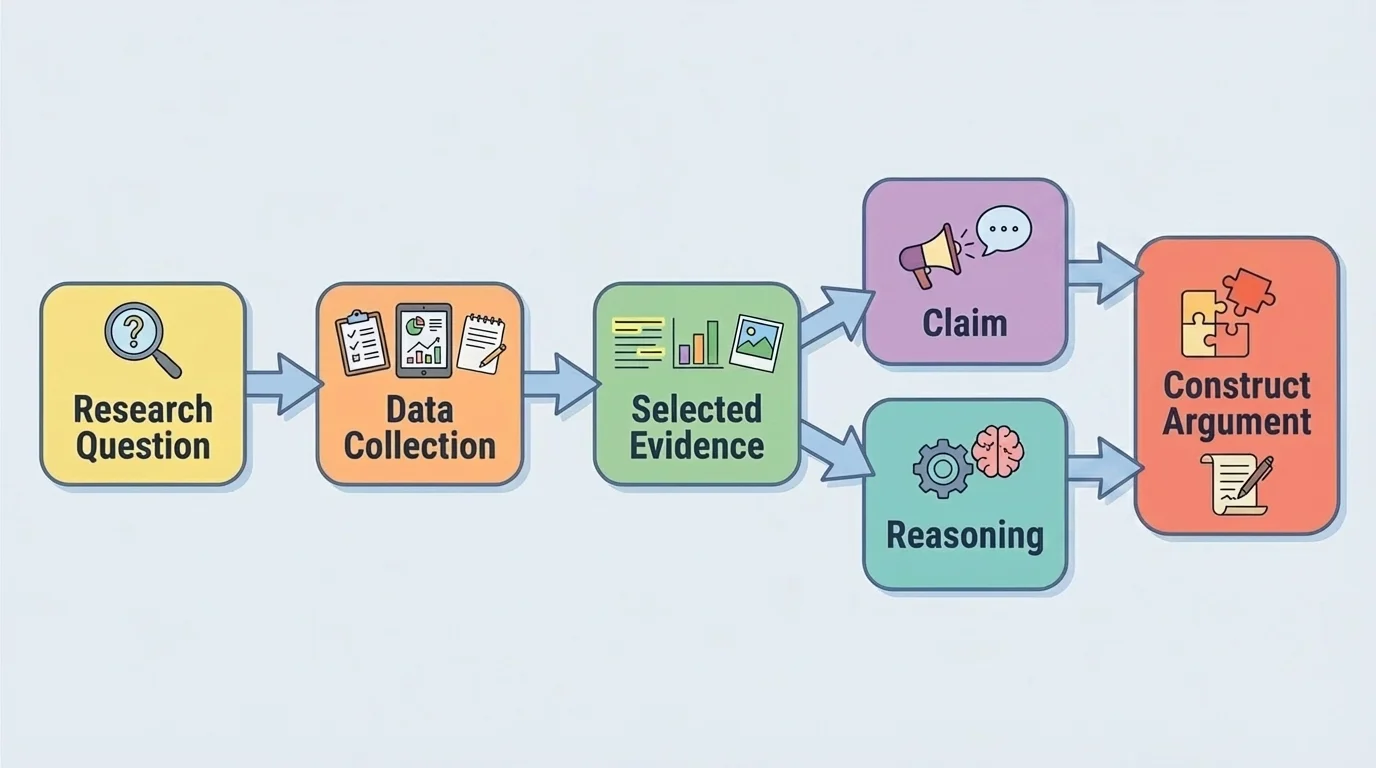
A strong academic argument usually includes three core parts: a claim, evidence, and reasoning. This framework is often called claim-evidence-reasoning (CER), and [Figure 1] shows how these parts connect from a question to a defended conclusion. The claim answers a question or states a position. Evidence consists of the facts, observations, measurements, or sources that support the claim. Reasoning explains why that evidence actually supports the claim.
It is important to separate data from evidence. Data are the raw observations or measurements collected during an investigation. Evidence is the specific data selected and interpreted to support a claim. For example, if students measure plant growth for three groups, the heights they record are data. If they then use those measurements to argue that one fertilizer increases average growth, the selected measurements become evidence.
Reasoning often uses scientific principles, logical rules, or background knowledge. Suppose an experiment shows that plants receiving fertilizer A grew, on average, more centimeters than plants without fertilizer. The measurements alone are not enough. You must explain that, because the plants were kept under the same light, water, and soil conditions, the difference in average growth is most reasonably linked to the fertilizer rather than another variable.
Another important term is claim. A claim should be clear and specific. "This method is better" is weak because it is vague. "Method A produces a higher average yield than Method B under the tested conditions" is stronger because it can be tested and defended.
Claim is a statement or conclusion that answers a question. Evidence is the relevant data, observations, or sources used to support that claim. Reasoning is the explanation that connects the evidence to the claim using logic, scientific ideas, or accepted principles.
Without reasoning, an argument becomes a pile of facts. Without evidence, it becomes unsupported opinion. Without a clear claim, it becomes a list of information with no conclusion.
Engaging in argument from evidence is not a single step. It is a process. First, a question or problem is identified. Then data are gathered from observations, experiments, surveys, texts, or other sources. Next, the quality of the data is examined. After that, a claim is made and justified. Finally, alternative claims are considered and the argument may be revised.
This process matters because evidence is rarely perfect. Measurements may vary. Sources may disagree. Experiments may contain limitations. A thoughtful student does not ignore these issues. Instead, the student asks whether the data are accurate enough, whether the source is trustworthy, whether the sample is large enough, and whether another explanation fits the data better.
In science, students often compare competing explanations. For example, if fish in a pond begin to die, one group may argue that fertilizer runoff caused oxygen levels to drop. Another may argue that an invasive species introduced disease. Both claims must be tested against evidence such as water chemistry data, species counts, timing of events, and observations of symptoms. The stronger argument is the one that best fits the complete set of evidence, not just the evidence that is convenient.
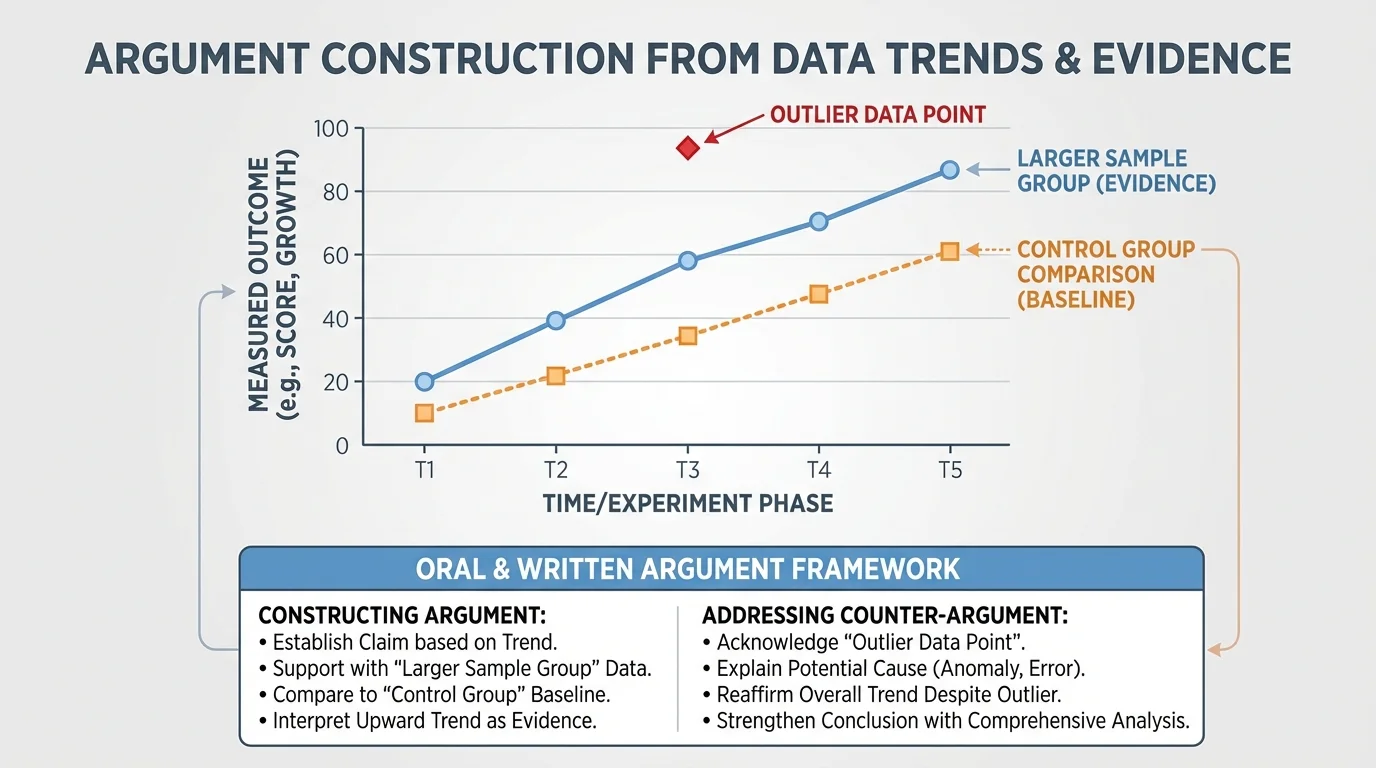
Good arguments depend on careful interpretation of data, and [Figure 2] illustrates why trends, outliers, and sample size matter. You should look for patterns such as increases, decreases, clusters, and repeated relationships. A single dramatic result may be interesting, but a repeated pattern across multiple trials is usually more convincing.
One major factor is sample size. If only two students are surveyed, the result may not represent the larger population. If 500 students are surveyed, the conclusion is generally more reliable. Larger samples reduce the chance that random variation creates a misleading pattern.
Another factor is the presence of a control variable and, in many studies, a control group. In an experiment, researchers try to keep certain variables constant so they can isolate the effect of one factor. If you test whether fertilizer affects plant growth, but one group gets more sunlight, your conclusion becomes weaker because the effect of sunlight was not controlled.
You also need to watch for outliers, which are data points that are far from the rest. An outlier may result from measurement error, unusual conditions, or a real but rare event. A strong argument does not simply erase an outlier. It asks whether there is a defensible reason to exclude it or whether it reveals something important.
Another key idea is the difference between correlation and causation. Correlation means two variables change together. Causation means one variable directly causes the other. If schools that start later have higher attendance, that is a correlation. To argue causation, you need stronger evidence showing that the later start time itself is responsible and not some other factor such as transportation changes, school funding, or community demographics.
Tables can help compare kinds of data evidence and what they can support.
| Type of information | What it can support | Common limitation |
|---|---|---|
| Experimental measurements | Cause-and-effect claims when variables are controlled | May not reflect real-world complexity |
| Survey results | Claims about opinions, behaviors, or trends | Responses may be biased or unrepresentative |
| Observational data | Patterns and possible relationships | Usually weaker for proving causation |
| Historical or published sources | Context, comparison, and expert support | Source credibility must be checked |
Table 1. Comparison of common types of information used as evidence and their limitations.
A tiny change in how data are graphed can make results look dramatic or almost invisible. That is why careful readers check the scale, labels, and sample size before accepting a conclusion.
When evaluating data, ask: Is the source trustworthy? Are the methods clear? Are the results consistent? Are enough data included? Are important limitations acknowledged? These questions help turn passive reading into active analysis.
A written argument usually begins with a clear thesis or claim. After that, it presents evidence in a logical order and explains how each piece of evidence supports the claim. Strong writing also anticipates questions from the reader. It avoids vague phrases like "obviously" or "everyone knows" because those phrases replace proof with assumption.
One useful structure is introduction, body, counterargument, rebuttal, and conclusion. In the body paragraphs, each paragraph should focus on one reason supporting the claim. Start with a topic sentence, provide evidence, explain the evidence, and connect it back to the larger claim.
Signal words help readers follow your logic. Words such as because, therefore, however, in contrast, and as a result show relationships between ideas. Clear transitions make an argument easier to evaluate because the reasoning becomes visible rather than hidden.
Example of a written claim and support
Claim: Later school start times improve student attendance.
Step 1: Present evidence
A district records a higher average attendance percentage after moving the start time later, while nearby districts with unchanged schedules show almost no change.
Step 2: Explain the reasoning
If the main schedule change is the later start time and attendance rises after the change, this supports the idea that students are better able to arrive on time and attend consistently.
Step 3: Address a limitation
The writer should still consider whether other changes happened at the same time, such as new transportation routes or attendance incentives.
The paragraph becomes stronger when it uses numbers precisely, names the comparison group, and acknowledges possible limitations.
Precision matters. If you say "attendance improved a lot," readers have to guess what "a lot" means. If you say attendance rose from one percentage to a higher percentage over one semester, readers can evaluate the claim more accurately.
Oral argument uses many of the same elements as written argument, but delivery matters more, and [Figure 3] illustrates how a speaker, visual evidence, and audience questions work together. In a presentation, you need a clear main claim, organized supporting evidence, and explanations that are easy for listeners to follow in real time.
When speaking, state your claim early. Then guide your audience through the evidence one piece at a time. Visual aids such as graphs, diagrams, and tables can help if they are simple and readable. A cluttered slide filled with text weakens communication because the audience does not know what to focus on.
Voice and pacing also matter. If you rush through numbers, listeners may lose the meaning. If you pause after presenting a key result, you give the audience time to connect the evidence to your claim. Eye contact, clear pronunciation, and confident posture increase credibility, but they do not replace evidence. Style supports substance; it cannot substitute for it.
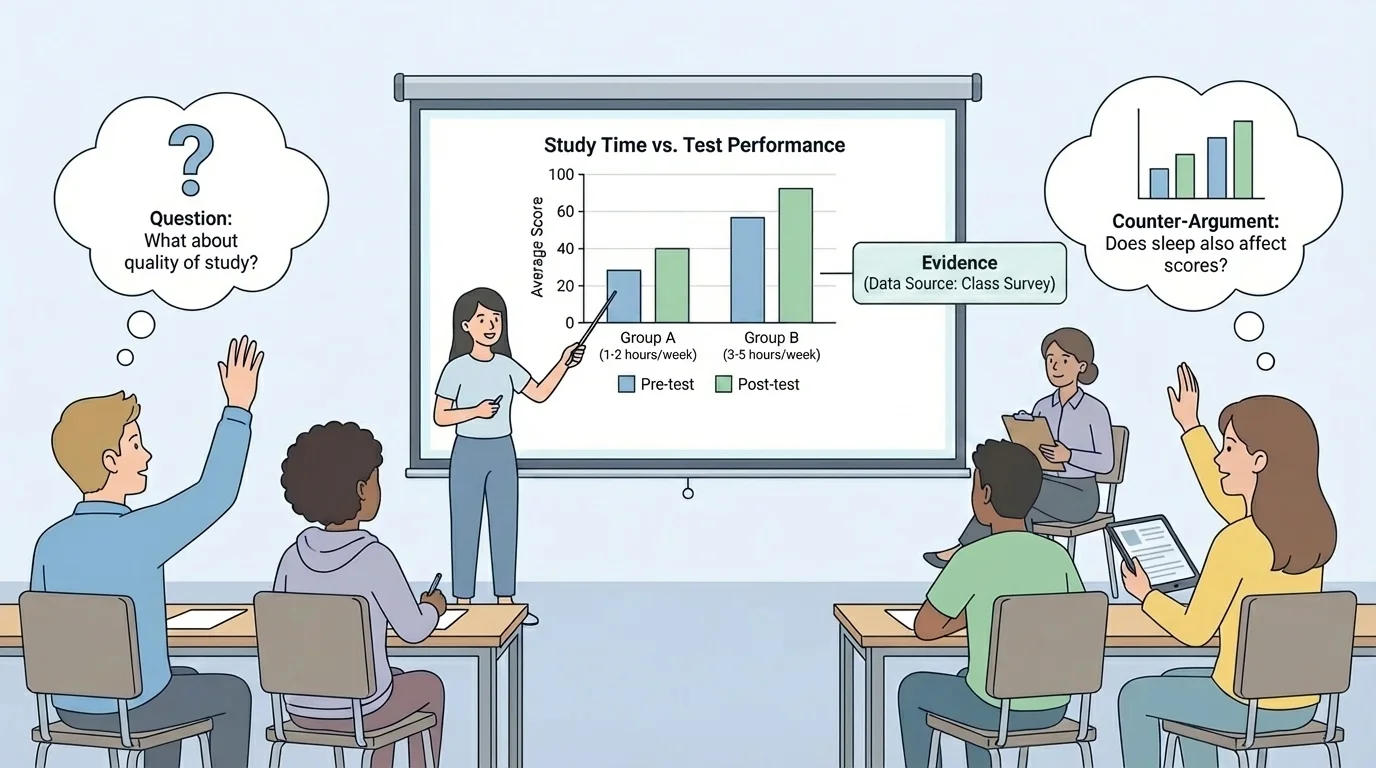
During an oral presentation, questions from the audience are not interruptions to fear. They are chances to demonstrate that your argument can withstand scrutiny. If someone asks about the sample size or an alternative explanation, answer directly and refer back to the evidence.
Later, when you compare speaking and writing, [Figure 3] remains useful because it reminds us that oral argument is interactive. Unlike an essay, a presentation often requires immediate defense of your reasoning.
A counterargument is an opposing claim or alternative explanation, and a rebuttal is the response that shows why your position remains stronger. In strong academic work, you do not ignore opposing views; you represent them fairly and answer them with evidence, as [Figure 4] demonstrates.
For example, suppose your claim is that a city should add more bike lanes because they reduce traffic congestion. A counterargument might say that bike lanes remove space for cars and could increase traffic. A good rebuttal would not mock that concern. Instead, it would examine traffic studies, compare before-and-after data from similar cities, and explain whether the evidence supports or weakens the concern.
The best rebuttals do one of three things: they show that the opposing evidence is weak, they show that the opposing claim does not explain all the data, or they show that your claim is better supported by a broader and more reliable set of evidence.
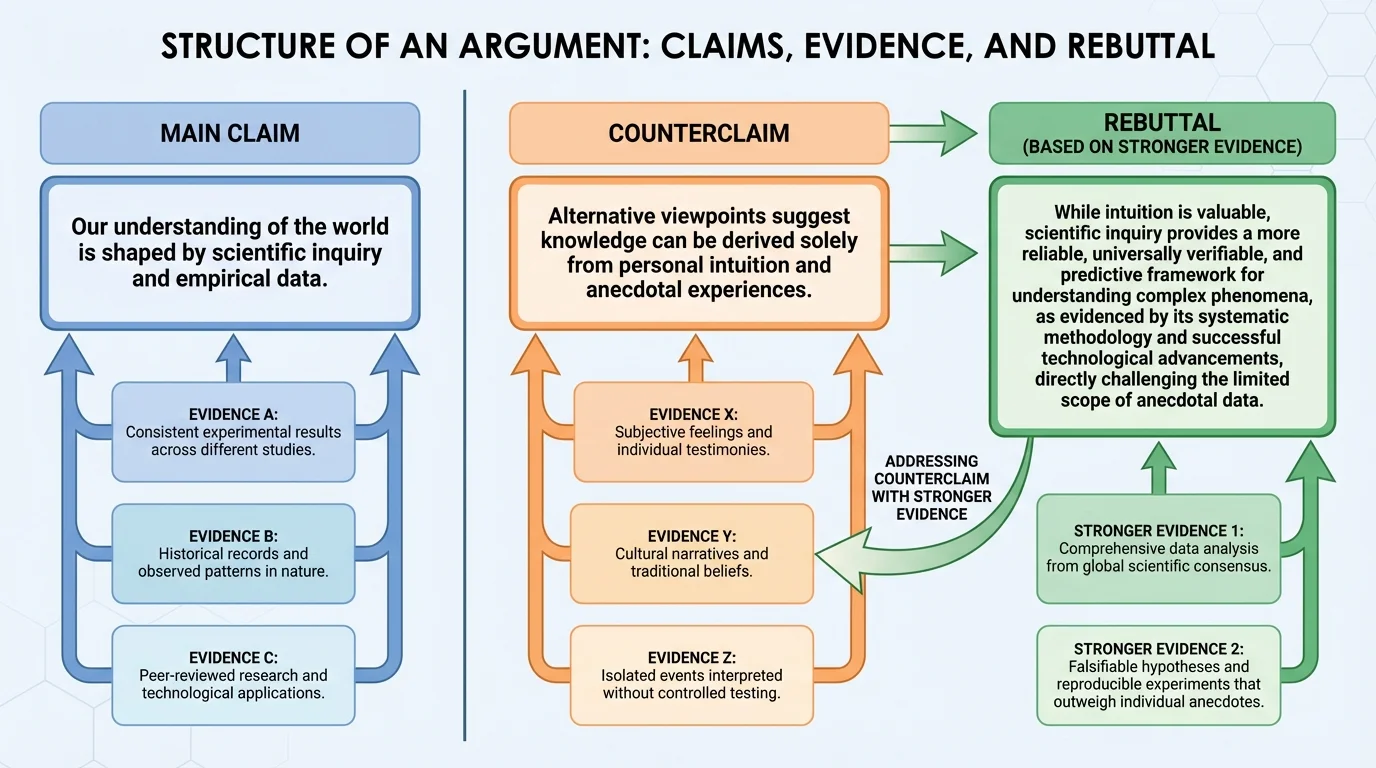
Counterarguments make your own argument stronger because they force you to test it. If your claim survives serious challenges, it becomes more credible. This is one reason scientific debate is productive: ideas improve when they are challenged with evidence.
Fairness in argument means stating the opposing view accurately before responding to it. Misrepresenting an opponent's claim may sound persuasive at first, but it weakens your credibility because it shows that you are arguing against an easier version of the issue rather than the real one.
Much later in a discussion, [Figure 4] still matters because the same pattern appears again and again: main claim, competing claim, evidence comparison, and reasoned rebuttal.
Consider a science investigation on fertilizer and plant growth. Three groups of identical plants are grown under the same light, soil, and water conditions. Group A receives no fertilizer, Group B receives fertilizer A, and Group C receives fertilizer B. After four weeks, Group A has the lowest average height, Group B a higher average height, and Group C the highest average height. A possible claim is that fertilizer B produces the greatest plant growth under the tested conditions. The evidence is the average height data across the three groups. The reasoning is that, because other important variables were controlled, the consistent difference in average height is most likely linked to the fertilizer type.
Now add a counterargument: perhaps the Group C plants were placed closer to a window. If that happened, the argument would weaken because the variable of light was not controlled. This example shows why careful method design matters before the argument is even written.
Consider another case from public health. Suppose a study finds that teens who sleep more hours per night perform better on memory tasks than teens who sleep less. That supports a claim that sufficient sleep is associated with stronger memory performance. But if you want to argue that sleep directly caused the difference, you must ask whether caffeine use, stress, or study habits also affected the results.
Even in daily life, evidence-based argument matters. If a social media post claims that a new energy drink boosts concentration, a critical reader should ask: What data support that claim? Who conducted the study? How many people were tested? Was there a control group? Was the improvement larger than what might happen by chance or expectation alone?
Case study: evaluating a claim from a graph
A news article claims that a city recycling program "dramatically reduced landfill waste." The graph shows landfill waste dropping from one year to the next.
Step 1: Identify the claim
The claim is that the recycling program caused the reduction in landfill waste.
Step 2: Examine the evidence
The graph shows a decrease, but one graph alone may not reveal whether population changed, whether industrial waste was counted differently, or whether another policy was introduced.
Step 3: Judge the argument
The evidence suggests a possible effect, but stronger evidence would include multiple years of data, comparison with similar cities, and details about other relevant changes.
This is a good reminder that evidence can support a claim to different degrees. Not every conclusion is equally certain.
The CER pattern from [Figure 1] appears in all of these cases. Whether the topic is plants, school policy, or public health, the same basic structure helps organize thought clearly.
One common mistake is cherry-picking, which means selecting only the evidence that supports your claim while ignoring evidence that complicates it. This creates a distorted argument. Strong arguers examine the full body of evidence, not just the convenient parts.
Another mistake is relying on weak sources. Anonymous posts, manipulated graphs, or articles without clear methods may be unreliable. Credibility improves when you use peer-reviewed studies, well-designed experiments, official data, and sources that explain how information was collected.
A third mistake is confusing confidence with proof. A statement said loudly is not automatically true. In fact, the most reliable arguments often include careful wording such as "the evidence suggests," "the data support," or "under these conditions," because honest thinkers recognize the limits of what their evidence can show.
Bias also affects argument. People often notice evidence that agrees with what they already believe and overlook evidence that challenges it. Being aware of bias helps you check your own reasoning. Ask yourself whether you would judge the evidence the same way if it supported the opposite conclusion.
From earlier work on experiments and source analysis, remember that reliability depends on clear methods, accurate measurement, and consistency. Those ideas do not disappear when you begin arguing; they become the foundation of a trustworthy argument.
The graph ideas in [Figure 2] connect directly to these mistakes. Misreading an outlier, ignoring sample size, or overstating a trend can turn a reasonable argument into a misleading one.
A strong argument is clear, relevant, sufficient, and logical. Clear means the claim is understandable. Relevant means the evidence actually relates to the claim. Sufficient means there is enough evidence to justify the conclusion. Logical means the reasoning connects the evidence to the claim without contradiction.
Strong arguments are also open to revision. If new and better evidence appears, a responsible thinker updates the claim. This is not weakness. It is intellectual honesty. Science advances precisely because arguments remain testable and revisable.
Finally, respectful argument matters. Presenting a counterargument fairly, responding with evidence instead of insults, and acknowledging uncertainty when necessary are signs of mature reasoning. In school, in science, and in public life, the most valuable arguments are not the ones that sound the strongest at first. They are the ones that remain standing after the evidence has been examined from every side.
