What if one tiny goal could make your whole day go better? A small goal like "I will put away my crayons after art time" can help you learn, stay calm, and show that you are responsible. Short-term goals are not giant, far-off dreams. They are small things you can do soon—today, tomorrow, or this week.
A short-term goal is something you want to do in a short time. It helps you focus on one job. When you reach a goal, you feel proud. Grown-ups also see that they can trust you with more things.
Short-term goal means a small, clear plan you can finish soon. It can be about learning something, making a good choice, or taking care of a job.
Short-term goals are helpful because they make big things feel easier. If you want to become a stronger reader someday, a short-term goal might be, "I will read for 10 minutes today." If you want to be more helpful, a short-term goal might be, "I will feed the pet with Mom after breakfast."
A goal is like a little path you can follow. You do not have to do everything at once. You just do the next small thing. That is why short-term goals work so well for kids. They are small enough to remember and simple enough to try.
Good short-term goals are clear. "Be better" is hard to understand. "Hang up my jacket after coming inside" is easier. You know exactly what to do.
Good short-term goals are also achievable. That means you can really do them. A goal should stretch you a little, but it should not feel impossible. If a goal is too big, you may feel upset and want to stop.
You can make goals for different parts of your life. The three big kinds are learning goals, behavior goals, and responsibility goals. [Figure 1] compares these goal types. These goal types are different, even though all of them help you grow.
A learning goal helps you learn something new or practice a skill. A behavior goal helps you make kind, safe, or calm choices. A responsibility goal helps you take care of your jobs, your things, or your space.
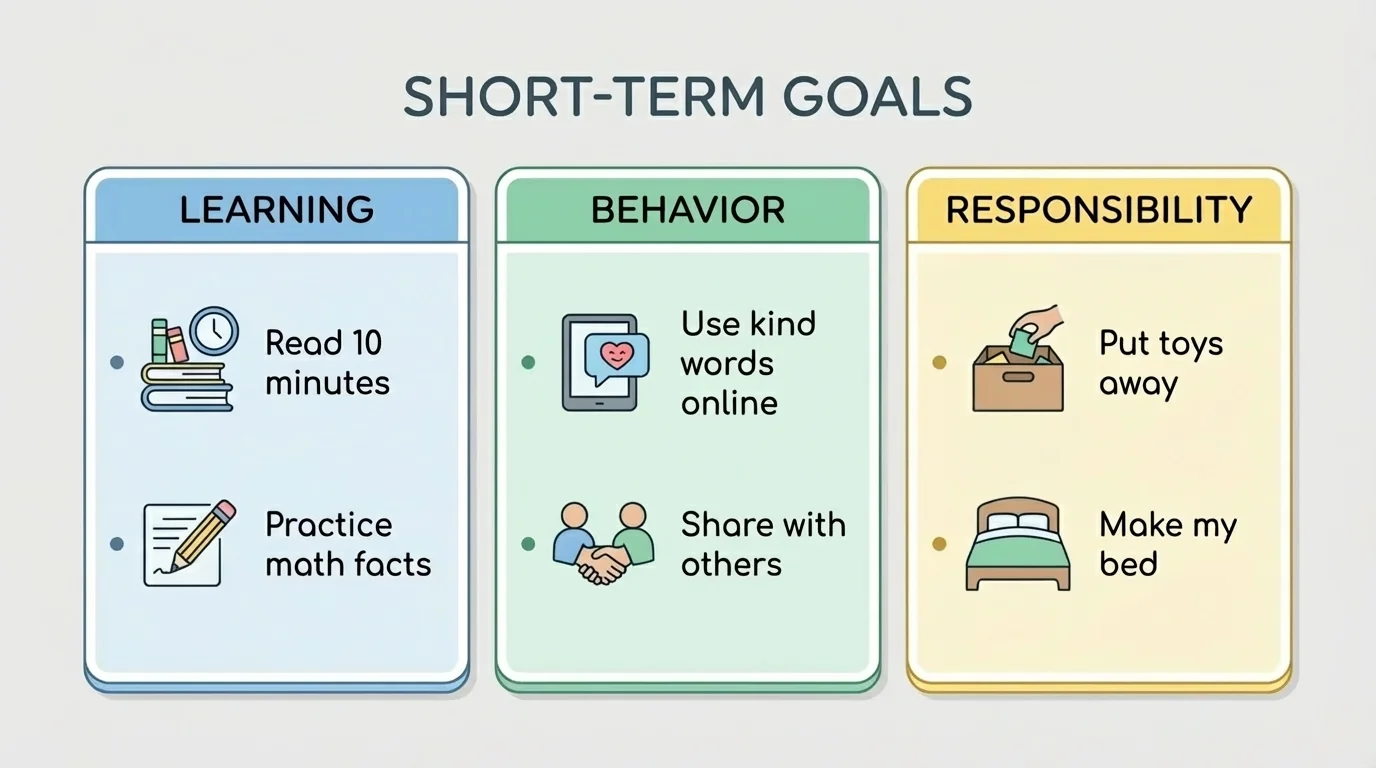
Here are some examples. A learning goal could be, "I will practice writing my name one time today." A behavior goal could be, "I will wait for my turn to talk during a video class." A responsibility goal could be, "I will put my cup in the sink after snack."
Each kind of goal matters. When you work on learning, you build your brain. When you work on behavior, you build strong friendships and self-control. When you work on responsibility, people learn they can count on you.
| Goal Type | What It Helps With | Example |
|---|---|---|
| Learning | Practicing a skill | Read one short story today |
| Behavior | Making a good choice | Use a calm voice on a call |
| Responsibility | Taking care of a job | Put books back on the shelf |
Table 1. Examples of three common kinds of short-term goals.
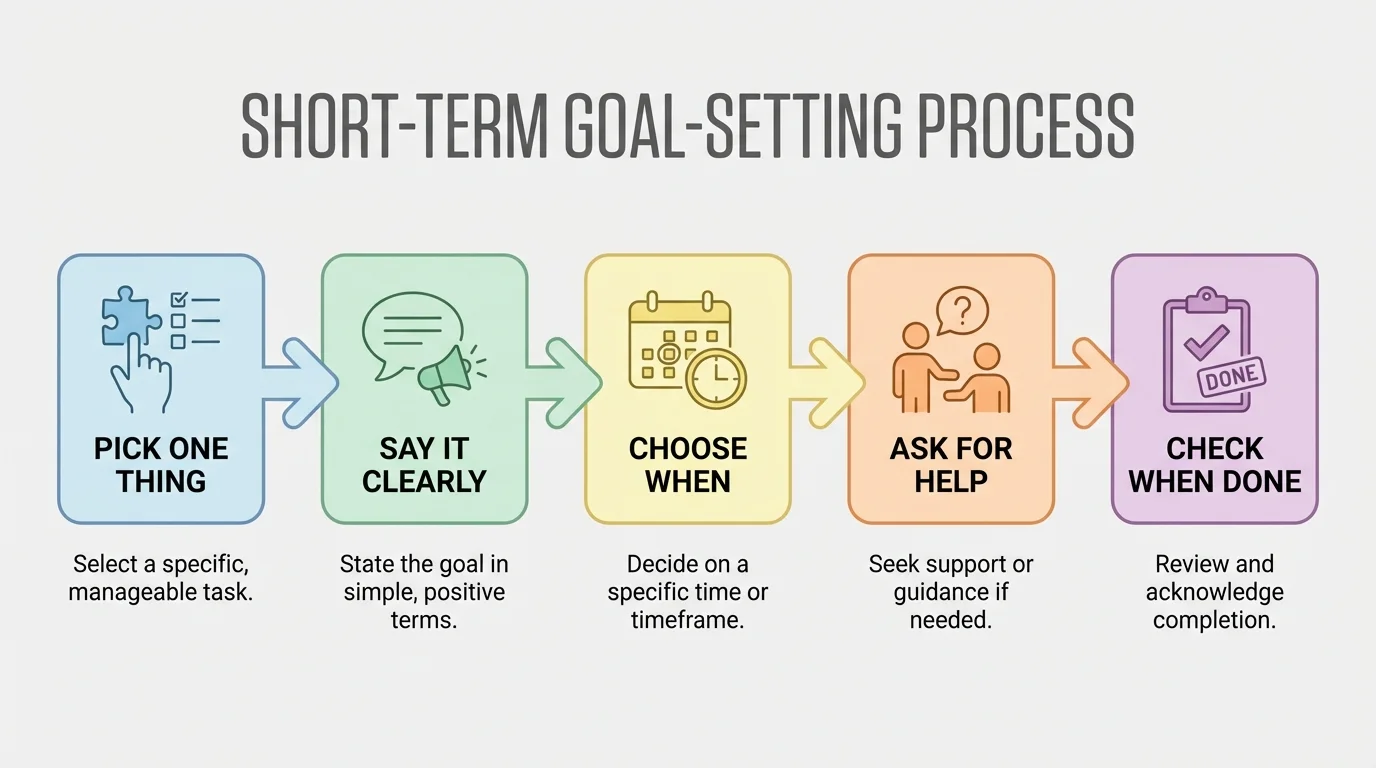
You can make your own goal by following a few easy steps. [Figure 2] shows the process in order. A strong goal starts small and clear. When you know exactly what you will do and when you will do it, reaching the goal is much easier.
Step 1: Pick one thing. Choose just one skill, one choice, or one job. Step 2: Say it clearly. Use simple words. Step 3: Choose when you will do it, like today, after lunch, or this week. Step 4: Think about help you might need, such as a reminder or a chart.
Making a goal
Let's turn a fuzzy idea into a clear short-term goal.
Step 1: Fuzzy idea
"I want to be better at cleaning."
Step 2: Pick one small job
Choose: putting toys in the bin.
Step 3: Add a time
"I will put my toys in the bin before dinner today."
Step 4: Add support
Ask a grown-up to remind you one time.
Now the goal is clear, small, and ready to do.
If your goal is too big, make it smaller. Instead of "I will always be neat," try "I will hang up my backpack today." Small goals are not too small to matter. They are smart goals.
Small wins help your brain feel ready for the next challenge. When you finish one short-term goal, it often feels easier to try another one.
It also helps to say your goal out loud. You can tell a parent, grandparent, or caregiver. Saying it aloud helps you remember it and makes it feel real.
Short-term goals can fit into many parts of your day. During online learning, a goal might be, "I will sit with my notebook ready before class starts." At home, a goal might be, "I will place my shoes by the door." With other people, a goal might be, "I will use kind words in my messages."
Here are more examples: "I will wash my hands before lunch." "I will finish one page of my reading work." "I will carry my plate to the counter." "I will look at the camera and listen when someone is speaking on a video call." These are all short-term goals because they are clear and can be done soon.
Why short-term goals matter
Short-term goals help you practice being the person you want to become. Every time you meet a small goal, you build habits. Habits make good choices easier the next time.
When goals go well, life often feels smoother. Your work gets done. Your room or learning space stays neater. People may remind you less. When goals do not go well, jobs can pile up, feelings can grow bigger, and you may miss chances to show what you can do.
Think about two children on the same day. One has the goal, "I will put my headphones back after class." The other forgets and leaves them on the floor. The first child finds the headphones quickly the next day. The second child wastes time looking for them. Small goals can save time and stress.
Sometimes a goal is easy to understand but hard to remember. That is why support tools matter. [Figure 3] shows simple tools that can help. A checklist, a timer, a sticker chart, or a note from a grown-up can help. These are simple ways to keep a goal in your mind.
You can also practice. These tools show simple ways to remember and practice a goal. If your goal is "I will greet people politely on video calls," you can practice saying, "Hi" and waiting quietly. If your goal is "I will clean up after snack," you can practice putting away one thing at a time.
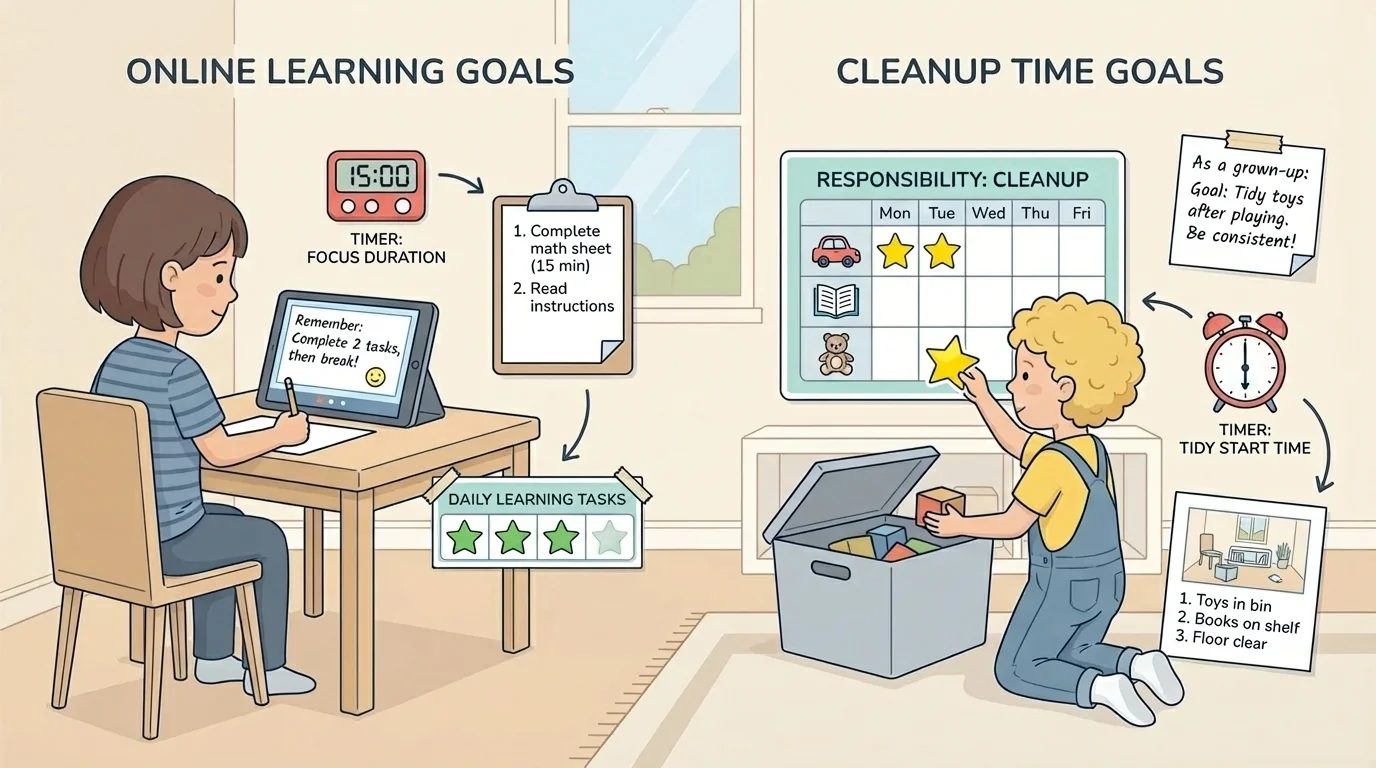
Another helpful tool is a routine. A routine means doing things in the same order. For example: log in, get pencil, open notebook, start work. When the order stays the same, your responsibility goal becomes easier to remember.
Later, when you think again about the three kinds of goals in [Figure 1], you can see that each kind may need a different helper. A learning goal may need practice. A behavior goal may need calm reminders. A responsibility goal may need a checklist near your learning space.
Helpful supports for one goal
Goal: "I will put dirty clothes in the basket every night this week."
Step 1: Put the basket where you can see it.
Step 2: Ask for a bedtime reminder.
Step 3: Check it off each night.
These supports make the goal easier to finish.
Sometimes a goal needs a little fix. That does not mean you failed. It means you are learning what works. If your goal was, "I will clean my whole room today," and that felt too hard, you can change it to, "I will put books on the shelf today."
A goal may also need more time. Maybe you are still practicing. That is okay. You can try again tomorrow or next week. The important thing is to keep the goal clear and small.
Trying again is part of learning. When something does not work the first time, you can stop, think, and make a better plan.
If you forget your goal, you can restart. If you make a poor choice, you can choose better next time. Goals are not about being perfect. They are about growing.
Small goals help build your future. A child who practices short-term goals learns how to plan, finish jobs, and take care of responsibilities. These are skills you will use for a long time.
Maybe today your goal is to close your markers after art. Later, your goals may be to finish homework on time, help care for a pet, or manage your own daily schedule. The little steps you take now help with the bigger steps later.
When you make a goal, work on it, and try again if needed, you are becoming stronger and more dependable. That means people can trust you more, and you can trust yourself too. The planning steps in [Figure 2] still help as your goals get a little bigger: pick one thing, say it clearly, choose when, and use support.
"Little by little, a little becomes a lot."
Your goals do not have to be fancy. They just need to be real, clear, and small enough to do. One good goal today can help make tomorrow a little better.
