Some online projects look successful from the outside, but behind the scenes many never make money, never gain real followers, and quietly disappear. The difference is usually not luck. It is planning. If you want to build a channel, newsletter, online store, tutoring service, design brand, or digital product, the smartest move is not to rush into posting or selling. It is to figure out whether people actually care, whether you can reach them, and whether your idea can grow without burning you out.
An online project can start small from your laptop or phone, but that does not mean it should be random. A strong plan helps you avoid wasting months creating content nobody wants, pricing something poorly, or trying to scale too early. It also helps you make better decisions when you feel excited, impatient, or discouraged. That matters in real life, because online ventures involve your time, your reputation, and sometimes your money.
Before doing research, get specific about what kind of project you want to build. A vague idea like "I want to make money online" is too broad to guide action. A better version sounds like this: "I want to create short study-help videos for overwhelmed high school students and sell a digital exam-prep guide," or "I want to offer beginner logo design for small gaming creators." Clear ideas are easier to test.
Your idea should answer three basic questions: Who is it for? What problem does it solve? How will you deliver the solution? If you cannot answer those yet, slow down and define them. For example, "busy students who struggle to organize assignments" is a group. "Late work and stress from poor planning" is the problem. "A digital planner template and weekly productivity tips" is the solution.
Digital venture means an online project built to create value for people through content, products, services, or community. Value proposition means the clear reason someone should pay attention to your project instead of ignoring it or choosing a competitor.
A strong value proposition is simple and useful. "I help beginner creators make clean, affordable thumbnails fast" is clearer than "I provide multimedia branding solutions." Online audiences decide quickly whether something feels relevant. If your message is confusing, they scroll away.
Try This: write one sentence using this pattern: "I help specific group solve specific problem by providing specific solution." If the sentence sounds broad, rewrite it until it feels concrete.
Market research is not just for large companies. It is the practical process of finding evidence about what people want, what already exists, and where your opportunity might be. Good research follows a path from clues to decisions, as [Figure 1] shows. You gather information, organize patterns, and use those patterns to shape your offer instead of guessing.
Start by looking at competitors or similar creators. Search your idea on YouTube, TikTok, Instagram, Etsy, Substack, podcasts, or Google, depending on your project. Do not only count followers. Study what they actually do. What topics get the most engagement? What complaints show up in comments? What products or services seem popular? What is missing?
Read reviews and comments carefully. If people keep saying things like "This course was too advanced," "I wish this came with templates," or "The advice was helpful but too expensive," those are useful signals. They tell you where people are frustrated and where you may be able to improve.
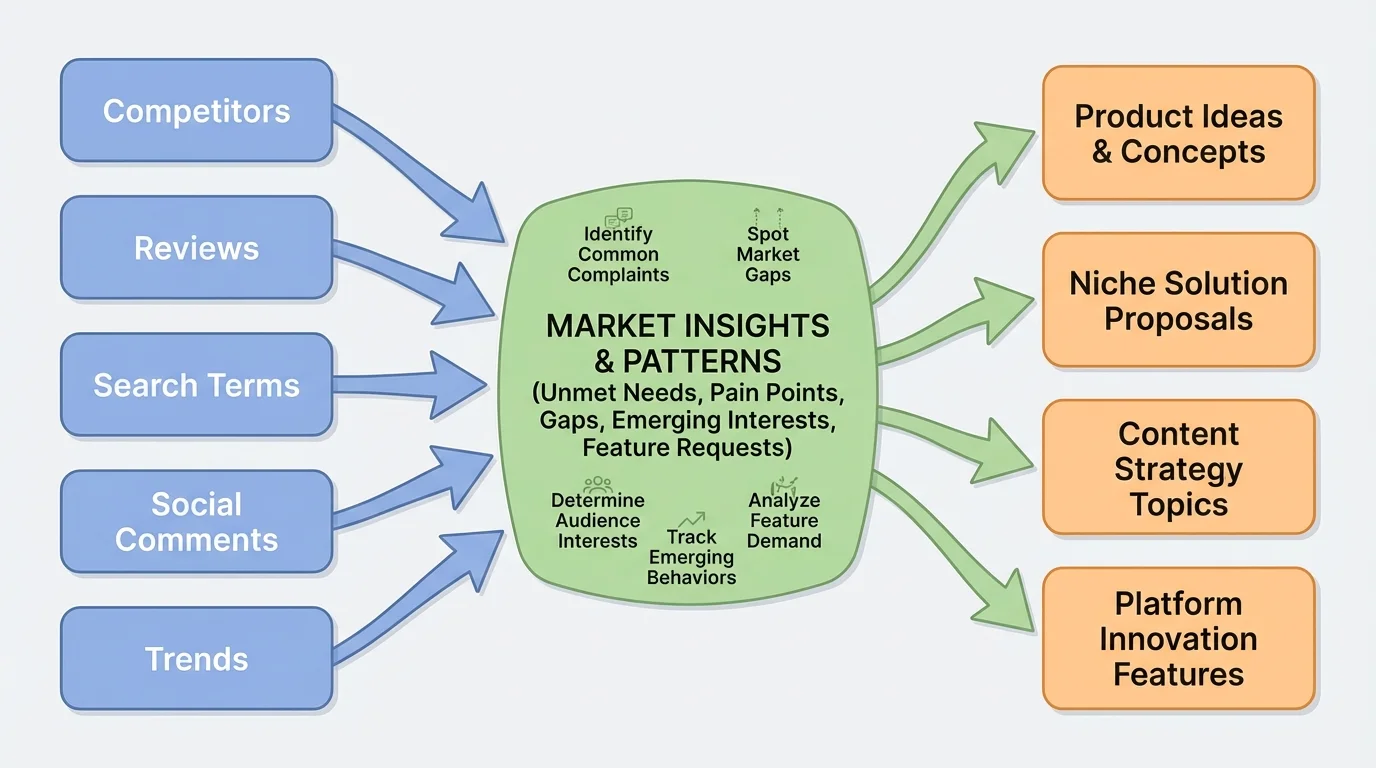
You can also use search behavior as a clue. If people regularly search "how to start a study blog," "cheap photo presets," or "planner template for teens," that suggests interest. Search suggestions, trending hashtags, forum posts, and frequently asked questions all help you spot demand. One search result does not prove a market, but repeated patterns matter.
Look for three kinds of evidence: attention, frustration, and spending. Attention means people are already watching, reading, or clicking. Frustration means they still have unmet needs. Spending means some people are already paying for solutions. When all three appear together, the opportunity is usually stronger.
Be careful with fake signals. A topic can look popular but still be hard to monetize. For example, lots of people may watch funny edits, but that does not automatically mean they will buy anything. On the other hand, a smaller audience with a serious need may be more valuable. A student who wants cheap wall art may browse casually, while a local business owner who needs a logo may be ready to pay soon.
A project with only a few hundred loyal followers can outperform a project with thousands of passive followers. Trust and need often matter more than raw audience size.
Later, when you compare possible offers, return to the research path in [Figure 1]. The point is not to copy competitors. It is to understand the market well enough to make smarter choices.
[Figure 2] Your target audience is the specific group you want to help or reach. It should be narrow enough to feel real, not so broad that it could mean almost anyone. "People who use the internet" is useless. "High school students who want better note-taking systems for online courses" is much more useful.
Think about your audience's goals, struggles, habits, and preferred platforms. What are they trying to achieve? What slows them down? Where do they spend time online? What kind of content do they save or share? When are they most likely to spend money? These details shape everything from your platform choice to your prices.
One helpful tool is a simple audience profile. You are not trying to stereotype people. You are creating a realistic picture of the kind of person your project serves best. You can include age range, schedule, budget, common frustrations, and what success looks like for them.
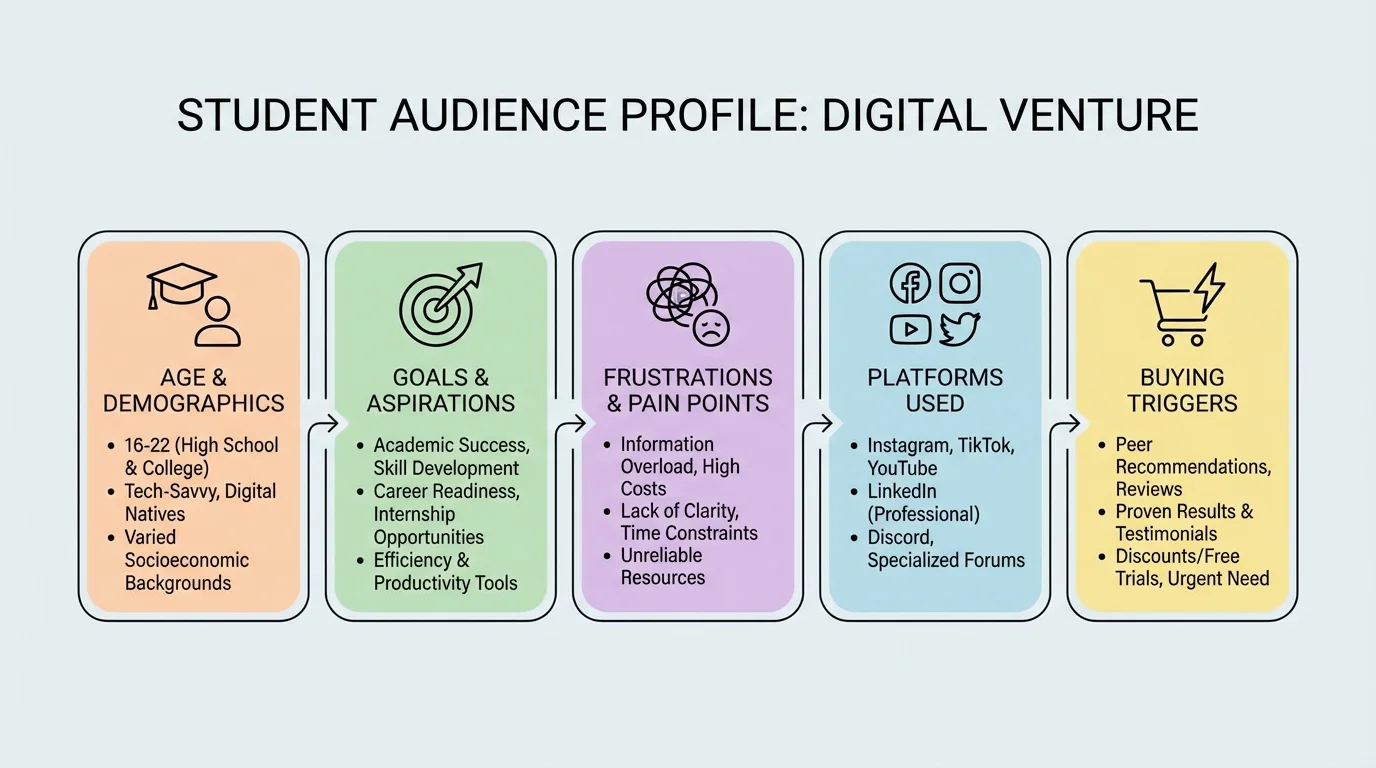
For example, if your venture is a digital planner brand, your audience might be students ages 15–18 who feel overloaded by deadlines, use TikTok and Pinterest for productivity ideas, prefer low-cost downloads, and want tools that look clean and simple instead of corporate or boring.
The more clearly you understand your audience, the easier it becomes to write captions, choose products, and avoid wasting effort. If your content feels like it is meant for everyone, it often connects with no one. Specificity builds relevance. That is why the audience profile in [Figure 2] matters so much when you start planning actual posts and offers.
[Figure 3] A content strategy is your plan for what you will publish, where you will publish it, and what each piece of content is supposed to accomplish. Good content does not exist just to "stay active." It moves people from noticing you, to trusting you, to taking action.
Think of content in three roles. First, discovery content helps new people find you. This includes short videos, searchable blog posts, carousels, clips, or useful threads. Second, trust-building content shows your knowledge, personality, reliability, and results. Third, conversion content invites people to join your email list, sign up for a waitlist, book a call, download a product, or buy something.
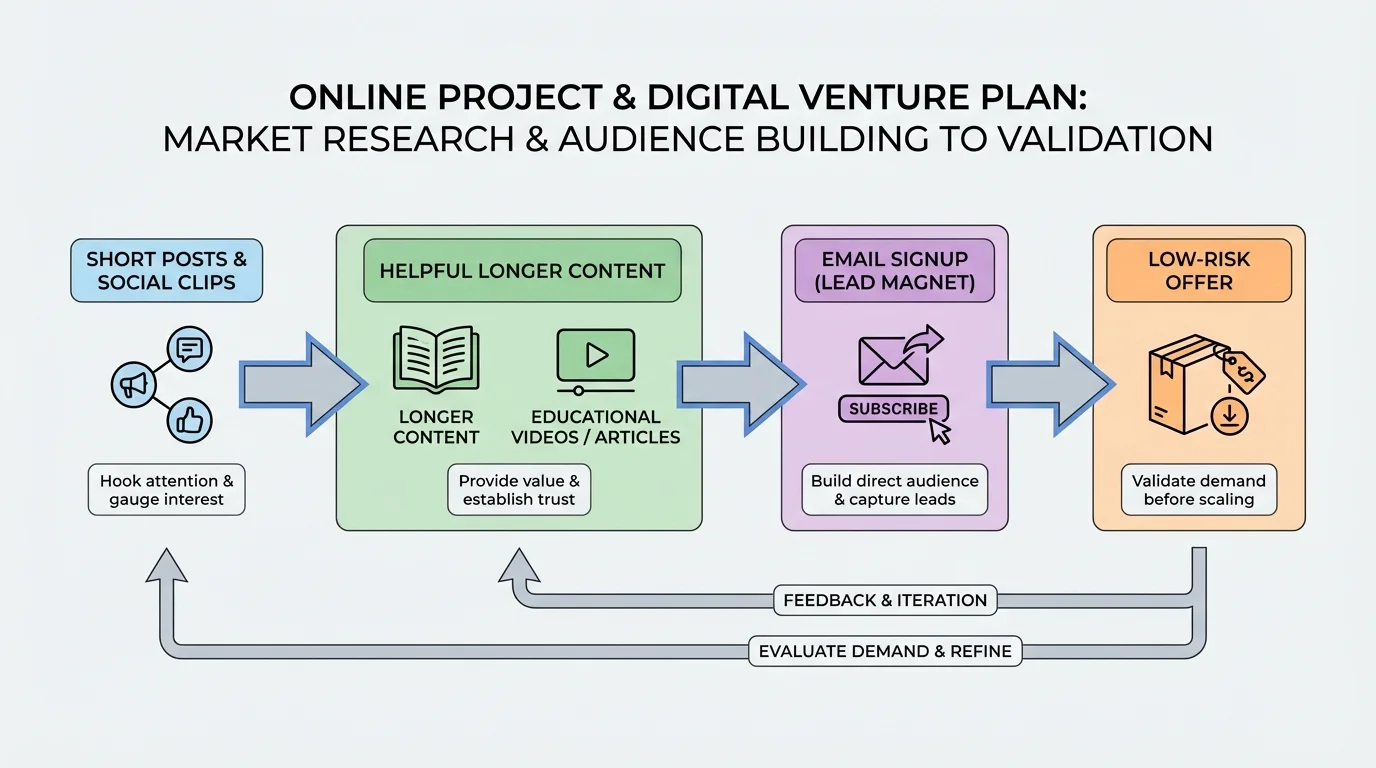
If you only post sales messages, people tune out. If you only post entertaining content with no clear direction, people may enjoy it but never take the next step. A balanced strategy includes value, clarity, and a gentle path forward.
Choose platforms based on where your audience already spends time and what type of content you can realistically make consistently. A student who enjoys video and can edit quickly may focus on TikTok or YouTube Shorts. Someone who likes writing and explaining ideas may prefer a blog or email newsletter. A visual creator may grow faster on Instagram, Pinterest, or a portfolio site.
You do not need to be everywhere. One well-run platform usually beats five neglected ones. Consistency matters more than constant posting. If you can only create two solid posts each week, plan around that instead of promising daily content and quitting after a week.
| Content Type | Main Goal | Example |
|---|---|---|
| Discovery | Reach new people | Short video: "3 ways to stop missing deadlines" |
| Trust-building | Show useful expertise | Carousel with a real planning system and explanation |
| Conversion | Encourage next action | Post linking to a free checklist or waitlist |
Table 1. Three common roles of content in an online venture.
Try This: pick one platform and plan one week of content using the three roles in Table 1. If every post has the same goal, your strategy is probably incomplete.
Audience building means attracting people who are likely to care about your work and giving them reasons to stay connected. This is different from chasing random views. A large audience that does not trust you or need your offer is not very useful.
One of the best ways to build an audience is to be genuinely helpful. Solve small problems publicly. Answer common questions. Share mistakes and what you learned. Show examples. People often follow creators who make confusing things easier. Reliability creates credibility.
It also helps to build a connection you control, not just one rented from a social platform. Social apps can change algorithms at any time. An email list, private community, or repeat customer base is more stable. Even a small list matters if the people on it truly care about your work.
Why trust beats hype
Online attention can be fast, but trust usually grows through repeated positive experiences. When people see clear advice, honest communication, and useful results over time, they become more willing to subscribe, recommend you, or buy from you. Hype may get clicks once; trust brings people back.
Audience growth also depends on interaction. Reply to comments when possible. Ask useful questions. Notice what people save, not just what they like. Saved posts, repeat visits, email opens, replies, and shares often matter more than vanity numbers.
Be realistic about your schedule. If you are balancing coursework, responsibilities at home, and maybe a part-time job, your audience strategy has to fit your real life. A simple system that you can sustain beats an ambitious plan you abandon.
Monetization means turning the value you create into income. The right model depends on what you make, how your audience behaves, and how much time you can commit.
Common monetization options include digital products, services, affiliate links, ads, sponsorships, subscriptions, memberships, and donations. A digital product could be a template, guide, mini-course, preset pack, or printable. A service could be tutoring, editing, design work, social media help, or coaching in a skill you know well. Affiliate income comes from recommending products and earning a commission if someone buys through your link.
Each model has trade-offs. Services can earn money faster, but they depend heavily on your time. Digital products can scale better, but they often require more testing before they sell consistently. Ads usually need a larger audience. Sponsorships depend on trust, brand fit, and audience quality, not just follower count.
A good early question is this: what would one customer be worth, and how many customers could you realistically get? If you sell a $12 study template and you estimate that only about 10 people per month will buy at first, that gives you about $120 per month before any fees. If you offer a $40 tutoring session and book 5 sessions, that gives you about $200. Simple math like this helps you compare ideas without overcomplicating things.
Comparing two early monetization options
A student creator is deciding between selling a digital planner and offering one-on-one study coaching.
Step 1: Estimate planner revenue
If the planner costs $10 and about 15 people buy it in a month, revenue is \(10 \times 15 = 150\).
That is about $150.
Step 2: Estimate coaching revenue
If one coaching session costs $25 and the creator books 8 sessions, revenue is \(25 \times 8 = 200\).
That is about $200.
Step 3: Compare time demands
The planner may take more setup time once, while coaching requires live time for every sale. Revenue is only one part of the decision.
This comparison shows why monetization choices should include both income potential and workload.
The best first model is often the one that is simple, ethical, and closely tied to the problem your audience already wants solved.
[Figure 4] Before you spend more money, build a full website, or create a giant content library, test whether people actually want your offer. This is called demand validation. Evidence should guide the decision, not just excitement.
You can test demand in small, low-risk ways. Examples include a waitlist form, a preorder page, a pilot version, a free sample that leads to a paid upgrade, or a short survey sent to interested followers. The goal is not perfection. The goal is to learn whether people care enough to click, sign up, reply, or pay.
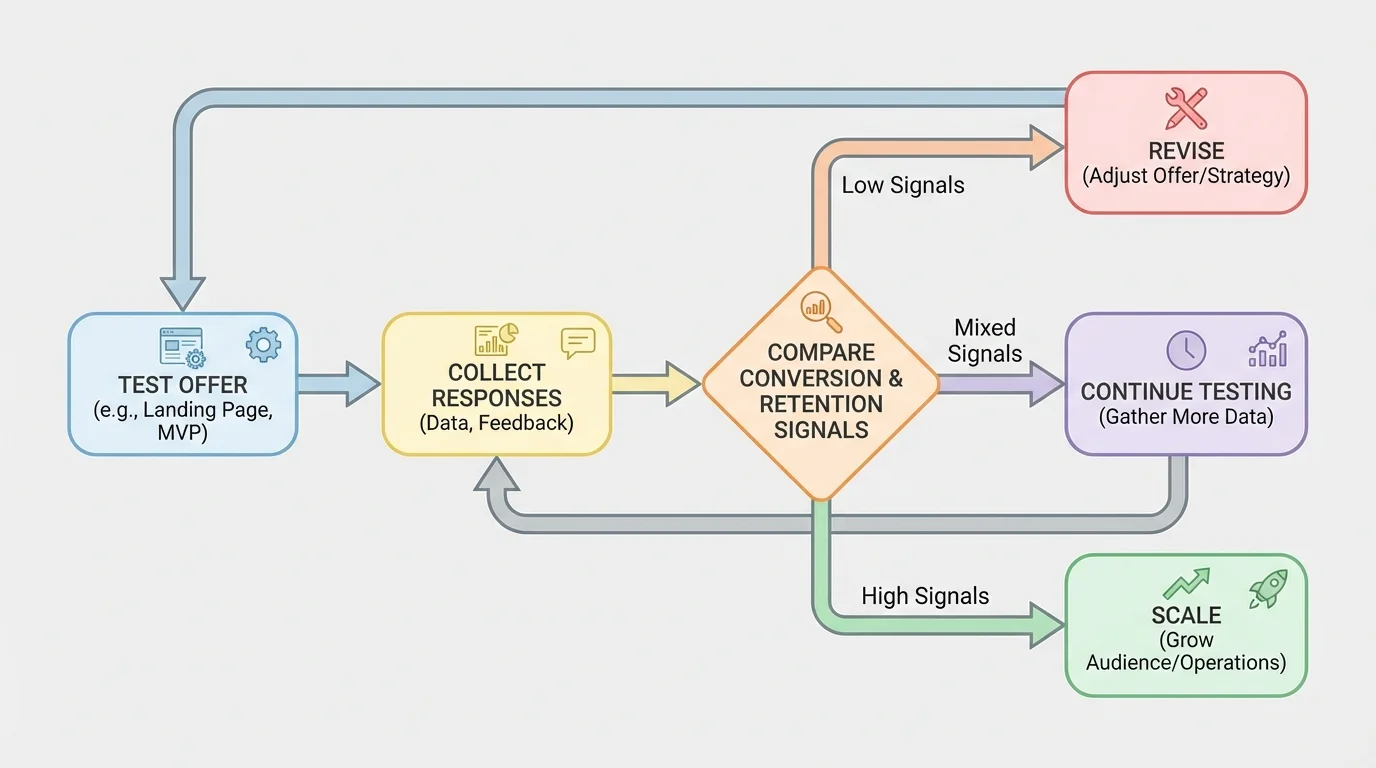
A useful early version of your offer is often called an minimum viable product, or MVP. That means the simplest version that still delivers real value. Instead of building a 60-page guide, you might test a 10-page starter guide. Instead of launching a full course, you might test one live workshop. Instead of creating a giant shop, you might release one product first.
Watch for strong signals. Are people signing up without being pushed? Are they opening your emails? Are they replying with questions? Are some willing to pay? Are they satisfied enough to come back or recommend you? If the answer is mostly no, revise before scaling.
You can track simple numbers to stay grounded. For example, if 200 people see your offer and 20 join the waitlist, that is a sign-up rate of \(\dfrac{20}{200} = 0.10\), or \(10\%\). If 20 join the waitlist but only 2 buy, then the buy rate from the waitlist is \(\dfrac{2}{20} = 0.10\), or \(10\%\). These numbers are not magic answers, but they help you compare tests honestly.
Small tests protect your time and money. Launching bigger does not fix weak demand. If a simple version does not interest people, a larger version often creates a larger disappointment.
When you revisit your results, the path in [Figure 4] helps you decide whether to revise the message, improve the offer, test a different audience, or move forward carefully.
Scaling means growing your venture in a way that increases reach, sales, or impact without your systems falling apart. Scaling sounds exciting, but it only makes sense when you already have signs of demand.
Good reasons to scale include repeated sales, strong feedback, clear audience growth, and a process you can repeat. Bad reasons include boredom, ego, pressure from social media, or copying someone else's timeline. Scaling too early can lead to stress, refund requests, missed deadlines, and a damaged reputation.
Before scaling, check your systems. Can you deliver what you promise on time? Can you answer customer questions? Do you understand your costs? If you suddenly doubled your orders, would quality drop? A venture that grows faster than its systems often creates problems instead of success.
Scaling can mean different things: posting more strategically, improving your website, increasing ad spend, launching a second product, automating part of your workflow, or collaborating with other creators. The right move depends on what the evidence shows.
You also need to think about safety and responsibility. Protect your passwords. Use strong privacy settings. Be careful with contracts, payment platforms, and sharing personal information. If your venture involves customers, keep communication honest and clear. Overpromising might get attention in the short term, but it hurts trust fast.
"Start small enough to learn fast, but serious enough to learn something real."
That idea is powerful because online projects reward learning loops. Small experiments tell you what to improve. Responsible scaling happens after those lessons, not before them.
Suppose you want to launch a digital venture selling simple note-taking templates for students in online courses. Here is what a practical plan might look like.
Case study: student note-template venture
Step 1: Define the offer
The creator helps students who struggle to organize notes by offering clean, low-cost digital templates plus short productivity tips.
Step 2: Research the market
The creator studies top note-taking videos, reads comments about what students dislike, and notices repeated complaints about cluttered layouts and complicated systems.
Step 3: Build audience content
The creator posts short videos on study mistakes, carousel posts on note structure, and a free sample template linked in a profile bio.
Step 4: Validate demand
A waitlist for a full template pack gets 60 sign-ups. A preorder test at $8 gets 12 buyers.
Step 5: Review the numbers
Preorder revenue is \(8 \times 12 = 96\), so the first test earns about $96. The preorder rate from the waitlist is \(\dfrac{12}{60} = 0.20\), or \(20\%\).
Step 6: Decide what to do next
Because people signed up and some paid, the creator improves the product, asks buyers for feedback, and then considers scaling with better content and a second template pack.
This plan works because it uses evidence at each stage instead of assuming demand.
You can adapt that same approach to almost any digital venture: art commissions, tutoring, editing, coding help, a niche newsletter, a small online shop, or social media services. The tools may change, but the logic stays the same: solve a real problem, research the market, know your audience, publish useful content, choose a fitting monetization model, test demand, and scale only when the signs are strong.
Try This: create a one-page venture plan with these headings: problem, audience, platform, content, offer, price, test, and success signals. If you cannot fill in one of those headings clearly, that is a sign you need more research before launching.
