You have $10 and spot two things you like. One is a bright little toy that looks fun for a short time. The other is a sturdy water bottle you can use again and again. Both cost money, but they do not give you the same help. Learning how to choose is part of growing up and using money wisely.
Every time you spend money, you make a choice. A smart choice is not always the cheapest one, and it is not always the most exciting one. A smart choice is the one that fits your purpose and gives good value for the money you spend.
Money is limited. If you spend it all on one thing, you may not have enough for something else later. That is why even small choices matter. Buying a snack, a game, art supplies, or a gift all use money that could be used in other ways.
When you make careful choices, your money can do more for you. You may get something that lasts longer, helps you more, or keeps you from needing to buy the same thing again soon. When choices are rushed, you might end up with something you barely use.
Small money choices add up. If you spend $2 five times, that is $10 altogether because \(2 + 2 + 2 + 2 + 2 = 10\).
That means learning to compare simple spending choices is a real-life skill. You can use it with allowance money, birthday money, or money you help spend with a trusted adult.
Value is about how helpful, useful, or lasting something is for the money you spend, as [Figure 1] shows. Sometimes two things cost the same, but one is used many times and the other is used only once. The one you use more often may have better value.
Purpose means the reason you are buying something. Are you buying it because you need it for drawing, staying hydrated, or replacing something broken? Or are you buying it just because it looks cool right now? Knowing the purpose helps you decide better.
Value means how much help, use, or enjoyment you get for the money you spend.
Purpose means the reason you are buying something.
If your purpose is to carry water every day, a strong water bottle has clear value. If your purpose is to have a small treat, then a sticker or snack might fit. The best choice depends on what the money is for.
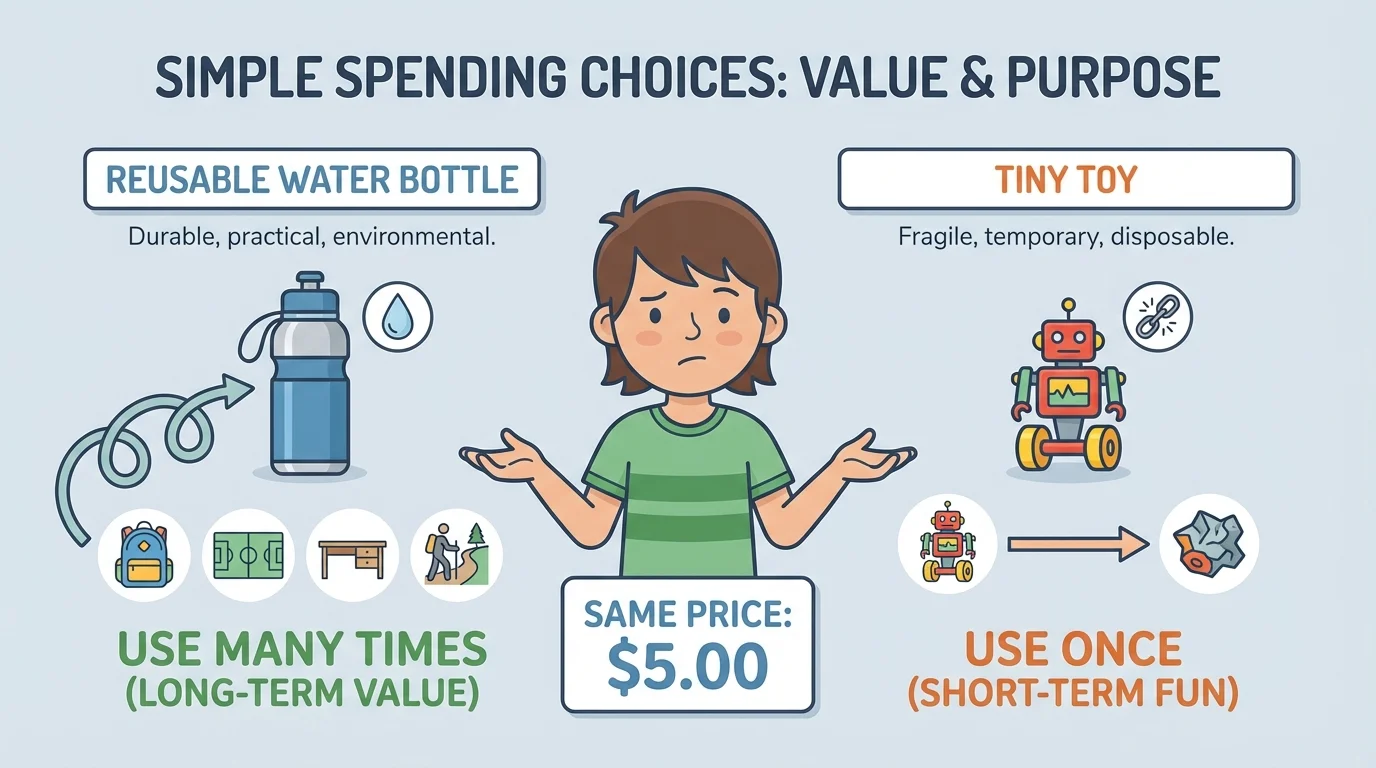
A good spender does not just ask, "Do I want this?" A good spender also asks, "What is this for?" and "Will this be worth the money?"
Before spending money, stop and ask yourself three smart questions. These questions help you slow down and think clearly.
First: What is it for? This checks the purpose. If your headphones broke and you need them for online lessons or music time, buying new ones may make sense. If you already have working headphones and just want a second pair because of the color, that may be less important.
Second: How much does it cost? You need to know if you can afford it. If you have $8 and the item costs $12, you cannot buy it yet. You would need $4 more because \(12 - 8 = 4\).
Third: Will I use it a lot? Things that are used often can have better value than things used once and forgotten.
Good value is not always the lowest price. A cheaper item may break quickly. A slightly more expensive item may last longer and be used many more times. When that happens, the second item can be the better choice.
This does not mean you should always choose the pricier thing. It means you should look at usefulness, durability, and purpose together.
Some spending choices are about needs. Needs are things that help take care of daily life, health, safety, or learning. Other choices are about wants. Wants are things that are fun or enjoyable but not necessary right away.
A notebook for writing stories, a replacement lunch container, or glue for a project may be more likely to be a need. A squishy toy, a second pack of stickers, or a game add-on may be more likely to be a want.
Wants are not bad. It is okay to spend on fun things sometimes. The important part is knowing what kind of choice you are making. That helps you decide if now is the best time to spend.
| Choice type | What it is like | Example |
|---|---|---|
| Need | Important for daily use | Replacing broken headphones |
| Want | Fun, but not necessary | Glow-in-the-dark stickers |
| Special treat | A fun choice you plan for | A small toy bought with saved money |
Table 1. A simple comparison of needs, wants, and special treats.
Sometimes a want can still be a good choice if you planned for it, saved for it, and truly enjoy it. Purpose still matters. A birthday gift for a friend has a kind purpose. A craft kit you will use many times may have better value than candy you finish in one day.
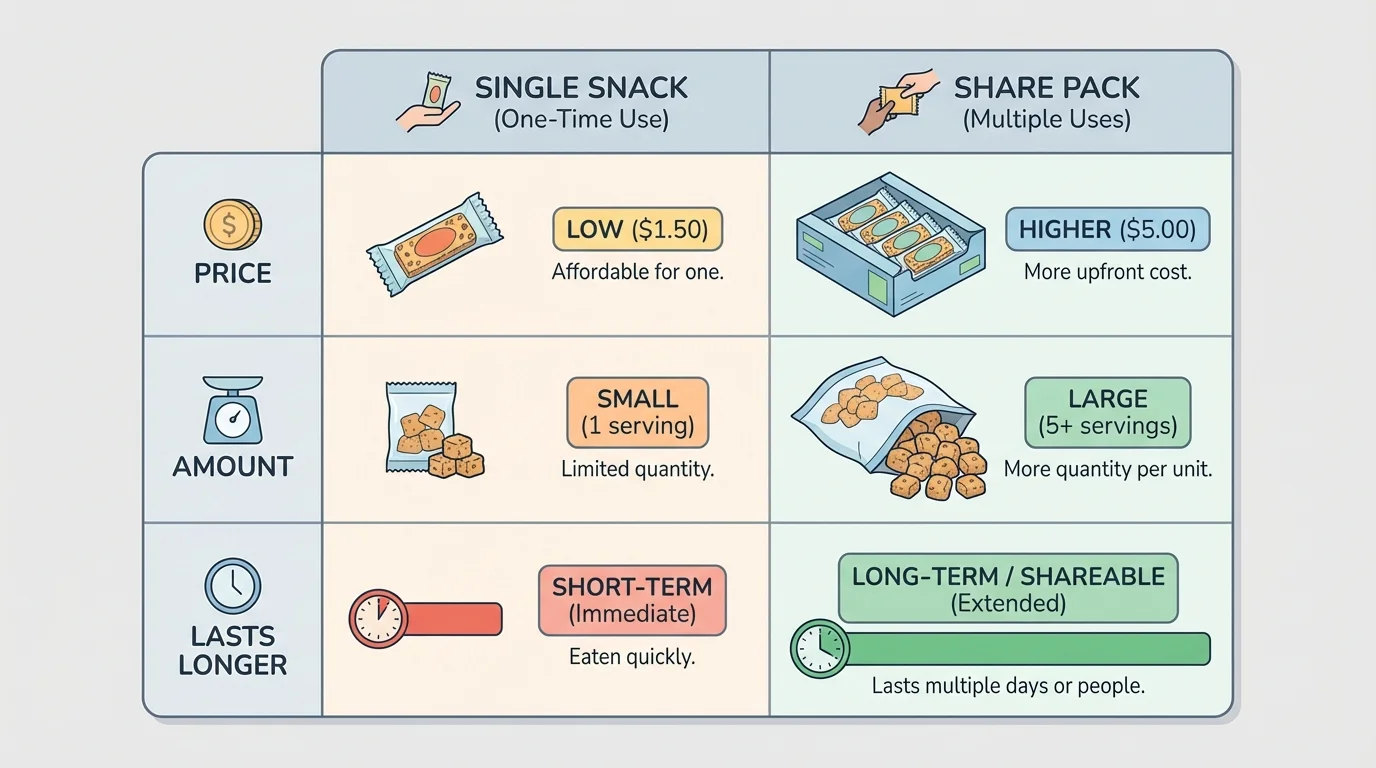
When you compare two choices side by side, you can notice details more easily, as [Figure 2] illustrates. You can compare price, amount, how long it lasts, and how much use you will get from it.
Here are some simple things to compare: cost, size, quality, number of uses, and whether you really need it now.
Example: Two snack choices
You have $6. You can buy one small snack for $3 or a bigger snack pack for $5 that lasts for two snack times.
Step 1: Compare the prices.
The small snack costs $3. The bigger pack costs $5.
Step 2: Compare how long each lasts.
The small snack is gone after one time. The bigger pack lasts for two times.
Step 3: Think about value.
If you will really use both servings, the bigger pack may have better value because it lasts longer.
The better choice depends on your purpose. If you need something small right now, the $3 snack may fit. If you want something that lasts longer, the $5 snack pack may be better.
Now think about art supplies. A thin marker set costs $4 but dries out quickly. A stronger set costs $6 and lasts much longer. If you draw every week, the stronger set may be the better value. This is like the comparison in [Figure 2], where the longer-lasting choice can help your money go further.
Comparing does not have to be hard. You are simply noticing which choice matches your reason for buying and gives more help for the money.
One common mistake is choosing only by looks. Something may be shiny, colorful, or trendy, but that does not always mean it is useful or worth the price.
Another mistake is buying too fast. When people rush, they may forget to check the price or think about whether they already own something similar.
A third mistake is ignoring how long something lasts. A cheap item that breaks in one day may not be a good deal after all.
You already know how to compare things by size, number, and use. Spending choices work the same way. You look carefully, notice differences, and then make a choice.
A better choice often comes from pausing, checking, and asking questions. You do not need to be perfect. You just need to think before spending.
[Figure 3] A simple order of questions can help you make careful choices every time. This keeps you from buying only because you feel excited in the moment.
Use these steps when you are deciding what to buy.
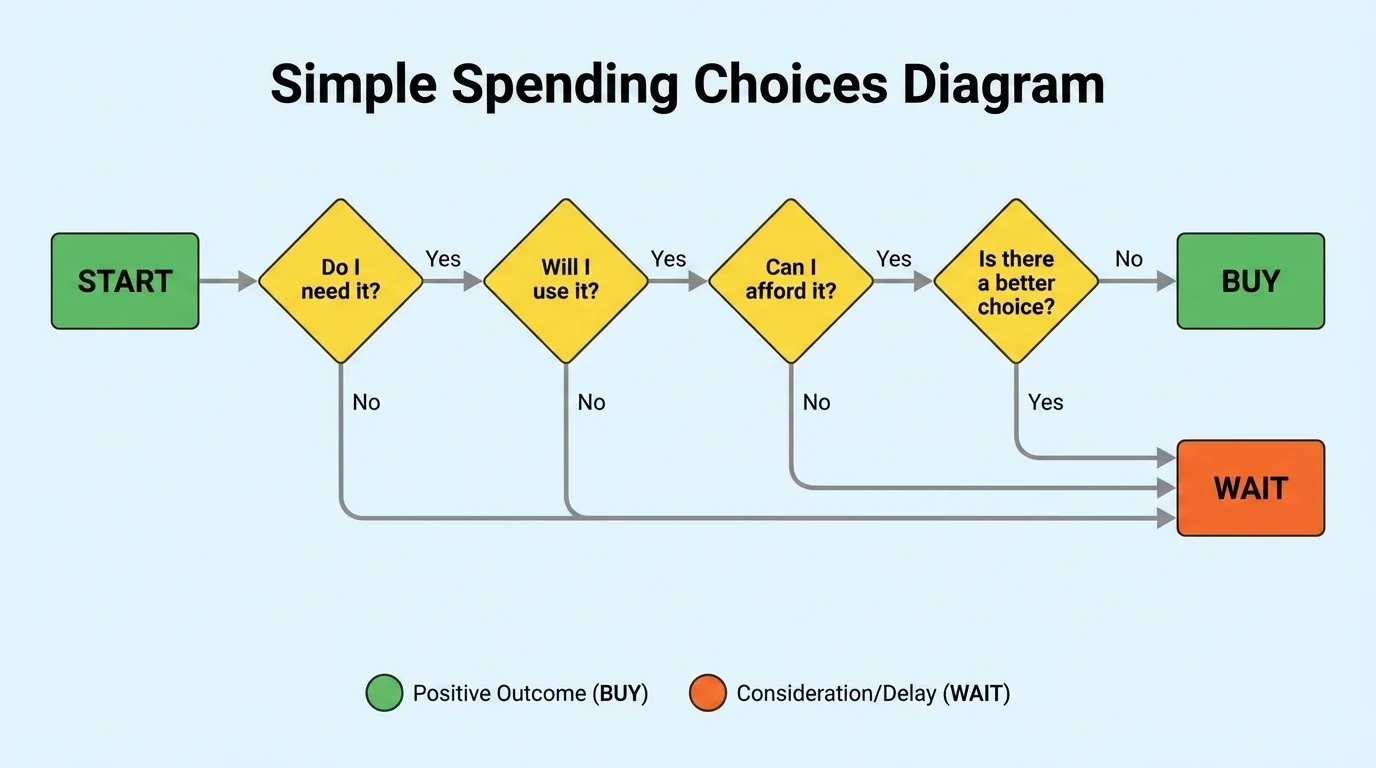
Step 1: Name the item. Say exactly what you want to buy.
Step 2: State the purpose. What is it for?
Step 3: Check the price. Make sure you know the cost.
Step 4: Ask if you can afford it. If you have $9 and the item costs $7, you can afford it and would have $2 left because \(9 - 7 = 2\).
Step 5: Compare it with another choice. Is there something cheaper, stronger, or more useful?
Step 6: Decide whether to buy now or wait. Waiting can be smart if you are unsure.
Example: Buying a game accessory
You have $15. One game accessory costs $15. A notebook and gel pens together cost $11 and will be used for drawing all week.
Step 1: Look at purpose.
The game accessory is mostly for fun right now. The notebook and pens are for a hobby you use often.
Step 2: Compare cost.
The first choice uses all your money. The second choice leaves $4 because \(15 - 11 = 4\).
Step 3: Compare value.
If you draw often, the notebook and pens may give more use over time.
That does not make the game accessory a bad choice forever. It just may not be the best choice today.
Following the order in [Figure 3] helps you stay calm and thoughtful. Good spending choices are usually slow choices, not rushed choices.
You might use this skill when spending birthday money, choosing a snack at a store, picking supplies for a hobby, or deciding whether to save for something bigger.
Suppose you have $20. You can buy four tiny toys at $5 each, because \(5 + 5 + 5 + 5 = 20\). Or you can buy one soccer ball for $18 and still have $2 left because \(20 - 18 = 2\). If you will play with the ball for many weeks, the ball may have better value than four tiny toys that break fast.
Suppose you want a gift for a grandparent. A handmade card may cost very little and serve a thoughtful purpose. A small plant may cost more but last longer. The better choice depends on your money, your reason, and what the person would enjoy.
Example: Save or spend?
You have $9 and want a toy that costs $14.
Step 1: Find how much more you need.
You need $5 more because \(14 - 9 = 5\).
Step 2: Decide if the purpose is important enough to wait.
If you really want it and will use it often, saving may be a smart plan.
Step 3: Think about other choices.
There may be a different toy for $9 or a better item to save for.
Sometimes the best spending choice is not buying yet.
That is a powerful skill. You are still making a choice, even when the choice is to wait.
Good money habits start small. Check the price. Think about the purpose. Compare choices. Ask if you will use it often. These simple habits can help you for many years.
If you are unsure, ask a trusted adult questions like, "Which one do you think has better value?" or "Do you think I should wait?" Talking about money choices can help you learn.
"Spend with a plan, not just with a feeling."
You do not need to buy the perfect thing every time. What matters is learning to notice the difference between a quick want and a thoughtful choice. That is how you become a careful, confident spender.
