Think about your breakfast. Maybe you ate toast, fruit, or cereal. Before that food reached you, many people helped: someone grew it, someone packed it, someone drove it, someone sold it, and someone made sure the store stayed clean and safe. A community is a lot like that breakfast: many people doing different kinds of work so daily life can happen.
A community is a group of people who live, work, and help one another in the same place or in connected places. Your community can include your neighborhood, your town, local parks, libraries, stores, clinics, and online groups where people work together to help others.
People in a community have different needs. They need food, water, homes, roads, health care, safety, communication, and places to get help. No single person can do all of that alone. That is why communities depend on many kinds of work and service.
Work is the effort people do to make, fix, grow, move, or help with something people need.
Service is work that helps people directly, such as teaching, delivering mail, caring for patients, or collecting trash.
Community helper is a person whose job or actions help other people in a community.
Some people make things. Some people fix things. Some people care for people. Some people protect places. Some people carry goods from one place to another. All of these jobs matter.
Workers are connected, and each job supports another job, as [Figure 1] illustrates. A doctor helps patients, but the doctor also depends on people who clean the clinic, make medicine, build the building, keep the lights working, and deliver supplies. A grocery worker helps families buy food, but that worker depends on farmers, drivers, repair workers, and people who manage computers and payments.
This connection is called interdependence. Interdependence means people rely on one another. In a strong community, different workers do different parts of the job of helping everyone live safely and well.
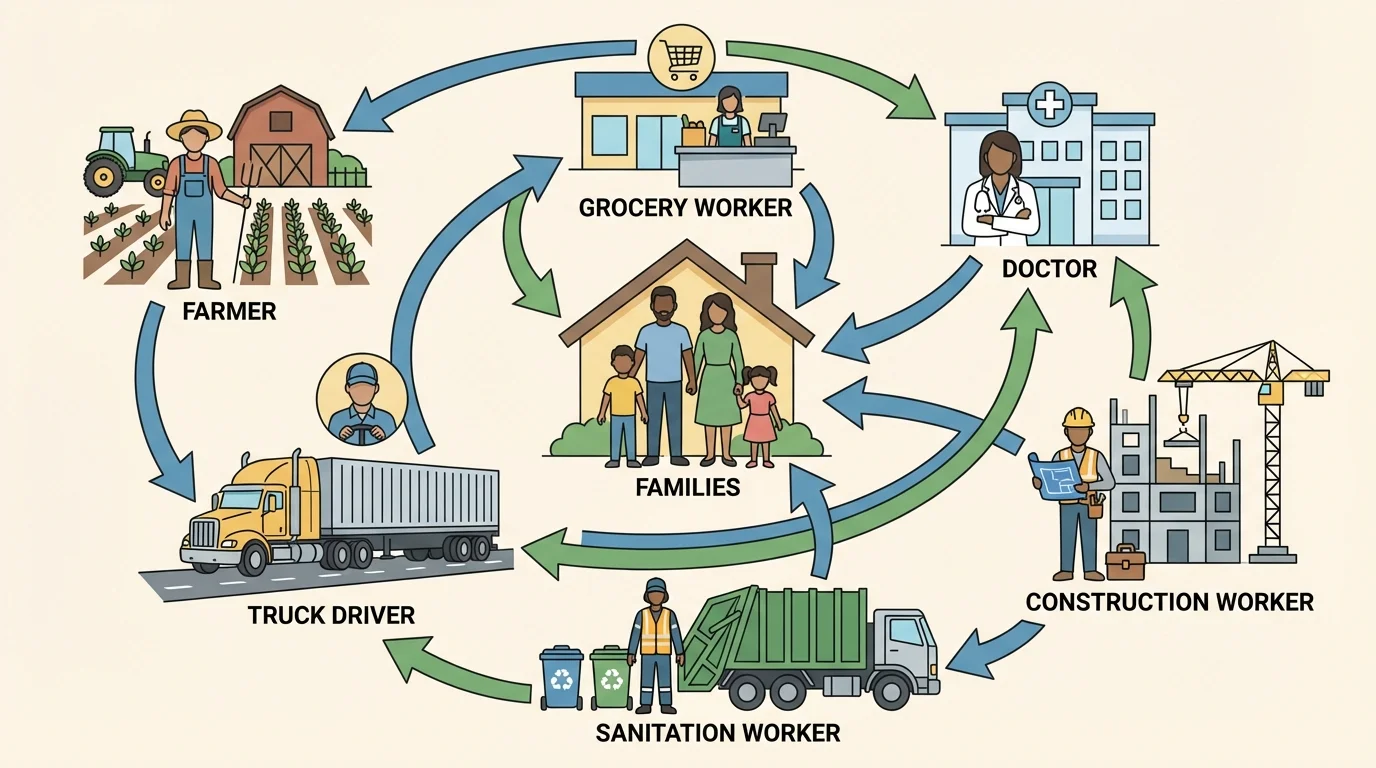
If one part of the chain breaks, other parts can be affected too. For example, if roads are not repaired, delivery trucks may be delayed. If trucks are delayed, stores may get food late. If food arrives late, families may not find what they need. One job can affect many others.
Many jobs you may not notice right away are still very important. If repair workers, internet technicians, or sanitation crews stop working, people quickly see how much those jobs matter.
This is one reason every kind of honest work deserves respect. A community needs many people with many skills, not just one kind of worker.
There are major groups of jobs in a community. Some jobs help with food, some with health, some with safety, some with building and fixing, some with transportation, and some with keeping places clean and connected, as [Figure 2] shows.
Here are some examples:
| Type of work | What workers do | Examples |
|---|---|---|
| Food work | Grow, make, move, and sell food | Farmers, bakers, cooks, store workers |
| Health work | Help people stay well | Doctors, nurses, dentists, pharmacists |
| Safety work | Protect people and respond in emergencies | Firefighters, police officers, crossing guards, dispatchers |
| Building and repair work | Build and fix homes, roads, and tools | Construction workers, plumbers, electricians, mechanics |
| Transportation work | Move people and goods | Bus drivers, truck drivers, delivery workers, pilots |
| Cleaning and care work | Keep places healthy and usable | Custodians, sanitation workers, recycling workers |
| Communication work | Help people share information | Mail carriers, internet technicians, reporters |
Table 1. Examples of different kinds of work and service that support a community.
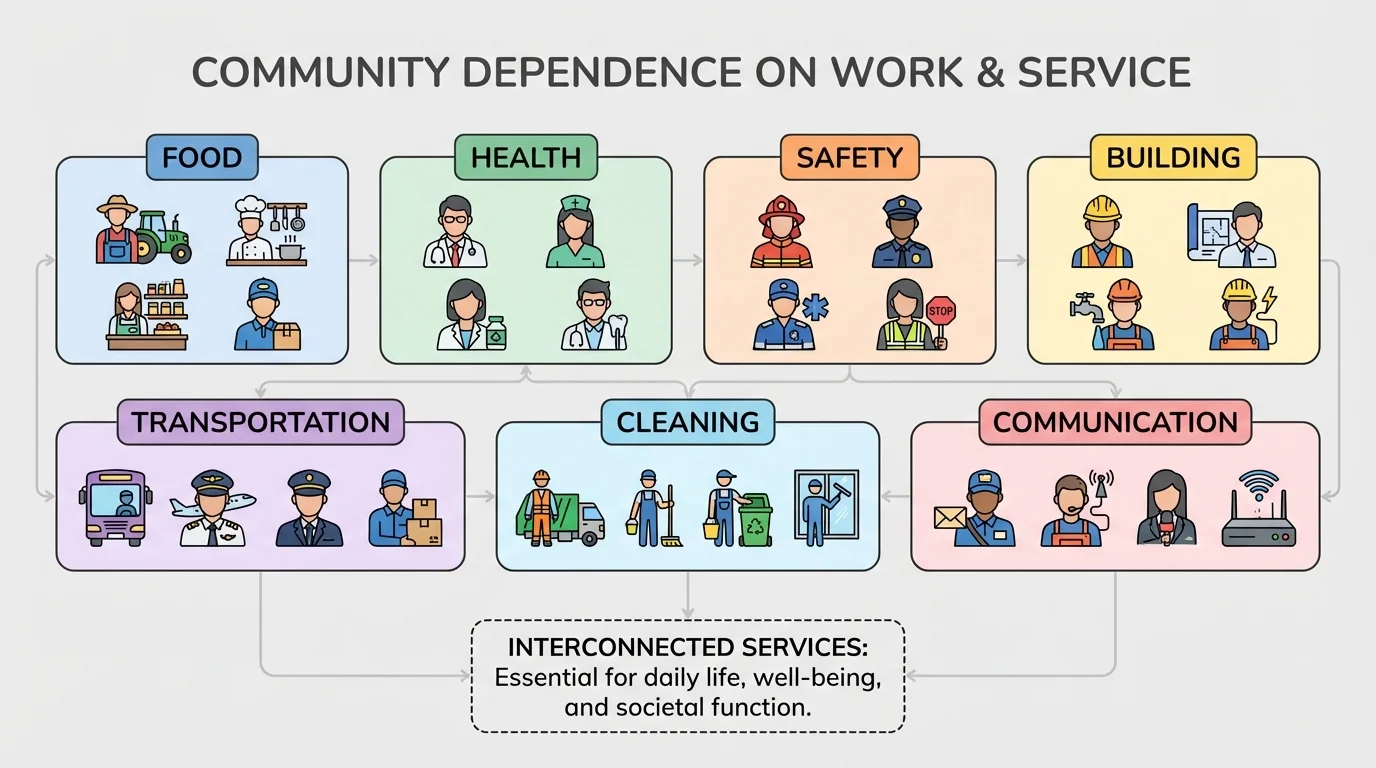
Food work helps people eat every day. A farmer may grow vegetables. A worker at a packing center may sort them. A driver may take them to a store. A store worker may place them on shelves. A cashier may help families buy them.
Health work helps people feel better and stay safe. Doctors and nurses care for patients. Pharmacists prepare medicine. Reception workers help people check in. Cleaning workers keep health spaces sanitary.
Safety work helps in emergencies. Firefighters respond to fires and rescues. Dispatchers answer emergency calls and send help. Police officers work to protect people and property. Other workers make sure warning systems and roads are ready when needed.
Building and repair work keeps the community working. Electricians help keep lights on. Plumbers help water flow correctly. Mechanics repair vehicles. Construction workers build homes, playgrounds, and stores.
Cleaning and care work is sometimes overlooked, but it is essential. Sanitation workers collect trash. Recycling workers help sort materials that can be used again. Custodians clean buildings so people can use them safely.
When you look around your area, you can often spot these jobs in action. Even if you do not see each worker, their help is still there. Clean water, safe roads, stocked stores, and working internet all come from people doing important jobs.
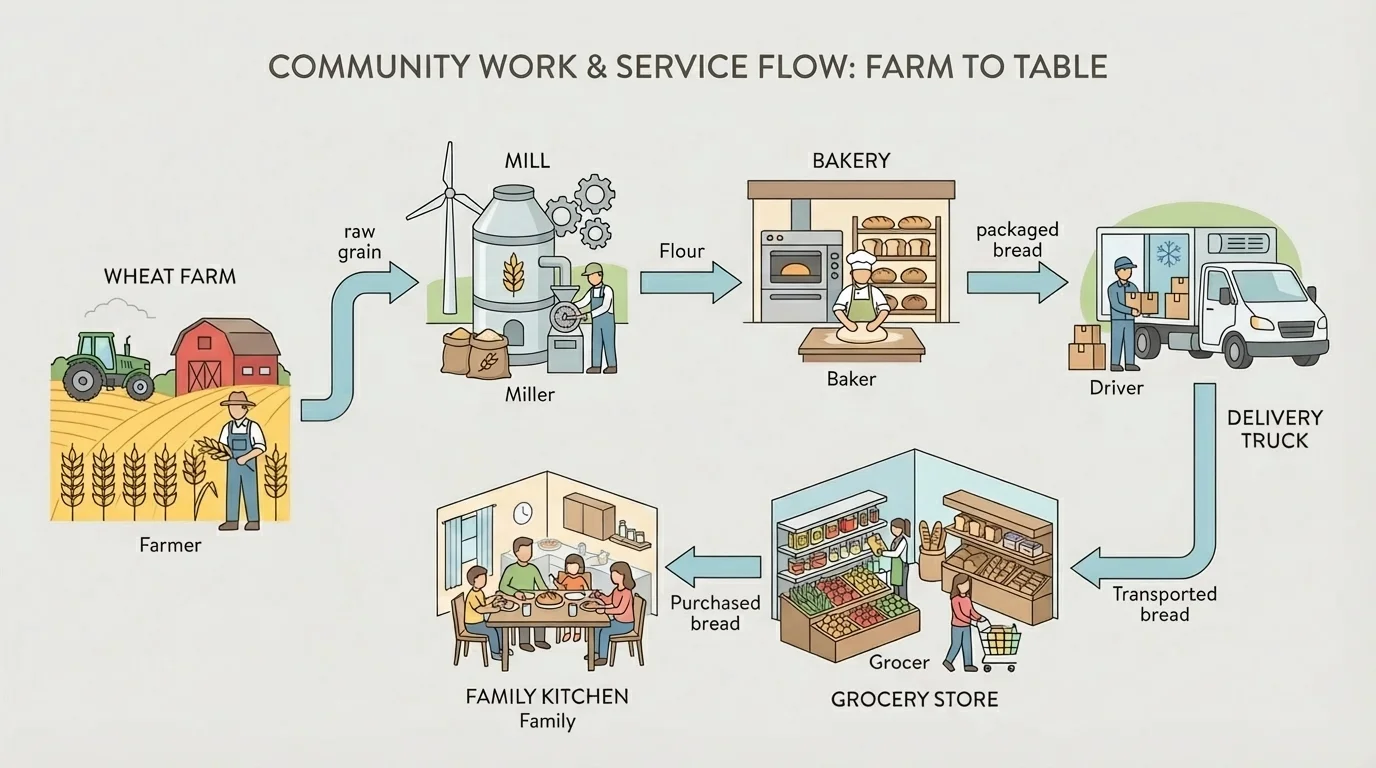
One easy way to understand community work is to follow one object from the beginning to the end. Bread is a good example, as [Figure 3] shows. Many workers help one loaf of bread reach a family.
First, a farmer grows wheat. Next, workers harvest it. Then it is moved by truck or train. At a mill, workers turn wheat into flour. A bakery worker uses the flour to make bread. Delivery workers bring the bread to stores. Store workers put it on shelves. A customer buys it and takes it home, as [Figure 3] shows.
That is a long chain of helpers for just one item. The same idea is true for medicine, books, clothes, and even electricity. Many people work together, even if they never meet each other.
How interdependence works in daily life
Interdependence means each worker does one part, and the parts fit together. When people do their work carefully and on time, the community works better. When one part is missing or poorly done, other people may have trouble too.
You can see this in your own life. If the internet stops working, an online meeting may freeze. Then a technician may need to fix equipment. That technician depends on tools made by factory workers and delivered by drivers. Even technology depends on many kinds of work.
As we saw in [Figure 1], jobs are connected like links in a chain. As the bread example in [Figure 3] also shows, one simple thing often depends on many workers behind the scenes.
Some jobs make goods, which are things people can hold, use, or buy, like shoes, bread, or books. Other jobs provide services, which are helpful actions done for people. Both goods and services are important in a community.
A haircut, delivering a package, fixing a sink, teaching a music lesson online, and caring for a sick person are all services. Services often save time, solve problems, or help people stay safe.
Goods and services around you
Step 1: Think of a pencil. The pencil itself is a good because it is an object you can hold.
Step 2: Think of a worker fixing a broken computer. That help is a service because the worker is doing something useful for someone.
Step 3: Notice that many community jobs include both. A baker provides a service by preparing food for customers and also sells a good, the bread.
Services are not always easy to see because they are often actions instead of objects. But they are a huge part of daily life.
Communities run best when important work gets done well and on time. When a needed job is missing, problems can spread fast.
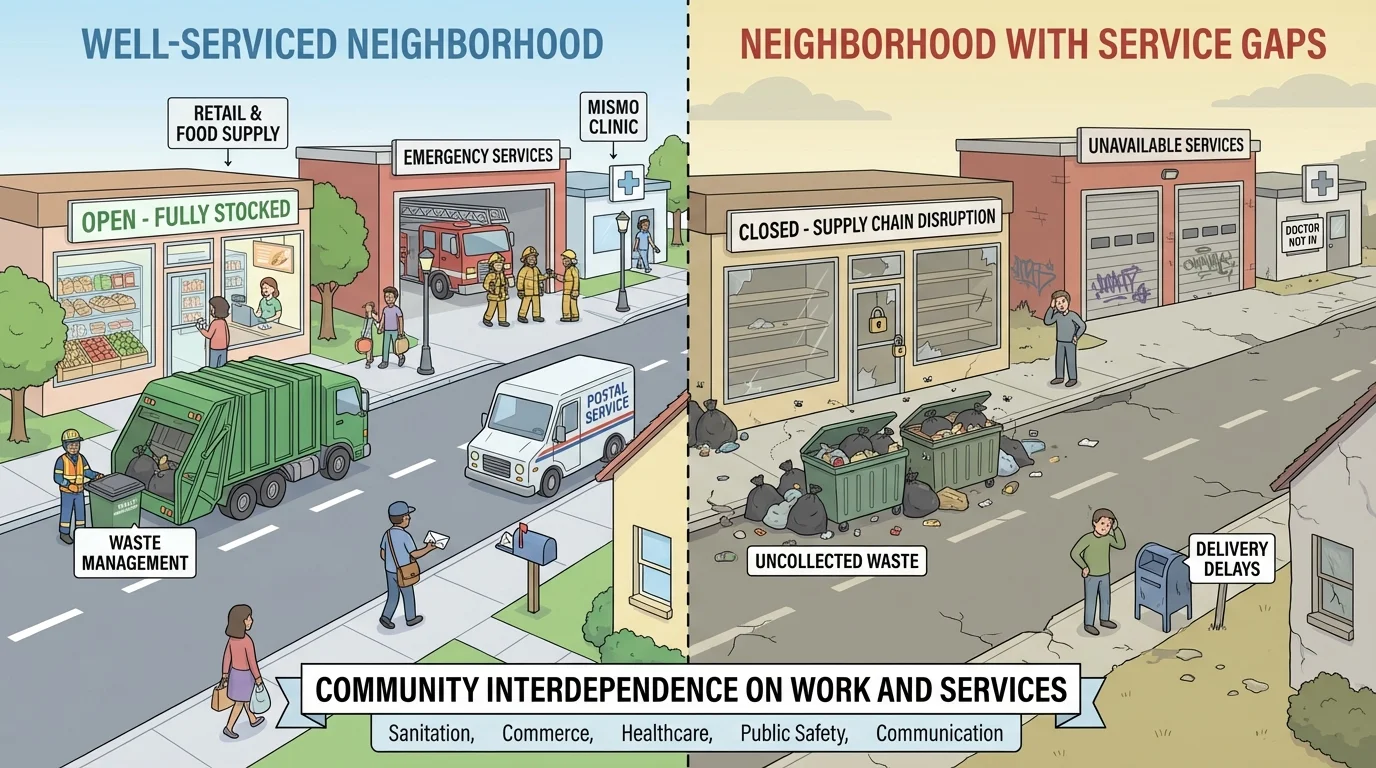
If trash is not collected, streets and buildings become dirty and unhealthy. If repair workers cannot fix broken water pipes, families may lose water. If delivery workers are delayed, stores may have fewer supplies. If health workers are too few, people may wait longer for care, as [Figure 4] shows by comparing a healthy community with one missing key services.
This does not mean one job is "better" than another. It means different jobs solve different problems. A safe, healthy community needs all of them.
When workers do their jobs with care, people often do not notice because things simply work. Lights turn on. Roads are open. Deliveries arrive. Water runs. But when these systems break, everyone can feel the effect.
When something in daily life seems simple, there is often a lot of hidden work behind it. Food, clean spaces, safe neighborhoods, and online services all depend on people doing their part.
That is why showing respect matters. Saying thank you, being patient, and following rules in public places can make workers' jobs easier and safer.
Different jobs need different training, but many job skills are useful almost everywhere. These are called job skills. You can start building them now.
Responsibility means doing what you said you would do. A responsible worker arrives on time, finishes tasks, and takes care of tools and spaces.
Teamwork means working well with others. A delivery team, hospital team, or repair team must cooperate to get the job done.
Communication means sharing ideas clearly. Workers need to listen, ask questions, and explain things in a kind and simple way.
Problem-solving means finding answers when something goes wrong. If a machine breaks, a route changes, or a customer needs help, workers think through what to do next.
Kindness and respect matter too. Communities are made of people, not just buildings and roads. Good workers often help others feel calm, heard, and safe.
"Many hands make light work."
— Proverb
You practice these skills already when you finish chores, help at home, speak politely, wait your turn, and solve small problems without giving up.
You do not need a job yet to understand community work. You can pay attention to the helpers around you and think about how their work affects your day.
Try This: When you use something helpful today, pause and ask, "Who made this possible?" If you drink water, think about plumbers, utility workers, construction workers, and engineers. If you read a library book, think about authors, printers, librarians, delivery workers, and building staff.
Try This: Practice respectful communication with workers in your community. Speak clearly, say thank you, and follow directions from helpers such as librarians, delivery workers, or medical staff.
Try This: Notice one community service you usually forget about, like trash pickup, road repair, or internet support. Talk with a family member about why that work matters.
These small actions help you grow into a person who understands how communities work. They also help you appreciate people whose jobs are sometimes unnoticed.
Later in the lesson, when you think again about [Figure 2] and [Figure 4], it becomes easier to see that every category of work supports comfort, health, and safety in a different way.
As you grow, you will learn more about what kinds of work interest you. Maybe you like fixing things, caring for animals, cooking, drawing, organizing, building, coding, or helping people feel better. Those interests can grow into future work.
A career is a line of work a person chooses and develops over time. Some careers are in health, some in art, some in science, some in skilled trades, and some in public service. Every career can help a community in its own way.
When you think about future work, ask yourself a few simple questions: What do I enjoy doing? What am I good at learning? How do I like to help people? What problems do I want to solve?
You do not need all the answers now. The important idea is this: communities need many kinds of talents. Your strengths may someday become part of the work that helps others.
