Have you ever had two good reasons to do different things at the same time? Maybe you want to join an online game with friends, but you also need to finish your schoolwork. Maybe you want to spend your allowance now, but you also want to save for something bigger later. These moments can feel frustrating because you are not choosing between something clearly good and clearly bad. You are choosing between competing needs or competing priorities.
Some problems are easy to solve. If milk spills, you wipe it up. But other problems are harder because more than one thing matters. You may care about time, money, safety, feelings, promises, or fairness all at once. When several important things pull you in different directions, it helps to slow down and use a plan instead of guessing.
Good decision-making does not mean you always get everything you want. It means you make the best choice you can with the information you have. Sometimes that means giving up one good thing to protect a more important thing.
Competing needs or priorities happen when two or more important things cannot all be fully met at the same time, so you must decide what matters most right now.
Priority means something that is more important than other things at a certain moment.
Compromise means finding a middle ground solution so different needs are respected as much as possible.
This skill matters in daily life. It helps you manage your time, get along with people, use money wisely, stay safe, and solve problems without panicking. A person who can balance priorities usually makes calmer choices and has fewer avoidable problems later.
Not every choice has a perfect answer. Sometimes you cannot do everything at once. If you have only one hour before dinner, you may not be able to clean your room, walk the dog, finish your reading, and watch a show. You need to decide what comes first.
That is where a trade-off comes in. A trade-off is what you give up when you choose something else. If you spend $10 on snacks, that $10 cannot also stay in your savings jar. If you stay up late chatting online, that time cannot also be used for sleep.
Making strong choices often means asking, "What matters most right now, and what can wait?" The answer may change depending on the situation. Safety usually comes before fun. A promise with a deadline may come before a hobby. Rest may come before extra activities if your body is exhausted.
There is not always a "perfect" choice
When needs compete, your goal is not to make everyone happy all the time. Your goal is to make a choice that is safe, responsible, and reasonable. A smart decision often solves the most important part of the problem first and saves less urgent parts for later.
One useful way to think about this is: first protect what is necessary, then support what is important, then fit in what is optional. That simple idea can guide many decisions.
[Figure 1] When a choice feels confusing, a clear decision-making process helps you move step by step instead of reacting too fast. You do not need a complicated system. You just need a reliable one.
Step 1: Name the problem clearly. Say it in one sentence. For example: "I have $15, and I want to buy a small toy now, but I also want to save for a $30 art kit."
Step 2: List the needs or priorities. Ask yourself what matters here. In that example, the priorities might be fun now, saving for a bigger goal, and using money responsibly.
Step 3: Rank what matters most. Is anything urgent? Is anything about safety, health, or a promise? If yes, those usually go near the top.
Step 4: Think of several options. Do not stop at just two. You might buy nothing, buy a cheaper item, save all the money, or save part and spend part.
Step 5: Predict the results. What happens next if you choose each option? How will you feel later today? What about next week?
Step 6: Choose the best option for now. Then act on it.
Step 7: Review the result later. Ask, "Did this work? Would I do the same thing again?" That reflection builds better judgment over time.
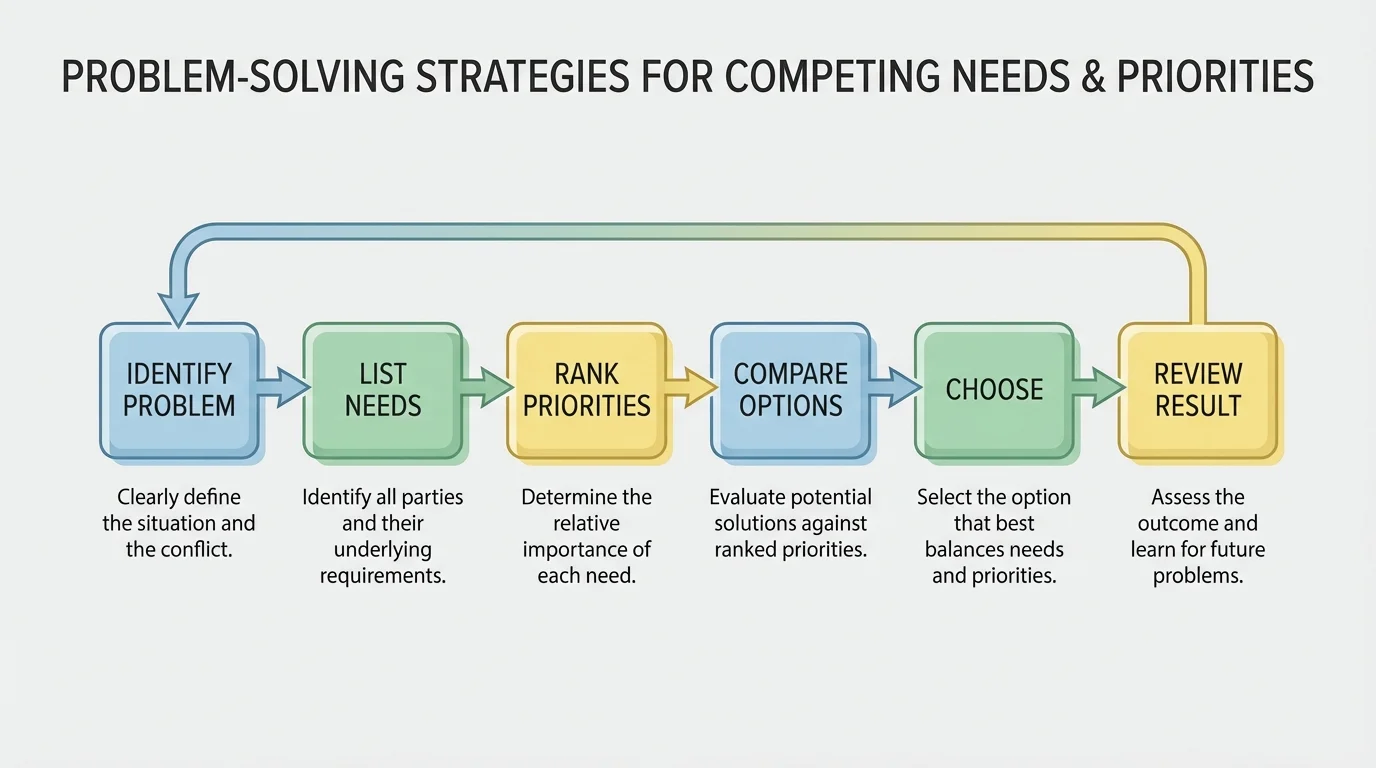
This process is helpful because it slows down impulsive decisions. An impulsive decision is a choice made too quickly, without enough thinking. Sometimes quick action is needed in emergencies, but most everyday problems improve when you pause first.
Example: Choosing how to use your afternoon
You have one free hour. You need to feed your pet, finish part of an assignment, and you want to watch videos.
Step 1: Name the problem
You cannot do everything in the same hour.
Step 2: List priorities
Pet care, school responsibility, and entertainment.
Step 3: Rank them
Pet care comes first because it affects another living thing. Schoolwork comes next because it has a deadline. Videos can wait.
Step 4: Choose a plan
Feed the pet first, work on the assignment next, and watch videos only if time remains.
This choice does not ignore fun. It simply puts the most important needs first.
Later, when you face another time problem, you can use the same pattern again. That is why routines are powerful. Once your brain learns a system, hard choices become less stressful.
[Figure 2] One of the biggest parts of solving priority problems is sorting choices by importance. A helpful way to do that is to place things into three groups: must do, should do, and could do.
Must do items involve safety, health, care, deadlines, and responsibilities. Should do items matter, but they may be more flexible. Could do items are nice extras that can wait if needed. For example, feeding a pet is usually a must do. Cleaning part of your desk may be a should do. Watching another episode of a show is often a could do.
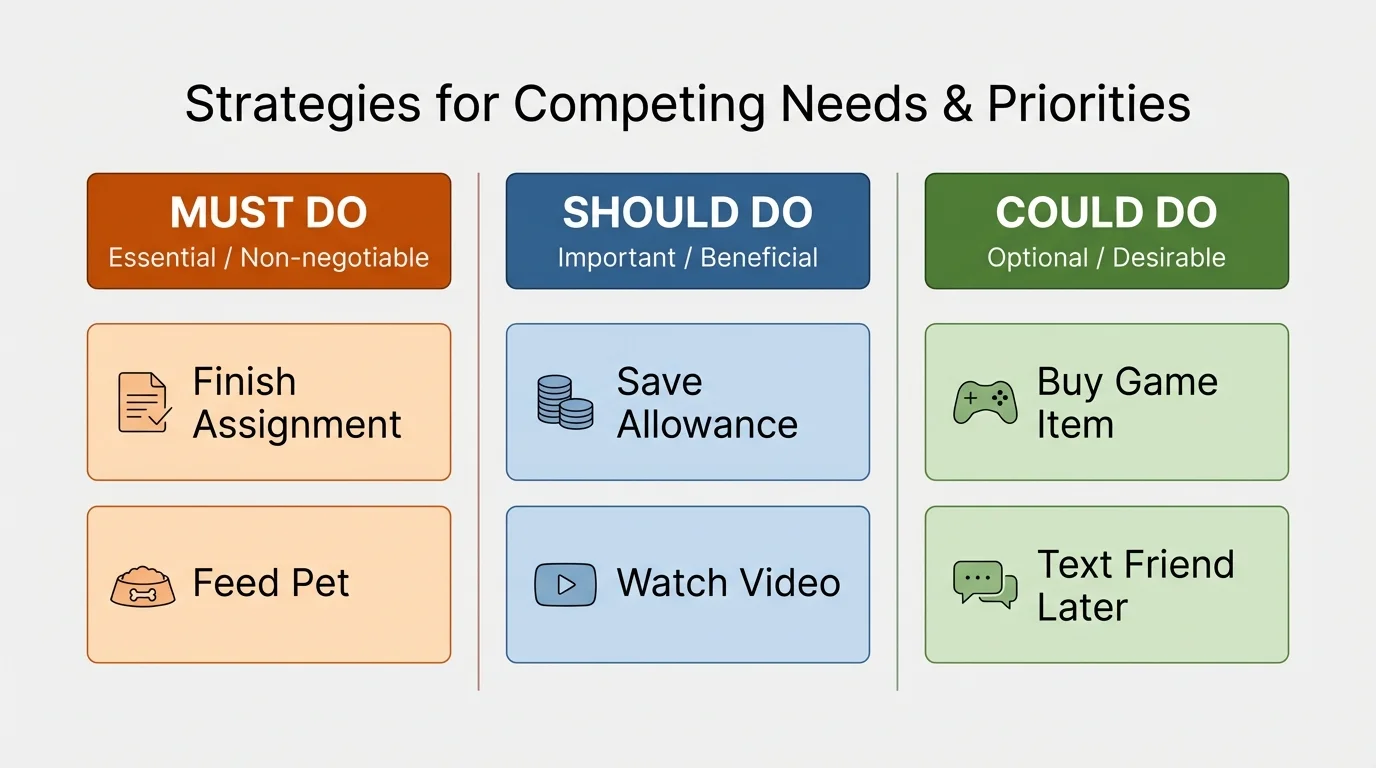
This sorting method does not mean wants are bad. Wants can be fun, relaxing, and motivating. The point is to be honest about what cannot wait. If everything feels equally important, nothing is truly being prioritized.
A useful question is: "What will happen if I wait?" If waiting causes harm, missed deadlines, broken trust, or safety problems, the task is probably more important. If waiting causes only disappointment or boredom, it may be lower on the list.
Your brain often notices what feels fun or urgent before it notices what is most important. That is why reminders, checklists, and routines can make better choices easier.
You can also ask: "Who is affected?" If your choice affects another person, a pet, or a family responsibility, that often raises its importance. As the categories in [Figure 2] show, priority is not only about what you feel like doing. It is also about what others need from you.
Many decisions involve the same few categories. When you are stuck, check whether your options affect fairness, safety, time, money, feelings, and responsibility.
Safety usually comes first. If one option is unsafe, you should not choose it just because it is more fun or easier. For example, if an online challenge seems risky or asks for private information, safety beats curiosity.
Fairness matters when choices affect other people. Fair does not always mean everyone gets exactly the same thing. It means people are treated in a reasonable way based on the situation. If two siblings both want the same device, a fair choice might be taking turns or giving it first to the person with an urgent task.
Time matters because some choices close other choices. If you put off a job for too long, you may lose the chance to do it well. A deadline can turn something from "important later" into "important now."
Feelings matter too, but feelings should be part of the decision, not the whole decision. For example, if you feel upset, you may want to quit a task. That feeling is real, but it does not always mean quitting is the best choice. Sometimes the better plan is to take a short break and return calmly.
Responsibility means doing what you said you would do, taking care of what depends on you, and thinking ahead about consequences. Responsible choices build trust over time.
"First things first."
— A simple rule for handling competing priorities
That short sentence sounds simple, but it is powerful. It reminds you that the best next step is often the one that protects safety, care, deadlines, or trust before comfort or entertainment.
Let's look at what this skill sounds like in daily life. These are the kinds of choices many students really face.
Example 1: Homework or screen time? You want to play a game online, but your assignment is due tonight. The wise choice is usually to finish the assignment first or complete a set amount of work before gaming. That way you protect your responsibility and still leave room for fun.
Example: Spending now or saving for later
You have $20. A game accessory costs $8 now, but a set of headphones costs $20 and you have been saving for it.
Step 1: Identify the trade-off
If you spend $8 now, you will have $12 left.
Step 2: Compare that result to your goal
With $12 left, you cannot buy the $20 headphones yet.
Step 3: Think of more than two choices
You could save all $20, spend none, or wait a day and decide again. You might also look for a cheaper accessory.
Step 4: Choose based on priority
If the headphones are your bigger goal, saving is the stronger choice.
Planning ahead helps your money match your priorities.
Example 2: Helping family or doing your own plan? You were about to start a hobby project, but a family member asks you to help carry groceries. Because the request is immediate and helpful, the family job may come first, especially if it only takes a few minutes.
Example 3: Rest or one more activity? You signed up for something fun online, but you are very tired and still need to wake up early. Rest may be the better priority. Taking care of your body is not laziness. It is smart planning.
Example 4: Two people need the same thing. Maybe you and a sibling both want to use the tablet. Instead of arguing, compare urgency. If one person needs it for a timed task and the other wants it for entertainment, the urgent task usually goes first.
Notice that these examples are not all solved in the same way. The strategy stays the same, but the answer changes with the facts. That is real problem-solving.
[Figure 3] Some of the hardest priority problems involve other people. Different people often care about different things. One person may want speed. Another may want fairness. Another may care most about feelings. Disagreement does not always mean someone is wrong.
Start by listening. Ask the other person what matters most to them and why. Then explain your own priority clearly. You can say, "I want to join the call, but I need ten minutes to finish this chore first," or "I understand you want the device now, and I need it for a deadline."
Then look for a compromise. A compromise does not mean both people get everything they want. It means both sides give a little so the solution is more balanced. You might split time, change the schedule, or find another option.
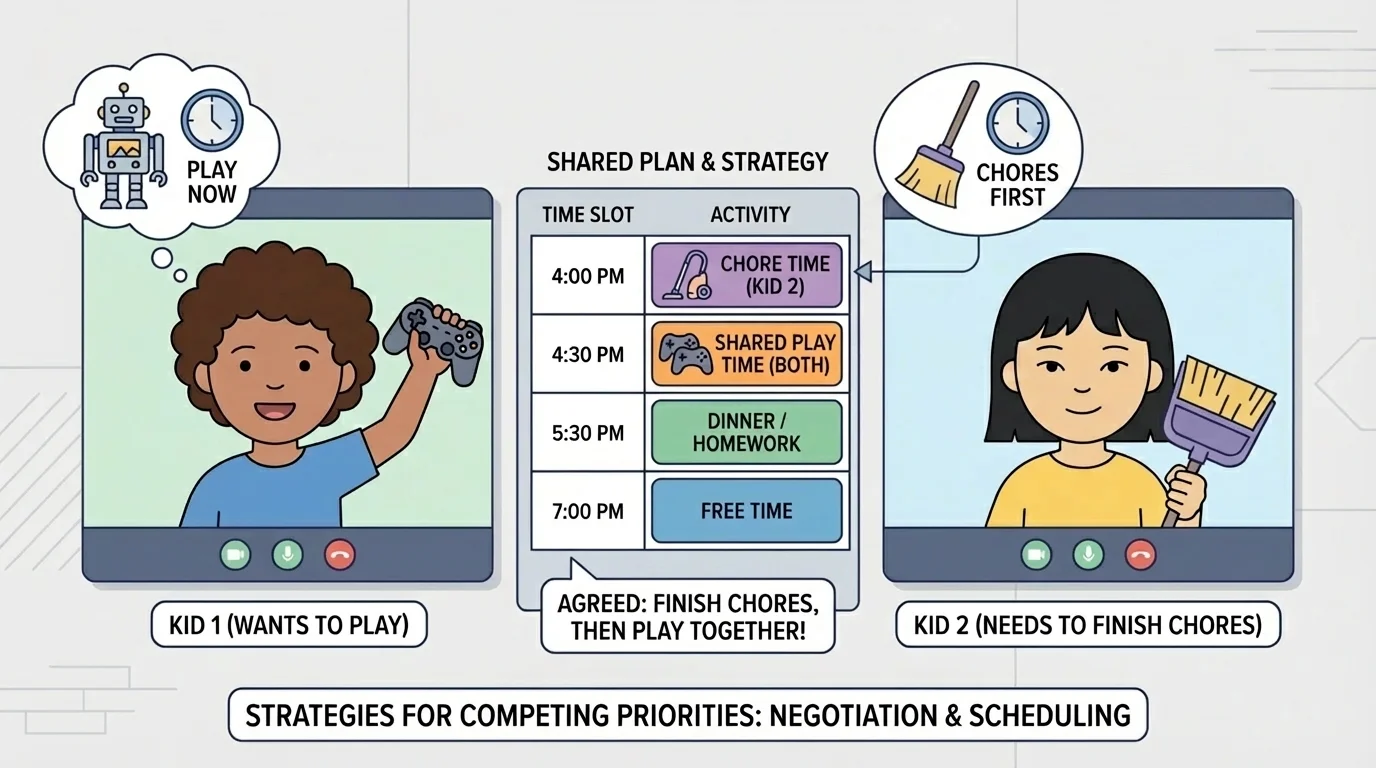
Use respectful words, especially in messages or online chats where tone is harder to read. Short, angry replies can make a small problem bigger. Calm words help people stay focused on the problem instead of attacking each other.
Example: Solving a disagreement fairly
Two friends want to use the same time for different plans during a weekend video call.
Step 1: Hear both sides
Friend A wants to play a game together now. Friend B needs to help at home first.
Step 2: Find the real priorities
Friend A cares about spending time together. Friend B cares about responsibility and still wants to join later.
Step 3: Build a compromise
They agree to start the game later and use the first few minutes to chat while Friend B finishes.
That solution respects both connection and responsibility.
Good communication is part of problem-solving. Without it, people may think the conflict is about not caring, when it is really about different priorities.
Later, if another disagreement comes up, you can remember the shared-plan idea from [Figure 3]. Many conflicts improve when people move from "my way or your way" to "what plan can work best for both of us?"
One common mistake is choosing based only on what feels good right now. That can lead to missed deadlines, unfinished chores, wasted money, or hurt trust.
Another mistake is trying to please everyone all the time. Sometimes that is impossible. If you always say yes to every request, you may ignore your own important needs like rest, time, or focus.
A third mistake is forgetting consequences. Before choosing, ask yourself what happens next. A decision is not only about the moment. It is also about the result.
Another problem is not reviewing your choices. If something went badly, do not just feel bad and move on. Ask what you can learn. Reflection turns mistakes into experience.
You already use problem-solving in everyday life when you plan your day, share space with others, or decide how to spend money. This lesson builds that skill by adding a clearer system for ranking what matters most.
Also watch out for "all-or-nothing" thinking. Sometimes the answer is not "do all of this" or "do none of it." Sometimes the best answer is partial: do part now, part later, or make a smaller version of the plan.
The more you practice, the easier this gets. You do not need to wait for a huge problem. Small daily choices are great practice.
Try This: When you feel torn between two choices today, pause and say the problem out loud in one sentence.
Try This: Make a quick list: must do, should do, could do. Put your choices into those groups.
Try This: Before spending money, ask, "Will this choice help or hurt my bigger goal?"
Try This: If you disagree with someone, ask one calm question before arguing back.
Try This: At the end of the day, think of one decision you made well and why it worked.
Over time, these small actions strengthen your judgment. You become better at noticing what matters most, thinking ahead, and making choices you feel good about later.
Strong decision-making does not mean life becomes conflict-free. It means you become more prepared. You learn that when needs compete, you can sort them, compare them, and choose with purpose.
