Being late usually does not happen because of one huge mistake. More often, it happens because of a chain of tiny misses: you forgot to charge your phone, couldn't find your keys, ran out of deodorant, or assumed a ride would be available without checking. Daily life logistics is the skill of preventing those small problems from piling up. When you get better at it, life feels smoother, less stressful, and more under your control.
Logistics means organizing the practical details that help something happen. In daily life, that includes timing, supplies, transportation, and backup plans. You already use logistics even if you do not call it that. If you decide when to start homework, pack what you need for practice, or figure out how to get somewhere on time, you are doing logistics.
Daily life logistics is the planning and coordination of everyday practical details, such as time, materials, transportation, and communication. Buffer time is extra time added to a plan in case something takes longer than expected. A backup plan is a second option you can use if the first one does not work.
Good logistics saves time, reduces stress, and helps people trust you. If you say you will join a volunteer event online at a certain time and you are ready with your materials, you look responsible. If you often scramble at the last minute, forget supplies, or miss rides, people may stop depending on you. That is why logistics is not just about being organized. It is also about building independence.
When daily plans get messy, use a simple decision framework. As [Figure 1] shows, you can solve many logistics problems with the same repeatable process: identify the goal, notice the limits, compare options, choose a plan, and set a backup. This works whether you are trying to get to soccer practice, finish a chore before a video call, or prepare for a family trip.
Step 1: Be clear about the goal. Ask, "What exactly needs to happen?" A vague goal like "get ready later" is weak. A strong goal is "be signed in to my club meeting by 6:55 p.m. with my notebook and charger nearby." Clear goals are easier to plan for.
Step 2: Identify constraints. Constraints are the limits you must work around, such as time, money, distance, weather, or what other people are available to do. If a bus only comes every 30 minutes, that matters. If you have only $5 for transportation, that matters too.
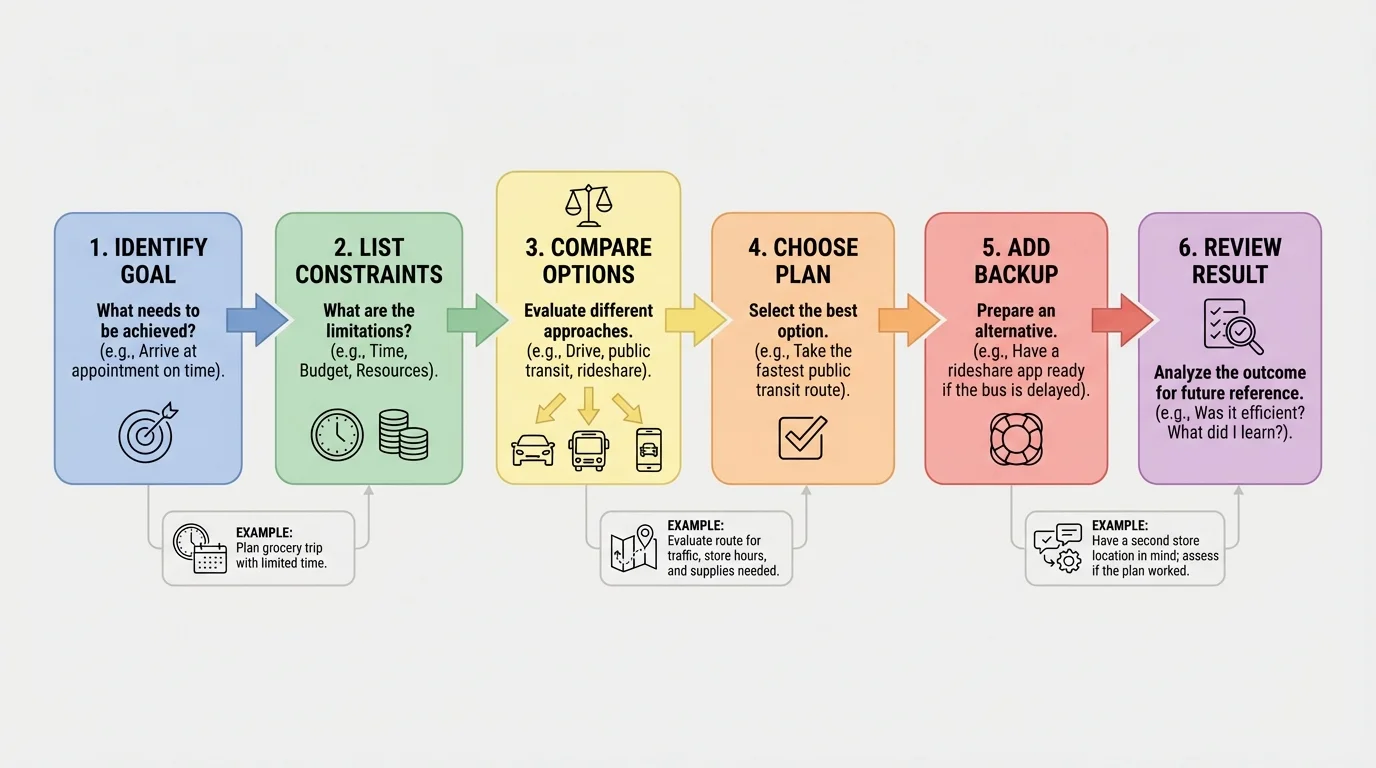
Step 3: List your options. There is often more than one way to solve a problem. If you need supplies for a project, your options might include using what you already have, borrowing from a family member, or changing the plan to fit available materials.
Step 4: Compare the options. Look at time, cost, effort, and reliability. The fastest choice is not always the best choice. A ride that sounds fast is not reliable if the driver has not confirmed. A cheaper option is not helpful if it makes you late.
Step 5: Choose the best plan and add a backup. That final part matters a lot. If your main ride falls through, what will you do? If a store is out of stock, what is your substitute? Figure that out before the problem happens.
Step 6: Review afterward. If your plan worked, notice why. If it failed, ask what part broke down. This is how logistics becomes a skill instead of a guess. The flow in [Figure 1] is useful because it reminds you that planning is not one choice; it is a chain of decisions.
Think in systems, not single tasks
A lot of stress comes from planning one step and forgetting the steps around it. For example, "leave at 4:30" sounds like a plan, but it ignores finding shoes, filling a water bottle, grabbing your phone, and locking the door. Strong logistics means seeing the whole system, not just one moment in it.
If you practice this method often, you stop reacting to problems at the last second and start preventing them earlier. That shift is one of the biggest signs of growing independence.
Time problems are some of the most common logistics problems. Many people think they are "bad at time," but usually the real issue is poor estimating. A better approach is to work backward from the deadline, as shown in [Figure 2]. Instead of asking, "When should I leave?" ask, "What time do I need to arrive, and what must happen before that?"
Suppose you need to arrive at a community center by 5:00 p.m. The ride takes about 18 minutes, getting ready takes 20 minutes, and packing supplies takes 7 minutes. If you also add a 10-minute buffer, the total prep time is \(18 + 20 + 7 + 10 = 55\) minutes. That means you should begin the process by 4:05 p.m., not 4:40 p.m.
Buffer time is one of the smartest habits you can build. Without a buffer, a tiny delay can wreck the whole plan. With a buffer, normal problems stay small. If everything goes smoothly, the "extra" time is not wasted. You can use it to relax, double-check your supplies, or arrive calm instead of rushed.
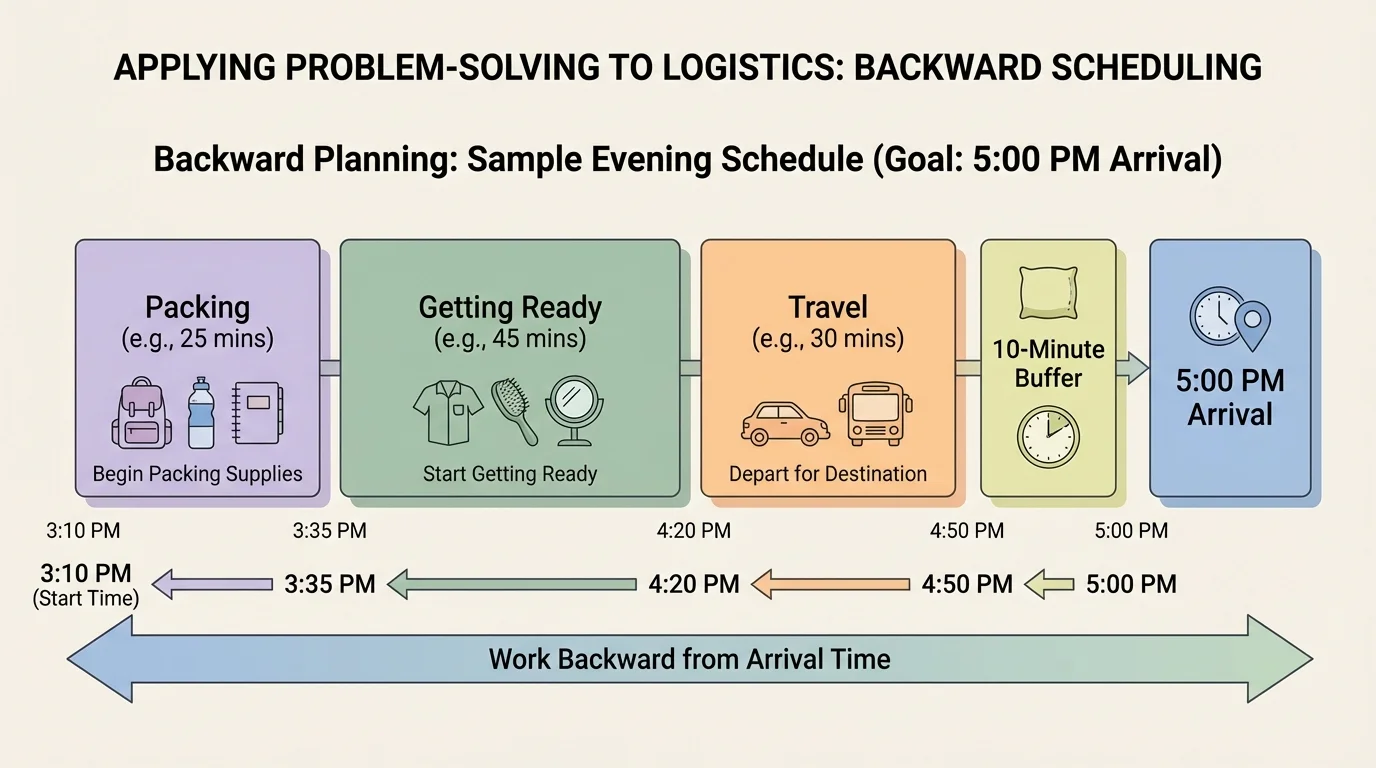
Here is a useful rule: if something has to happen at a certain time, never plan to arrive exactly at that time. Aim to be early. For online commitments, log in a few minutes before the start. For in-person events in your community, aim to arrive early enough to handle a small surprise.
Worked example: planning backward from a deadline
You need to join a video interview at 7:30 p.m. You need 15 minutes to dress appropriately, 8 minutes to set up your device and test audio, and 12 minutes to review your notes. You also want a 10-minute buffer.
Step 1: Add the preparation times.
\(15 + 8 + 12 + 10 = 45\) minutes
Step 2: Count backward from the start time.
\(7{:}30 - 0{:}45 = 6{:}45\)
Step 3: Set your real start time.
Begin getting ready at 6:45 p.m., not "sometime after 7:00."
Working backward turns a stressful deadline into clear action steps.
Another time skill is noticing the difference between task time and transition time. Task time is the time spent doing the main thing, like showering or studying. Transition time is the time between tasks, like finding your notebook, walking downstairs, or waiting for a webpage to load. People often forget transition time and then wonder why the schedule failed.
Use alarms and calendar reminders in layers. One reminder can tell you to start preparing. Another can tell you it is time to leave or log in. If you use only one alarm at the final moment, you leave yourself no room to recover.
Running out of something at the wrong moment can cause bigger problems than people expect. A missing pen, charger, permission form, or clean shirt can slow everything down. Good supply planning means thinking ahead about what you need, what you already have, and what will run out soon.
Start with categories. Many daily supplies fit into a few groups: personal care, schoolwork materials, food and water, tech items, activity equipment, and documents. Once you think in categories, it becomes easier to make a checklist. For example, if you are leaving for an afternoon activity, your list might include water bottle, snack, phone, charger, notebook, and any special gear.
A helpful habit is the inventory check. Inventory means knowing what you have before you need it. If you wait until the last minute to discover you are out of printer paper or toothpaste, you lose choices. But if you notice earlier, you can restock during a normal errand or ask for help with enough time.
Small repeated shortages create more stress than big rare emergencies for many people. A missing everyday item can interrupt your routine, waste time, and make the whole day feel harder than it needed to be.
One easy strategy is to set a "refill point." This is the amount where you decide it is time to replace something. For example, if your family keeps bottled water for outings, you might decide to restock when there are only 3 bottles left. If you use one notebook for planning, you might replace it when only a few pages remain. The key is to restock before zero.
Another smart habit is grouping supplies by activity. Keep your sports items together, your tech charging items together, and your art supplies together. If everything is scattered, every trip becomes a treasure hunt. If things live in the same place, packing becomes faster and more reliable.
Case example: checking supplies before an event
You are leaving home at 3:30 p.m. for a volunteer clean-up event. You need gloves, a water bottle, sunscreen, and your phone.
Step 1: Check what you already have.
You find the gloves and phone, but the water bottle is empty and the sunscreen is nearly gone.
Step 2: Fix problems early.
Refill the bottle now and ask a family member whether there is extra sunscreen at home.
Step 3: Prepare a substitute if needed.
If there is no sunscreen, wear a hat and long sleeves if the event rules and weather allow it.
This is better than discovering the problem when you are already halfway out the door.
Supply planning also saves money. When you forget what you already own, you may buy duplicates. When you fail to notice what is running low, you may have to buy quickly instead of comparing prices. Organized supplies help you make calmer, smarter choices.
Transportation planning is not just about getting from one place to another. It is about choosing a method that fits your schedule, budget, safety needs, and reliability. Instead of grabbing the first idea, compare choices carefully, as [Figure 3] shows.
Your transportation options might include walking, biking, public transit, a ride from family, or a carpool with another trusted person. Each option has strengths and weaknesses. Walking costs nothing but may take too long. A ride may be fast but depends on someone else's schedule. Public transit may be affordable but requires close attention to departure times.
When comparing transportation, ask four main questions: How long does it take? How much does it cost? How reliable is it? What is the backup if it fails? A plan with no backup is weaker than it looks.
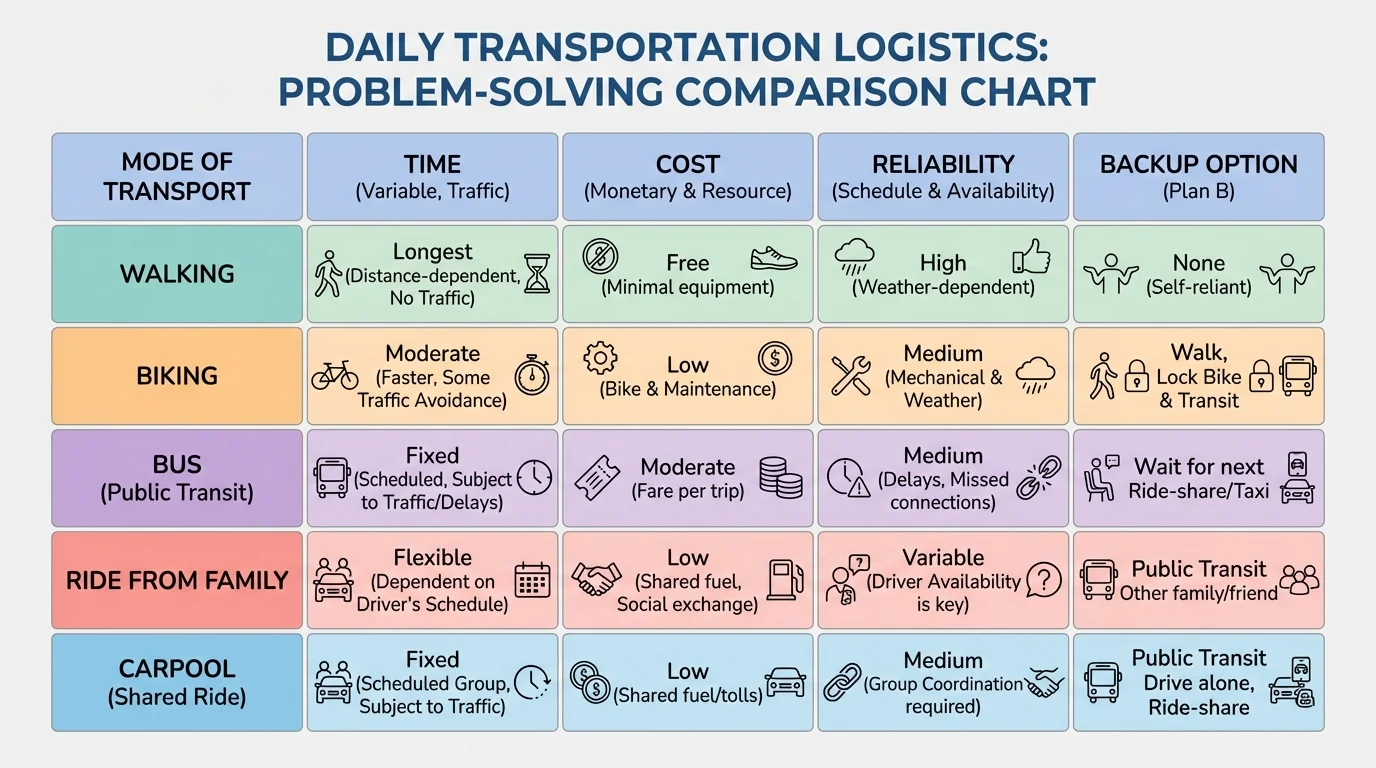
For example, suppose you need to reach the library by 2:00 p.m. Walking takes 35 minutes, biking takes 15 minutes, and the bus takes 12 minutes if you catch the 1:35 bus. If you miss that bus, the next one is too late. In that case, the bus is fast but less forgiving. Biking may be a better choice if your bike is ready and the route is safe.
Transportation decisions sometimes involve simple math. If a ride costs $4 each way, a round trip costs \(4 + 4 = 8\). If the bus costs $2.50 each way, a round trip costs \(2.50 + 2.50 = 5.00\). The bus saves $3, but only if the timing works. Cheap and late is not always better than slightly more expensive and on time.
Always check conditions that can change the plan: weather, traffic, transit delays, daylight, device battery, and whether the person giving you a ride has actually confirmed. Do not assume. Confirm.
Safety matters too. If you are walking or biking, choose known routes, tell a trusted adult where you are going when needed, and make sure your phone has enough battery if you rely on it for directions or communication. A plan that looks efficient but is unsafe is not a good plan.
Later, when you compare combined plans in full situations, the categories in [Figure 3] still help: time, cost, reliability, and backup. Those four checks catch many transportation mistakes before they happen.
As [Figure 4] shows, separate skills are useful, but real life mixes them together. A full logistics problem usually includes time, supplies, transportation, and communication all at once. This kind of combined planning can be seen in a single everyday scene: checking the schedule, packing needed items, and confirming the route before leaving.
Say you are going to a weekend art workshop at 10:00 a.m. across town. You need a sketchbook, pencils, water bottle, and your tablet. The bus ride takes 25 minutes, and the stop is an 8-minute walk from home. You also want a 12-minute buffer and 15 minutes to get ready. The total pre-arrival time is \(25 + 8 + 12 + 15 = 60\) minutes. That means you should start getting ready by 9:00 a.m.
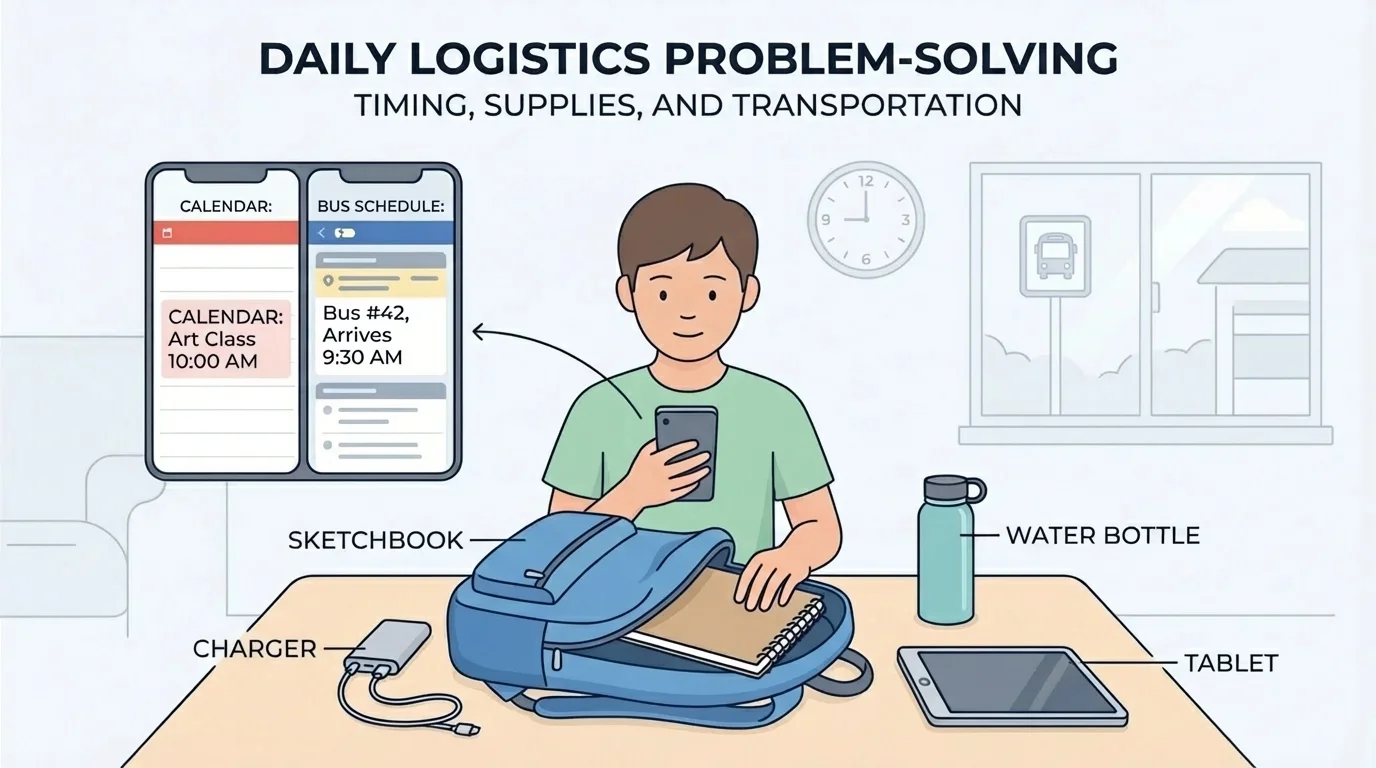
Now add supplies. You check your bag the night before and find your tablet battery is low. That is a supply-and-tech problem, not just a time problem. Charging it before bed prevents a morning emergency. You also notice your water bottle is missing, so you place another bottle by the door. Small actions the night before make the next day much easier.
Combined example: choosing the best full plan
You must be at a community event by 4:00 p.m. Option A is a family ride that usually takes 20 minutes, but the driver is not confirmed. Option B is a bus that takes 30 minutes and leaves at 3:10 p.m. You need 15 minutes to get ready and 10 minutes to gather supplies.
Step 1: Calculate preparation time.
\(15 + 10 = 25\) minutes
Step 2: Test Option A.
If the ride is confirmed and leaves at 3:35 p.m., arrival is around 3:55 p.m. That leaves almost no buffer.
Step 3: Test Option B.
To catch the 3:10 p.m. bus, you should be ready by 2:45 p.m. Arriving around 3:40 p.m. gives more buffer.
Step 4: Decide based on reliability.
Option B may be slower, but it is more reliable because the schedule is known. Option A only becomes stronger if the ride is fully confirmed and leaves earlier.
The best logistics choice is often the one that is most dependable, not the one that seems fastest at first.
Communication is part of logistics too. If someone is involved in your plan, send a clear message early. Instead of "Can you take me later?" say, "Can you drive me to the community center at 3:20 p.m. on Saturday? I need to arrive by 3:45." Specific requests are easier for others to answer accurately.
If the person says "maybe," treat that as uncertain. Build a backup. Unclear plans create more trouble than firm plans, even when the firm answer is "no."
You do not need fancy apps to get better at logistics. Simple tools work well if you use them consistently. A calendar helps with deadlines and start times. A notes app or paper list helps with supplies. Repeating reminders help with routines. A charging station helps you keep devices ready in one place.
One strong habit is the nightly reset. Spend a few minutes checking tomorrow's schedule, putting needed items in one place, charging devices, and setting alarms. That short routine prevents a lot of morning stress. It also helps you sleep better because your brain is not trying to remember everything overnight.
You may already know how to make a checklist or set reminders. The new skill here is using those tools together as one system: schedule the time, prepare the supplies, confirm transportation, and create a backup.
Another strong habit is the launch zone. This is one place near the door where you keep items you often need when leaving, such as a bag, keys, headphones, or a water bottle. A launch zone reduces the common "Where is it?" problem that wastes a surprising amount of time.
If you share responsibilities with family members, keep communication simple and visible. Some families use a shared digital calendar. Others use a whiteboard or group chat. The exact tool matters less than the consistency. Everyone should know where important information lives.
| Tool or Habit | What It Helps With | Example |
|---|---|---|
| Calendar | Timing | Mark event start times and reminders to begin getting ready |
| Checklist | Supplies | Pack charger, water, notebook, and any special gear |
| Launch zone | Faster exits | Keep bag and needed items in one regular spot |
| Nightly reset | Preparation | Review tomorrow, charge devices, set out clothes |
| Backup plan | Problem recovery | Know a second ride option or a substitute item |
Table 1. Everyday tools and habits that support better timing, supply management, and transportation planning.
Even the best plan can fail. Buses run late. Weather changes. Chargers stop working. A family member gets busy. The goal of logistics is not perfection. The goal is to recover quickly and make good decisions under pressure.
When something goes wrong, pause and sort the problem into one of three types: time problem, supply problem, or transportation problem. Then ask what part is still under your control. If the bus is late, you may not control the bus, but you do control whether you notify the person waiting for you. If you forgot a supply, you may still be able to borrow, substitute, or adjust the plan.
"The best plan is not the one with zero problems. It is the one that can survive a problem."
A calm response often looks like this: notice the issue, choose the next best option, and communicate clearly. For example, "The bus is delayed by 12 minutes. I'm still coming, but I may arrive at 5:07." That message is much more helpful than silence.
Try not to hide small logistics mistakes. If you are missing something or running behind, saying so early gives you and others more options. Waiting too long usually makes the problem bigger.
Strong logistics is built through repetition, not talent. You do not wake up one day as an organized person. You become organized by practicing small behaviors until they become normal. Every time you check supplies the night before, work backward from a deadline, or confirm transportation early, you are training reliability.
Try This: Pick one event coming up this week and plan it fully. Write the start time, work backward to find when preparation should begin, list the supplies you need, and choose a backup transportation idea if the first one fails.
Try This: Create one short repeatable checklist for leaving home. Keep it simple: phone, charger, water, keys, wallet if needed, and activity-specific items. Use it until you notice you are forgetting fewer things.
Try This: Start a refill list on your phone or on paper. Whenever you notice something is running low, write it down immediately. This turns memory into a system.
You do not need to control every minute of your day. You just need enough structure to avoid preventable problems. That balance matters. Good logistics supports freedom. When you handle practical details well, you gain more time, more trust, and more room to enjoy what you are actually trying to do.
