Some of the biggest problems people face do not start with giant mistakes. They start with small choices made too fast: clicking "buy now," trusting a rumor, following a health trend from social media, or replying when angry. Critical thinking is what helps you slow down, notice what is real, and choose based on good reasons instead of pressure, panic, or impulse.
Critical thinking is not about being negative or suspicious of everything. It means using evidence, logic, and self-control to make better decisions. In real life, that matters because your choices affect your body, your money, your reputation, and your relationships. One smart decision might help you feel better, save money, or avoid drama. One careless decision might create stress that lasts for weeks or months.
Strong decision-making skills help you in ordinary moments, not just emergencies. You use it when choosing what to eat, deciding whether a deal is worth it, figuring out whether someone is trustworthy, or deciding how to respond to a text that upsets you. The goal is not perfection. The goal is to make choices that are more informed, more balanced, and more respectful of your future self.
Critical thinking means carefully examining information, asking questions, and judging whether something makes sense before you believe it or act on it.
Decision-making is the process of choosing between options after considering facts, values, and possible consequences.
Consequence is the result of a choice. Some consequences happen right away, and some appear later.
When you use critical thinking well, you become harder to manipulate. Ads affect you less. Rumors influence you less. Pressure from other people has less power over you. That does not mean you never feel emotional. It means your emotions stop driving the whole car.
When a choice is confusing, a repeatable process helps you think clearly, as [Figure 1] shows. You do not need a complicated system. You need a few reliable steps that work whether the choice is about food, spending, or friendships.
Step 1: Pause. If a choice feels urgent, emotional, or exciting, stop for a moment. A short pause can protect you from acting on impulse.
Step 2: Name the decision. Be specific. Instead of "What should I do?" say, "Should I spend $35 on this game today?" or "Should I reply to this message now or wait until I calm down?"
Step 3: Gather facts. What do you actually know? What are you assuming? Facts are things you can check. Assumptions are guesses, fears, or hopes.
Step 4: List options. Many bad decisions happen because people act as if there are only two choices. Usually there are more. You might buy now, wait, compare prices, ask for advice, or decide not to buy at all.
Step 5: Think about consequences. Ask what happens today, next week, and next month. A smart choice often looks less exciting in the moment but works better over time.
Step 6: Choose and review. After you act, look back. Did the choice help? What would you do differently next time? That review is how judgment gets stronger.
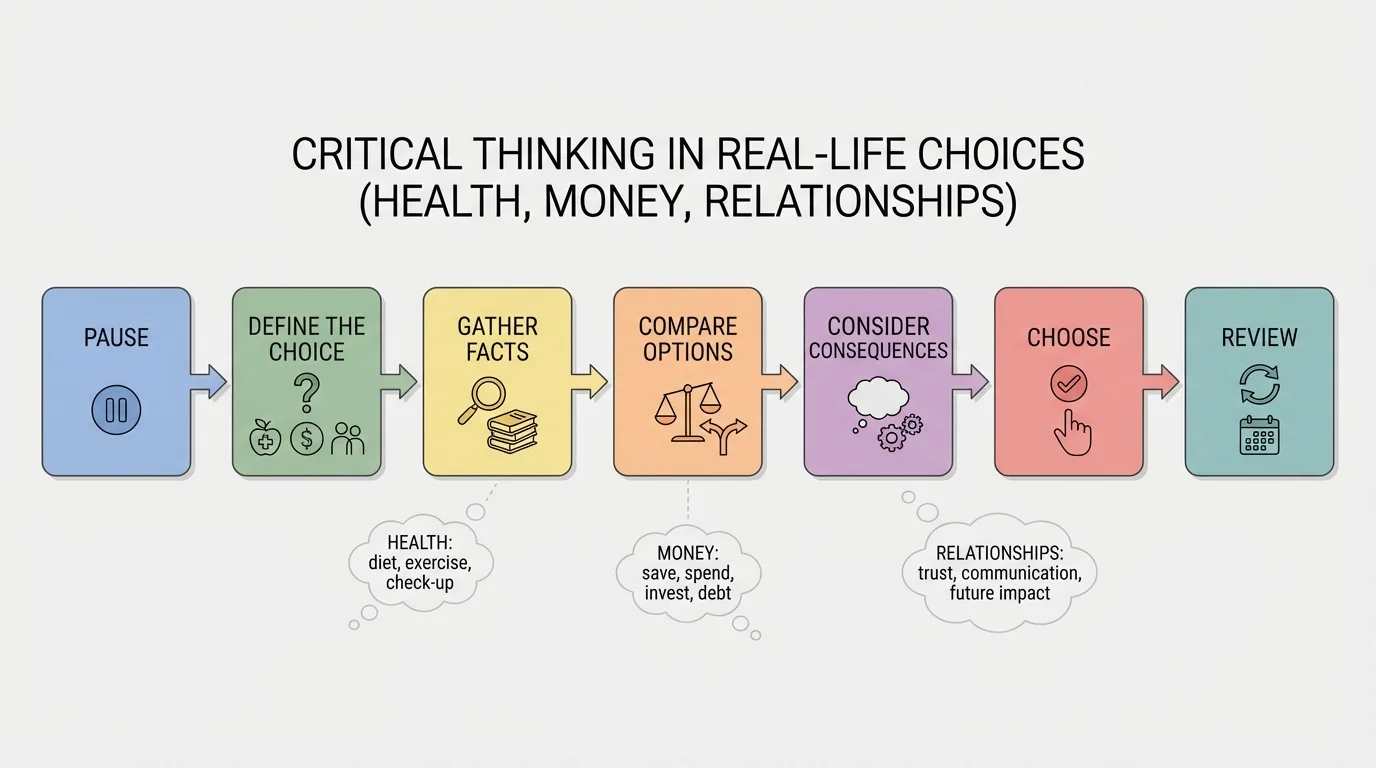
You can turn this process into a quick mental checklist: Pause. Facts. Options. Consequences. Choice. It may take less than a minute for small decisions and longer for important ones. The key is that you are choosing on purpose.
Feelings matter, but they are not the whole story. Emotions carry useful information. Fear can signal danger. Excitement can show interest. Anger can point to unfair treatment. But emotions are not always accurate guides to the best action. Critical thinking means noticing your feelings and then checking them against facts.
If you are upset, try asking: "What am I feeling? What happened? What proof do I have? What outcome do I want?" Those questions separate the emotion from the action. That space is where better decisions happen.
Health decisions show why critical thinking matters. Online, you will see claims about diets, supplements, workout plans, skin products, sleep hacks, and "miracle" fixes. Some are helpful. Many are oversimplified, exaggerated, or designed to sell something. Useful questions to ask include: "Who is making this claim?" "What evidence supports it?" and "What are the risks?"
For example, suppose a creator says a certain drink gives you instant energy, burns fat, and improves focus. Before believing it, ask: Who is saying this? Are they selling it? Is there expert advice or reliable research behind it? Does the claim sound realistic? Promises that solve many problems at once are often a warning sign.
Health choices also involve trade-offs. Staying up late to watch videos might feel good now, but if you sleep only about 6 hours instead of a healthier amount like 8 hours, you lose 2 hours of sleep. Over 5 nights, that becomes \(2 \times 5 = 10\) hours of missed sleep. That can affect mood, focus, and energy. Critical thinking helps you notice that short-term fun may create long-term costs.
Another example is food. You do not need to label foods as "good" or "bad" in a dramatic way. A smarter question is: "What does my body need most right now?" If you have not eaten much all day, a snack with some protein, fiber, or lasting energy usually serves you better than something that gives a quick burst and then a crash.
Health decision case study
You see a social media post promoting a supplement that promises better skin in three days.
Step 1: Pause before buying.
The post is designed to create excitement. Fast promises can push people to spend before thinking.
Step 2: Check the source.
Look for whether the person is being paid, whether ingredients are clearly listed, and whether reliable health sources support the claims.
Step 3: Consider risk.
Could it cause side effects, waste money, or distract from better habits like sleep, hydration, and regular skincare?
Step 4: Choose the option with the strongest long-term value.
You might decide to wait, research more, or talk with a trusted adult or health professional instead of ordering immediately.
Good health choices are often less dramatic than bad ones. Drinking water, getting enough sleep, moving your body regularly, and being careful with trends may not look exciting online, but they are usually more dependable than quick fixes.
Try This: Before following any health advice online, ask three questions: "What is the source?" "What proof is there?" and "What are the risks?" If you cannot answer those clearly, slow down.
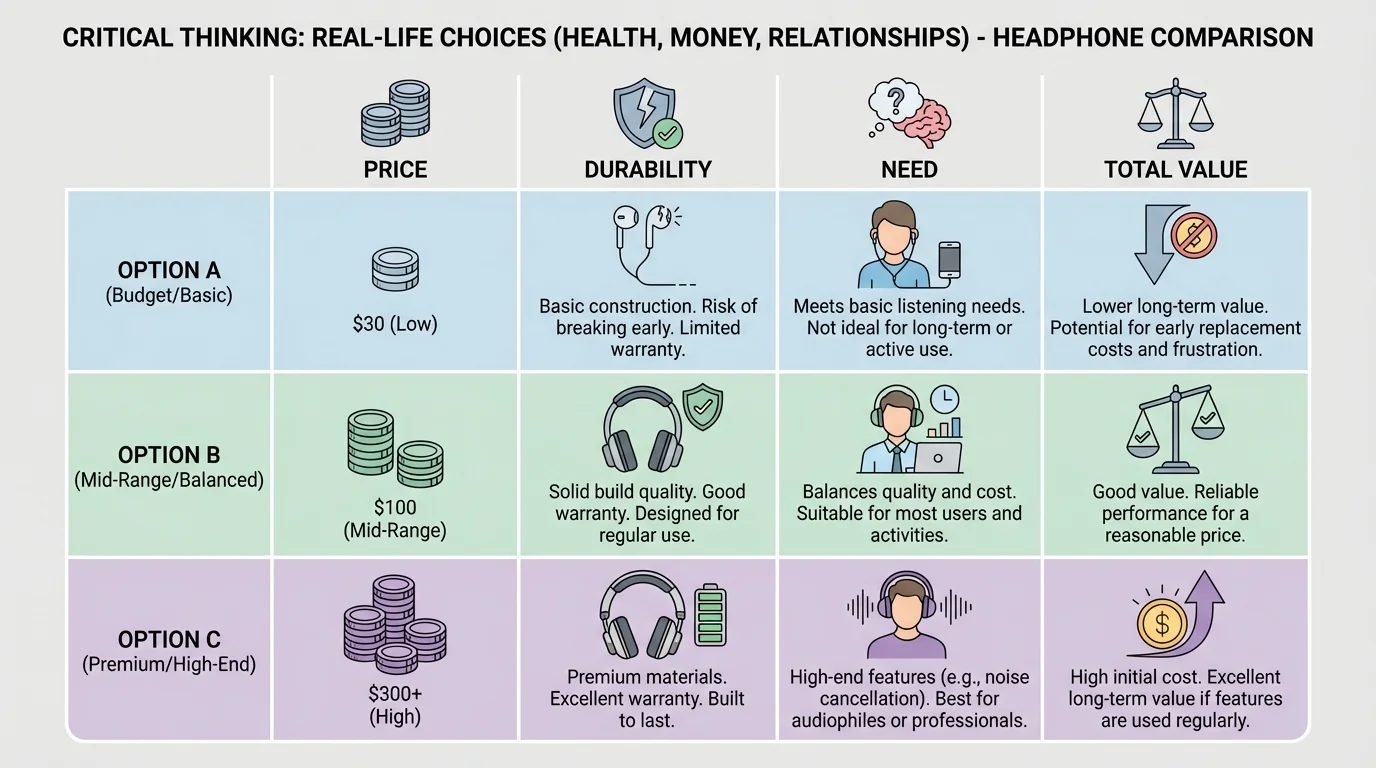
Money decisions are not only for adults. You already make financial choices when you spend gift money, compare products, save for something bigger, or decide whether to subscribe to an app. Strong critical thinking helps you judge value, not just price. Using clear criteria instead of hype makes spending smarter, as [Figure 2] illustrates.
A cheap item is not always a good deal if it breaks quickly. A more expensive item is not always better if you do not really need it. Ask yourself: Is this a need or a want? Will I still want it next week? How often will I use it? What am I giving up by spending this money now?
This idea is called opportunity cost. If you spend $20 on snacks and random online purchases, that same $20 cannot go toward headphones, art supplies, a game you care about more, or savings for a future goal. Every choice closes other options.
Comparing options can be simple. If one pair of headphones costs $18 and may last 3 months, while another costs $30 and may last 10 months, the second option may offer better value over time. The monthly cost is about \(\dfrac{18}{3} = 6\), so about $6 per month for the first pair, and \(\dfrac{30}{10} = 3\), so about $3 per month for the second pair. Lower long-term cost can matter more than lower starting cost.
Subscriptions are another place where people lose money without thinking. A charge of $5 per month may seem tiny, but over a year that is \(5 \times 12 = 60\), so $60. Critical thinking means looking past the small monthly number and seeing the full cost.
Scams also depend on poor critical thinking. Messages that say "Act now," "Only two left," or "You have won a prize" often try to create urgency so you stop asking questions. Real opportunities can wait long enough for you to verify them.
Money decision case study
You want to buy a hoodie online for $42.
Step 1: Define the choice.
Are you deciding whether to buy this hoodie now, or whether to spend money on clothes at all this month?
Step 2: Check facts.
Look at shipping cost, return policy, quality reviews, and how much money you have available.
Step 3: Compare consequences.
Buying it now may feel great today, but if you have only $50, you would have just $8 left. If another need comes up, you may regret it.
Step 4: Consider alternatives.
You could wait 48 hours, look for a better deal, or save toward it instead of buying right away.
Later, when you compare another purchase, the same value thinking still works. A smart spender does not ask only, "Can I buy this?" A smarter question is, "Is this the best use of my money right now?"
Try This: Use a 24-hour pause for non-urgent purchases. If you still want the item after a day and it fits your budget, your decision is more likely to be thoughtful rather than impulsive.
Critical thinking also matters in friendships, dating, family situations, and online communication. Not every social problem needs the same response, and a clear process helps you decide what is safe and respectful, as [Figure 3] shows. Strong relationship choices involve more than feelings. They involve trust, boundaries, honesty, and consequences.
Suppose a friend sends a message saying someone is talking about you. Your first reaction might be anger or panic. Critical thinking asks you to slow down. Do you know this is true? What exactly was said? Is the source reliable? Is there another explanation? Acting on incomplete information can turn one rumor into a much bigger conflict.
A healthy boundary is a limit you set to protect your time, energy, privacy, and well-being. For example, you might decide not to answer messages late at night, not to share passwords, or not to stay in conversations where someone insults you. Boundaries are not punishments. They are tools for self-respect.
You also need to notice peer pressure. Pressure can sound like "If you were a real friend, you would do this," or "Everyone does it." Those statements are not proof that something is wise or safe. Sometimes the smartest relationship choice is saying no, leaving the conversation, or asking a trusted adult for help.
Warning signs in a relationship can include constant guilt-tripping, controlling behavior, disrespect for privacy, lying, threats, or trying to isolate you from other supportive people. These signs matter even if the person can also be funny, charming, or apologetic. One nice moment does not erase repeated harm.
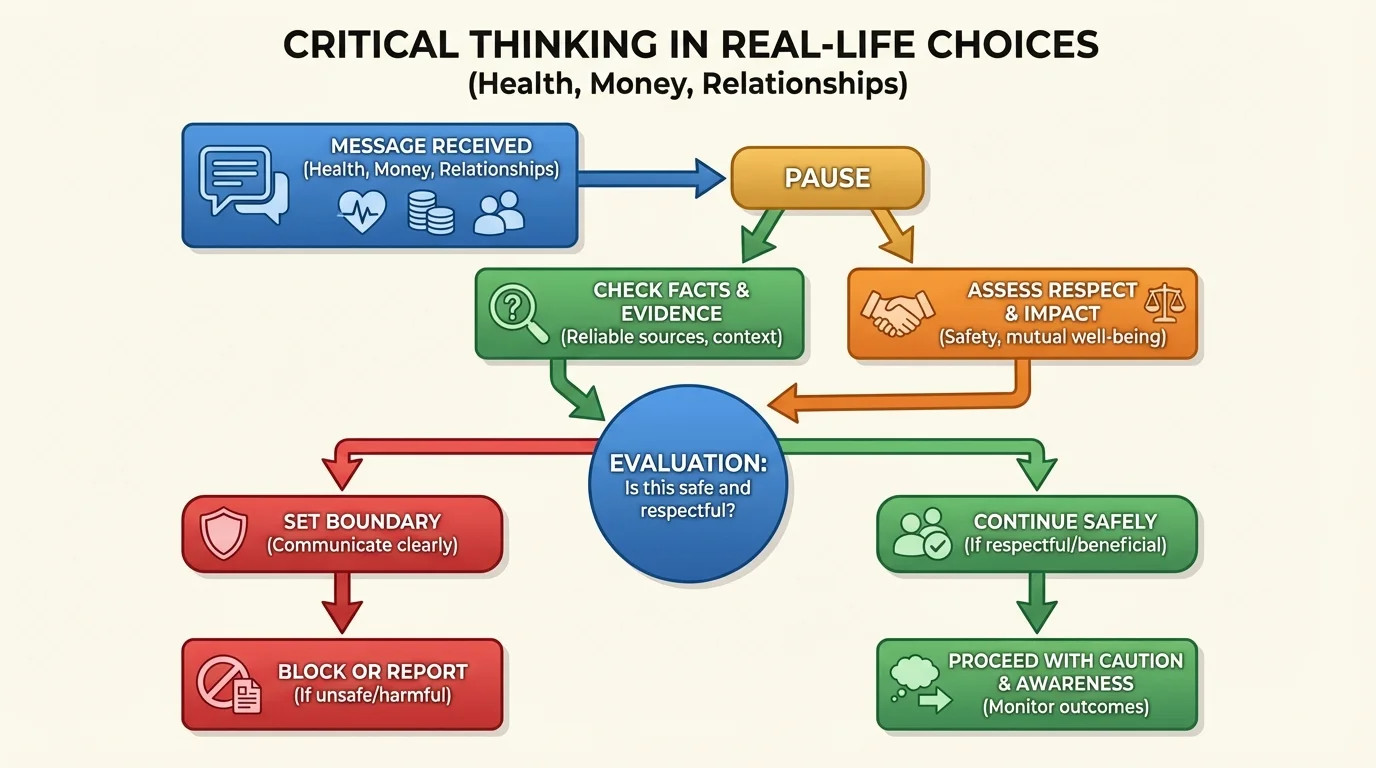
If someone crosses a line, you have options. You can respond calmly, take time before replying, state a boundary clearly, mute or block an account, save messages as records, or talk with a trusted adult. The best choice depends on the level of risk. Not every conflict should be handled by arguing back.
Relationship decision case study
A person you know online keeps pressuring you to share private information.
Step 1: Identify the red flag.
Pressure around private details is a warning sign, especially if the person gets angry when you hesitate.
Step 2: Check your boundary.
You are allowed to keep personal information private. You do not need to explain or defend that choice at length.
Step 3: Choose a safe action.
You can say no once, stop replying, block the account, and tell a trusted adult if the situation feels unsafe.
Try This: Write one sentence you can use when you need a boundary, such as "I'm not comfortable sharing that," or "I need to leave this conversation now." Practicing the sentence makes it easier to use when emotions are high.
Even smart people make poor choices when their thinking gets distorted. A bias is a mental tendency that can push your judgment in an unfair or inaccurate direction. For example, if you already want something badly, you may notice only information that supports buying it and ignore the downsides.
Urgency is another distortion. If someone says you must decide immediately, that pressure can make your brain focus on speed instead of quality. This is common in scams, arguments, risky dares, and emotional situations.
Social proof can also mislead you. If many people online support an idea, it may feel true. But popularity is not proof. A rumor repeated 50 times is still a rumor unless it is verified.
Your brain often prefers fast answers because fast thinking saves effort. That is useful in simple situations, but it can cause mistakes when a choice is emotional, expensive, or risky.
One of the strongest ways to improve critical thinking is to ask, "What would I tell a friend to do in this situation?" That question creates distance, and distance often makes the better answer easier to see.
Good decision-making is not just one skill. It is a set of habits. You get better by practicing on small choices so you are more ready for big ones. That means slowing down before spending, checking sources before believing claims, and noticing how people treat you over time instead of judging only one moment.
A practical checklist can help:
You do not need to overthink every tiny decision. If the stakes are low, a quick choice is fine. But if a choice affects your safety, your body, your money, your trust, or your future, slow thinking is usually worth the extra time.
"You do not have to believe every thought, trust every claim, or follow every impulse."
Critical thinking is really a form of everyday self-protection. It helps you make choices that match your values instead of your mood in one moment. It helps you become someone who can think clearly under pressure, act responsibly, and recover wisely when a choice does not go perfectly.
Try This: Choose one decision this week involving health, money, or a relationship. Use the five-word checklist: Pause. Facts. Options. Consequences. Choice. The more often you practice it, the more natural it becomes.
