One person can change the whole mood of a group without ever giving a big speech. If a team leader ignores messages, takes all the credit, or makes fun of someone's idea, people pull back fast. But if that same leader listens, stays fair, and follows through, the group becomes stronger. That is why leadership is not mainly about holding authority. It is about the choices you make and the effect those choices have on other people.
You do not have to lead a company or a huge organization to matter here. You might lead an online group project, help organize a community event, manage a club's social media page, be the captain of a sports team outside school, or simply be the person others look to in your family or friend group. In all of those situations, your decisions influence whether people trust you, whether they join in, and whether anyone takes responsibility when things go wrong.
Leadership is the way a person influences a group toward a goal. Some people think leadership means being the loudest voice or making every decision. In real life, strong leadership usually looks different. It often means staying calm, being clear, treating people fairly, and helping others do their best.
Leadership choices matter because groups run on relationships. If people feel respected, they are more likely to contribute. If they feel ignored or judged, they often stay quiet, stop trying, or leave the group entirely. That is true in volunteer teams, online gaming communities, youth organizations, family planning, and part-time jobs.
Trust is the belief that someone will be honest, fair, and reliable.
Participation is the active involvement of people in a group's work, decisions, or discussions.
Accountability means taking responsibility for actions, decisions, and results.
These three ideas connect closely. Trust makes people feel safe enough to participate. Participation gives more people a chance to contribute and solve problems. Accountability keeps the group honest, because everyone knows that actions and results matter.
Think about a student running an online fundraiser for a local animal shelter. If the leader clearly explains the goal, answers messages, and gives updates, people are more willing to help. If the leader disappears for days, changes plans without telling anyone, or avoids questions, trust drops quickly.
The same pattern shows up in smaller situations. Maybe your family is planning a move, a trip, or a weekly schedule. If one person keeps making promises and not following through, everyone starts double-checking them. That wastes time and creates tension. Reliable choices save energy because people stop worrying about what might go wrong.
Many teams fail not because members are untalented, but because people stop sharing honestly. Once trust drops, good ideas often stay unspoken.
That matters for your future too. Whether you later work in healthcare, business, technology, construction, or community service, people will notice if others can depend on you. Technical skill matters, but trust often decides who gets opportunities and who is chosen for bigger responsibilities.
Trust grows through repeated actions, not one dramatic moment. A leader builds trust by being honest, consistent, respectful, and dependable. A leader breaks trust by hiding information, playing favorites, making excuses, or saying one thing and doing another.
One important choice is transparency. [Figure 1] Transparency means being open enough that people understand what is happening and why. It does not mean sharing every private detail. It means you do not leave people confused on purpose. For example, if you are leading a team creating digital content for a community event and you move the deadline earlier, explain the reason right away. People are more likely to accept a hard decision if they understand it.
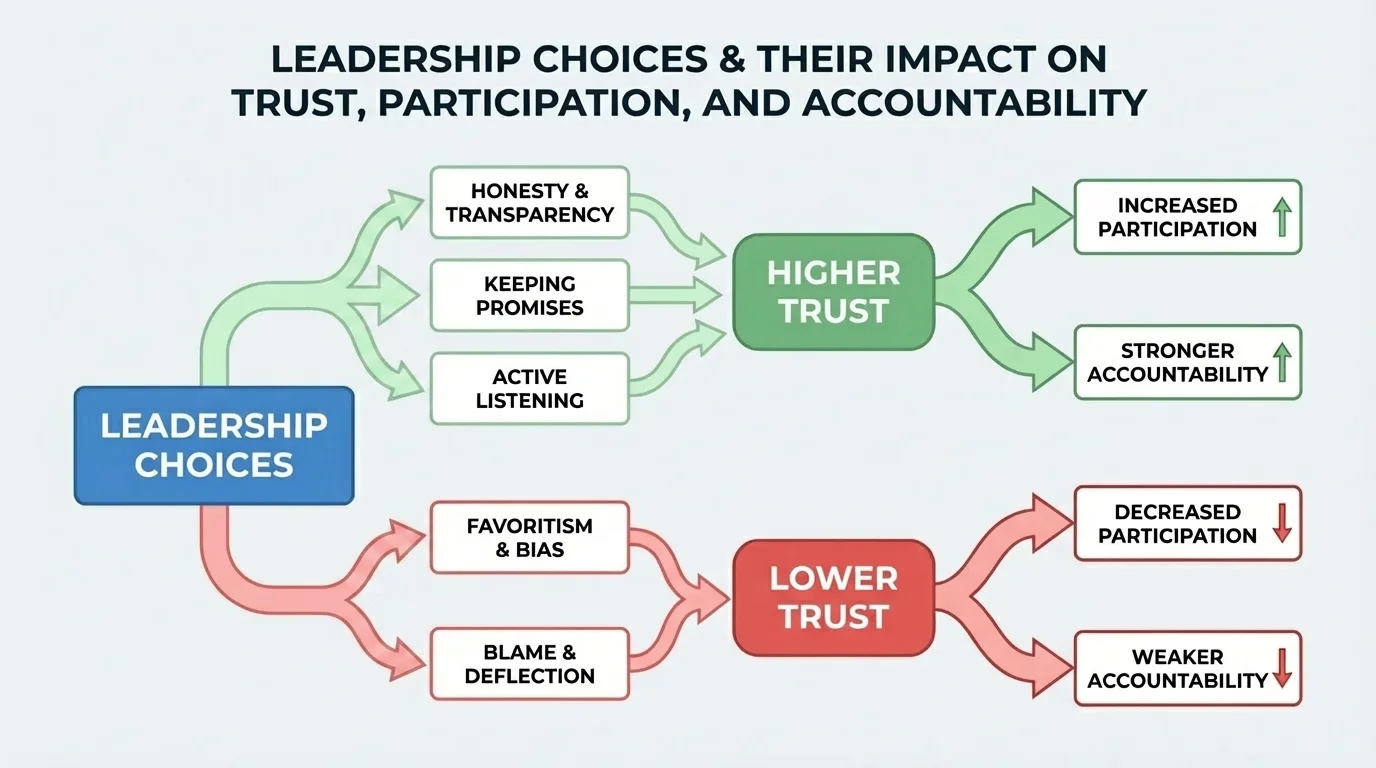
Another important choice is consistency. If you enforce rules one way for your friends and another way for everyone else, people notice. Fairness is a major part of trust. Even when people do not like a decision, they are more likely to respect it if the standard applies to everyone.
Listening also matters. Listening is not just staying quiet while someone else talks. Real listening means trying to understand, asking useful questions, and responding to the actual issue. A leader who interrupts, jokes at the wrong time, or instantly dismisses concerns teaches the group that speaking up is risky.
Handling mistakes well is another trust test. Strong leaders admit errors early. Weak leaders often hide mistakes until the damage gets bigger. If you send the wrong meeting link, forget an important task, or misread a deadline, own it quickly. A simple response works: "I made a mistake. Here's what happened. Here's how I'm fixing it." That response protects trust far better than excuses.
Privacy matters too. If someone shares a concern with you privately and you spread it around for attention, trust can collapse. This is especially serious in online spaces where screenshots and forwarded messages can travel fast. Being trustworthy includes knowing what should stay confidential and what must be shared for safety.
Later, when you evaluate whether a leader deserves confidence, return to the pattern shown earlier: do their repeated choices create clarity and safety, or confusion and fear? Trust is usually built or broken in small, repeated moments.
Case study: A trusted leader
A teen volunteer coordinates a neighborhood clean-up using a group chat and shared sign-up form.
Step 1: The leader posts the plan clearly.
They share the meeting time, location, supplies needed, and backup weather plan.
Step 2: The leader responds honestly.
When only a few people sign up, the leader says turnout is low instead of pretending everything is fine.
Step 3: The leader adjusts fairly.
They shorten the clean-up route and ask for volunteers for the most urgent areas first.
Step 4: The leader follows through.
After the event, they thank everyone and share the final result with photos and next steps.
Because the leader is clear, realistic, and reliable, people are more likely to help again.
If the same leader had exaggerated sign-ups, ignored questions, and blamed others afterward, many volunteers would probably stop trusting them. The event might still happen once, but future support would shrink.
Participation increases when people feel safe, included, and useful. A leader affects participation not only by what they say, but by how they structure the group.
Some leaders accidentally shut people out. [Figure 2] They talk too much, decide too fast, or only notice the most confident voices. In online groups, this can happen when one person dominates the video call while quieter members never get a chance to speak. It can also happen when all decisions are made in private messages instead of shared spaces.
Good leaders lower barriers to joining in. That might mean posting an agenda before a call, asking for ideas in chat as well as out loud, using a poll, rotating speaking turns, or giving people time to think before answering. Not everyone participates in the same way. Some people speak quickly. Others contribute better through writing, planning, research, or design.
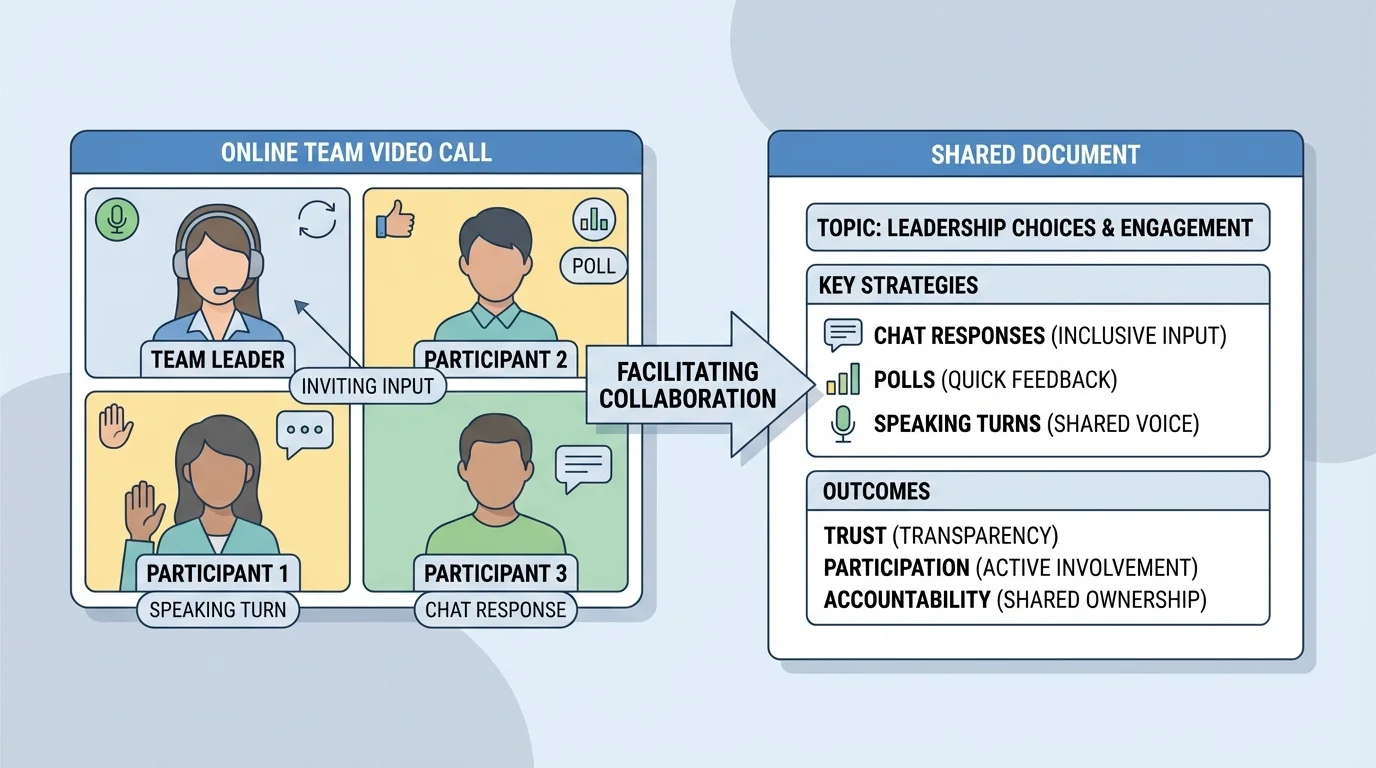
Clear roles also help. If no one knows what to do, many people stay passive. But if the leader says, "You handle outreach, you make the schedule, you check supplies, and I'll manage updates," the group becomes easier to join. Structure can actually make people feel more comfortable, not less.
Respectful feedback matters too. If every idea gets criticized immediately, participation drops. A better pattern is to first understand the idea, then improve it. For example: "I like the goal of your idea. Let's talk about what resources we'd need." That keeps creativity alive while still being realistic.
Inclusive leaders notice who has not spoken yet. They do not force everyone to talk, but they make space. A simple line such as, "We've heard a few opinions; does anyone want to add something in the chat?" can change the whole group dynamic. As the process shown earlier suggests, participation is often built through design, not luck.
Psychological safety is the feeling that you can speak honestly, ask questions, or admit uncertainty without being mocked or punished. Leaders create this by responding calmly, thanking people for input, and treating mistakes as problems to solve rather than proof that someone is useless.
Participation is not just about fairness. It improves results. Groups usually make better decisions when more perspectives are included. A leader who invites broad input often catches problems earlier and finds stronger solutions.
Accountability is not about constant control. It is about making sure responsibilities are clear and outcomes are owned. In healthy groups, accountability helps people succeed. In unhealthy groups, the word gets twisted into blame or punishment.
A leader creates accountability by setting clear expectations. [Figure 3] People should know the goal, the deadline, the quality standard, and who is responsible for each part. Vague directions like "someone handle the post" or "finish it soon" often lead to confusion. Specific directions work better: "Post the event reminder by Thursday at 6 p.m. and include the registration link."
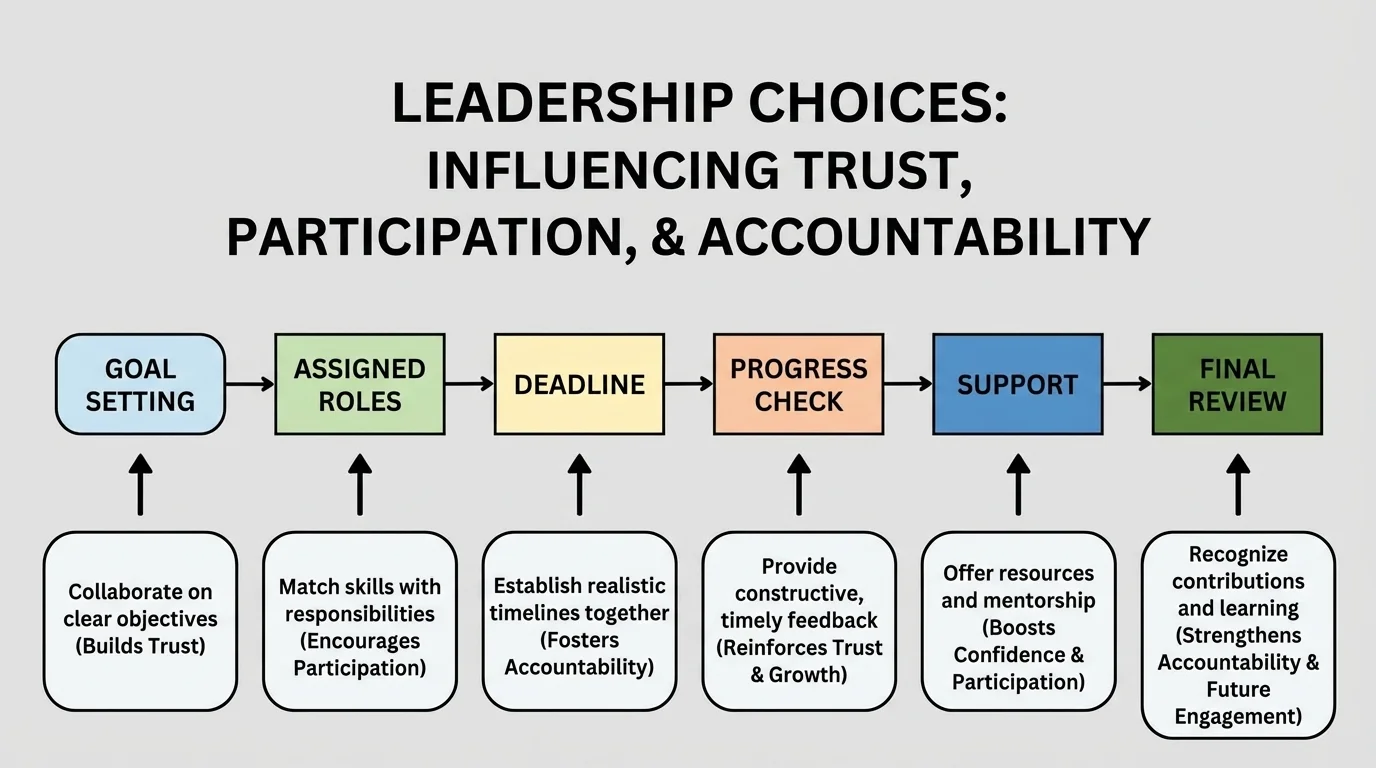
Check-ins matter too. Accountability is not waiting until the final minute and then getting angry. Good leaders follow up early enough to help. If a team member is behind, the leader asks what is blocking progress and what support is needed. That approach solves problems while there is still time.
Strong leaders also model accountability themselves. If they miss a deadline, forget a task, or make a poor call, they own it. That sets the tone for everyone else. A group becomes more responsible when the leader shows that responsibility applies to them too.
Blame destroys accountability. Blame focuses on protecting image: "Whose fault is this?" Accountability focuses on action: "What happened, what can we learn, and what do we do next?" Those questions feel different, and they lead to different group cultures.
When you look again at the process shown earlier, notice that support is part of accountability. People need both responsibility and resources. Holding someone responsible for a job they were never prepared to do is unfair, not accountable.
| Leader choice | Likely effect on trust | Likely effect on participation | Likely effect on accountability |
|---|---|---|---|
| Explains decisions clearly | Trust rises | People engage more | Expectations are clearer |
| Ignores messages | Trust drops | People stop contributing | Tasks get missed |
| Invites multiple viewpoints | Trust rises | More people speak up | Shared ownership increases |
| Blames others publicly | Trust drops sharply | People become cautious or silent | Responsibility turns into fear |
| Owns mistakes and fixes them | Trust rises | People feel safer participating | Healthy accountability grows |
Table 1. Comparison of common leadership choices and their effects on trust, participation, and accountability.
Not all leaders behave the same way. Some are overly controlling. Some are too passive. Some create balance. You can often tell the difference by watching how they make decisions, how they communicate, and how they respond when things go wrong.
An overly controlling leader makes every choice personally, gives little explanation, and may act as if others cannot be trusted. This can sometimes create short-term order, but it usually hurts participation and long-term trust. People may obey, but they do not feel ownership.
A passive leader goes too far the other way. They avoid hard conversations, leave roles unclear, and hope problems solve themselves. This can feel relaxed at first, but confusion grows fast. Tasks get missed because nobody knows who is in charge of what.
Three leadership styles in one situation
A community group is planning an online awareness campaign for a local cause.
Controlling leader: Assigns every task without discussion and rejects suggestions.
Result: work gets done faster at first, but team energy drops and fewer people volunteer next time.
Passive leader: Says everyone should "just help where you can" without deadlines or roles.
Result: several key tasks are duplicated while others are forgotten.
Balanced leader: Sets the goal, asks for input, assigns roles clearly, and checks progress.
Result: the campaign is organized, people feel included, and responsibility is shared.
A balanced leader combines clarity with respect. They make decisions when needed, but they also listen, explain, and invite others to contribute. This style usually supports trust, participation, and accountability best.
You do not need advanced training to analyze leadership well. Use a simple framework. Ask yourself: What choices is this leader making? How are people responding? What pattern is forming over time?
Start with trust. Does the leader tell the truth, keep promises, and act fairly? Next, look at participation. Do people have real opportunities to contribute, or does the group revolve around one voice? Then check accountability. Are goals and roles clear? Do people own outcomes, including the leader?
You can also use this quick checklist:
If the answers are mostly yes, leadership is probably helping the group. If the answers are mostly no, leadership is likely weakening trust and performance.
"People may listen to your words, but they believe your patterns."
This idea matters because one nice message does not cancel a habit of unfair or unreliable behavior. Patterns reveal leadership more accurately than promises do.
Suppose you are helping lead a youth sports team's fundraiser outside school. One leader keeps changing plans in separate private messages, so some volunteers know details and others do not. That choice lowers trust because it feels unfair and confusing. Participation falls because people are unsure what is happening. Accountability also weakens because nobody can tell who was told what.
Now picture a different leader. They post updates in one shared space, assign roles clearly, answer questions, and check progress two days before the event. If a problem appears, they address it early. The result is not perfection, but the group works better because people understand the system.
Or consider an online creative team making videos for a community campaign. If the leader laughs at unfinished drafts, members may stop sharing ideas. If the leader gives specific feedback such as "the opening is strong; tighten the ending and add sources," people improve instead of shutting down.
Being responsible is not the same as doing everything yourself. Good leadership often means sharing work in a clear, fair way so the whole group can succeed.
That matters for the future because leadership habits grow. A person who learns at age 14 to communicate clearly, include others, and own mistakes is building skills that transfer to jobs, friendships, community service, and family life.
If you want to become a stronger leader right now, start small and repeat the habits consistently.
Try This: Before your next group task, send one clear message that includes the goal, deadline, and who is doing what.
Try This: During your next online discussion, invite one person who has not spoken to share in chat or voice, without pressuring them.
Try This: If you make a mistake, practice owning it in one sentence and adding a fix.
Try This: After any team activity, ask yourself three questions: Did people trust the process? Did more than a few people participate? Did everyone know who was responsible for what?
These habits may seem simple, but simple does not mean weak. Repeated small choices shape how people experience your leadership.
