Many people think cooking is mostly about recipes. It is not. The real skill is being able to make food that is safe, tastes good, and does not strain your budget. If you can do that, you are building a valuable life skill. One forgotten container in the fridge, one cutting board used for raw chicken and then for vegetables, or one grocery trip with no plan can lead to food poisoning, wasted money, or both.
Learning to handle food safely and cook a few basic meals gives you real independence. It means you can feed yourself after a busy day, help at home, make smarter choices with your money, and avoid common mistakes that lead to spoiled food or disappointing meals. You do not need fancy equipment or chef-level talent. You need a system.
Food affects your energy, mood, time, and money. If you skip meals, rely only on expensive takeout, or let groceries spoil, the cost adds up fast. For example, buying a frozen pizza for $6, a drink for $2, and a snack for $3 seems small, but each purchase like that already costs $11. If that happens three times, the total is \(11 \times 3 = 33\), so you have spent $33 on just a few meals and snacks.
On the other hand, a simple homemade meal like rice, beans, and sautéed vegetables can cost much less per serving and leave leftovers for later. Safe food handling also matters because food that looks normal can still contain harmful bacteria. You cannot always see, smell, or taste when food is unsafe.
Foodborne illness is sickness caused by eating contaminated food. Cross-contamination happens when harmful germs move from one food or surface to another, especially from raw meat, eggs, or unwashed produce onto ready-to-eat food.
Good kitchen habits protect your health and your wallet at the same time. When you store food properly, cook it correctly, and use leftovers in time, you waste less and get more value from what you buy.
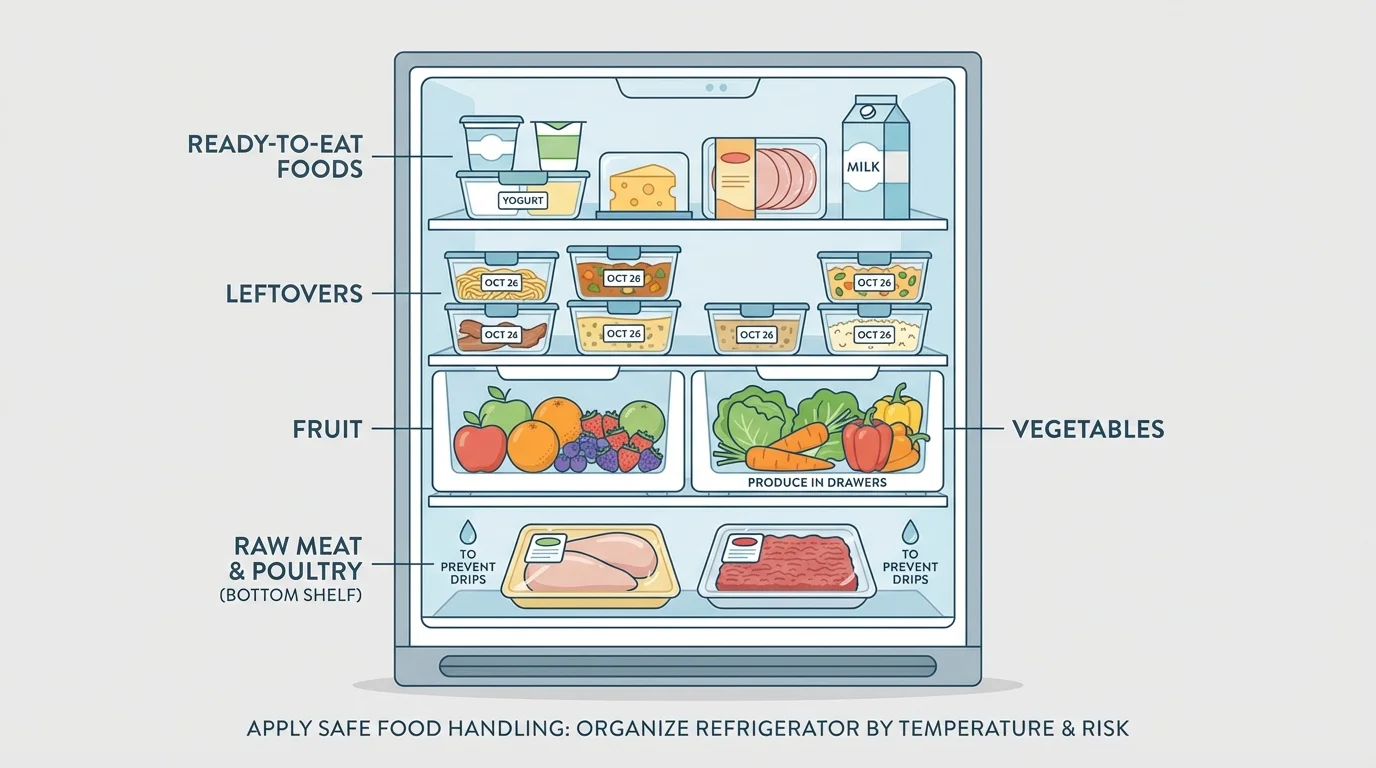
Cross-contamination is one of the biggest kitchen risks, and it often happens through small mistakes. Raw meat juices on a cutting board, dirty hands after touching eggs, or a towel used on several surfaces can spread germs. Raw foods that may contain harmful bacteria should stay separate from foods you eat without further cooking, and raw meat belongs below other foods in the refrigerator, as shown in [Figure 1].
Start with clean hands. Wash your hands with soap and warm water before cooking, after touching raw meat, after using the bathroom, after coughing or sneezing into your hands, and after handling trash or pets. Scrub for about 20 seconds. A simple way to time it is to sing part of a song or count slowly.
Keep surfaces and tools clean too. Wash cutting boards, knives, counters, and mixing bowls after they touch raw meat, poultry, seafood, or eggs. If possible, use one cutting board for raw meats and another for fruits, vegetables, bread, or cooked foods. Proper refrigerator storage is another important way to prevent contamination. If you only have one, wash it thoroughly with hot soapy water before using it again.
Temperature matters. Bacteria grow quickly in the danger zone, which is the temperature range where food becomes unsafe faster. A practical rule is this: do not leave perishable food sitting out for long. Refrigerate leftovers soon after eating, especially foods with meat, dairy, eggs, cooked rice, or cooked pasta.
Pay attention to labels, but do not rely on them blindly. A best-before date usually refers to quality, not always safety. A use-by date is more urgent. Even before those dates, food can go bad if it is stored incorrectly. Trust both the label and the condition of the food.
Storage order helps protect your food. Ready-to-eat foods go on upper shelves. Raw meat, poultry, or seafood should be sealed and stored on the bottom shelf so drips cannot contaminate other foods, which is the exact safety pattern shown earlier in [Figure 1]. Leftovers should be kept in clean containers with lids, and it helps to label them with the date.
Cooked rice is one of the foods people often underestimate. If it sits out too long, bacteria can multiply even though the rice may still look normal.
When in doubt, be cautious. If a food has been left out too long, smells off, feels slimy, or has visible mold, throw it away. Saving a few dollars is not worth getting sick.
Safety gets much easier when you follow the same routine every time. Instead of trying to remember random rules, build a sequence.
Before cooking: tie back long hair, wash your hands, clear the counter, gather ingredients, and check expiration dates. If you are using frozen meat, thaw it in the refrigerator, not on the counter.
During cooking: keep raw and cooked foods separate, wipe spills quickly, use clean utensils for tasting, and put ingredients back in the fridge if they will not be used for a while. Do not put cooked food back on the same plate that held raw meat.
After cooking: cool and store leftovers, wash dishes and tools, wipe counters, and check the sink area. This part matters because tomorrow's safe meal often depends on today's cleanup.
A kitchen routine saves mental energy. When you always wash, separate, cook, store, and clean in the same order, you make fewer mistakes. Routines are useful because you do not have to rethink every step each time you make a meal.
If you cook for yourself after online classes, sports practice, or work, routine matters even more. You may be tired, distracted, or hungry. That is when people forget the basic safety steps.
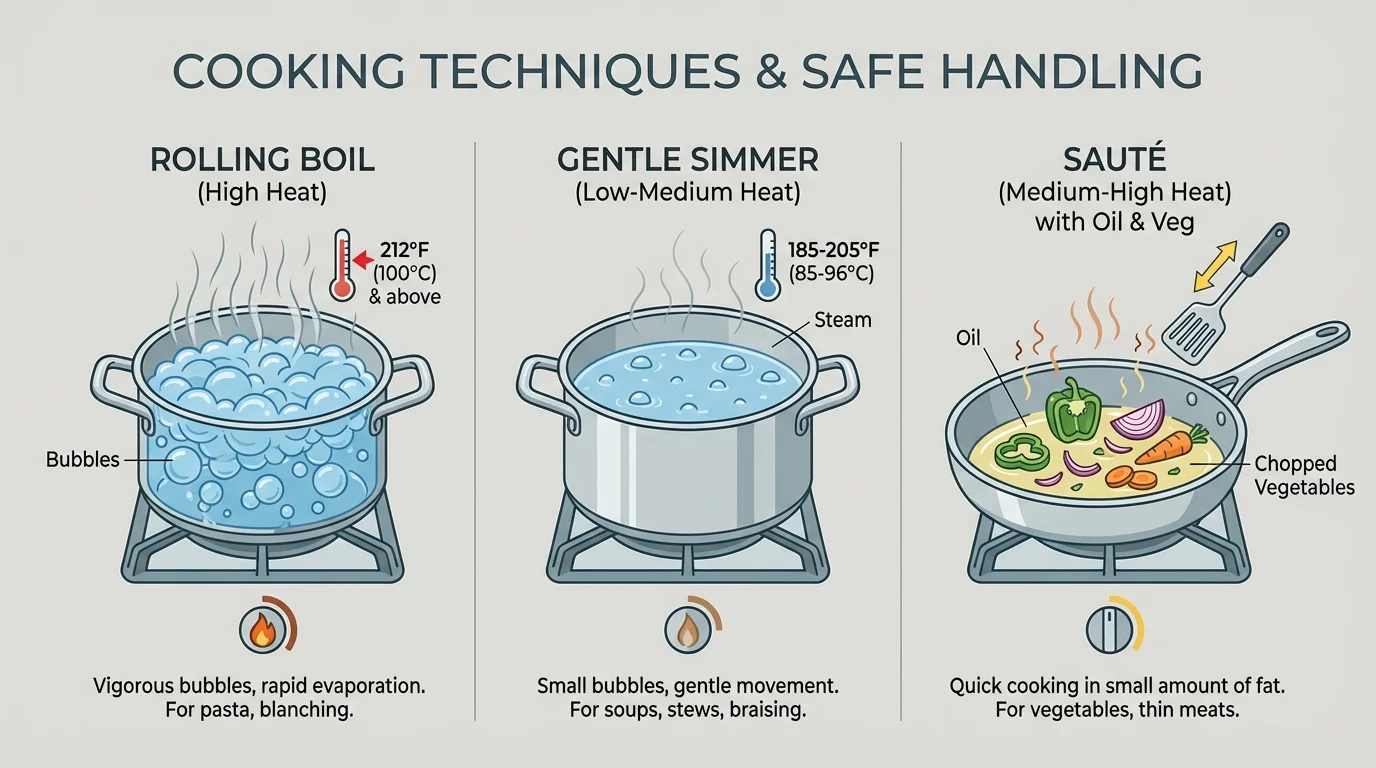
You do not need ten advanced methods. You need a few basic ones you can trust. Heat level changes how food cooks, how fast moisture evaporates, and how the final texture turns out. As shown in [Figure 2], once you understand a few techniques, you can cook many different foods without needing a strict recipe.
Boiling means cooking food in hot liquid with strong, active bubbles. It works well for pasta, potatoes, and some vegetables. Simmering uses gentler bubbles and is better for soups, beans, sauces, and foods that need time to soften without falling apart.
Sautéing means cooking food quickly in a small amount of oil over medium to medium-high heat. It is great for onions, peppers, spinach, or cut chicken. Cut food into similar-sized pieces so it cooks more evenly.
Roasting and baking both use dry heat in the oven. Roasting is often used for vegetables or proteins and can create browning and crisp edges. Baking is often used for foods like casseroles, potatoes, or simple egg dishes. Spread food out on a pan so hot air can move around it.
Microwaving is useful, not lazy. It can steam vegetables, reheat leftovers, cook oatmeal, and soften foods quickly. The main safety issue is making sure food heats evenly. Stir partway through if possible, and check that the center is hot.
Knife safety matters just as much as heat safety. Use a stable cutting board, curl your fingers slightly inward when holding food, and cut slowly. A rushed cut causes more injuries than a careful one. Keep the blade pointed down when carrying a knife, and never try to catch a falling knife.
Seasoning can make cheap meals taste much better. Salt, pepper, garlic powder, onion powder, dried herbs, soy sauce, lemon juice, salsa, and a little oil can change a basic bowl of rice and beans into something you actually want to eat. Start small. You can add more, but you cannot easily remove too much salt.
Using one ingredient with different techniques
A potato is a great example of how cooking method changes the result.
Step 1: Boil it.
Cut potato pieces and cook them until soft; they are good for soup, mashed potatoes, or adding to a skillet meal.
Step 2: Roast it.
Toss pieces with a little oil and seasoning, then roast until browned. The outside gets crisp while the inside stays soft.
Step 3: Microwave it.
A whole potato cooks faster this way and can become an easy meal with beans, cheese, or leftover vegetables on top.
One low-cost ingredient becomes several different meals just by changing the technique.
Later, when you are deciding whether a food should cook fast or slow, the visual comparison in [Figure 2] helps you match the method to the result you want.
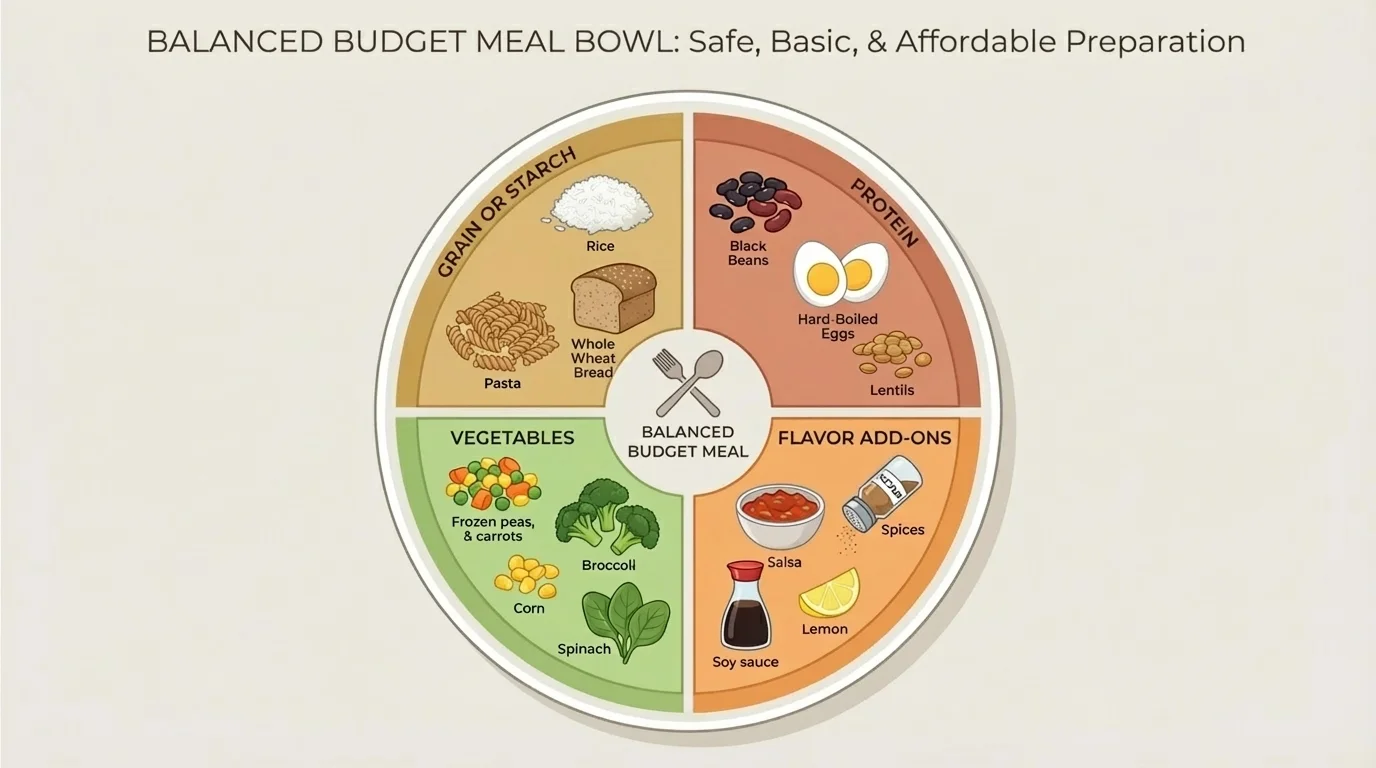
One of the easiest ways to plan meals is to stop thinking in terms of perfect recipes and start thinking in patterns. As shown in [Figure 3], a simple, repeatable meal structure keeps shopping easier and cuts down on waste. One useful pattern is a grain or starch, a protein, vegetables or fruit, and flavor.
A low-cost meal can still be filling and nutritious. For example, rice plus black beans plus frozen mixed vegetables plus salsa is cheap, fast, and balanced. Oatmeal with peanut butter and banana is another affordable option that gives you energy and protein.
Think in categories:
Frozen and canned foods can be smart choices. Frozen vegetables are often cheaper, last longer, and reduce waste because you use only what you need. Canned beans save time, though you may want to rinse them. Dried beans cost less but take longer to prepare.
Balanced meals do not need to look perfect or complicated. If you include a source of energy, a source of protein, and some produce most of the time, you are building a stronger routine than many people who only chase trendy foods.
Leftovers are part of smart meal building. If you cook extra rice tonight, it can become tomorrow's burrito bowl or fried rice-style meal. If you roast extra vegetables, they can go into eggs, pasta, or a wrap the next day. The meal pattern in [Figure 3] works especially well for leftovers because each part can be swapped without starting over.
Budget-friendly meal preparation starts before you cook. It starts when you decide what to buy. Walking into a store hungry and without a list often leads to expensive choices and random foods that do not turn into actual meals.
Make a short plan first. Choose about \(2\) or \(3\) main meals for the next few days, then list the ingredients. Check what you already have before shopping. If you already own rice, oil, and spices, you do not need to buy them again.
Compare unit price, not just package price. A larger item may cost more up front but less per ounce or per serving. For example, if one bag of rice costs $2 for \(2\) pounds and another costs $3 for \(5\) pounds, the second one gives more food for the money. The cost per pound is \(\dfrac{2}{2} = 1\) dollar per pound for the first bag and \(\dfrac{3}{5} = 0.6\) dollars per pound for the second bag.
Store brands are often worth trying. In many cases, the quality difference is small, but the savings add up. Buying ingredients instead of many single-serve snacks usually lowers the cost too.
| Item | Option A | Option B | Better Budget Choice |
|---|---|---|---|
| Rice | $2 for \(2\) lb | $3 for \(5\) lb | Option B |
| Yogurt | $1 each for \(4\) small cups | $3.50 for \(1\) large tub | Usually Option B |
| Carrots | $1.50 baby carrots | $1 whole carrots | Usually whole carrots |
Table 1. Examples of comparing package price and value to make lower-cost food choices.
Watch out for waste. A deal is not a deal if you never use the food. Buying a giant container of spinach for cheap does not help if half of it turns slimy in the fridge. Start with realistic amounts.
Simple meal-cost check
You want to make bean and rice bowls for \(4\) servings.
Step 1: Add the ingredient costs.
Rice costs $1.20, beans cost $1.80, frozen vegetables cost $2.40, and salsa costs $2.60.
Step 2: Find the total cost.
The total is \(1.20 + 1.80 + 2.40 + 2.60 = 8.00\), so the meal costs $8 total.
Step 3: Find the cost per serving.
Divide by \(4\): \(8.00 \div 4 = 2.00\). Each serving costs $2.
That is much cheaper than many fast-food meals, and it gives you a full meal rather than just a snack.
If money is tight, build your plan around a few versatile ingredients instead of lots of specialty foods. Rice, pasta, oats, eggs, beans, potatoes, onions, bananas, frozen vegetables, and peanut butter can be used in many ways.
Here are some realistic meals a beginner can make:
Breakfast: oatmeal with banana and peanut butter; scrambled eggs with toast; yogurt with oats and fruit.
Lunch: bean and cheese quesadilla with salsa; tuna sandwich with carrot sticks; leftover rice bowl with vegetables.
Dinner: pasta with tomato sauce and sautéed vegetables; baked potato with beans and shredded cheese; chicken, rice, and frozen broccoli.
Snack ideas: apples with peanut butter, toast, popcorn, yogurt, boiled eggs, or a banana.
These meals work because they use overlapping ingredients. If you buy tortillas, cheese, beans, salsa, rice, oats, eggs, bananas, and frozen vegetables, you can make several meals from the same grocery trip instead of buying completely different ingredients for every dish.
Mistake 1: Leaving food out too long. Fix it by putting leftovers away soon after eating.
Mistake 2: Using the same board or knife for raw meat and ready-to-eat food. Fix it by washing tools well between tasks or using separate boards.
Mistake 3: Cooking everything on high heat. Fix it by matching the heat to the method. Simmer soups, sauté quickly, and roast when you want browning.
Mistake 4: Buying groceries without a plan. Fix it by choosing a few meals first and shopping from a list.
Mistake 5: Forgetting leftovers. Fix it by placing them where you will see them and labeling containers.
Mistake 6: Thinking cheap food must be unhealthy or boring. Fix it by learning a few seasonings and combining simple ingredients better.
"Good cooking is less about perfection and more about paying attention."
That idea applies to safety, taste, and budgeting. Pay attention to where raw food touches, how heat changes food, and whether what you buy can turn into several real meals.
Pick one meal you can make with ingredients already at home. Before cooking, wash your hands, clear a space, and gather tools. While cooking, notice which method you are using: boiling, simmering, sautéing, roasting, baking, or microwaving. Afterward, store leftovers correctly.
Then try one small budget habit: make a grocery list for \(3\) meals, compare at least \(2\) prices, or use one leftover ingredient in a new way. Skills grow faster when you repeat small actions, not when you wait to become "good at cooking" first.
