Sometimes a problem feels small at first, but it can grow bigger if no grown-up knows. If someone is being mean, leaving you out on purpose, or doing something unsafe, you do not have to handle it alone. You can tell a trusted adult.
Teasing is when someone says or does unkind things to make you feel bad. Exclusion is when someone leaves you out on purpose. Unsafe behavior is anything that can hurt your body, your feelings, or your safety.
Trusted adult means a grown-up who listens, helps, and works to keep you safe. This can be a parent, grandparent, caregiver, family friend, coach, counselor, or another safe grown-up in your life.
Telling an adult is not tattling when someone is getting hurt, scared, or treated badly. Telling is how you get help. It helps keep you safe and can help other children stay safe too.
A trusted adult is someone you can safely go to for help, as [Figure 1] shows with different grown-ups in a child's life. This might be a parent, grandparent, aunt, uncle, babysitter, neighbor your family knows well, coach, club leader, or your remote teacher.
A trusted adult listens carefully. They believe you, help you calm down, and take action. You may have more than one trusted adult, and that is a good idea.
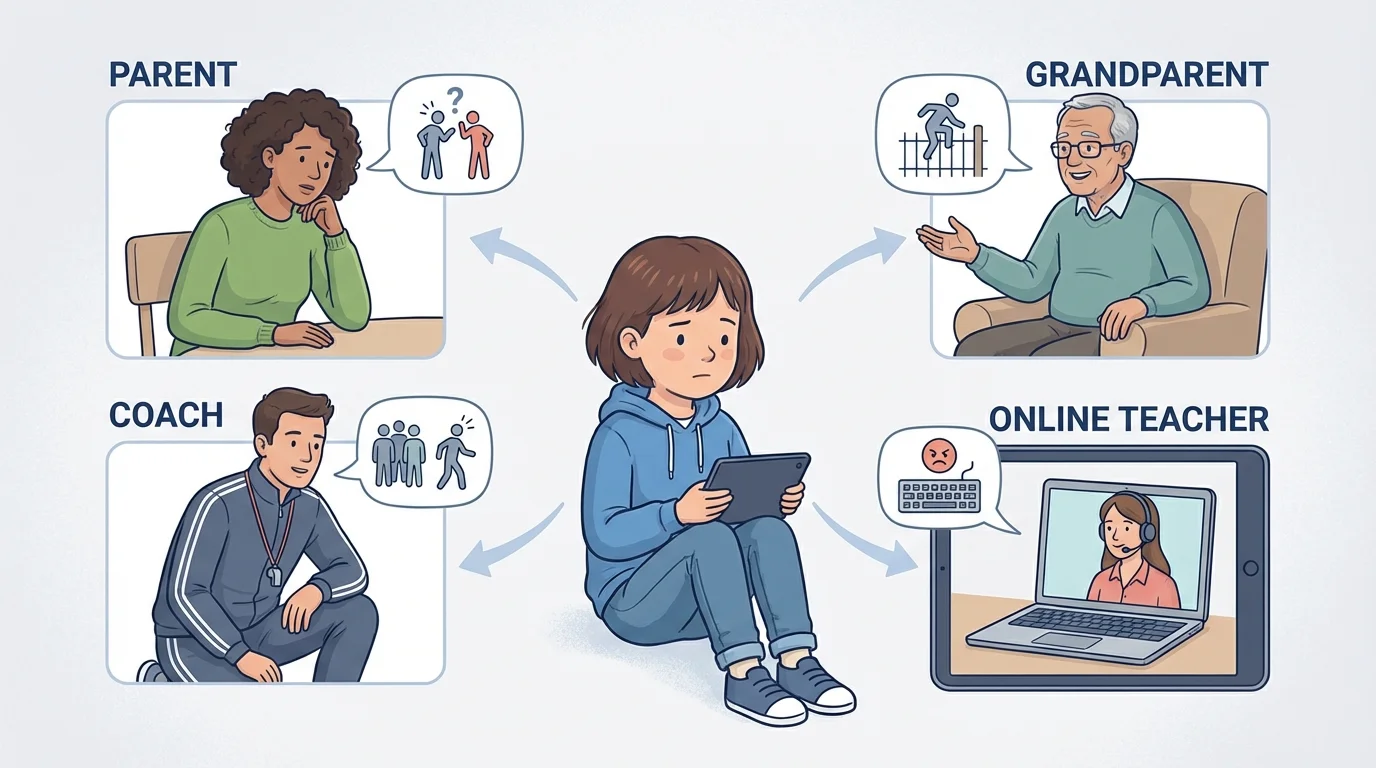
You can make a small "help list" in your mind. Think of three adults you can tell. If one adult is busy, you can tell the next one.
Safe adults help, not blame. A trusted adult should stay calm, listen to your words, and help you decide what to do next. If a grown-up tells you to keep unsafe behavior a secret, that person is not acting like a safe helper.
Sometimes children worry, "What if I get someone in trouble?" The most important thing is safety. If someone is teasing, excluding, or acting unsafe, adults need to know.
There are clear clues that mean it is time to tell an adult, and [Figure 2] illustrates several of them. Tell right away if someone hurts you, threatens you, tells you to keep a scary secret, sends mean online messages, shows private body parts, asks to see your private body parts, touches you in a way that is not safe, or tries to make you do something that feels wrong.
You should also tell if someone keeps leaving you out on purpose or laughs when you feel sad. Being left out over and over can hurt feelings and make you feel lonely. Adults can help fix the problem.
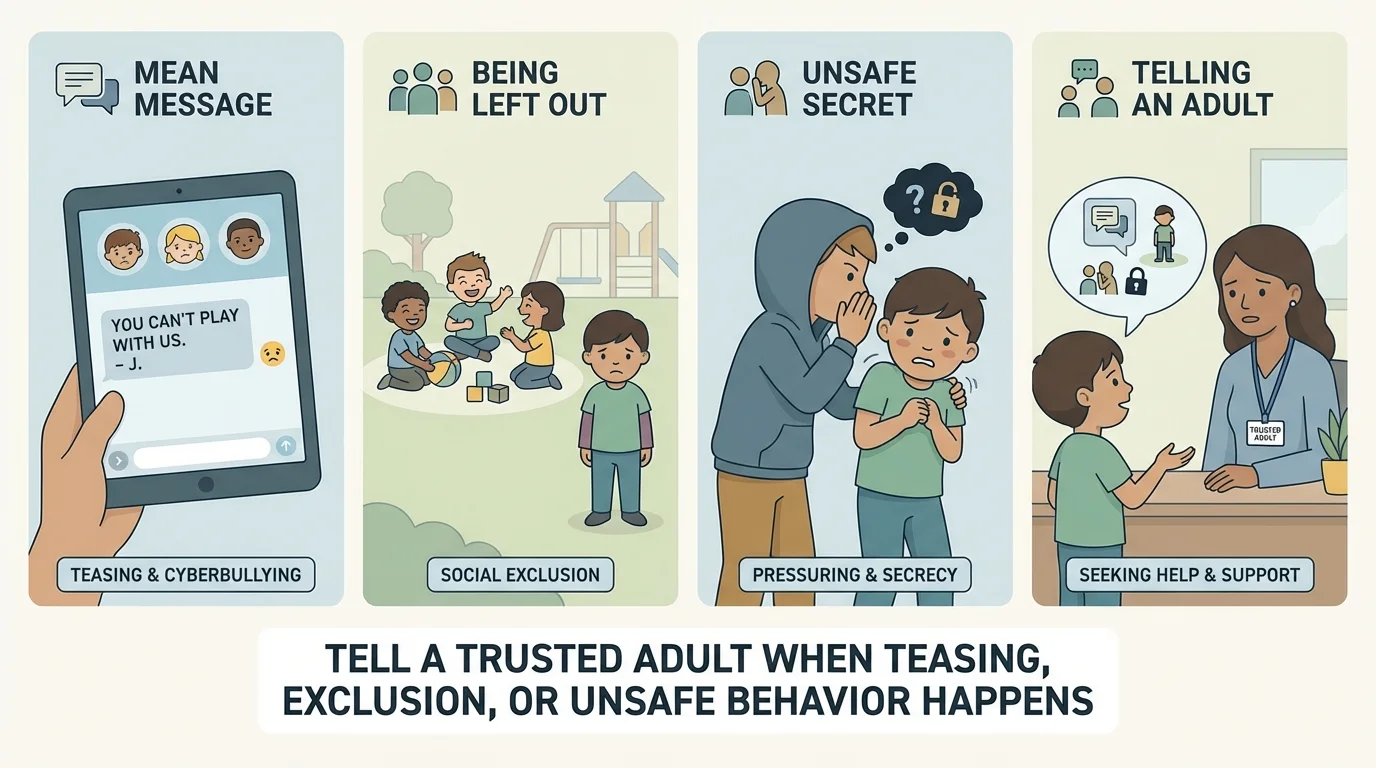
If something makes your tummy feel tight, your chest feel tight, or your mind say, "Uh-oh," pay attention. Those feelings can be signs that you need help.
Your body can give you warning signs before you even know all the words for the problem. Feeling shaky, scared, frozen, or very confused can mean it is time to go to a trusted adult.
Even if you are not sure whether it is a big problem, you can still tell. Safe adults would rather know than have you stay worried and alone.
There is a simple way to remember how to get help: stop, go, and tell. Stop what is happening if you can, go to a trusted adult, and tell what happened in simple words.
[Figure 3] You do not need a long story. Short, clear words work well. You can say, "I need help." You can say, "Someone is being mean to me." You can say, "I do not feel safe."
Here are easy sentence starters you can use: "Someone left me out on purpose." "I got a mean message." "A person told me to keep a secret and it scared me." "Someone touched me and I did not like it." "I saw something unsafe."
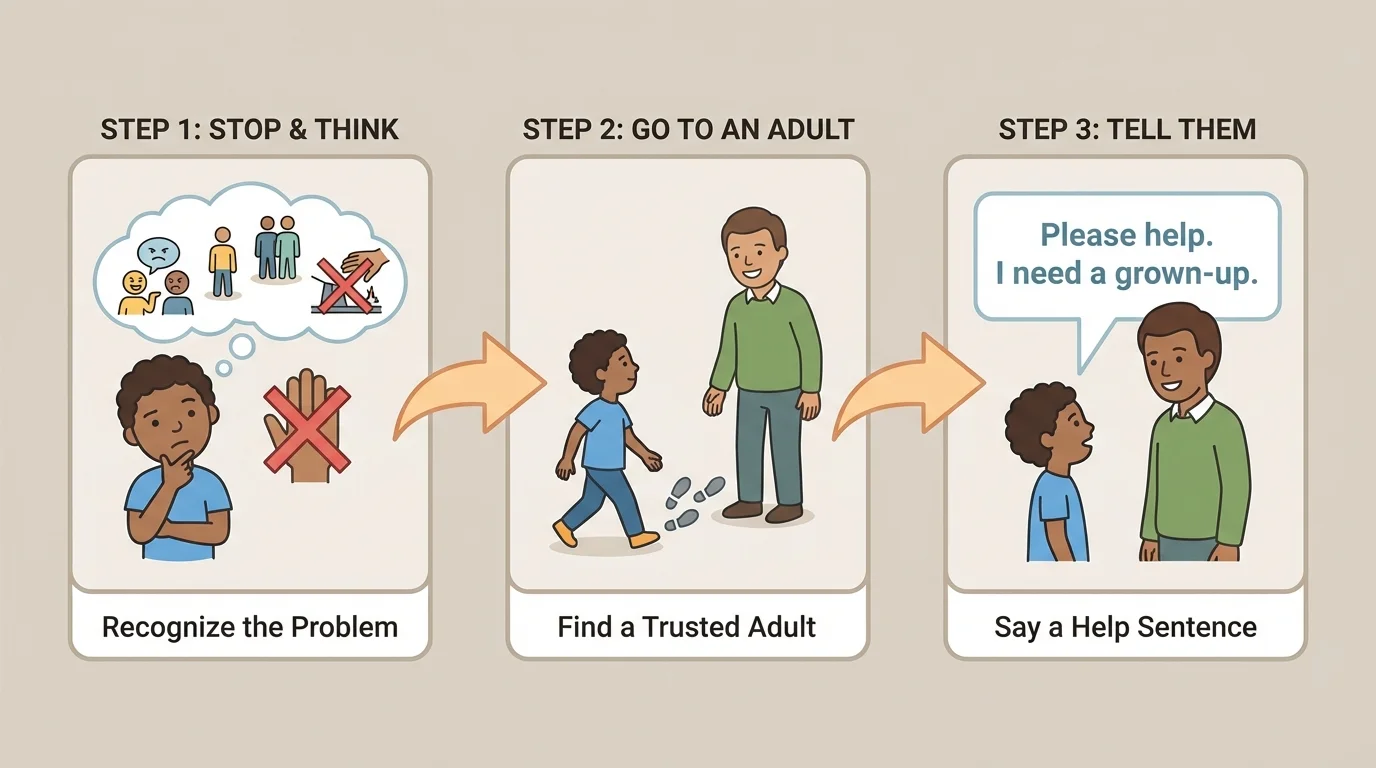
What telling can sound like
Step 1: Get close to a trusted adult.
Walk to them, call them, or ask for a private moment on a video call.
Step 2: Say the problem clearly.
Try: "I need to tell you something important. Someone was teasing me in the group chat."
Step 3: Share how you feel.
Try: "It made me feel sad and scared."
Step 4: Ask for help.
Try: "Can you help me now?"
If talking feels hard, you can still get help. You can point, whisper, send a message to your grown-up, or say just one important sentence. The adult can help you with the rest.
Most trusted adults will help right away. But if the first adult does not listen, stays too busy, or does not understand, tell another trusted adult. Keep telling until someone helps you.
This is important for serious problems like unsafe touch, threats, scary secrets, or repeated meanness. As we saw earlier in [Figure 1], you can have more than one safe grown-up in your life.
"If it feels unsafe, keep telling until a safe grown-up helps."
You are not being a problem. You are solving a problem by asking for help.
Here are some times when telling is the right choice. If a child in your neighborhood says, "You can't play with us," again and again, tell a trusted adult. If someone sends unkind words in a game or chat, tell. If an older child dares you to do something dangerous, tell. If anyone asks you to keep an unsafe secret, tell right away.
Maybe someone says, "Don't tell or I won't be your friend." That is another sign you should tell. Safe friends do not use fear to control you.
Quick real-life examples
Example 1: In an online game, another child types, "You're dumb. Go away."
You can leave the chat, save the message to show a trusted adult, and tell a trusted adult.
Example 2: At a park playgroup, children run away and say you cannot join every time.
You can go to your caregiver and say, "They keep leaving me out, and I need help."
Example 3: Someone says, "Keep this secret from your family," and it makes you feel scared.
You should tell a trusted adult right away. Unsafe secrets should not be kept.
When you speak up, adults can help stop the problem, comfort you, and make a safer plan. That is why telling matters.
