Long ago, many children walked to school, rode a horse, or did not go to school every day at all. Today, many students ride in cars or buses and learn with books, computers, and tablets. Looking at these differences is like being a history detective. When we compare the past and the present, we learn how people, ideas, and events helped shape the communities where we live now.
To compare means to look at two things and notice how they are alike and how they are different. In history, we compare past situations and events with present ones. A situation is how life is at a certain time, such as how people traveled, learned, or communicated. An event is something that happened, such as a town being built, a railroad arriving, or a bridge opening.
Comparing the past and present helps us answer important questions. How did people live before cars, phones, and airplanes? Why are towns built near rivers, roads, or railroads? How did earlier people make choices that still affect us now? When we ask these questions, we begin to see that the world did not suddenly become the way it is today. It changed bit by bit over time.
Past means the time long ago. Present means now. History is the study of people and events from the past. Community means a group of people who live, work, or learn together in the same place.
Some changes happen quickly, but many happen slowly. A dirt path may become a road. A road may help a town grow. The town may later have stores, schools, and neighborhoods. By comparing different times, we can understand how communities develop and how regions connect with one another.
[Figure 1] Historians learn about the past by studying primary sources and secondary sources. A primary source comes from the time being studied. It can be a photograph, a diary, a letter, an old newspaper, a tool, or a piece of clothing. These sources give clues about what people saw, used, and experienced.
A secondary source is made later by someone who studied the past. A history book, an article, or a documentary can be a secondary source. Both kinds of sources are helpful. Primary sources bring us close to the time long ago, and secondary sources help explain what the evidence means.
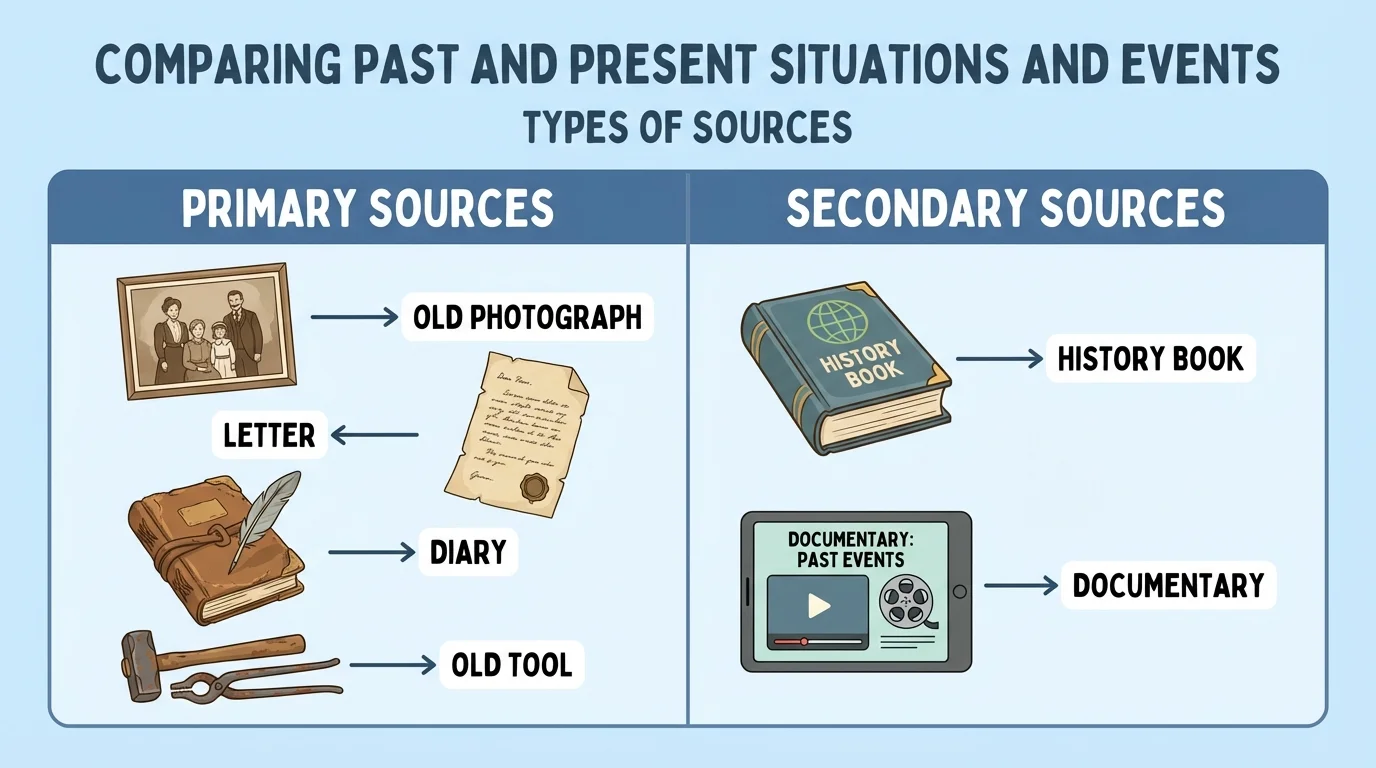
Suppose a class wants to learn about a town from 100 years ago. Students might look at old photographs of the main street, read a diary from a child who lived there, and examine a map. Then they might read a book about the town's history. By using more than one source, they can make a stronger comparison between life then and life now.
Some museums keep toys, dishes, tools, and clothing from long ago. Ordinary objects can teach us a lot because they show what everyday life was really like.
When we compare sources, we should ask: Who made this? When was it made? What does it show? What does it leave out? A photograph may show a wagon on a street, but it may not tell us how long the trip took. A diary may tell feelings and daily routines that a photograph cannot. Looking carefully helps us build a fuller picture of the past.
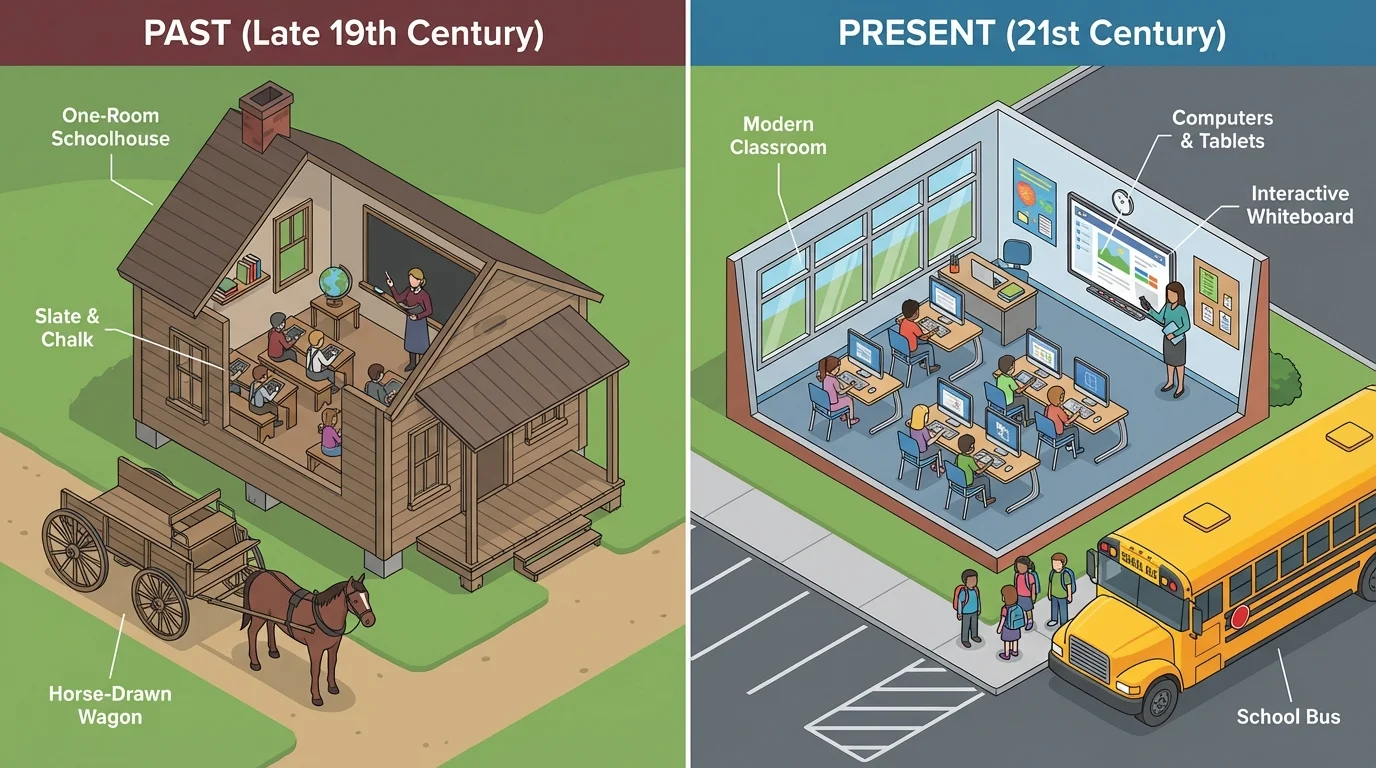
[Figure 2] One of the easiest ways to compare history is to look at everyday life. Children in the past and children today both learn, play, help their families, and belong to communities. The examples in school and transportation show how the tools and routines of daily life may be very different.
Schools in the past were often smaller. Some children went to one-room schoolhouses where one teacher taught many grades together. Students wrote on slates or paper and used fewer supplies than many students use today. Schools today often have separate classrooms, libraries, cafeterias, playgrounds, and technology tools such as computers.
Transportation has changed a great deal. Long ago, people often walked, rode horses, or traveled by wagon or boat. Trips could take many hours or even days. Today, people use cars, buses, trains, and airplanes. This change helps communities connect more quickly. Food, mail, and people can move more easily from one place to another.
Communication has changed too. In the past, letters carried news from one person to another, and messages could take a long time to arrive. Later, the telephone made communication faster. Today, people can send messages almost instantly using phones or computers. Even though tools changed, the need to share news and stay connected stayed the same.
Homes and chores were different as well. Many families in the past cooked over fires or wood stoves, carried water by hand, and washed clothing without machines. Today, many homes have electricity, running water, refrigerators, and washing machines. These inventions changed daily work and gave people more time for other tasks.
| Part of Life | Past | Present |
|---|---|---|
| School | Often one room, fewer supplies | Many classrooms, more tools and technology |
| Travel | Walking, horses, wagons, boats | Cars, buses, trains, airplanes |
| Communication | Letters, face-to-face talks | Phones, computers, fast messages |
| Home chores | More done by hand | Many machines help with chores |
Table 1. A comparison of everyday life in the past and the present.
When we compare daily life, we should be careful not to say that all people lived exactly the same way. Life in a city could be different from life on a farm. Life in one region could be different from life in another. History includes many experiences.
A community changes because people make choices, build places, and create connections. Long ago, many communities began near rivers, forests, or good farmland. People needed water, food, and ways to move goods. If a river allowed boats to travel, that place could grow into a busy town.
Farmers are an important example. When people learned how to grow crops and raise animals, they could stay in one place more often. Villages and towns grew. Food surpluses meant not everyone had to farm. Some people became builders, shopkeepers, or craftspeople. In this way, people in the past helped create stronger communities.
Trade also linked places together. If one area had fish, another had grain, and another made tools, people could exchange what they had. Trade helped communities depend on one another. Over time, roads, ports, and railroads made these connections larger and faster. A region is a larger area that may include many communities. When communities trade and travel, regions become more connected.
How people influence communities
People in the past influence later communities by building homes, roads, bridges, schools, markets, and places to worship. They also influence communities through inventions, laws, traditions, and movement from one place to another. Even choices made long ago, such as where to build a town, can still matter today.
The arrival of a railroad is one example of a past event changing a place. Before the railroad, a town might be small because travel was slow. After tracks were built, goods and people could move quickly. Stores opened, workers arrived, and the town grew. A road, bridge, harbor, or canal can have a similar effect.
Migration changed communities too. Migration means moving from one place to another. Families moved for land, jobs, safety, or new opportunities. When they moved, they brought languages, foods, music, celebrations, and skills. This helped shape the culture of communities and regions.
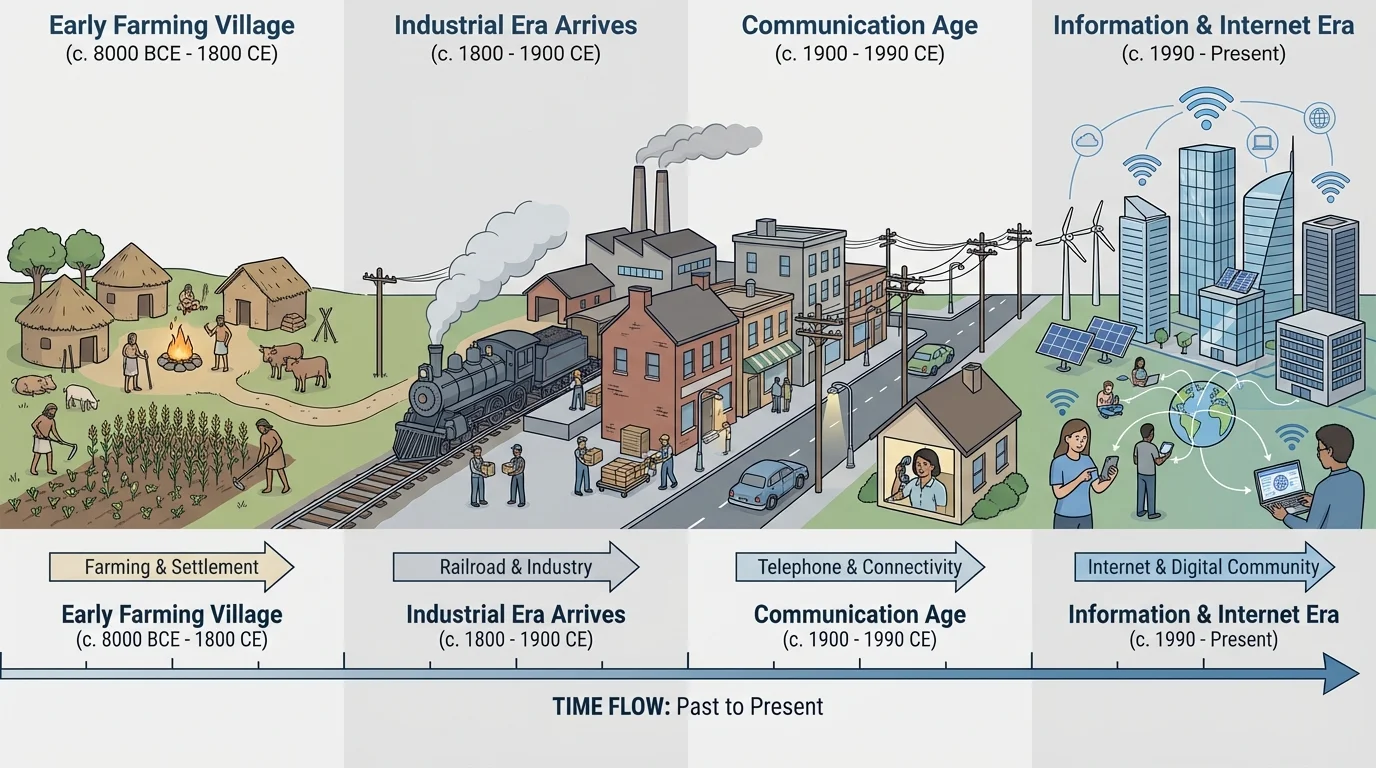
[Figure 3] History is easier to understand when we place events in order on a timeline. A timeline helps us see what happened first, next, and later. It can show how a few important changes are arranged from earlier to later. This matters because one event often leads to another.
For example, first a settlement may grow near a river. Next, roads or railroads may be built. Later, businesses may expand, and more families may move in. Finally, modern technology may connect the place to the wider world. Each step builds on earlier steps.
Some key figures changed communities through leadership, inventions, or brave actions. Inventors helped people travel, communicate, and work in new ways. Community leaders helped build schools, roads, and services. Workers, farmers, and families also mattered because ordinary people shape history through everyday choices.
One important event in many places was the building of schools. A school does more than teach reading and writing. It helps children prepare for the future, brings families together, and strengthens the community. Another important event was the building of roads or railroads, which connected one town to another. These changes often happen over time, not all at once.
We can also compare how communities responded to problems. Long ago, a flood, drought, or fire could greatly affect a town. People worked together to rebuild, move, or change how they used the land. Today, communities still face challenges, but they often have more tools, machines, and communication systems to help.
Case study: A town near a river
A small town begins near a river because people need water and an easy way to move goods.
Step 1: The river helps people settle there.
Families farm nearby land, fish in the river, and build homes close together.
Step 2: Trade helps the town grow.
Boats carry crops and supplies, so shopkeepers and workers come to the town.
Step 3: New transportation changes the town again.
A bridge or railroad makes travel faster, so the town grows into a larger community.
This example shows how people and events from the past can influence the communities we see today.
When students study local history, they may find that their own town grew because of a river, a road, a railroad, a factory, or farmland. That means local places are part of a larger story about how people shape regions.
History is not only about change. It is also about continuity, which means some things stay the same over time. People in the past needed food, water, shelter, safety, and friendship. People today still need these things. Families cared for children in the past, and families care for children now.
At the same time, many things changed. Tools improved. Travel became faster. Communication became quicker. Buildings became larger or stronger. Jobs changed as new inventions appeared. Looking for both change and continuity gives a more complete picture of history.
When you compare two things, look for both similarities and differences. A good comparison does not only say what changed. It also notices what stayed the same.
For example, school has changed because classrooms, books, and technology are different today. But school has also stayed the same in an important way: children still come together to learn. Transportation changed from wagons and horses to cars and buses, but people still travel to work, school, and family gatherings.
These comparisons help us avoid a mistake. The past was not completely different from today, and the present is not completely separate from the past. The two are connected. The choices of earlier people still affect roads, buildings, traditions, and community life.
When you compare a past situation or event with one in the present, ask simple questions. What was happening? Who was involved? Where did it happen? When did it happen? What changed? What stayed the same? Why did it matter? These questions help organize thinking.
Another helpful question is: How did people influence the outcome? Maybe workers built a railroad. Maybe leaders started a school. Maybe families moved into a new area. Maybe inventors created better tools. History is full of people making choices that affected communities around them.
You can also compare by using clue words such as before, after, earlier, later, same, and different. These words make your ideas clear. For example: "Earlier, people sent letters and waited days for news. Today, people use phones and get news quickly." That sentence tells both the change and the comparison.
"The more you know about the past, the better prepared you are for the future."
— Theodore Roosevelt
Learning to compare past and present situations and events helps us understand why our world looks the way it does. Towns, schools, roads, and traditions all have stories behind them. By paying attention to those stories, we can see how people from long ago still influence our lives today.
