Gold in mountain streams, cattle on wide grasslands, trains carrying crops, skiers on snowy slopes, and people designing computer programs in cities all belong to Colorado's story. That may sound like many different worlds, but they are all part of the same state economy. Over time, people in Colorado have made different things, offered different services, and changed their choices when new opportunities appeared.
Colorado has not always produced the same kinds of things. Long ago, people living in this region grew food, hunted, traded, and made useful items. Later, miners searched for gold and silver. After that, railroads helped ranchers and farmers send their products farther away. In more recent times, factories, energy companies, tourism businesses, and technology companies became important too.
When we study these changes, we are studying the economy. An economy is the way people make, buy, sell, and trade goods and services. Colorado's economy changed because people responded to what they needed and to the rewards or problems they faced.
Goods are things people make or grow that can be used or sold, such as crops, cattle, tools, coal, or computers.
Services are jobs people do for others, such as teaching, driving trains, guiding tourists, fixing machines, or running hotels.
Incentives are reasons that encourage or discourage people from making certain choices. A reward is a positive incentive. A cost, danger, or punishment is a negative incentive.
People often respond to positive incentives because they hope for something good. For example, if farmers can earn more money by selling crops to a bigger market, they may grow more crops. People also respond to negative incentives. If mining becomes too dangerous or too expensive, some miners may leave and choose other work.
These ideas help explain Colorado history. The state's mountains, plains, rivers, and climate gave people many choices, but incentives helped decide which choices looked best at different times.
Before Colorado became a state in 1876, Native nations such as the Ute, Arapaho, and Cheyenne lived in this region. As [Figure 1] shows, they used land and natural resources in many ways. Some groups hunted buffalo and other animals. Others farmed, gathered plants, traded goods, and made tools, clothing, and shelters. In this early economy, people exchanged useful items and labor to meet needs.
Early goods in Colorado included animal hides, dried meat, crops such as corn and beans in some communities, tools, and handmade items. Early services included trading, guiding travelers, caring for horses, and helping groups move goods from place to place.
Later, Spanish explorers, traders, trappers, and settlers entered the region. Trappers wanted beaver fur, which could be made into hats and clothing in eastern cities and in Europe. Beaver pelts were an important good. Traders offered services by carrying goods between places and helping people exchange what they had for what they needed.
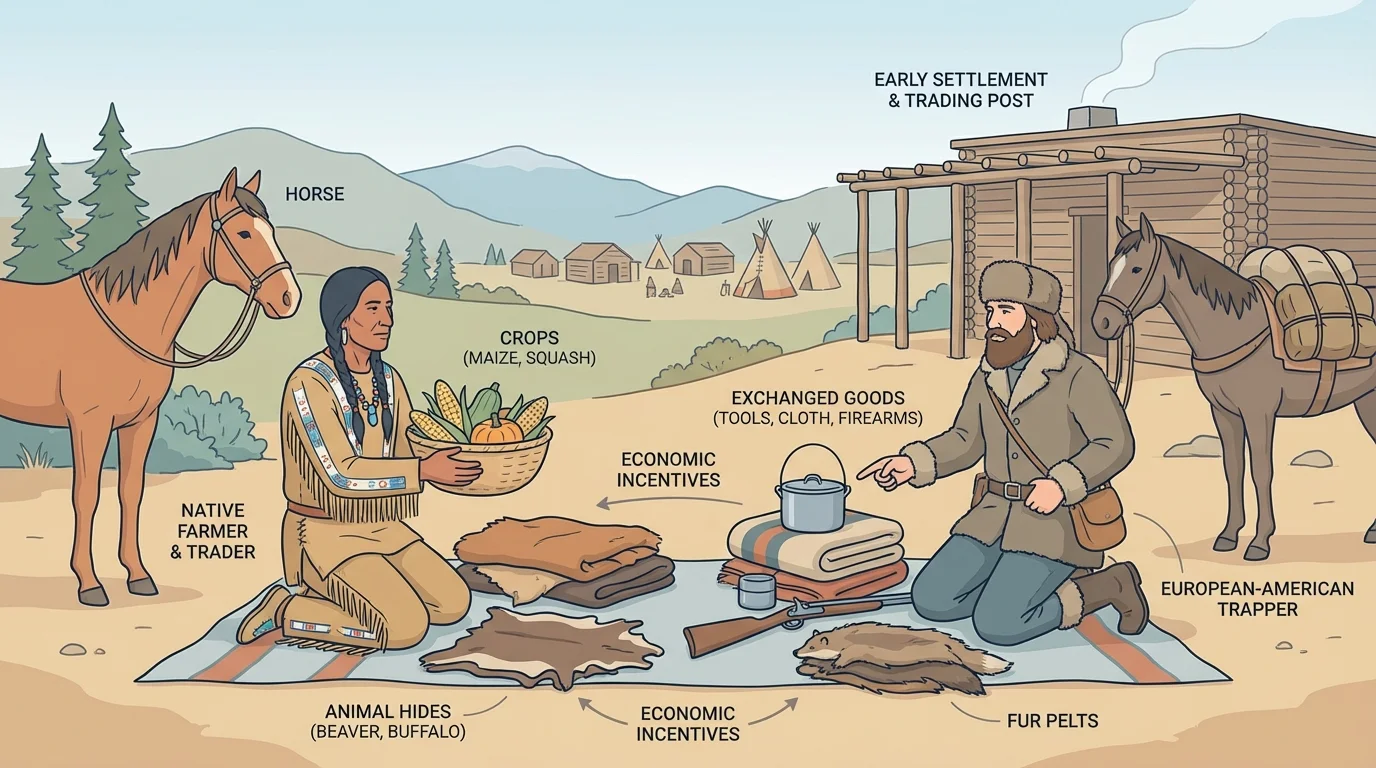
Why did people do this work? Incentives mattered. A positive incentive for trappers was the chance to earn money or valuable trade items from furs. A negative incentive was danger. Trapping could be cold, difficult, and risky. Weather, wild animals, and long travel could make the job hard.
For early farmers, a strong positive incentive was survival. Growing food helped families and communities eat through the year. A negative incentive was drought or poor weather. If crops failed, farming became much harder.
Colorado's location made it a meeting place for many groups of people. Because of that, trade became important long before Colorado was a state.
In 1858, news of gold near the Rocky Mountains spread quickly. As [Figure 2] helps show, many people suddenly rushed into the region. This event is often called the Colorado Gold Rush. One natural resource changed the whole economy and led to many other jobs besides mining itself.
The main goods from this period were gold and, later, silver and other minerals. Miners dug these resources out of the ground. These were valuable goods because people could use them in money, jewelry, tools, and machines.
But mining did not stand alone. It created many services. Storekeepers sold supplies. Cooks made meals. Boarding houses gave miners places to sleep. Blacksmiths repaired tools. Stagecoach drivers carried mail and people. Doctors treated injuries. All of these were services connected to mining.
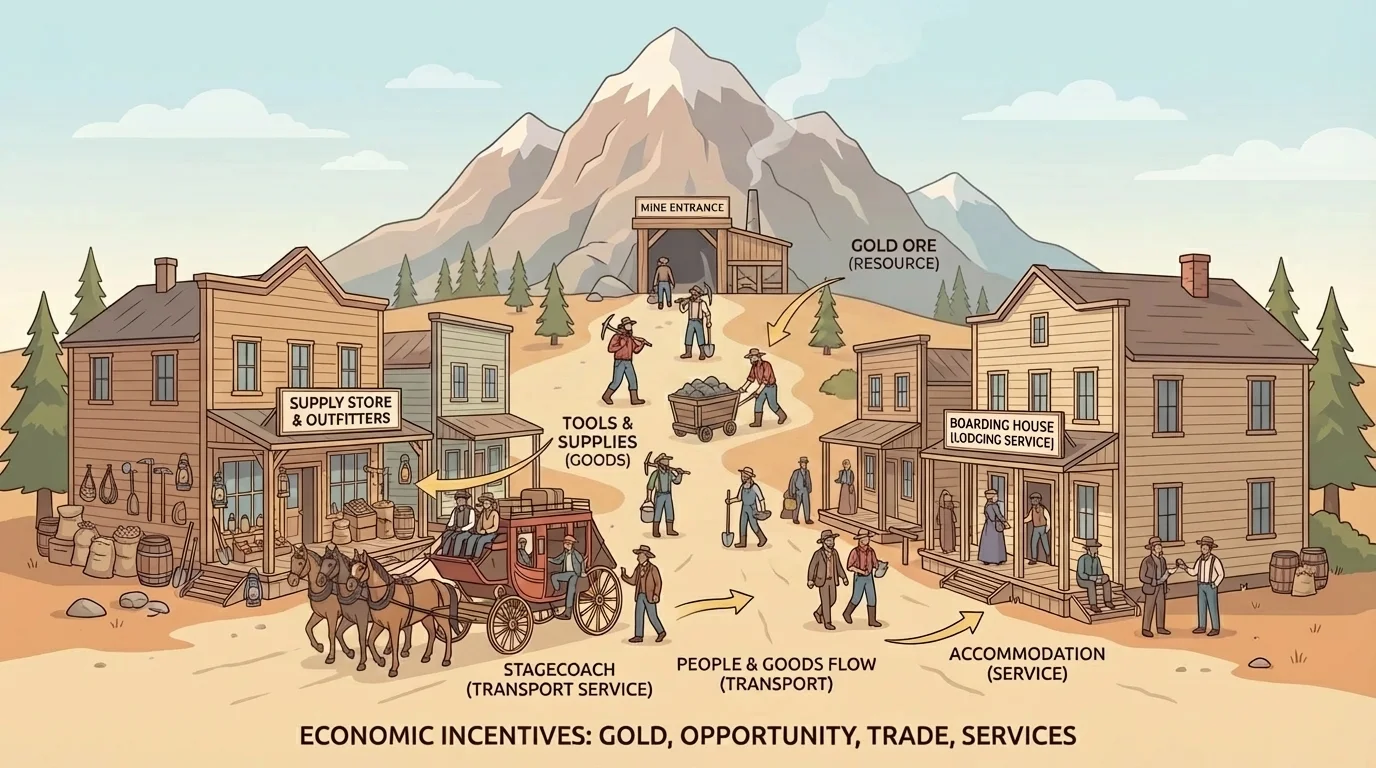
Positive incentives pulled people toward mining. The biggest one was the hope of getting rich. Even if only a few miners found large amounts of gold, the possibility attracted thousands. Businesses also saw opportunity. A shop owner might make steady money selling shovels, boots, and food.
Negative incentives pushed some people away. Mining could be dangerous. Tunnels could collapse. Winters in the mountains could be severe. Sometimes miners spent a lot of money and found very little gold. For some workers, these risks were too high, so they chose safer jobs.
Mining towns grew fast because they followed incentives. If a town was near a successful mine, more businesses opened there. If the ore ran out, people often moved away. That is why some Colorado mining towns became busy centers for a while and then shrank or turned into ghost towns.
After the early mining boom, Colorado's economy became more connected and organized. As [Figure 3] illustrates, railroads were a huge change. They helped move people and goods more quickly and linked farms, ranches, towns, and train depots together.
With better transportation, Colorado could send more goods to other places. Ranchers raised cattle and sheep. Farmers grew wheat, corn, hay, and later sugar beets. These were important goods. The railroad itself also created service jobs, such as engineers, conductors, repair workers, and station workers.
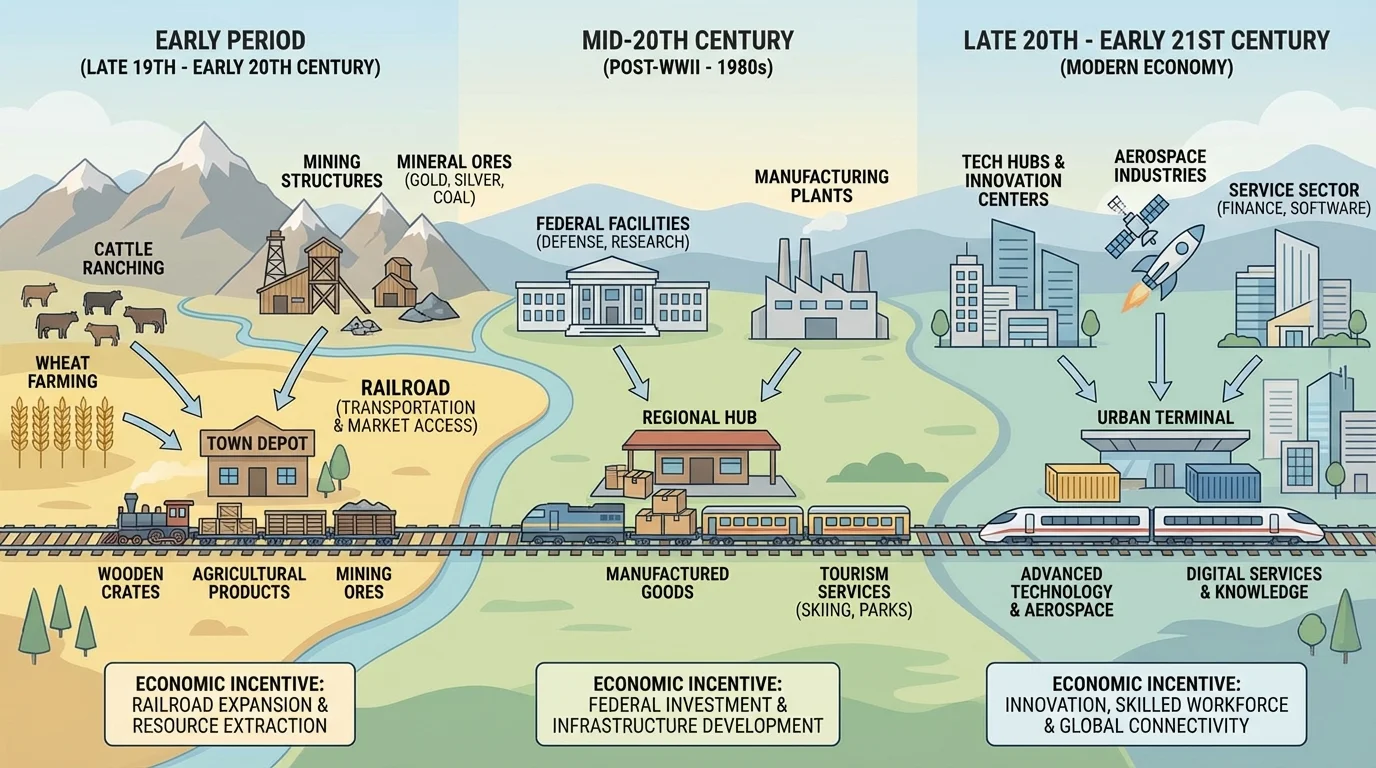
Railroads were a positive incentive because they opened larger markets. Before railroads, moving heavy goods long distances was slow and expensive. With trains, ranchers and farmers could sell to more customers. That made producing cattle and crops more worthwhile.
There were negative incentives too. Farming on the plains could be difficult because of dry weather, harsh winters, and insects. Prices could also change. If crop prices dropped, some farmers earned less money. Even so, many families continued farming because land ownership, food production, and the chance to build a future were powerful incentives.
The growth of towns brought more services. Schools, banks, stores, newspapers, and repair shops became part of Colorado communities. These services supported the people who produced goods and helped towns become permanent places instead of temporary camps.
As Colorado grew in the late 1800s and 1900s, people began producing more than raw materials. They also processed materials in factories. For example, sugar beet farming became important in some areas. Farmers grew sugar beets as a crop, and factories processed them into sugar. This added more jobs and value.
Colorado also became known for steel production in Pueblo. Coal mining and other energy industries helped power factories, trains, and homes. Coal was an important good, and miners, factory operators, and railroad workers provided services that kept the system running.
How one industry supports another
Sometimes one good or service leads to many others. Mining needed tools, food, and transportation. Farming needed railroads, mills, and markets. Tourism needs hotels, restaurants, and guides. Economies are made of connected parts, not separate pieces.
Incentives again mattered. Factory jobs offered regular pay, which was a positive incentive for many workers. Businesses had incentives too. If Colorado had useful natural resources, railroad connections, and workers, companies had reasons to build there.
Negative incentives included hard working conditions, pollution, and changes in demand. If a factory could not make enough profit, it might close. If a resource became scarce, people had to look for new industries.
Today, Colorado produces many different goods and services. As [Figure 4] shows, its economy is more varied than it was in the past. Colorado now includes agriculture, energy, tourism, technology, and urban businesses at the same time.
Modern goods include cattle, corn, wheat, peaches from the Western Slope, manufactured products, electricity from energy sources, and items made with advanced technology. Some companies also create equipment for science, medicine, and outdoor activities.
Modern services are a huge part of Colorado's economy. Ski instructors, hotel workers, park rangers, doctors, teachers, truck drivers, software designers, and engineers all provide services. Tourism is especially important. Visitors come to ski, hike, camp, and enjoy national parks, state parks, and mountain towns.
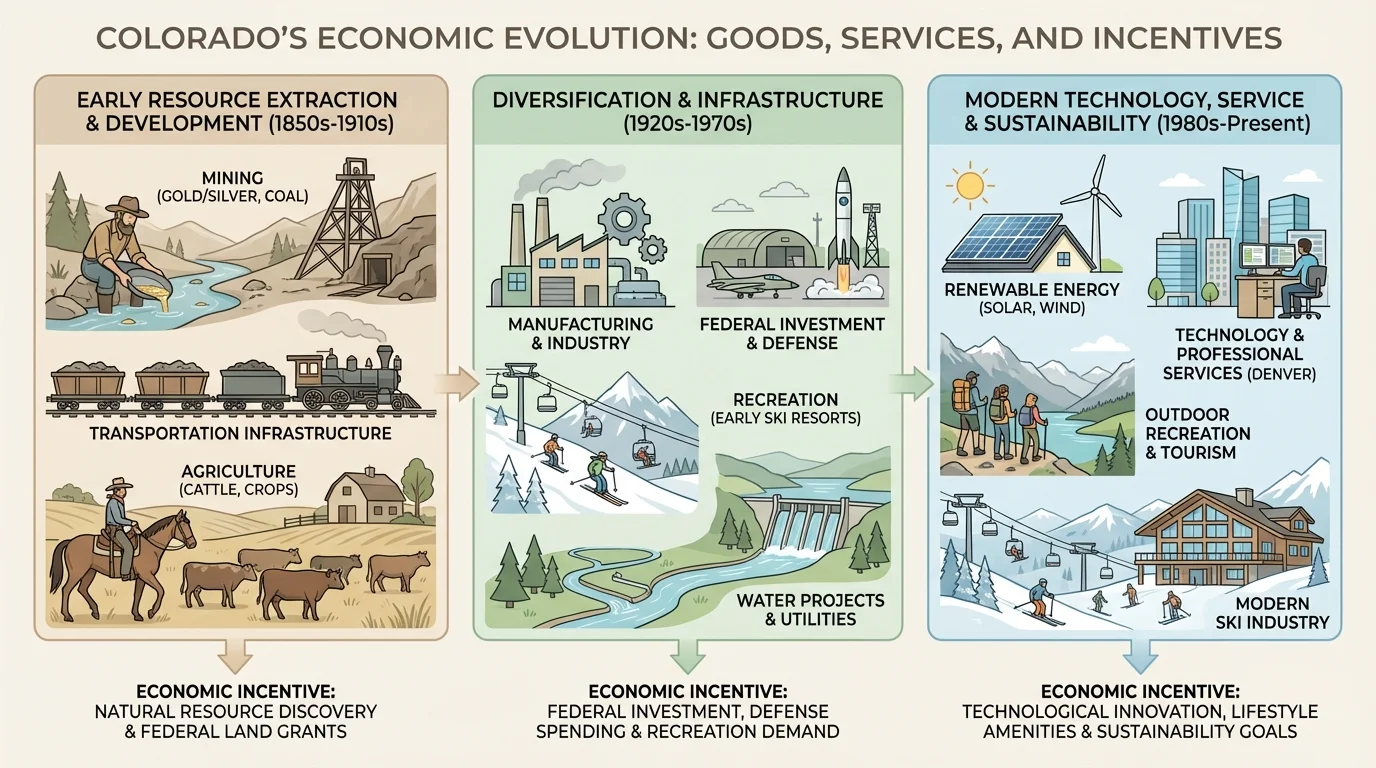
Positive incentives today include job opportunities, good pay, beautiful surroundings, and the chance to start businesses. For example, a company may move to Colorado because skilled workers live there. A family may open a lodge near a ski area because many tourists visit the area each winter.
Negative incentives still affect choices. Housing costs in some places are high. Drought can hurt farming. Wildfires can affect tourism and homes. Changes in energy prices can influence drilling or electricity production. People and businesses must keep adapting.
Colorado has also invested more in renewable energy, such as wind and solar power. These are connected to incentives too. If cleaner energy becomes more affordable and people want it, companies and communities have stronger reasons to produce it.
A producer is a person or business that makes goods or provides services. Producers often ask simple economic questions: What do people want? What can we make here? Will it be worth the cost? The answers change over time.
In Colorado history, miners responded to the possibility of finding gold. Ranchers responded to demand for meat and leather. Farmers responded to the chance to sell crops through railroads. Hotel owners and ski resorts responded to tourism. Technology companies respond to the availability of skilled workers and customers.
Students can think of incentives as signs pointing people toward some choices and away from others. A reward, like profit or success, points one way. A risk, like danger or loss, points the other way. People do not all make the same choice, but incentives influence many decisions.
Colorado examples of incentives
Step 1: A miner hears about gold in the mountains.
The positive incentive is the chance to earn a lot of money.
Step 2: The miner also learns that the trip is dangerous and costly.
The negative incentive is risk, hard travel, and possible failure.
Step 3: The miner decides whether the possible reward is worth the risk.
This is how incentives affect economic choices.
The same pattern appears again and again. As we saw with railroads in [Figure 3], better transportation encouraged more farming and ranching because producers could reach more buyers. In modern Colorado, as shown in [Figure 4], good roads, airports, internet access, and popular recreation areas support both goods and services.
When we compare time periods, we can see both change and continuity. Colorado has always depended on its land and resources, but the kinds of work people do have changed. Long ago, more people worked in trapping, mining, and basic farming. Today, many more people work in tourism, health care, education, technology, and other services.
| Historical period | Examples of goods | Examples of services | Important incentives |
|---|---|---|---|
| Early Colorado | Hides, crops, tools, traded items | Trading, guiding, transporting goods | Need for food, trade opportunities, danger of travel |
| Gold Rush and mining | Gold, silver, minerals | Storekeeping, cooking, transport, tool repair | Hope of wealth, risk and harsh conditions |
| Railroad and farm growth | Cattle, wheat, corn, hay, sugar beets | Rail transport, banking, teaching, town services | Larger markets, weather problems, changing prices |
| Modern Colorado | Agricultural products, energy, manufactured items | Tourism, technology, medicine, education, engineering | Jobs, profit, high costs, drought, environmental challenges |
Table 1. Examples of Colorado goods, services, and incentives in different historical periods.
Colorado's story shows that economies are always changing. New resources are discovered. New tools are invented. New transportation systems connect places. New needs appear. Through all of these changes, people keep responding to incentives as they decide what goods to produce and what services to offer.
The early trading world in [Figure 1] and the mining town economy in [Figure 2] may look very different from Colorado today, but they are linked by the same basic idea: people notice opportunities and challenges, then make choices. That is one of the most important ways economics helps us understand history.
