People argue every day about issues that actually matter: whether schools should start later, whether social media helps or harms teenagers, whether communities should limit plastic waste, or whether a novel should be taught in class. The strongest arguments are not the loudest; they are the clearest. A persuasive writer does more than say, "I think this is right." A persuasive writer builds a case so readers can follow the logic and judge the evidence for themselves.
That is why argumentative writing depends on four connected parts: a clear claim, strong reasons, solid evidence, and fair attention to other viewpoints. If one part is weak, the entire argument weakens. A precise claim gives the paper direction. Reasons explain why the claim makes sense. Evidence proves those reasons. Counterclaims show that the writer understands that the issue is not one-sided.
When these parts are organized carefully, argument becomes more than opinion. It becomes analytical writing. That matters not only in English class, but also in science reports, history essays, civic debate, and real decisions adults make in public life.
A weak argument often fails before the second sentence. Why? Because the writer is too broad, too emotional, or too unclear. A statement like "Phones are bad" does not tell readers enough. Bad in what way? For whom? Under what conditions? Compared to what alternative? Precision forces a writer to think carefully instead of reacting quickly.
Precision also helps a writer sound fair and credible. Readers are more likely to trust a writer who makes a focused, supportable point than one who makes sweeping claims. Compare these two statements: "Homework is useless" and "Homework is most effective when it reinforces a specific skill instead of assigning long repetitive tasks." The second claim is narrower, more thoughtful, and easier to support with evidence.
Claim is the main argument or position a writer wants readers to accept. Counterclaim is a competing viewpoint that challenges the main claim. Reason is a logical explanation that supports a claim. Evidence is the specific information—such as facts, examples, data, or quotations—that supports a reason.
In school writing, precision does not mean making a claim sound complicated. It means making it exact. A reader should be able to identify what the writer believes, what the writer is responding to, and what kind of support the writer will use.
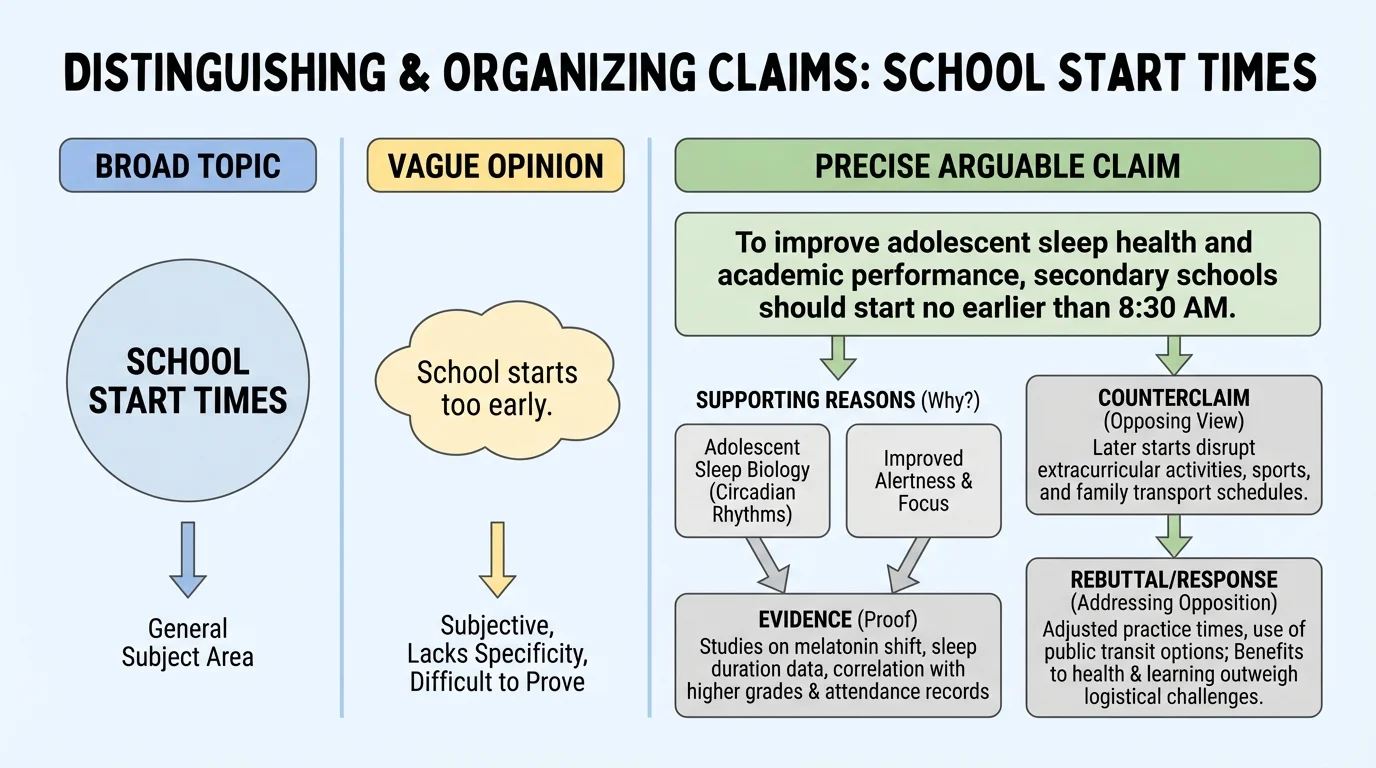
A claim is not the same thing as a topic. A topic is simply the subject, such as school lunches, renewable energy, or curfews for teens. A claim goes further by making a specific, arguable statement about that topic. As [Figure 1] shows, strong writers move from a broad subject to a focused statement that someone could reasonably support or challenge.
A claim is also not just a personal preference. "Chocolate ice cream tastes better than vanilla" may be an opinion, but it is not usually a strong academic argument unless the writer is analyzing taste tests, marketing, or culture. An effective academic claim invites reasoning and evidence. For example: "Public schools should begin no earlier than 8:30 a.m. because later start times improve student alertness, attendance, and mental health."
That claim works because it is specific, arguable, and focused. It names the issue, takes a position, and points toward reasons that can be developed.
Strong claims often have these qualities:
A claim should also match the purpose of the writing. If the assignment asks for analysis of a text, the claim should say something meaningful about the text. For example, instead of writing "The author uses symbolism," a more precise claim would be "In The Giver, color imagery symbolizes emotional awakening and helps readers see how controlled the society has become." That statement gives the writer a clear direction for analysis.
Legal arguments, scientific debates, and editorials all rely on the same basic pattern: a claim supported by reasons and evidence. The setting changes, but the logic stays surprisingly consistent.
Another useful test is whether the claim can be challenged by an intelligent person. If no reasonable reader would disagree, the statement is probably a fact, not a claim. "Water freezes at \(0\,^\circ\textrm{C}\)" is a scientific fact under standard conditions. "Schools should teach climate science earlier in the curriculum" is a claim because it can be debated and defended.
A strong writer does not pretend only one viewpoint exists. On serious issues, there are usually counterclaims, and sometimes there are multiple alternate claims. An alternate claim offers a different solution or perspective. An opposing claim directly argues against the writer's main position.
Suppose the main claim is that schools should start later. One opposing claim might be that early start times prepare students for adult work schedules. Another alternate claim might be that schools should keep current schedules but shorten homework instead. These are not identical. One directly resists the change; the other proposes a different response to the same problem.
Distinguishing among these views matters because different claims require different responses. If the opposition argues about transportation costs, the writer should answer transportation concerns. If the alternate claim argues that sleep problems come mostly from screen time, the writer should address sleep habits and school schedules separately. Effective argument depends on understanding what the other side is actually saying.
Fair treatment of other views means representing alternate or opposing claims accurately before responding to them. A writer should not oversimplify, mock, or distort another position just to make it easier to defeat. Fairness strengthens credibility because it shows intellectual honesty.
Readers notice when a writer is unfair. If a student writes, "People who support later start times just want students to be lazy," that response sounds biased and weak. It ignores the actual reasoning behind the other side. A better approach would be: "Some critics argue that later start times may reduce time for after-school sports and jobs. This concern is important, but districts that have changed start times often adjust practice schedules rather than eliminate activities."
That response does two things well. First, it states the opposing view respectfully. Second, it answers with reasoning instead of sarcasm.
Once a writer has a clear claim, the next task is to build support. A reason explains why the claim is valid. Evidence provides the proof. Students sometimes confuse these two. Think of it this way: reasons are the logic; evidence is the support that makes the logic convincing.
For the claim about later school start times, one reason might be that teenagers need more sleep for healthy brain function. Evidence for that reason might include research from sleep experts, attendance data, or findings from districts that changed their schedules. A reason says, in effect, "Here is why my claim makes sense." Evidence says, "Here is why you should believe that reason."
Good evidence is relevant, sufficient, and credible. Relevant evidence directly connects to the reason being made. Sufficient evidence is enough to support the point instead of relying on a single weak example. Credible evidence comes from trustworthy sources, such as research studies, reliable journalism, historical documents, or the text being analyzed.
| Type of support | What it does | Example |
|---|---|---|
| Reason | Explains why the claim is logical | Later start times improve student focus in morning classes. |
| Evidence | Proves or supports the reason | A district report shows fewer first-period absences after start times moved later. |
| Commentary | Explains how the evidence supports the claim | This suggests students are more present and prepared when school begins later. |
Table 1. The table shows the difference between a reason, evidence, and commentary in an argument.
Notice the third category in the table: commentary. Writers cannot simply drop in evidence and expect it to speak for itself. They need to explain how the evidence connects to the reason and the claim. Without commentary, even good evidence may feel disconnected.
Example: Turning a weak support paragraph into a strong one
Weak version: "Schools should start later because students are tired. Studies prove it."
Step 1: State the reason clearly.
"Schools should start later because teenagers' sleep cycles make very early mornings especially difficult."
Step 2: Add specific evidence.
"According to pediatric sleep research, many adolescents naturally fall asleep later at night, which makes waking up before dawn harder."
Step 3: Explain the evidence.
"Because the issue is biological rather than simple irresponsibility, later start times respond to how teenage bodies actually function."
The revised version is more convincing because it includes reason, evidence, and explanation.
Evidence can take different forms depending on the task. In a literary analysis, evidence often comes from quotations, scenes, imagery, or patterns in the text. In a social issue essay, evidence may come from statistics, expert testimony, case studies, interviews, or historical examples. The form changes, but the job stays the same: support the reasoning.
As we saw in [Figure 1], a precise claim makes it easier to gather relevant evidence. If the claim is too broad, the writer ends up collecting information that does not clearly fit together.
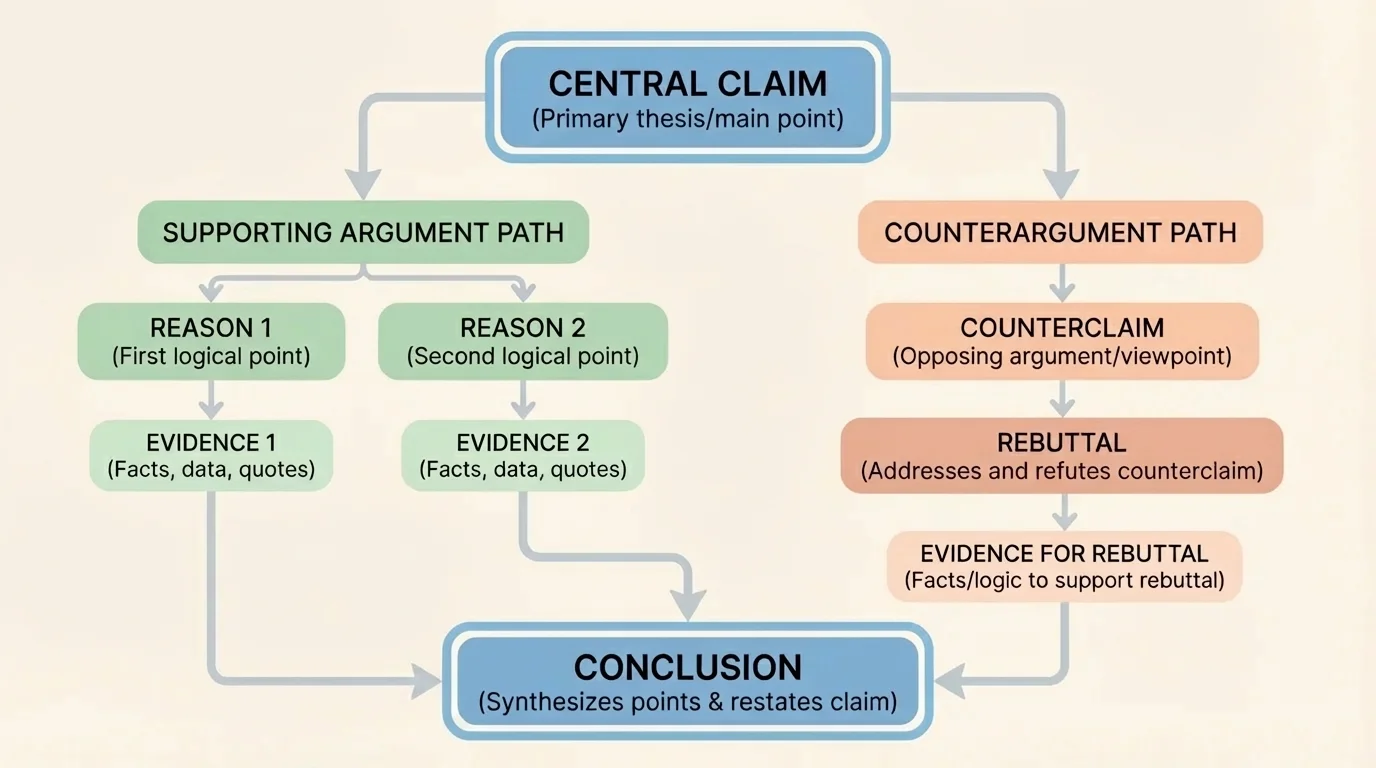
Even strong ideas can become unconvincing if they are arranged poorly. Readers should be able to track the relationships among the main claim, supporting points, counterclaims, and evidence without confusion. As [Figure 2] illustrates, a strong argument is not a pile of facts. It is a structure in which each part connects logically to the next.
One common organization begins with an introduction that presents the issue and states the claim. Body paragraphs then develop separate reasons, each supported by evidence and commentary. A later paragraph presents a counterclaim and responds to it. The conclusion reinforces the significance of the argument without simply repeating earlier lines word for word.
Another effective organization introduces a counterclaim earlier, especially when the opposing view is strong or widely accepted. In that structure, the writer states the main claim, acknowledges the competing claim, and then shows why the main position remains stronger. The best choice depends on purpose, audience, and topic.
Clear organization also depends on transitions. These words and phrases show relationships among ideas: because, for example, in contrast, however, although, therefore, and as a result. Transitions help readers understand whether the writer is adding support, introducing opposition, giving evidence, or drawing a conclusion.
Paragraph structure matters too. Each paragraph should usually focus on one main reason or one key move in the argument. If a paragraph jumps from attendance data to transportation budgets to student mental health without a clear pattern, readers may lose the thread. Strong writers group related ideas together.
From earlier writing work, you may remember the idea of a topic sentence. In argument writing, the topic sentence often states a reason that supports the claim. The rest of the paragraph should then supply evidence and explanation for that reason.
A useful way to test organization is to outline the paper after drafting it. If you can label each paragraph's role in one short phrase—claim, reason 1, reason 2, counterclaim, rebuttal, conclusion—the structure is probably clear. If not, the relationships among ideas may need revision.
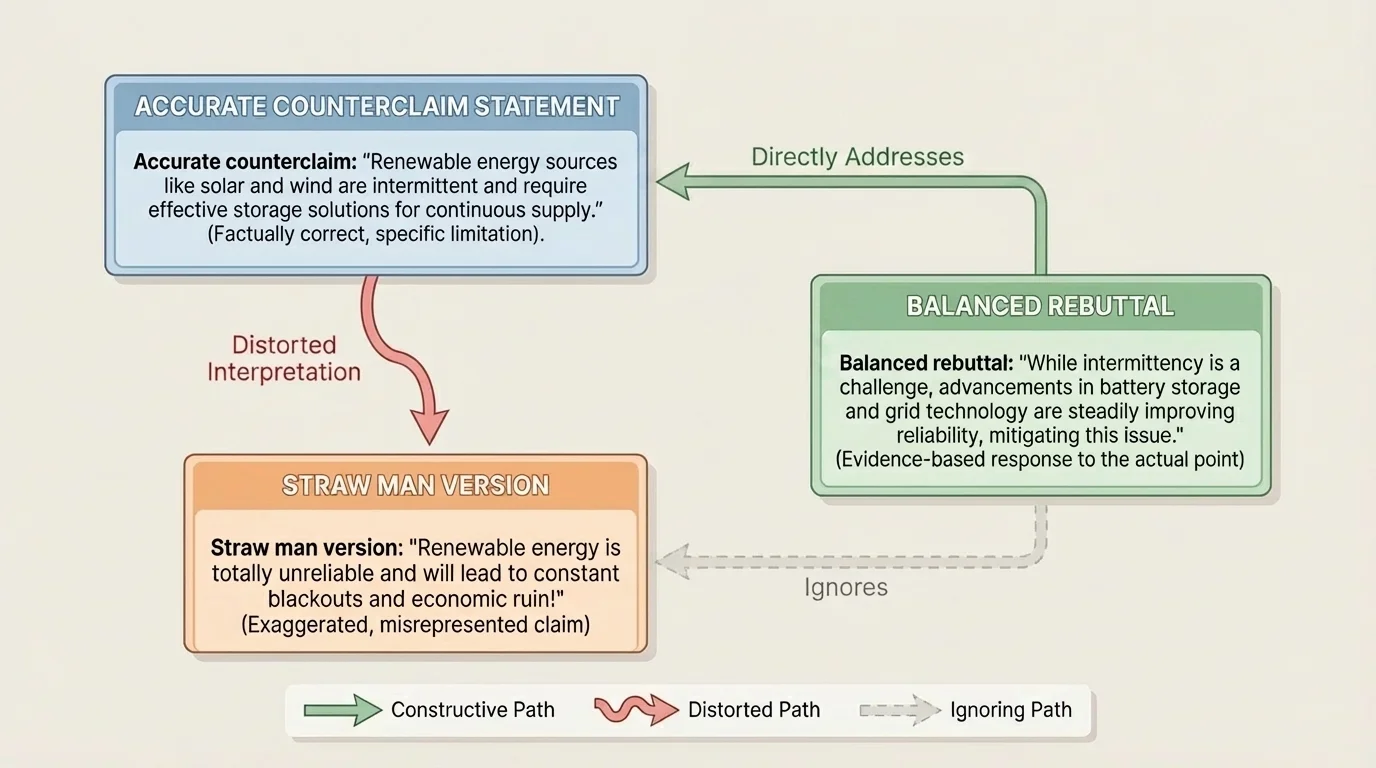
One of the strongest signs of mature argument writing is the ability to address opposition fairly. As [Figure 3] shows, a careful rebuttal begins by stating the other side accurately. Then it explains, with reasoning and evidence, why the writer's claim is still more convincing.
A rebuttal is not an insult. It is a reasoned response to a counterclaim. Sometimes it fully refutes the other side. Sometimes it concedes a point first and then explains why the main claim still stands. For example: "Although changing school schedules may create transportation challenges, the academic and health benefits for students make the adjustment worthwhile."
This method is powerful because it sounds balanced. It shows the writer can recognize complexity. Many important issues do not have perfect solutions, so strong argument often involves weighing trade-offs rather than pretending one side has no weaknesses.
Writers should avoid creating a straw man, which is a distorted version of the opposing argument that is easier to attack than the real one. Saying "Anyone who disagrees hates students" is not a rebuttal. It is a misrepresentation. Fair argument requires accuracy.
Language choices matter here. Phrases such as "some critics argue," "supporters of this view claim," or "an alternate perspective suggests" help maintain an unbiased tone. Phrases such as "obviously," "only an idiot would think," or "everyone knows" often weaken the argument because they replace reasoning with pressure or disrespect.
"The test of a first-rate intelligence is the ability to hold two opposed ideas in mind at the same time and still retain the ability to function."
— F. Scott Fitzgerald
In argument writing, that idea means you can understand another view without surrendering your own. In fact, your own argument usually becomes stronger when you test it against serious opposition.
Later in revision, [Figure 3] remains useful as a reminder that fairness and strength are connected. The most persuasive rebuttal does not erase the other side; it answers it.
Consider this model claim: "Cities should limit single-use plastic bags because the environmental damage they cause outweighs the convenience they provide." This claim is precise enough to guide the whole argument.
The writer might organize the essay like this: first, explain how plastic bags contribute to litter and pollution; second, show how wildlife and waterways are affected; third, address the counterclaim that plastic bags are necessary for convenience and low cost; finally, argue that reusable alternatives reduce harm while still meeting consumer needs.
Model argument paragraph sequence
Step 1: Claim
"Cities should limit single-use plastic bags because their environmental costs are too high."
Step 2: Reason with evidence
"Plastic bags often become windblown litter, and cleanup programs in many communities spend significant time and money removing them from streets, parks, and storm drains."
Step 3: Counterclaim
"Opponents argue that plastic bags are cheap, convenient, and useful for carrying groceries."
Step 4: Rebuttal
"However, reusable bags and paper alternatives can meet the same need while reducing long-term environmental harm."
This sequence works because each part has a distinct role and the relationship among parts is clear.
The same pattern works in text analysis. Suppose you argue that a character in a novel changes because of guilt. Your reasons might focus on specific actions, dialogue, and internal conflict. Your evidence would come from quotations and scenes. A counterclaim might argue that the character changes because of fear instead. Your rebuttal would compare the textual evidence and show why guilt better explains the pattern.
One common mistake is writing a claim that is too broad. "Technology affects society" is true, but it is too large and obvious to support effectively in a short essay. Narrowing the claim gives it power.
A second mistake is confusing evidence with explanation. A student may include a quotation or statistic and then move on without interpreting it. Evidence only becomes persuasive when the writer explains its significance.
A third mistake is including a counterclaim just to check a box. If the writer summarizes the other side in one weak sentence and never responds thoughtfully, the argument feels shallow. Counterclaims should be meaningful enough to matter.
A fourth mistake is relying on emotionally loaded language instead of logic. Strong arguments can have passion, but they should not depend on exaggeration. Words such as disgusting, ridiculous, or evil may express emotion, but without evidence they do little persuasive work.
Professional fact-checkers often test arguments by asking simple questions: What exactly is the claim? What is the source of this evidence? Is the opposing view represented fairly? Those same questions improve student writing too.
A final mistake is disorganization. If the paper introduces three reasons but only develops one, or if evidence appears before readers understand the point it supports, the relationships among ideas become blurred. Clear structure is part of persuasion, not just presentation.
Revision is where many good arguments become excellent ones. Start by highlighting your claim. Is it precise? Is it arguable? Does every paragraph connect back to it? If not, revise the claim or remove material that does not fit.
Next, examine each body paragraph. Can you identify the reason being developed? Is there enough evidence? Is the evidence credible and relevant? Have you explained how it supports the claim? If a paragraph has facts but no explanation, add commentary. If it has explanation but no proof, add evidence.
Then look at the counterclaim. Is it one a thoughtful person might actually hold? Have you represented it accurately? Have you answered it with logic instead of dismissal? Mature argument writing sounds confident, not defensive.
Finally, read the piece for coherence. The organizational pattern in [Figure 2] provides a useful mental checklist: claim, reasons, evidence, counterclaim, rebuttal, conclusion. If readers can trace that path easily, your argument is likely well built.
Good argumentative writing is not about overpowering readers. It is about guiding them through a logical structure in which each idea earns its place. When your claim is precise, your treatment of opposing views is fair, and your organization makes relationships clear, your writing becomes more convincing, more thoughtful, and more academically strong.
