A lone meerkat on a rock, a giant school of fish turning at the same moment, and penguins packed tightly against the icy wind may look very different. But they all help answer the same science question: How do we know a behavior helps an animal survive? Scientists do not answer that by guessing. They build an argument using facts they can observe, measure, and explain.
In everyday life, the word argument can mean a disagreement. In science, an argument means something different. A scientific argument is an explanation that tells what you think is true and why you think the evidence supports it.
Claim is a statement that answers a question.
Evidence is the information that supports the claim. Evidence can come from observations, measurements, data, or models.
Reasoning explains how the evidence supports the claim.
Suppose the question is, "Why do some animals live in groups?" A student might say, "Animals live in groups because they like each other." That is an idea, but it is not yet a strong scientific answer. A stronger answer would be: "Some animals live in groups because groups can help them find food, stay warm, or avoid predators." Then the student would need evidence and reasoning.
Scientists often begin with a question, look for patterns, and then make a claim. They support that claim with facts. If new evidence appears, scientists may improve or change their argument. That is one of the most powerful parts of science: ideas must match the evidence.
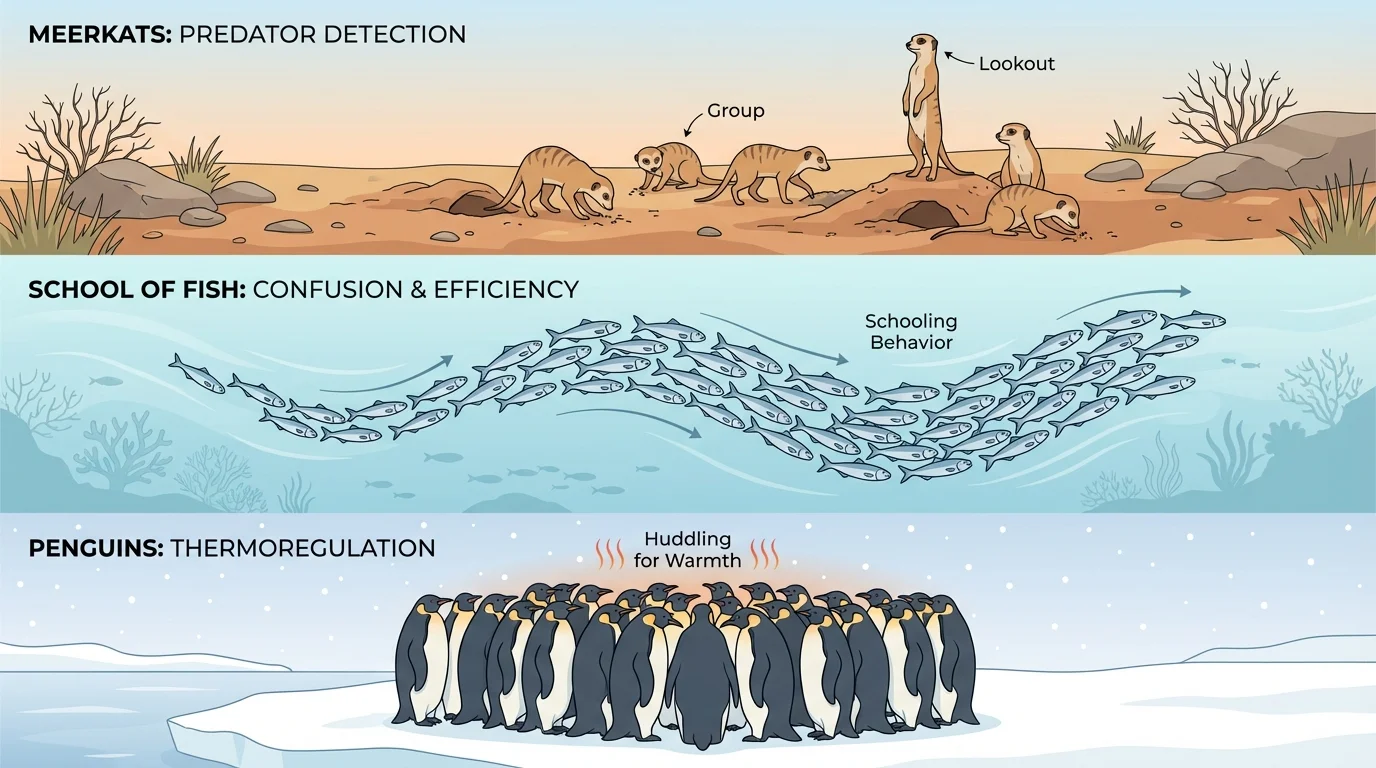
Many animals show group behavior, and these groups can help members survive, as [Figure 1] shows through several different examples. Survival means staying alive long enough to grow and often to reproduce. Group living does not help in exactly the same way for every species, but there are common patterns.
Some groups help with predator safety. A predator is an animal that hunts other animals for food. When many eyes and ears watch for danger, it is harder for a predator to surprise the group. Some groups help animals catch or gather food. Others help keep animals warm, protect young, or confuse attackers.
Think about a herd of zebras. One zebra alone may not notice a lion right away. But a herd has many animals looking, listening, and reacting. If one zebra runs, others quickly react too. That fast group response can increase the chance of escape.
Birds in flocks show another pattern. A single bird searching for seeds may have to spend a great deal of time watching for danger. In a flock, birds can feed while others stay alert. Fish in schools often move together so quickly and smoothly that a predator has trouble choosing one target.
Some penguins take turns standing on the colder outside edge of a huddle. By rotating positions, the group helps many members stay warmer during freezing weather.
Not every animal lives in groups, and not every group works the same way. That is why scientists need evidence. They must look closely at what the animals actually do and what happens because of that behavior.
Scientific evidence can come from different sources. One kind is an observation. An observation is something you notice with your senses or with tools. For example, you may observe that one meerkat stands upright while others dig for food.
Another kind of evidence is data. Data are pieces of information collected during an investigation. Data may include counts, measurements, or records made over time. If a scientist counts how many times a hawk attack succeeds when birds are alone compared with when they are in a flock, those numbers are data.
Why data matter
Data help scientists move beyond opinion. If one case happens once, it may be an accident. If the same pattern happens again and again, the evidence becomes stronger. Repeated observations and data make an argument more trustworthy.
Scientists also use models. A model is a simpler representation of something real. It might be a drawing, a diagram, a physical object, or even a short role-play. A model can help explain how a group behavior works when it is hard to see every detail in nature.
Sometimes evidence is qualitative, which means it describes qualities such as shape, color, sound, or behavior. Sometimes evidence is quantitative, which means it uses numbers. For example, "the fish moved together" is qualitative. "The school had about \(50\) fish" is quantitative. Both can help build an argument.
When you construct an argument, you are building it carefully, piece by piece. A good way to do this is to follow a simple path.
First, ask a clear question. For example: "How does living in a group help penguins survive?"
Next, make a claim. A claim could be: "Penguins huddle in groups to stay warmer in cold conditions."
Then, gather evidence. You might note that penguins stand close together, that the center of the huddle is warmer than the outside, and that penguins switch places over time.
Finally, explain your reasoning. You could say: "Because penguins lose less heat when they are packed together, the group helps members survive freezing weather."
Building a simple scientific argument
Question: Why do fish swim in schools?
Step 1: Make a claim.
Claim: Fish swim in schools because swimming together can help protect them from predators.
Step 2: Add evidence.
Evidence: In observations, many fish turn at nearly the same time when danger appears. Predators may have trouble picking one fish from a moving group.
Step 3: Add reasoning.
Reasoning: If a predator cannot easily single out one fish, more fish may escape. That means the group behavior can help members survive.
A strong argument does not just list facts. It connects the facts to the claim. That connection is the reasoning. Without reasoning, the listener may not understand why the evidence matters.
Meerkats live in groups, and one behavior scientists study is sentinel behavior. A sentinel is a group member that stays alert for danger while others feed. The sentinel may stand on a rock or rise upright to scan the area.
[Figure 2] Here is a possible claim: "Meerkats form groups because group members can help warn one another about predators."
What evidence could support that claim? Scientists may observe that while some meerkats search for insects, another meerkat watches the sky and land. They may also record that the lookout makes alarm calls when danger appears. After the call, the others quickly run for cover. This suggests that the feeding meerkats can spend more time looking for food and less time watching for danger.
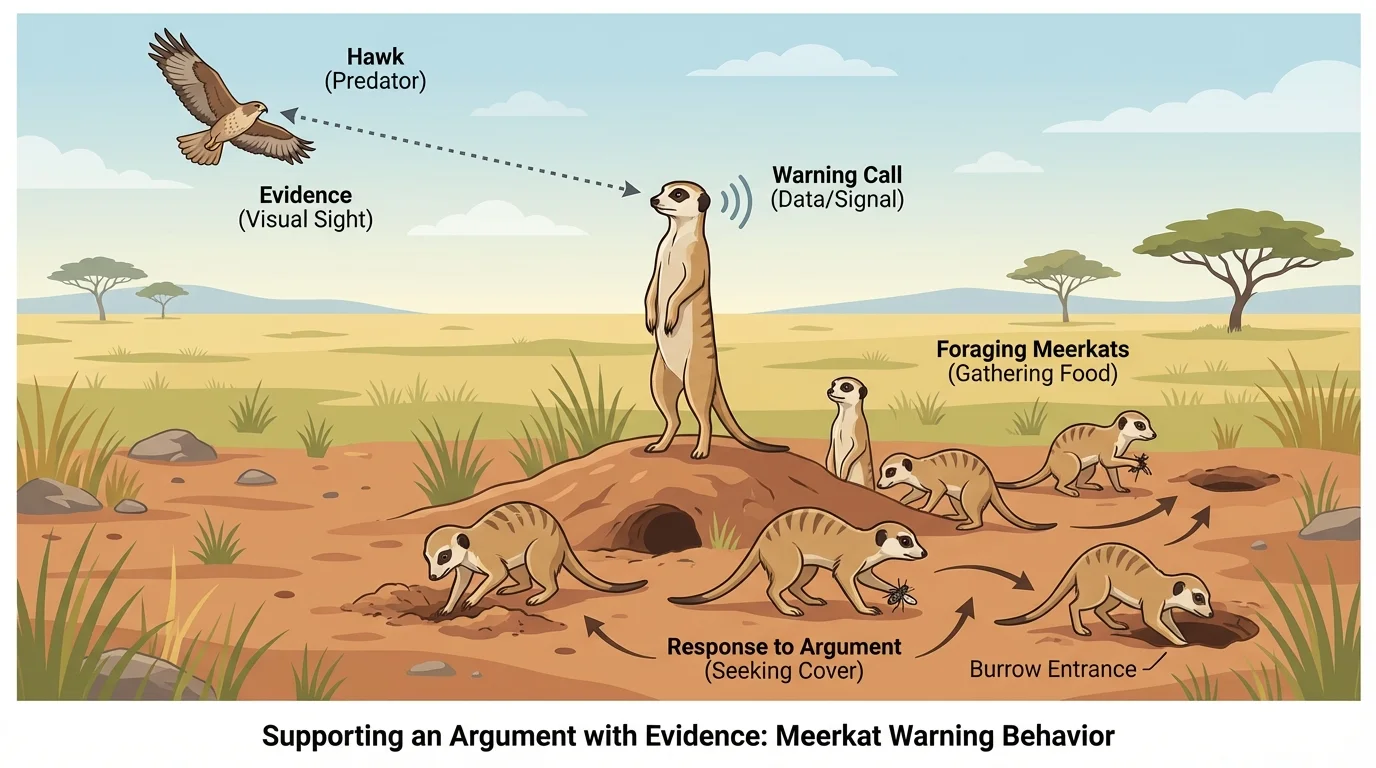
The reasoning connects the evidence to the claim: if one meerkat warns the group, more group members may avoid being caught by a predator. That makes survival more likely for at least some members of the group.
This does not mean every single meerkat is always safer in every situation. Science arguments often describe patterns, not perfect rules. But if the pattern appears often, the argument becomes stronger.
Different animals form groups for different reasons. Looking at several examples helps us understand that one claim may have different kinds of supporting evidence.
| Animal group | Group behavior | How it may help survival | Evidence scientists might collect |
|---|---|---|---|
| Fish | Swimming in schools | Confuses predators; helps many fish react quickly | Videos showing quick turning and predator response |
| Birds | Flying or feeding in flocks | More eyes watch for danger; may help find food | Counts of feeding time and warning behavior |
| Penguins | Huddling close together | Reduces heat loss in cold weather | Temperature measurements inside and outside the huddle |
| Musk oxen | Standing in a circle around young | Protects calves from wolves | Observations of body positions during danger |
Table 1. Examples of animal groups, the behaviors they show, and evidence that could support arguments about survival.
Notice that the evidence is not the same in each case. For fish, movement patterns matter. For penguins, temperature evidence matters. For musk oxen, body position around young matters. Scientists choose evidence that fits the question.
You already know that animals need food, water, shelter, and safety to survive. Group behavior can help with several of these needs at the same time.
As we saw earlier in [Figure 1], animal groups can look very different, but they may still solve the same basic problem: staying alive in a challenging environment.
Data are powerful, but they must be used carefully. Suppose a scientist watches birds at a feeder. On one day, birds in a flock spot a cat quickly. On another day, a lone bird also escapes. One example alone is not enough to prove a strong claim.
Scientists look for patterns across many observations. If birds in flocks escape danger more often than birds alone across many situations, that pattern is better evidence. A scientist might compare numbers such as \(8\) successful escapes out of \(10\) flock observations and \(4\) successful escapes out of \(10\) lone-bird observations. The larger pattern supports the claim that flocking can help survival.
Using numbers in an argument
A scientist observes rabbit groups and lone rabbits during danger.
Step 1: Collect data.
Grouped rabbits escaped in \(9\) out of \(12\) observations. Lone rabbits escaped in \(5\) out of \(12\) observations.
Step 2: Compare the results.
Because \(9 > 5\), the grouped rabbits escaped more often in these observations.
Step 3: Build the argument.
Claim: Grouping helps rabbits survive danger. Evidence: grouped rabbits escaped more often than lone rabbits. Reasoning: if grouped rabbits escape more often, the group may help them detect danger or confuse predators.
Data do not speak for themselves. Scientists must interpret them carefully. It is important not to make a claim that is bigger than the evidence. If the data come from one place or one short time, scientists may say, "This evidence suggests..." instead of "This proves forever..."
Sometimes a model makes an idea easier to understand because it can show relationships clearly. A model is useful when real animals move too fast, live far away, or are hard to study safely.
[Figure 3] For example, students can make a simple model with counters or drawings. One counter can represent a lone animal, and a cluster of counters can represent a group. A separate marker can represent a predator. By acting out different situations, students can test ideas such as whether more group members notice danger sooner.
Another model might be a diagram showing warm air trapped among penguins in a huddle. The model does not include every detail of real life, but it helps explain why being close together can reduce heat loss.
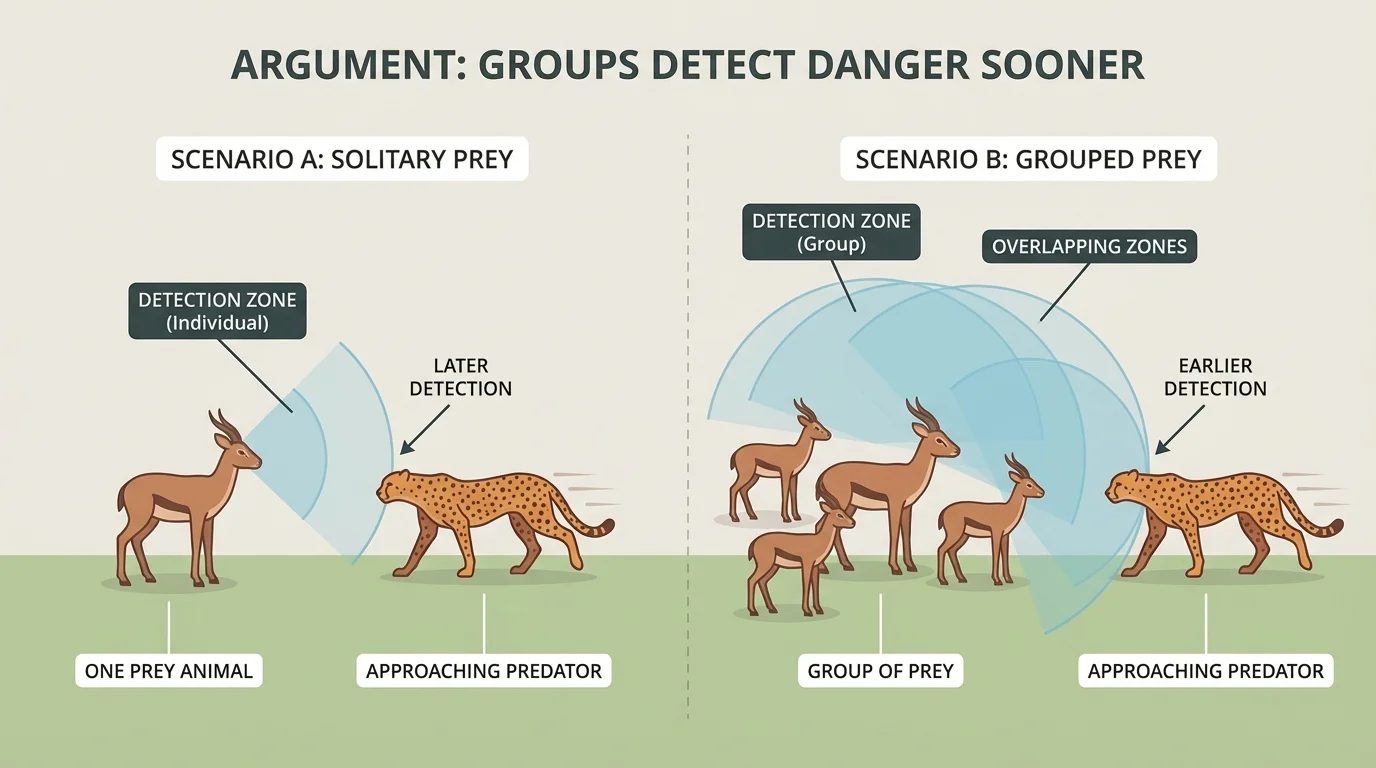
Models do not replace real evidence from nature. Instead, they help us think about how and why a behavior may work. Later, scientists compare the model's ideas to real observations and data.
When you think back to the meerkat example in [Figure 2], a model can help explain why one lookout may allow others to keep feeding. It turns a hard-to-see pattern into something easier to discuss and test.
A strong argument uses a clear claim, relevant evidence, and reasoning that makes sense. A weak argument may be missing one of those parts, may use unrelated facts, or may jump to conclusions.
Here is a weak argument: "Penguins huddle because penguins are friendly." That statement may sound nice, but it does not use evidence about survival.
Here is a stronger argument: "Penguins huddle because huddling helps them stay warmer in freezing weather. Scientists observe penguins packed closely together during cold conditions, and temperatures inside the group are higher than outside. Because staying warmer reduces heat loss, huddling can help penguins survive."
How to improve an argument
If your argument feels weak, ask three questions: What exactly is my claim? What evidence supports it? How do I know this evidence connects to the claim? Answering all three usually makes the argument stronger.
Another mistake is using evidence that does not match the claim. If your claim is about safety from predators, then evidence about feather color may not help unless you explain how feather color affects safety. Good arguments stay focused.
Constructing arguments with evidence is not only for scientists in the field. People use this skill whenever they make careful decisions. Wildlife experts may argue that protecting a wetland matters because data show it shelters many animals. Park workers may use evidence to decide how to protect nesting birds. Farmers may observe whether animals guard one another from danger.
Students use this skill too. If you say that one plant grew better in sunlight than in shade, you should support that idea with observations and measurements. If you say that ants work better in groups than alone, you should describe what you saw and explain why it matters.
"Science is a way of thinking much more than it is a body of knowledge."
— Carl Sagan
When you build an argument from evidence, you are doing something scientists do every day. You are asking careful questions, noticing patterns, and explaining the world with reasons instead of guesses. That is especially important when studying how animals survive in ecosystems, because living things depend on one another and on their environment in many connected ways.
