People argue every day about all kinds of things: which team played better, which snack tastes best, or whether a backpack is too heavy. But in science, an argument is not just a disagreement. It is a careful way of saying, "Here is what I think, and here is why I think it." The strongest scientific arguments are not built on guesses or loud opinions. They are built on evidence.
When scientists say they are arguing, they usually do not mean shouting. They mean using facts and observations to support a claim. A claim is a statement that answers a question or solves a problem. For example, if someone says, "Plants grow better in sunlight than in darkness," that is a claim. To make it strong, the person must support it.
Good arguments matter because they help people decide what is most likely true. Doctors use evidence to choose treatments. Engineers use evidence to test bridges and buildings. Meteorologists use evidence to predict weather. Even students use evidence when they explain why one solution works better than another.
Claim is a statement or conclusion that answers a question.
Evidence is the information that supports a claim, such as observations, measurements, or facts.
Reasoning is the explanation that shows how the evidence supports the claim.
A strong scientific argument usually has three main parts: a claim, evidence, and reasoning. These parts work together like links in a chain. If one link is weak, the whole argument becomes weaker.
To understand this clearly, look at how the parts connect, as [Figure 1] illustrates. First comes the claim, which tells what you think is true. Next comes the evidence, which gives the facts. Then comes the reasoning, which explains why those facts support the claim.
Suppose a class is testing which paper towel absorbs the most water. One student says, "Brand B is the most absorbent." That is the claim. The class then measures how much water each towel absorbs. If Brand B absorbs the greatest amount, those measurements are evidence. The reasoning might be: "Because Brand B absorbed more water than the other brands in the same test, the data support the claim that it is the most absorbent."
Notice that evidence is not the same as reasoning. Evidence is the information itself. Reasoning is the thinking that connects the information to the claim. Many students can find evidence, but the reasoning is what shows that they truly understand the connection.
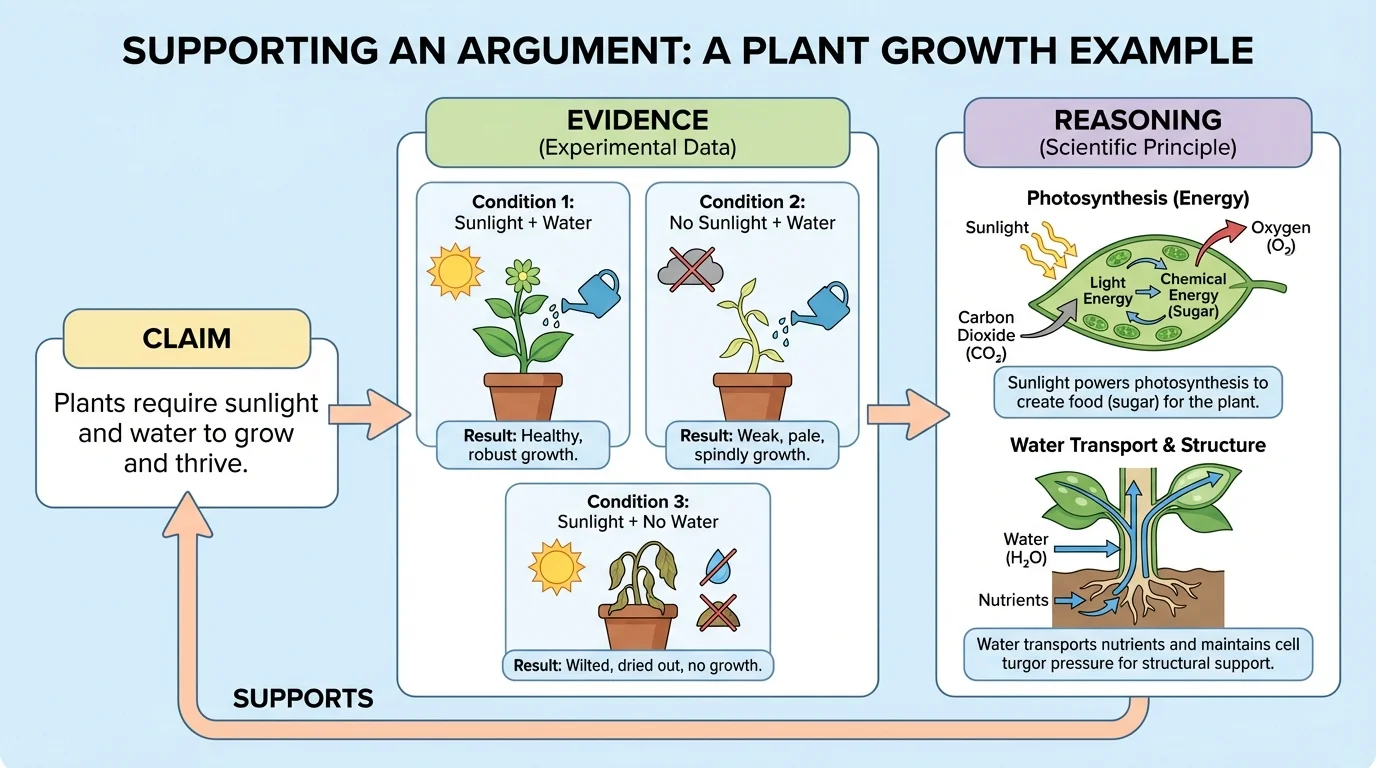
If someone gives a claim without evidence, it is only an opinion. If someone gives evidence but does not explain it, the listener may not understand why it matters. A strong argument needs both evidence and reasoning.
Earlier science work may have asked you to make observations, measure carefully, and record results. Those skills are important here because evidence often comes from those exact actions.
Scientists also know that a claim can change. If new evidence appears, they may revise the claim. This is not failure. It is part of thinking honestly and carefully.
Evidence can come in different forms. It may be something you observe with your senses, like seeing ice melt. It may be a measurement, like recording that the temperature changed from \(8^\circ\textrm{C}\) to \(14^\circ\textrm{C}\). It may come from repeated test results or from a reliable source such as a science book, article, or trusted data collection.
Not all information counts as good evidence. Good evidence should be relevant, which means it actually connects to the claim. If your claim is about which soil helps beans grow tallest, then the height of the plants is relevant. The color of the pots probably is not.
Good evidence should also be accurate. Measurements should be taken carefully. Tools should be used correctly. If a ruler has a broken edge at the \(0\) mark, the measurement may be wrong. Evidence should also be sufficient. One observation may be interesting, but several observations or repeated trials are often more convincing.
Many famous scientific ideas were accepted only after scientists gathered evidence again and again. Repeated results help show that a finding was not just luck.
Reliable evidence often comes from fair tests. In a fair test, only one thing is changed at a time while other conditions stay the same. If you are testing sunlight, then the type of plant, amount of water, and size of pot should stay the same as much as possible.
[Figure 2] Data are recorded facts, measurements, or observations. Data can be written in a table, shown in a graph, or described in words. When students use data well, they do not just copy numbers. They study the numbers to find patterns, differences, or trends in the results.
Imagine two groups of bean plants. Group A gets 2 hours of sunlight each day. Group B gets 8 hours. After one week, Group A has an average height of 4 centimeters, and Group B has an average height of 9 centimeters. Those measurements are data. They can support the claim that more sunlight helped the bean plants grow taller in this test.
When using data, it helps to compare carefully. You might look for which number is larger, whether results stay consistent, or how much change happened. For example, the difference in average height is \(9 - 4 = 5\) centimeters. That makes the comparison clearer.
| Group | Sunlight each day | Average height after 1 week |
|---|---|---|
| A | 2 hours | 4 cm |
| B | 8 hours | 9 cm |
From this table, a student might argue: "Bean plants in Group B grew taller than those in Group A. Since sunlight was the main thing changed in the test, the data support the claim that more sunlight led to more growth." That statement includes the claim, the evidence, and the reasoning.
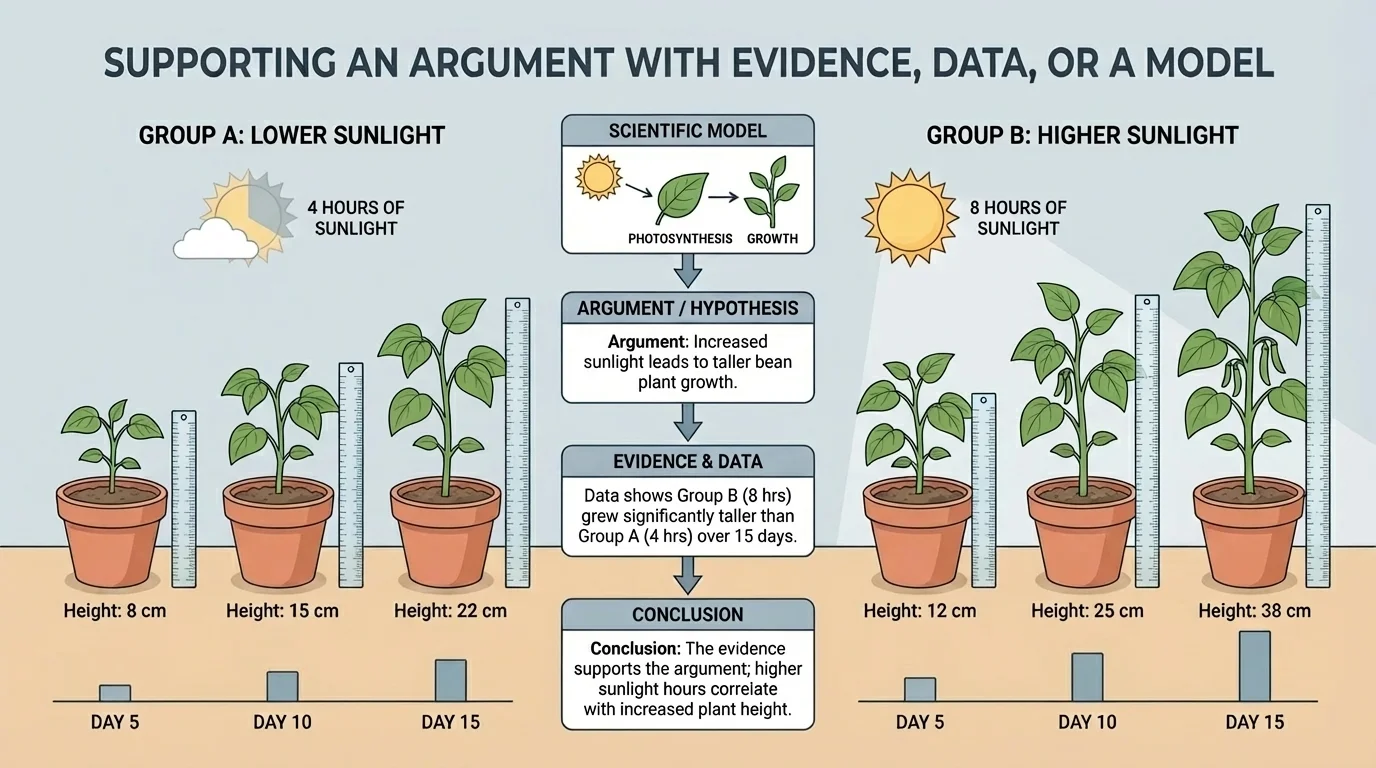
Data can also show when a claim is weak. If two groups have almost the same results, or if the results change wildly from trial to trial, then the evidence may not strongly support the claim. Being honest about what the data really show is a big part of scientific thinking.
Example: Supporting a claim with data
A student says, "Seeds sprout faster in warm places than in cold places." The student tests this idea with two sets of seeds.
Step 1: State the claim clearly.
The claim is that warmer conditions help seeds sprout faster.
Step 2: Look at the data.
Warm place: 8 of 10 seeds sprouted in 3 days. Cold place: 3 of 10 seeds sprouted in 3 days.
Step 3: Explain the reasoning.
Because more seeds sprouted in the warm place during the same amount of time, the data support the claim that warmth helped the seeds sprout faster.
This is stronger than simply saying, "I think warm places are better."
As seen earlier in [Figure 1], data become useful evidence only when they are connected to a claim by clear reasoning.
Sometimes we cannot observe something directly, or the real thing is too large, too small, too fast, or too dangerous to study easily. In those cases, a model can help. A model is a simpler representation of something in the real world. It may be a drawing, a diagram, a physical object, or even a computer simulation. Models help people explain ideas and test thinking, as [Figure 3] demonstrates.
For example, a globe and flashlight can model day and night on Earth. The globe stands for Earth, and the flashlight stands for the Sun. By turning the globe, students can see why one side has daylight while the other side has darkness. That model can support the claim that Earth's rotation causes day and night.
Another model is a diagram of the water cycle. It shows evaporation, condensation, and precipitation. Even though the diagram is not the real sky, real ocean, or real clouds, it helps explain how water moves through the environment.
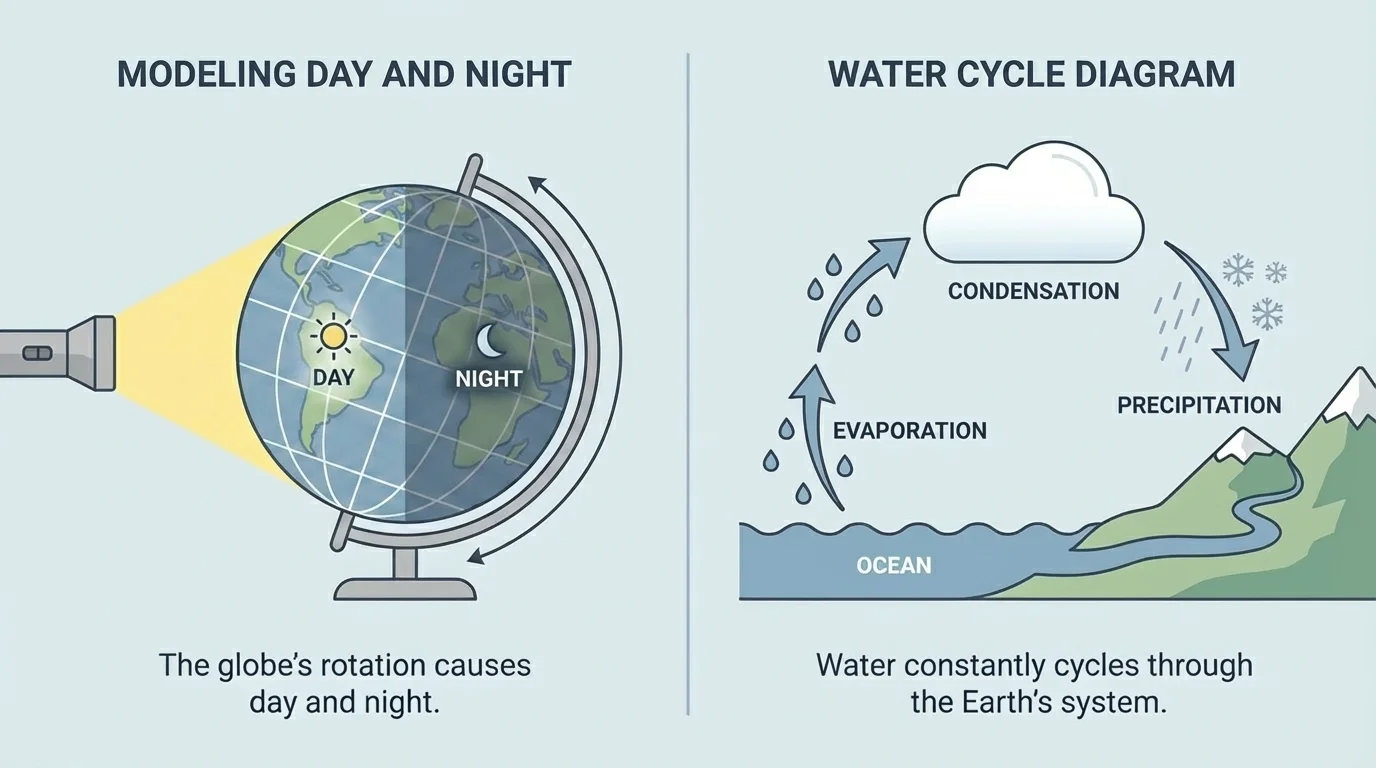
Models are useful, but not perfect. A model simplifies reality so people can focus on important parts. Because of that, every model leaves something out. Good scientists ask not only, "How does this model help?" but also, "What does this model not show?"
If a student says, "Earth has day and night because it rotates," a globe-and-flashlight model helps support the claim. The reasoning might be: "The model shows that when different parts of Earth face the light, they receive daytime, and when they face away, they experience nighttime."
Models are powerful because they help people see ideas they cannot easily watch in real life. Later, when students compare explanations, they can return to the model in [Figure 3] to check whether the claim still fits what the model shows.
Not every argument is equally strong. To judge an argument, ask several questions. Is the evidence relevant to the claim? Is it accurate? Is there enough of it? Was the test fair? Could there be another explanation?
Suppose someone claims that a certain soccer shoe makes players run faster. If only one player wore the shoes one time, that is weak evidence. The player may have been well-rested that day, or the weather may have been cooler. But if many players tested the shoes several times under similar conditions, the argument becomes stronger.
Strong arguments also pay attention to limitations. A limitation is something that may affect how sure we can be. For example, if only 5 plants were tested, that is a smaller sample than 50 plants. A smaller sample can still give useful evidence, but it may be less convincing.
"Scientific knowledge is based on evidence."
— A core idea of science
Sometimes two people use the same evidence but reach different claims. When that happens, they should compare reasoning. One person may have ignored an important detail. Another may have made a claim that goes beyond what the evidence can actually support.
Part of engaging in argument from evidence is listening to other people's ideas. You may agree, disagree, or partly agree. But your response should still use evidence and reasoning. Saying "You're wrong" is not enough. Saying "I disagree because your data come from only one trial, and our class results from three trials show a different pattern" is much stronger.
Scientists often compare explanations. They ask which explanation best fits the evidence. They also revise their own thinking when needed. If another student gives stronger evidence, it is smart to adjust your claim.
Example: Revising a claim
A student first claims that darker pavement always gets hotter than lighter pavement.
Step 1: Look at new evidence.
In one test, dark pavement reached \(42^\circ\textrm{C}\) and light pavement reached \(38^\circ\textrm{C}\). In another test, one dark surface was shaded and only reached \(31^\circ\textrm{C}\).
Step 2: Notice the limitation.
Color matters, but shade also affects temperature.
Step 3: Revise the claim.
A better claim is: "Darker pavement often gets hotter in direct sunlight, but shade can lower the temperature."
This revised argument fits the evidence more carefully.
Respectful argument helps everyone learn. It focuses on ideas, not on attacking people.
Students often use this skill in science class, but it matters outside school too. If a family wants to know whether a reusable bottle keeps drinks cold longer than a paper cup, they can test both and measure the temperature over time. If the bottle stays colder, the data support the claim.
City planners also use evidence. They may compare playground surfaces to decide which is safest. They gather data about injuries, measure heat on sunny days, and test how surfaces cushion falls. Then they build an argument for the best choice.
Weather forecasters use data from satellites, thermometers, wind measurements, and computer models. They do not just guess whether it will rain. They use multiple kinds of evidence to support their prediction. That is another form of argument from evidence.
Example: Using a model in real life
A teacher asks why coastal places often have milder temperatures than inland places.
Step 1: Use a model.
The class uses trays of water and soil under the same lamp.
Step 2: Gather evidence.
After the same amount of heating, the soil temperature rises more quickly than the water temperature.
Step 3: Make the argument.
The model and temperature data support the claim that large bodies of water heat and cool more slowly, which can make coastal temperatures milder.
This shows how models and data can work together.
The same careful thinking appears in medicine, environmental science, sports, and engineering. Wherever people test ideas, they need claims supported by evidence.
One common mistake is giving a claim with no support. Another is giving information that does not really connect to the claim. A third is using too little evidence. A fourth is mixing up evidence and reasoning.
For example, if someone says, "This fertilizer works because the plants were green," that may be weak if plant height or number of leaves was the real question. Greenness alone may not answer the question being studied. The evidence must match the claim.
Another mistake is choosing only the evidence you like and ignoring the rest. Good arguments consider all the important data, even when some results are unexpected.
Fairness matters in argument. A strong argument does not hide weak spots. It includes the best available evidence, notices limits, and explains honestly what the evidence can and cannot prove.
If evidence is mixed, the claim may need to be more careful. Instead of saying "always," it may be better to say "often" or "in this test." These small word changes can make an argument much more accurate.
Strong arguments are not usually written in one quick try. People improve them by asking questions, collecting more evidence, checking for mistakes, and making the reasoning clearer. This is how science moves forward.
When new information appears, a claim might stay the same, become stronger, become weaker, or change completely. That is normal. Good thinkers care more about getting closer to the truth than about defending a weak idea.
When you support an argument with evidence, data, or a model, you are doing something very important. You are showing not just what you think, but why your thinking makes sense. That skill helps in science, in school, and in everyday decisions.
