People argue in science all the time, but not the way you might think. A scientific argument is not about being loud or stubborn. It is about using facts, observations, and careful thinking to decide which idea makes the most sense. When students and scientists explain why ice melts, why plants lean toward light, or why a puddle disappears after rain, they are doing something very important: they are building arguments from evidence.
Science is about understanding how the world works. We notice events around us, ask questions, gather information, and try to explain what we observe. Then we check whether the explanation really fits the evidence. Sometimes the evidence supports the explanation. Sometimes it shows that the explanation is incomplete or wrong.
This process is called argument from evidence. It means making a claim and backing it up with facts. It also means listening to other claims and deciding whether their evidence is strong enough. Good scientific arguments help us improve explanations and models instead of simply defending a guess.
Phenomenon is something that happens in nature that we can observe, such as a shadow changing length during the day.
Explanation is a statement that tells why or how a phenomenon happens.
Model is a representation of something that helps us understand it. A model can be a drawing, diagram, physical object, or idea.
Scientists use arguments from evidence because appearances can be misleading, as [Figure 1] helps show. For example, the Sun seems to move across the sky, but that appearance needs an explanation based on Earth's rotation. Evidence helps us choose the best explanation instead of the most obvious one.
A phenomenon is any event or pattern we can notice. It might be simple, like dew forming on grass, or larger, like seasons changing. Scientists study a phenomenon by asking what causes it and by building an explanation and sometimes a model, as [Figure 1] shows.
An explanation answers the question "Why does this happen?" If a metal spoon feels colder than a wooden spoon in the same room, one explanation is that metal transfers heat away from your hand faster than wood. The explanation connects the observation to science ideas.
A model helps us picture or test an idea. A model of evaporation might show water particles spreading farther apart as they enter the air. Models are useful, but they are not perfect copies of reality. They are tools for thinking.
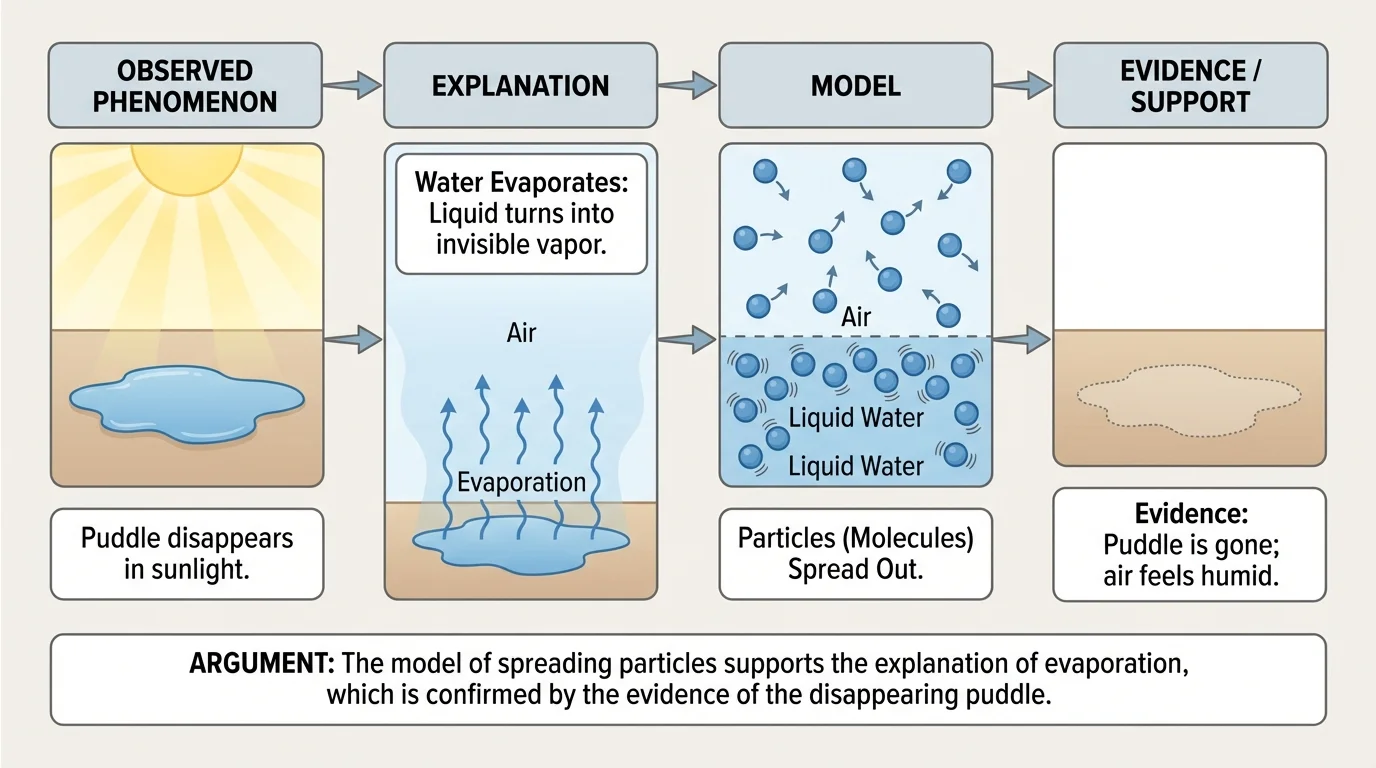
One phenomenon can have more than one possible explanation at first. That is why evidence matters. We must compare the explanations and ask which one best matches what we observe. The same is true for models. A model is helpful only if it fits the evidence.
A model does not have to be a small object. A map, a weather forecast computer program, and a drawing of the inside of Earth are all models because they represent something in a useful way.
When you support or refute an explanation, you are not just saying "I agree" or "I disagree." You are showing how observations, measurements, and scientific ideas connect to that explanation or model.
A strong scientific argument has three major parts: a claim, evidence, and reasoning, as [Figure 2] shows.
Claim is the statement you say is true. For example: "Plants in sunlight grow taller than plants kept in the dark." That is the statement you want to support or test.
Evidence is the information that supports the claim. It can come from observations, measurements, investigations, or reliable scientific sources. If students measured plant heights for two weeks and found that the sunlit plants averaged more growth, those results are evidence.
Reasoning explains why the evidence supports the claim. In this case, the reasoning might be that plants need light to make food through photosynthesis, so plants with more light have a better chance to grow.
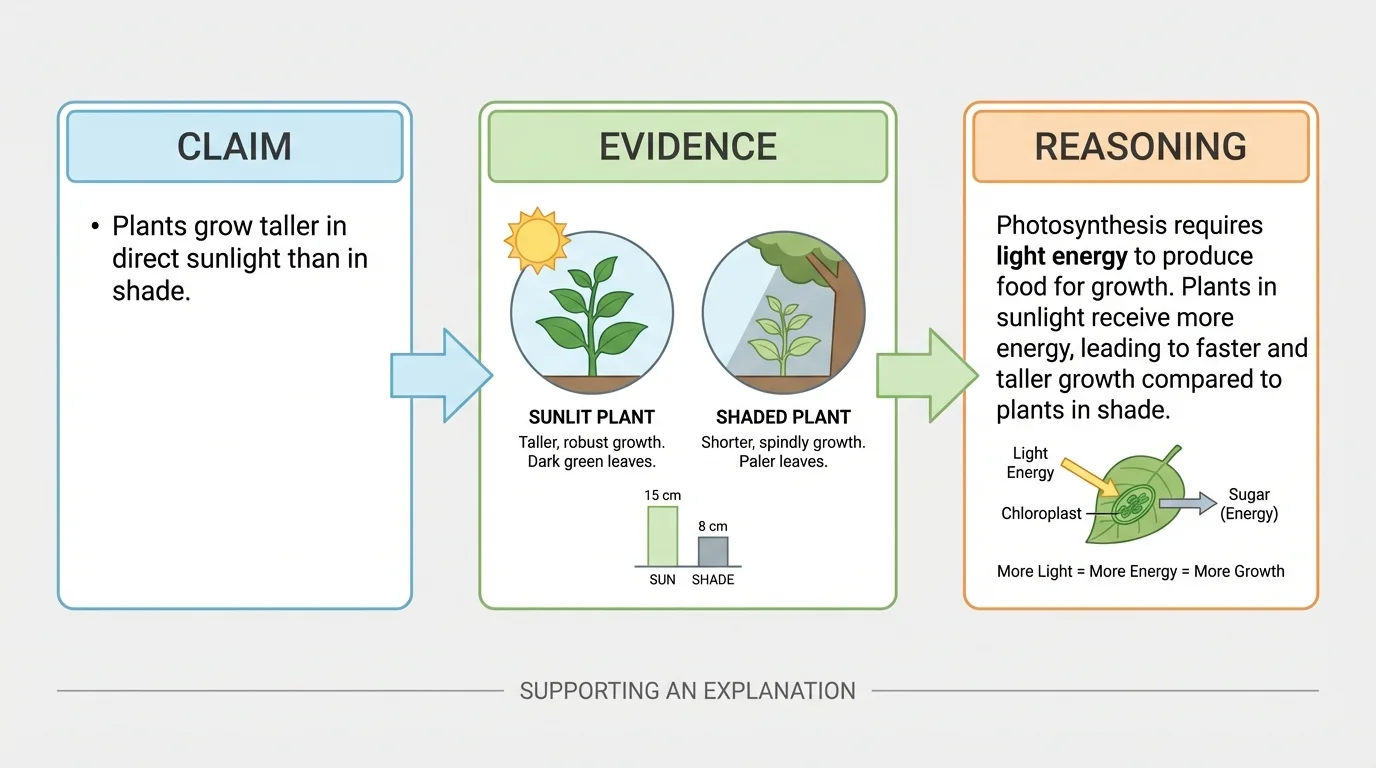
If one of these parts is missing, the argument becomes weak. A claim without evidence is just an opinion. Evidence without reasoning is a list of facts with no clear meaning. Reasoning without a claim does not tell us what idea is being supported.
Suppose a student says, "I think the bigger rock fell faster because it is heavier." That is a claim. But to make it a scientific argument, the student would need evidence from a fair test and reasoning that connects the evidence to the idea. If the evidence shows both rocks hit the ground at almost the same time when air resistance is small, then the original claim should be changed.
Example: Supporting an explanation about a puddle disappearing
Step 1: State the claim.
"The puddle disappeared because the water evaporated."
Step 2: Give evidence.
The puddle became smaller during a warm, sunny day. No one wiped it up. The ground around it dried, and similar puddles in sunlight disappeared faster than puddles in shade.
Step 3: Add reasoning.
Heat energy from the Sun gives water particles more motion, allowing some particles to leave the liquid and enter the air as water vapor. That matches the observed decrease in the puddle's size.
This argument supports the explanation because the evidence is connected clearly to the science idea.
Notice that the argument is stronger when it includes specific observations, not just a general statement such as "it was probably the Sun." Specific evidence gives the listener or reader something to evaluate.
Evidence in science can come from many places. One common source is direct observation. If you notice that mold grows faster on bread kept in a warm place than in a cold place, that observation may become evidence.
Another source is measurement. Measurements are often stronger than general observations because they are more exact. Instead of saying one plant grew "more," you might report that one plant grew from \(5\ \textrm{cm}\) to \(12\ \textrm{cm}\) while another grew from \(5\ \textrm{cm}\) to \(7\ \textrm{cm}\). In proper math notation, the first plant grew by \(12 - 5 = 7\ \textrm{cm}\) and the second by \(7 - 5 = 2\ \textrm{cm}\).
Investigations are another major source. In an investigation, we test one variable at a time as fairly as possible. If we want to know whether light affects growth, we should keep other conditions similar, such as water, soil, and type of plant.
Evidence can also come from reliable texts, data tables, maps, photographs, or expert observations. But even then, we should ask whether the source is trustworthy and whether the information truly applies to the question we are studying.
From earlier science work, remember that an observation uses the senses, while a measurement uses numbers and tools. Both can be evidence, but measurements often make an argument clearer and more precise.
Not every fact is useful evidence. If we are arguing about why a bridge shadow changes during the day, the bridge's paint color is probably irrelevant. Evidence must connect directly to the claim.
Good evidence has several important qualities. It is relevant, meaning it relates directly to the claim. It is accurate, meaning it is measured or recorded carefully. It is often repeated, which helps show that the result was not just an accident.
Scientists also ask whether there is enough evidence. One observation may start an idea, but several observations or repeated tests usually make the argument stronger. If only one seed sprouts in sunlight and none in darkness, that result alone may not be enough. Maybe the other seeds were damaged. More trials help us decide.
Fair testing matters too. In a fair test, only the factor being studied changes. If one plant gets more light but also more water, we cannot tell which factor caused the greater growth. Weak evidence can lead to weak conclusions.
| Question to ask | Why it matters |
|---|---|
| Is the evidence related to the claim? | Evidence must help answer the scientific question. |
| Was the test fair? | A fair test helps isolate the cause of the result. |
| Was the evidence measured carefully? | Careful measurement makes results more trustworthy. |
| Was the result repeated? | Repeated results are stronger than a single trial. |
| Is there enough evidence? | More evidence usually makes an argument stronger. |
Table 1. Questions students can use to judge the strength of scientific evidence.
When students learn to judge evidence, they become better at both supporting and refuting explanations. They also become better at spotting weak arguments in advertisements, rumors, and online posts.
To support an explanation, begin by clearly stating the explanation. Then point to evidence that matches it. Finally, explain why the evidence makes the explanation more likely.
For example, consider the phenomenon that a closed bottle of cold juice becomes covered with water drops on the outside. One explanation is that water vapor in the air cools and condenses on the bottle. Evidence for this explanation includes the fact that the bottle was dry when it came from the refrigerator, the drops formed only after the bottle sat in warm air, and the liquid appeared on the outside rather than leaking from the cap.
The reasoning is that cooling causes water vapor in the air to lose energy and form liquid drops on a cold surface. This explanation fits the evidence better than saying the bottle "sweats" by making water.
Strong support means matching evidence to the idea. An explanation is not supported just because it sounds reasonable. It is supported when observations and data line up with it again and again. The more directly the evidence matches the explanation, the stronger the support becomes.
As with the puddle in [Figure 1], a good explanation often uses an unseen process to explain a visible event. We cannot see water vapor easily, but we can use evidence to infer that evaporation or condensation is happening.
To refute an explanation means to show that the evidence does not support it well, or that different evidence supports another explanation better. Refuting is not rude. In science, it is a respectful way to improve ideas.
Suppose someone explains that heavier objects always fall faster than lighter ones. If students test objects of different masses but similar shapes and find that they land at nearly the same time, that evidence challenges the explanation. The explanation may need to be changed to include the effect of air resistance.
A model can also be refuted. Imagine a model showing that the phases of the Moon happen because Earth's shadow covers different parts of the Moon each week. Evidence refutes that model because lunar phases happen in a regular monthly pattern caused by our view of the Moon's sunlit half, while Earth's shadow causes a lunar eclipse only sometimes.
Refuting does not always mean an explanation is completely useless. Sometimes part of it is correct, but it needs revision. Scientists often improve models little by little as new evidence appears.
Example: Refuting an explanation about shadows
Step 1: State the explanation being tested.
"A shadow changes length during the day because the object gets taller and shorter."
Step 2: Examine the evidence.
A flagpole keeps the same height all day, but its shadow is long in the morning, shorter at noon, and longer again later.
Step 3: Explain why the evidence refutes the idea.
Since the object's height does not change, the changing shadow must be caused by the Sun's changing position in the sky, not by the object growing and shrinking.
The evidence refutes the explanation and supports a better one.
Good refuting uses the same careful structure as good supporting: clear claim, solid evidence, and reasoning.
A scientific argument can be spoken or written. An oral argument is shared by speaking. A written argument is shared in sentences and paragraphs. Both should include claim, evidence, and reasoning.
In an oral argument, your voice and organization matter. Speak clearly, give your claim early, and use specific evidence. It also helps to listen carefully to questions and answer them using the same evidence. Oral arguments are common during class discussions, presentations, and team investigations.
In a written argument, your sentences must do the work your voice would do in speaking. The claim should be easy to find. Evidence should be specific and ordered. Reasoning should connect the evidence to science ideas. A strong written argument often uses words such as because, therefore, for example, and this shows.
Here is a simple written structure students can use: first, state the claim. Next, provide two or more pieces of evidence. Then explain how each piece of evidence supports or refutes the explanation or model. Finally, address other possible ideas if needed and explain why your conclusion is stronger.
"In science, changing your mind when the evidence changes is a strength, not a weakness."
Whether speaking or writing, respectful language is important. We challenge ideas, not people. Saying "The evidence does not support that model" is stronger and kinder than saying "You are wrong."
Sometimes the job is not just to support one model, but to compare two. Scientists ask which model better fits the evidence. This happens often in Earth science, life science, and physical science.
Imagine two models for how certain seeds move to new places. One model says wind carries them. Another says animals carry them. Evidence might include the seed's shape, how far from the parent plant the seeds are found, and whether the seeds have hooks that cling to fur.
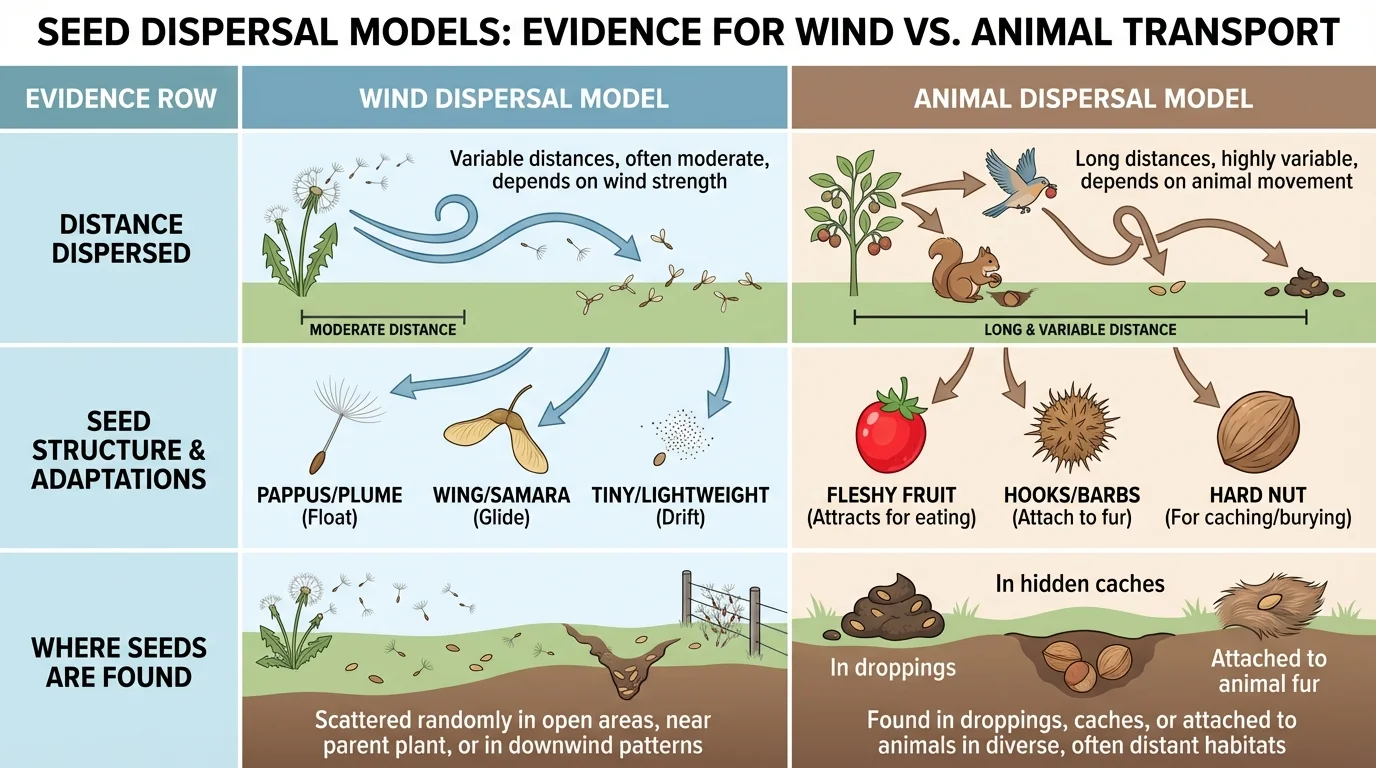
If the seeds are light and have wing-like parts, wind may be the better model. If the seeds have tiny hooks and are often found along animal paths, the animal-carrying model may fit better. Sometimes both models explain part of the evidence, and students must explain which one is better supported or whether both can occur.
Comparing models means looking at how well each one explains all the evidence, not just one detail, as [Figure 3] shows. A model that explains more observations with fewer problems is usually stronger.
This kind of comparison is one reason charts and organized notes help. They let us see patterns and decide which explanation has the strongest support.
Arguing from evidence is not only for science class. Weather forecasters compare models to predict rain, storms, or temperature changes. Doctors look at evidence from symptoms, tests, and medical studies to decide which explanation best fits a patient's illness. Engineers test designs and use evidence to support one solution over another.
Even in everyday life, people make better decisions when they ask for evidence. If a product says it works better than another, we should ask: What tests were done? Was the comparison fair? Is the evidence relevant? These are the same habits used in science.
Space missions depend on argument from evidence. Scientists compare models of planetary surfaces, weather, and gravity to decide where a spacecraft can land safely.
These skills also help students become careful thinkers. Instead of accepting the first explanation they hear, they learn to ask what evidence supports it and whether another explanation fits better.
One common mistake is confusing a strong opinion with a strong argument. Saying "I really think this is true" adds no scientific strength. Evidence gives strength, not confidence alone.
Another mistake is using evidence that does not actually match the claim. If the question is why one material keeps drinks colder longer, evidence about the material's color may not help. Relevant evidence matters most.
Students also sometimes give evidence but skip the reasoning. They list observations and stop there. But the reasoning is what explains the connection. It tells why the evidence supports or refutes the explanation or model.
A final mistake is drawing a conclusion from too little information. One trial, one sample, or one unusual event may not be enough. Scientific thinking becomes stronger when we look for patterns across repeated observations and tests.
When you build an argument, ask yourself: What is my claim? What evidence supports it? Why does that evidence matter? Could another explanation fit better? Those questions lead to clearer oral and written arguments.
