Have you ever seen a piece of trash on the playground and wanted everyone to notice it too? Scientists do something like that all the time. They look closely, find a problem, and then communicate what they learned so other people can understand and help. Even young students can do this by talking, drawing, writing, building, and counting.
Our local environment is the place around us, such as our classroom, schoolyard, park, street, or backyard. People use these places every day. Sometimes our actions help these places, and sometimes our actions hurt them. If we want to solve a problem, we need to tell others what we noticed.
When we share science ideas, we are not just saying, "There is a problem." We try to explain what the problem is, where it is, and what evidence we have. Evidence can be a careful drawing, a simple map, a few counted objects, or words that describe what we saw.
Communicate means to share information with others. In science, people communicate by speaking, writing, drawing, using numbers, or showing models so others can understand an idea or a problem.
Clear communication helps families, teachers, classmates, and community helpers make good choices. If children notice that too much paper is being thrown on the ground near the lunch area, they can share that information and help the school think of a better way to keep the area clean.
There are many ways to share science ideas, as [Figure 1] shows. You can talk to a class, point to a drawing, label parts of a picture, build a model, or use numbers to tell how many things you counted. Each way gives helpful details.
A model is a simple object or picture that helps show something. A model might be a small playground made from blocks, showing where trash cans are. A drawing might show plants that are bent or stepped on. A sentence might say, "The flowers by the path are getting crushed." Numbers can make the message stronger, such as "We found \(5\) juice boxes and \(3\) wrappers."
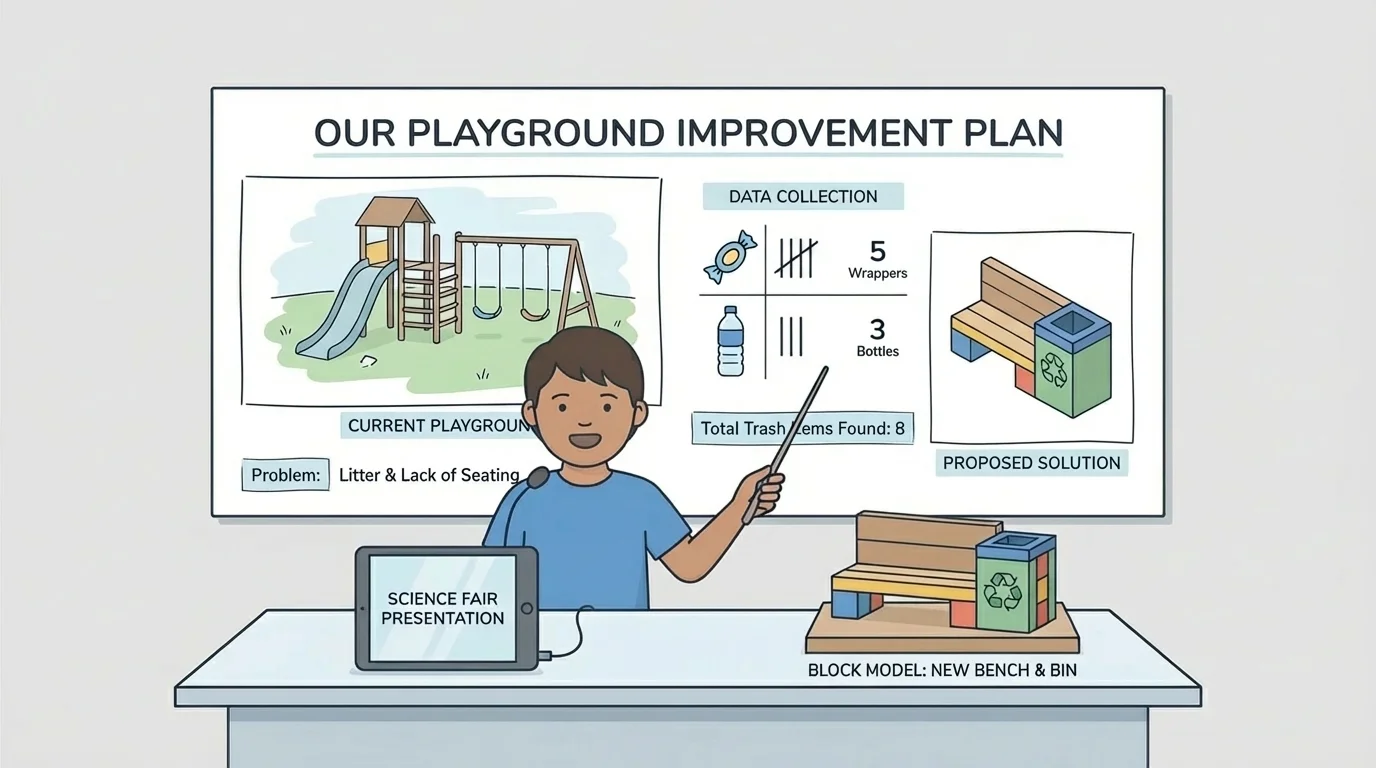
Speaking is useful when you want to explain your idea right away. Writing is useful when you want others to read your idea later. Drawings help people see a place. Numbers help people know how much or how many. When we use more than one way, our message is often easier to understand.
For example, if a student says, "The sink leaks," that is a start. If the student adds a drawing of the sink and says, "We saw \(4\) drops fall while we counted slowly to \(10\)," the idea becomes much clearer. The numbers and picture give details.
Scientists often use pictures and numbers together because one tool may show something the other tool cannot. A drawing can show where a problem is, and numbers can show how much of the problem there is.
Later, when you share a solution, the same tools still help. As we saw in [Figure 1], a child can point to a picture or model to explain where a new trash can, sign, or garden path should go.
People can change the environment around them in many ways. Trash left on the ground can make a place dirty and unsafe. Too much stepping on plants can damage them. Wasting water at a sink can use more water than we need. Loud or messy places can also affect animals and people.
[Figure 2] These are called human impacts because they happen when people affect the land, water, air, plants, or animals. Some impacts are harmful, and some are helpful. Planting a tree is a helpful impact. Throwing litter near a storm drain is a harmful impact.
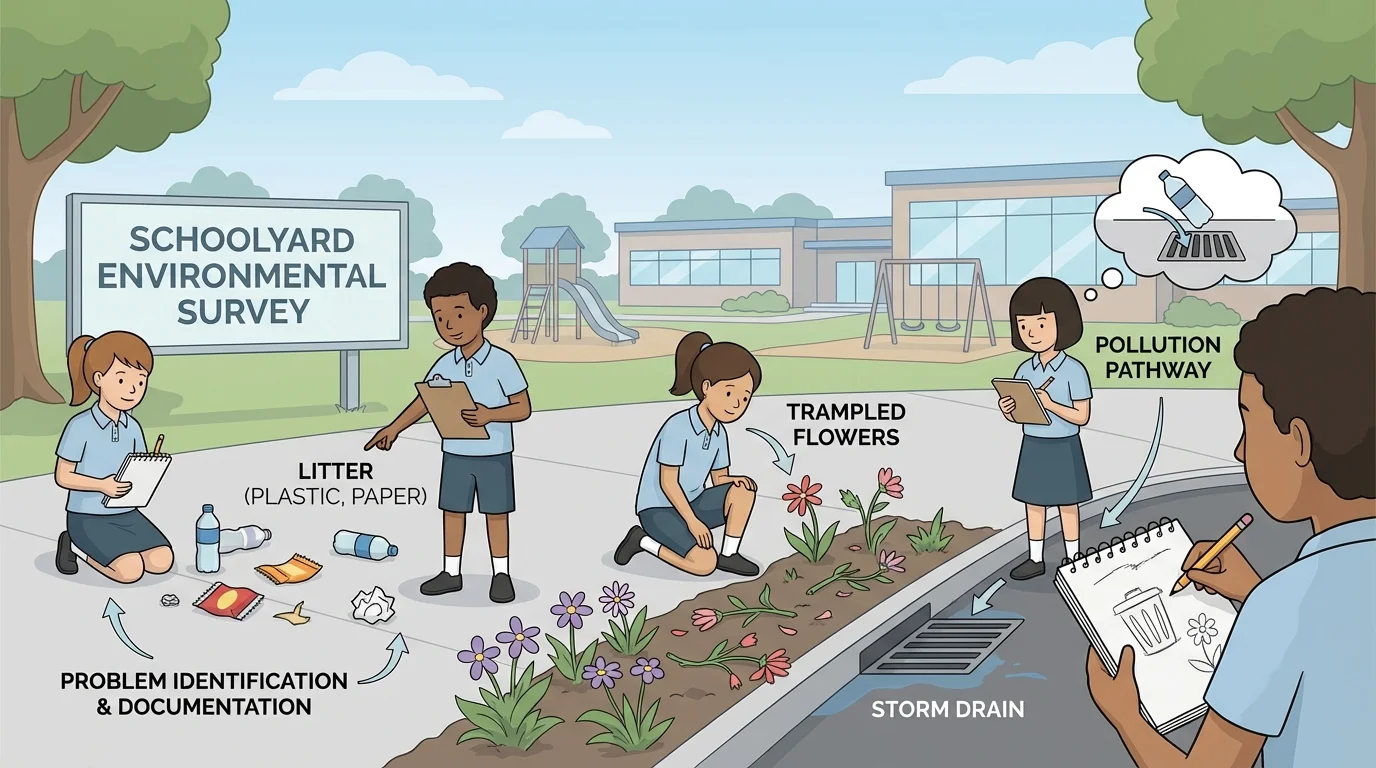
To define a problem, we try to say exactly what is happening. Instead of saying, "The schoolyard is bad," we can say, "There is trash by the fence," or "The flowers next to the sidewalk are being stepped on." This makes the problem easier to understand and solve.
We can also ask simple questions. Where is the problem? What do we see? How often does it happen? Who uses this place? These questions help us notice important details. Looking carefully is called making an observation.
From noticing to defining a problem
A science problem becomes clearer when we move from a general idea to a specific one. "There is too much trash near the slide" is clearer than "The playground is messy." A clear problem statement helps people think of useful actions.
Sometimes numbers help define the problem. If students count litter in two places, they may find that one place has more. For example, near the bench there may be \(2\) cups, but near the gate there may be \(7\) cups. Since \(7 > 2\), the gate area has more litter and may need attention first.
A good science message has details. A drawing can show where things are. A short piece of writing can explain what happened. Numbers can show counts. A model can show a new idea for fixing the problem.
If students notice that birds do not come near a noisy area, they can draw the area, label the swing set and speakers, and write, "Birds were in the quiet tree, not near the loud wall." That tells others what they saw and where they saw it.
Numbers are especially useful when we compare. Suppose one group counts paper scraps on Monday and Tuesday. On Monday they find \(4\). On Tuesday they find \(1\). They can say the number changed by \(4 - 1 = 3\). That means there were \(3\) fewer scraps on Tuesday. This helps show whether a cleanup idea is working.
| Tool | What it helps show | Simple example |
|---|---|---|
| Speaking | Quick explanation | "We found trash by the gate." |
| Writing | Important details in words | "The flowers are stepped on near the path." |
| Drawing | Where things are | A picture of the playground with litter spots |
| Model | A design idea or solution | A block model showing a location for a new trash can |
| Numbers | How many or how much | "We counted \(6\) wrappers." |
Table 1. Different tools students can use to communicate environmental problems and solutions.
When we use these tools together, our message becomes stronger. A classmate can listen to your words, look at your picture, and check your numbers. That helps everyone understand the same idea.
Example: sharing a water problem
A student notices a classroom sink dripping.
Step 1: Observe carefully.
The student observes the sink and sees drops falling.
Step 2: Count or measure simply.
The student counts \(4\) drops while counting slowly to \(10\).
Step 3: Make a drawing and write a sentence.
The student draws the sink and writes, "The sink drips and wastes water."
Step 4: Share a solution.
The student tells the teacher, "Please help fix the faucet."
This communication includes speaking, writing, drawing, and numbers.
That is exactly what scientists and engineers do on a larger scale. They collect information and share it clearly so people can make changes.
A solution is a way to help solve a problem. When we share a solution, we should explain how it matches the problem. If litter is near the gate, one idea might be to place a trash can closer to the gate. If plants are being stepped on, one idea might be to make a path or put up a sign.
Some solutions are actions people do. Some solutions are design ideas people build. A sign that says "Please use the path" is a design idea. A class cleanup day is an action. Both can be communicated with pictures and words.
Remember that a strong solution connects to evidence. If you counted \(6\) wrappers by one bench, your solution should help with trash near that bench, not a different problem somewhere else.
It is helpful to say why a solution may work. For example: "We think a trash can by the gate will help because we counted \(7\) cups there." The count gives a reason, not just an opinion.
Sometimes there is more than one good idea. Students might compare two designs and choose the one that fits the place best. A small sign may work in one spot, while a trash can may work better in another.
This example shows how students can put everything together in a schoolyard study. They can look around the playground, make observations, count litter, draw a simple map, and then share a plan for helping the area.
Suppose a class finds most litter near the soccer field fence. They count \(6\) wrappers and \(2\) bottles. Altogether that is \(6 + 2 = 8\) pieces of litter. They draw the fence, the nearby bench, and the place where the trash is found.
Case study: helping the area by the soccer field fence
Step 1: Define the problem.
Students say, "There is litter near the soccer field fence."
Step 2: Gather evidence.
They count \(6\) wrappers and \(2\) bottles, for a total of \(8\).
Step 3: Communicate the information.
They make a drawing of the fence area and write one or two clear sentences.
Step 4: Share a solution.
They suggest a trash can near the bench and a reminder sign.
The class uses observations, numbers, and a design idea to help others understand both the problem and the plan.
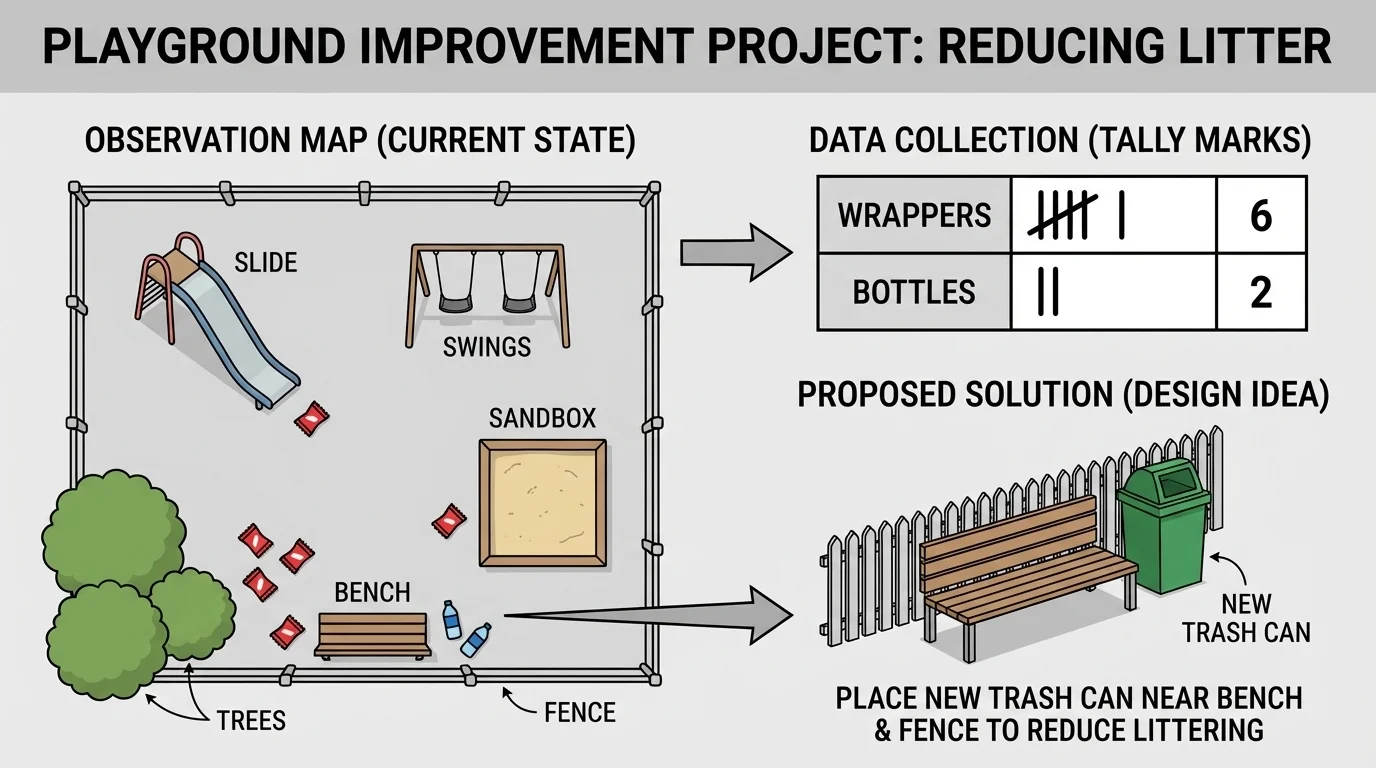
When students present this idea to the teacher or another class, they can point to the map and the counts. The information is easier to understand because it includes details. Later, the same evidence helps everyone remember why that location was chosen for the new trash can.
This kind of work matters in real life. Communities use signs, maps, reports, and counts to care for parks, streets, rivers, and neighborhoods. Even young learners can be part of that work.
Good communication is clear, honest, and respectful. We share what we really observed, not what we guess without evidence. We also speak kindly because solving environmental problems is about helping a place, not blaming people.
It helps to use simple sentences. "We counted \(5\) pieces of trash by the slide" is clearer than a long confusing message. Pointing to a drawing or model while speaking can also help listeners understand.
"Good ideas can help more when we share them clearly."
Scientists, engineers, students, and families all need to communicate. When we notice problems in our local environment and explain them with words, pictures, models, and numbers, we make it easier for others to join in and help.
